Welcome.
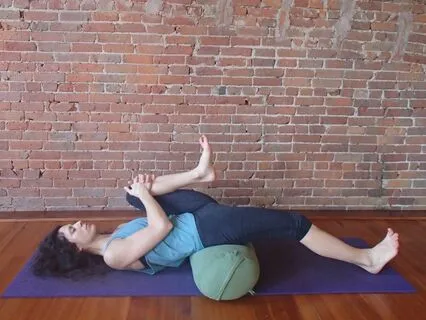
Today we're working on relieving the front of the hips.
So you'll need a block and a strap.
The strap is optional for the pose today.
So please lay on your back,
Have that block close to you.
And if you don't have a block or if you have a cork block,
I actually recommend using a folded blanket.
We're going to lay on the back with your knees bent and then lift your hips up and you're putting the block or a folded blanket underneath your sacrum.
Now we're going to hug the right knee into the chest and as soon as you pick up that foot,
You might feel the need to adjust the prop underneath you.
So hug the right knee in.
Now this is where the strap is optional.
If it's difficult to reach your knee or your shin,
You would put the strap around your foot or maybe behind the knee I think is better.
And then you,
In that sense,
You're bringing your leg to you with the strap.
So we're hugging the right knee in and then straighten that left leg.
So as you draw the right leg in and you straighten the left leg out,
You're getting the release along the hip flexors of that left side.
Now given that this is yin,
We want to remain as passive as possible.
With the arms,
There's going to be some degree of effort because we have to hold on to the leg or to the strap.
But you can try to relax your legs as much as possible.
And you'll notice the more you hug in with your arms or the greater the tension in your front of the left leg.
Do the best you can trying to relax your pelvis,
Your abdomen,
Your hip flexors,
Your abdomen.
Make sure you're relaxing that left leg.
When we practice passive stretching like this,
The first minute is the most difficult for the body.
It wants to tense up.
It doesn't understand,
You know,
That you're trying to release.
So it takes the first 60 seconds or so to comprehend.
And then eventually you start to feel the letting go,
The softening,
Which is why in yin we stay in the stretch for at least three minutes.
And this is for the lower half of the body.
When you start working with the shoulders,
Three minutes becomes long.
But for the purposes of this pose today and for the rest of our yin poses for the week,
We'll be staying in them for anywhere between three to five minutes.
So to come out of this,
We're going to re-bend the left knee,
Foot comes to the floor,
Then place your right foot down.
And we're just going to rest with both feet on the mat.
So after spending a few minutes lengthening one side,
It's important to give your body several breaths before going to the other side.
Let your body come back on its own.
Let it redistribute its length.
Okay,
And then we'll switch.
So we'll hug the left knee in.
And then if you need to adjust your strap,
If you're using one,
Make that happen.
And then you're going to straighten now your right leg.
And again,
You determine your sensation.
If you hug that knee in more,
You're likely going to get a greater stretch through the front of the right hip.
So this pose is to combat all of the sitting that we do over the course of the day.
All of the sitting that we do over the course of the day.
When we sit with such a shortened hip flexor area,
Those muscles and those tissues get so tight.
And that tension can present itself in the front of the hip,
But also in the low back.
So by doing this,
We're also working on relieving some tension in the low back area.
And then we try to remain as still as possible,
Which isn't always easy when we're uncomfortable.
We're going to stay for about one more minute.
Smooth breaths.
Relax the legs.
To come out,
Please bend your right knee,
Foot to the floor,
Then bring your left foot down.
Just rest here,
Feet on the mat.
And then lift your hips,
Remove your prop,
And settle back down.
Roll to your side.
Give yourself at least one breath on your side.
And then press yourself up.
We're going to sit for at least a minute in silence.
So elevate your hips over the block or the blanket that was just underneath your hips,
Your sacrum.
We take this minute to feel the residue,
The lingering sensations of the stretch,
The new shifts,
The quality of your mind,
Your thoughts.
One minute here,
Please.
Please take two more breaths here.
Your homework is to share with me in the course classroom how you enjoyed that stretch and how it shifted the quality of your breath,
The quality of your thoughts.
If there was a sense of steadiness,
Alertness,
You fill in the blanks.
I'd love to hear from you.
The quality of your thoughts.
If there was a sense of steadiness,
Alertness,
You fill in the blanks.
I'd love to hear the changes in the shifts that have happened for you just in those six,
Seven minutes.
Thank you so much for practicing today.
Tomorrow,
We're going to focus on a different stretch to relieve low back tension,
But also tension in the tight outer hips.
Thank you for being here.