Welcome to your practice.
In this guided breathing practice,
Savitri Pranayama,
Which I like to refer to as a rectangular breath,
We will be incorporating pauses at the top of the inhale and the bottom of the exhale breath.
This is another practice designed to calm and regulate the nervous system.
I also love this practice because it gives us the opportunity to find more ease in those spacious moments in between breaths.
When you focus particularly on that empty space at the bottom of the exhale,
You may notice the grasping tendency of the mind reaching for that next inhale breath,
Much like the way we reach for anything in life to free us from uncomfortable moments.
So this practice presents a beautiful opportunity to work with the mind's reactive tendencies and to train yourself to find ease and inner peace,
Even in moments of temporary discomfort.
So let's go ahead and begin.
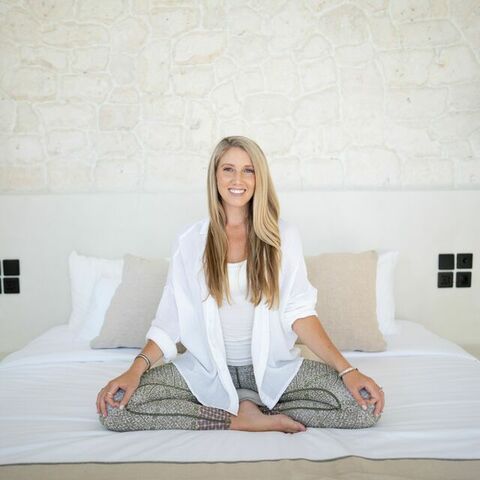
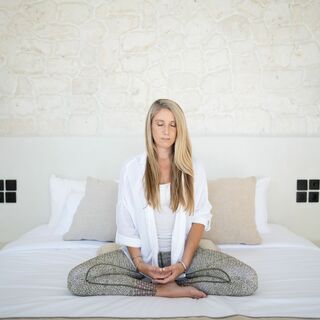
As you position yourself for this meditation,
Focus on creating a sense of spaciousness in the spine.
Allow the base of your spine and your pelvic bowl to anchor you,
And from that grounded space,
Grow and lengthen.
Start to become aware of the natural rhythm of your breath.
As you start to deepen and lengthen your breath,
Allow your inhale to find its fullest capacity,
Expanding into the belly,
Ribs,
All the way into the chest.
And then sense the calming quality of the exhale as you release and let everything go.
Before we begin your practice,
Know that at any time,
If tension or stress begins to arise,
You can always ease off or release the breath count completely and return when you're ready.
We'll start our practice by simply balancing our breath for an even count and then we'll begin adding a pause for half of the length of the inhale and exhale.
Start by taking one cleansing round of breath.
Inhale,
Fill up.
And exhale,
Empty completely.
Inhale for four,
Three,
Two,
One.
Exhale for three,
Two,
One.
Take your time to establish a steady rhythm here,
Inhaling for four and exhaling for four.
After your next round of even count,
Add a pause for two counts at the top of your inhale and the bottom of your exhale.
So we'll inhale for four,
Pause for two,
Exhale for four,
And pause for two.
If you feel comfortable here,
You can work towards extending the breath to a six and three count,
Inhaling and exhaling for six and pausing for three on either side.
The goal here is to find your own sweet edge,
Gradually expanding your breath count.
The goal here is to find your own sweet edge,
Gradually increasing your capacity without creating any added tension.
Eventually,
You may even work up to an eight and four count.
Just know that you'll receive the benefits of this practice no matter where you are in your breath,
So honor what feels best for you.
Notice what it feels like to linger in the pause.
Can you soften and find greater peace as you rest in this potent space?
Then begin to gradually ease off.
So if you're at a six and three count,
Returning to four and two.
Once you arrive at four and two,
Eventually releasing the pause for an even breath.
And in a very slow,
Intentional way,
Eventually releasing the breath count altogether and just relaxing back into your own natural rhythm.
Meditation offers us the opportunity to be the observer of our present moment experience.
So notice what's alive in you in this moment.
Simply witness without reaction,
Without the narrative,
Just pure presence for these final moments of practice.
And slowly begin to deepen and lengthen your breath.
Tune in to the physical sensation of breath entering,
Expanding,
And releasing.
As you prepare to transition into the rest of your day,
Set the intention right here and now to find those moments to pause.
Use your attention and breath to shift gears from autopilot to conscious awareness at every opportunity.
And remember,
You always have the power to choose a new moment.
Thank you for joining me for this practice.