Hello,
This is Mark Taylor from the Center for Body-Mind Movement.
In this exploration,
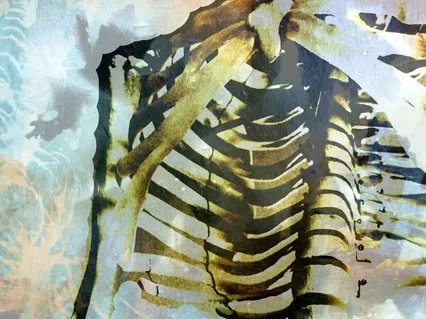
We're going to play with the bones of breath and work with the movement of our ribs and sternum.
We'll be focused on finding ease and relaxation in breathing.
So in the beginning,
What I would encourage you to do is lie down in a comfortable position.
You might want a bolster under your knees or a pillow.
You might want a blanket.
You might want some extra support under a sensitive part of your body.
First,
I'd like to invite you to breathe into your skull.
Imagine that when you breathe in through your nose,
Your skull gently expands.
The bones move away from each other.
And as you exhale,
They can soften and find their way back toward a resting position.
And on the exhalation,
You can invite your breath to fall through the back of your skull into the earth.
And let's bring awareness to the chest and the ribs.
And notice that as we breathe in,
There's an expansion of all the bones.
And as we exhale,
They come back to a resting place.
And you can begin to focus your exhalation through your scapula into the earth.
And similarly,
You can move your awareness to your pelvis,
Visualizing your bones expanding into space with your inhalation and releasing back toward your center with your exhalation.
It might be a tiny movement,
But it can be palpable.
And you can begin to release your exhalation through your sacrum into the earth.
So take a moment now to unify these three cavities,
Feeling all the bones of your skull,
Your chest,
And your pelvis expanding with your inhalation and coming back to rest with your exhalation as the breath moves into the earth.
So I want to invite you to bring your attention to your sternum.
And take your fingers and place them at the top of your manubrium,
Which is the top bone of your sternum,
Right under your neck.
And just massage the bone of the manubrium.
And if you walk your fingers down,
You'll find a horizontal bump.
This is called the sternal angle.
And it's the joint between your manubrium and your sternal body.
If you continue walking your fingers and tracing the bone down the sternal body,
Between your breasts,
In front of your heart,
You'll come to the bottom of the sternum,
The sternal body where the ribs converge.
And at that bottom,
There's a third bone of the sternum called the xiphoid process.
In a natural breathing pattern,
When we inhale,
The xiphoid process will rise toward the ceiling.
It's like a little tail at the bottom that wags with your breath.
And on the exhalation,
The xiphoid process will come back to a resting position closer to the center of your body.
And once again,
Bring your fingers up to the manubrium,
The top of the sternum.
Place the fingers of your right hand on the right side of the sternum and the fingers of your left hand on the left side,
And trace all the joints of the ribs.
As you move down the sides of the sternum,
Feel where the ribs insert.
These are all joints.
They move with breath.
So bringing your hands to the side of your body at the base of your ribcage,
Feel how wide that is.
There's width.
The ribcage is shaped like a dome.
The higher you go,
The narrower it is.
So let your hands walk up your ribs on the sides and feel them narrowing and narrowing and narrowing until up under your armpits.
You can feel that they're actually quite narrow.
Your shoulders are wide,
But the ribcage is narrow at the top.
So observing the movement of all of your ribs,
12 on the left and 12 on the right.
So for just a moment,
I'm going to invite you to roll onto your front surface,
Exposing your back to the ceiling.
Once you're there,
Place your hands on the bottom part of your thoracic spine.
If you can find the 11th and 12th thoracic vertebrae,
That would be great just above your low back.
In that place,
You have floating ribs.
With each in-breath,
The ribs will open like a book,
With your spine like the spine of a book.
So feeling this part of your back expanding with your in-breath and feeling how your floating ribs are like little wings,
Rising up as you inhale and falling as you exhale.
Now I'm going to invite you to roll onto your side and touch the middle part of your chest on the surface that's exposed to the ceiling.
And as you inhale,
See if your ribs are rising to the ceiling as you breathe and falling toward the earth as you exhale.
These middle ribs are engineered for movement that widens you and narrows you slightly and gently with each breath.
Many of us inhibit this motion.
You might want to give those ribs a little stretch by letting your elbow come up toward your ear and finding an elongation in the ribs that are toward the ceiling.
Feel how they can stretch and rise.
And then as the arm comes back down toward your pelvis,
Let those ribs fall so they have mobility in the vertical plane.
When coming back to your back,
I would invite you to place each hand on the side of your ribs and just notice whether they are expanding to the sides as you breathe.
So,
Finally,
I'll invite you to bring your hands back to your sternum and find the sternal angle.
Once again,
That's the joint between your manubrium and your sternal body.
And there's usually a horizontal bump.
If you expand your fingers to the side,
You'll feel the second ribs joining the sternum at that level.
This is a joint that's made for movement.
So when the air comes toward the top of your lungs,
Your sternal body can float forward to the ceiling.
And as you exhale,
Allow it to fall back toward the floor.
So it increases the depth of your lung space from front to back.
This joint is created for movement,
But many of us lose the movement and it can ossify.
So even if you don't feel much movement,
Imagine the movement being free and open with the knowledge that you can regain movement in that place.
Let's finish by bringing attention back to the three cavities,
The skull,
The ribs,
And chest,
And the pelvis.
Allow your breath to expand all the cavities as you inhale and come back to a resting position as you exhale.
And I wish you good breathing for the rest of your life.
Thanks for participating.
Good night.