Welcome to the Turning Point podcast.
I am Maritas Pala.
If you are already a fan of the podcast,
Welcome back.
If you're new to the podcast,
I speak with the top creators and entrepreneurs as we discuss business,
Creativity,
Mental health,
And how those may interconnect with each other.
Have you ever wondered if you can train your mind similarly to how you can train your body?
Training our mind and shifting our mindset can have an enormous impact in our lives.
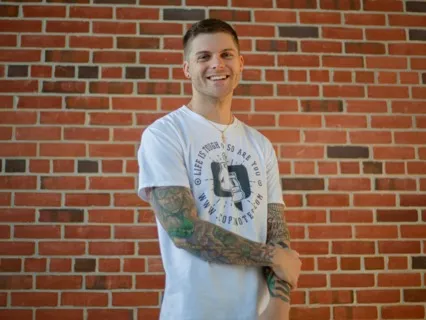
My guest today is Johnny Crowder,
A musician,
A tech talk speaker,
A mental health and sobriety advocate,
And the founder of Copenotes.
Through both music and motivational speaking,
Crowder's testimony has impacted millions of lives across the globe.
His business,
Copenotes,
Is a positive psychologically based subscription service that sends daily text messages to help users develop healthier thought patterns.
But before we begin the show,
If you are enjoying the podcast,
I would really appreciate it if you would follow,
Subscribe,
Share the podcast with a friend,
And maybe even leave a rating and a review.
It would mean the world to me.
And now,
Let's kick off the show.
Hi,
Johnny,
How are you?
I am sitting on an exercise ball and it is very pleasing.
Anyone who has sat on an exercise ball and worked knows what I'm talking about.
Do you know what?
I don't have one,
But I did have to purchase a comfortable chair for my desk because I've been spending a lot of time in it and my back was killing me.
And I had like one of those crappy fake leather executive chairs.
You probably know the one that I'm talking about.
Yeah,
They're horrible.
I got an IKEA one,
Which is IKEA,
You know,
So but it's pretty good for the lower back and it had to stretch it out for the head.
It's just like it's a good chair to have overall.
So I recommend that too.
Well,
Welcome to the podcast.
And I really like to kick off the episode just,
You know,
I share a little bit about you and what you're up to in the intro.
But I want to learn more about and for the listeners as well about your journey and what led you to create Hope Notes.
Oh boy,
The journey question.
I get this a lot and it's kind of difficult.
Oh,
There's like a paradox.
I forgot what it's called.
I think it starts with a P.
But there's a paradox around things that are too complex to explain.
And I think mental health kind of falls into that.
Like if I tell people,
You know,
I grew up with schizophrenia and bipolar one and OCD and PTSD,
Or I grew up in an abusive household,
Or,
You know,
If I use any of those phrases,
People go,
Oh,
Yeah,
Sounds tough.
And I'm like,
Man,
How on earth do I communicate to you?
How traumatic my childhood was?
So suffice it to say,
I have lived through a lot of really brutal things.
And my whole outlook,
My knuckles say save them,
I have saved them tattooed across my knuckles.
And my whole outlook has been,
How do I help people who have had really tough goes of it,
Like there are people who,
Unfortunately,
Have just been dealt a really rotten hand have been through some really awful things.
So my,
My mindset is always how do I help people who feel like me,
You know?
Yeah,
You're in that position of service,
Just like because you went through it yourself.
So you want to help people that are in it right now.
And so that's what led you to to create this.
Oh,
Brilliant.
I think every single entrepreneur creates something that they wish they had,
Like something that they turn to,
You know,
Think about this,
One day someone is eating a tater tot,
I'm making this up.
And they were like,
Man,
I wish I could dip this into like a tomato paste.
And it's a crazy idea.
But then that guy invented ketchup.
Like,
You only invent something if you wish you had it,
You know?
Yeah,
I think and most entrepreneurs that I have,
Or creators as well in in the podcast,
That's how they build their business is basically they were looking for something that didn't exist.
Or the other example that I use a lot,
Probably the listeners are tired of me using the same one is finding gaps in an existing product and making it better,
Similar to what happened with Facebook and like Myspace and Friendster existed,
But Mark Zuckerberg made Facebook because he found holes in something that already was out there and made it better.
So either one,
I think that's usually like,
You're in that fork of where do you go when you're making a product or service?
Why does it work?
So I was in the website,
Because I do research,
Of course,
And I'm my guests.
I know you have different packages for coke notes,
I think it's for groups and individuals.
But if I were to sign up today,
What can I expect?
Like,
How is this going to,
I guess,
Help me?
Am I feeling really like,
I guess,
Just down because I think this is a really good tool,
But I'm pretty sure also you have to combine this with actual therapy to help you,
Depending where you are and what state you are.
But what do I get if I sign up?
And how does it make me just feel better in general?
So I want to address two things.
The first thing that stuck out to me was you said you probably have to combine this with therapy in order for it to really be effective.
And I would say that's kind of like saying,
Well,
You actually have to go to the dentist,
You can't just brush your teeth.
And it's like,
Yeah,
But you should still brush your teeth,
You know,
Nothing happens in a silo.
So I would make,
You know,
If going to therapy is going to the dentist for you,
Then coke notes is brushing your teeth.
It's a way for you to maintain your mental and emotional health on a daily basis.
And when you asked,
What can you expect?
I would say expect to be sitting in traffic,
Banging your head against the steering wheel frustrated that the old lady in front of you will not go even though the light is green.
You had a terrible day at work,
And you're arguing with your significant other.
And then you get a text on your phone and you think what the heck now?
What?
What does somebody want from you?
And instead of someone asking you for something,
It's someone asking you something.
It is a text message that provides comfort that provides perspective that provides relief,
Or maybe a probing thought provoking question that kind of pulls you out of that negative agitated state and into a little bit more presence where you can actually take a few moments to breathe and focus practice on that self-care.
And over time,
That happens enough times to where your brain starts learning to think in healthier patterns naturally without those interruptions.
I really like that.
I don't know if you're,
I bet you probably are familiar with meditation and different types of meditations.
This sounds very similar to maybe like a trigger that you get when you're practicing mindfulness meditation,
Where every day you're kind of like focusing on concentration and like equanimity,
Kind of like trying to manage the plus and the unpleasant.
Like this sounds like a really good way of just using a text,
Which is usually what you said.
Usually you get a text and it's very rare is someone asking you,
How are you doing today?
Is usually someone needing something from you,
A reminder of a doctor's appointment.
So it keeps reminding you like now you're busy,
Here's an additional thing to make you think how busy you are to remind you of this appointment that's coming up.
Like it's usually never someone just asking you how you are.
Like I don't,
I have very few friends who will start a conversation saying,
How are you today?
And I do want to clarify,
We do not text people,
How are you?
We text people,
All sorts of stuff.
We're texting psychology facts and journaling prompts and exercises and advice and encouragement,
All sorts of stuff.
You never know when the text will show up on your phone cause it's random timing and you never know what the text will say,
But you do know that whatever that text is,
Is designed to interrupt a negative thought pattern in real time and train your brain slowly to start thinking healthier patterns over time.
Yeah,
No,
And what I meant when I said,
How are you is usually like something when someone's asking how are you is like about yourself and just like a little bit of self care that someone else is providing in that space.
So I wanted to use that as an example as like maybe how I would perceive that text coming,
Right?
And I like what you're saying because when I first learned about Copenotes and in your work,
I was thinking that it was more like you were saying like just a positive message.
Are you able to share maybe just an example of maybe an exercise or just like a sneak peek of what people would get if they sign up?
My answer to this is always the same now.
So before I would like scroll through my,
Because I use Copenotes,
So I'd scroll through my Copenotes text thread and pick out a text.
But right now,
Because people ask me that question so often,
I just tell them go to Copenotes.
Com and right at the top of our website,
There's a phone and that phone scrolls automatically through a week's worth of Copenotes text messages.
So I instead of giving you one example,
I'll give you seven and they're all right there on the website for you to check out.
Awesome.
If we go more into like the science behind it,
Because I bet you've probably done plenty of research yourself.
How can just a daily reminder,
Something positive,
The exercise,
Whichever it is that you get that day,
The science behind it,
How does this really help us kind of like rewire our brain?
Yeah,
So I'm going to try,
Stop me if I get too nerdy.
No,
I like it.
Go ahead.
I went to school for psych.
So I mean,
This is like what I dream about.
So inside of your brain,
You have these things called synapses.
And every time you think a thought,
One of those synapses shoots a charge to another synapse.
So those synapses are communicating with each other.
And the more often you think a particular thought,
The closer those synapses grow,
So they kind of inch closer together to improve the efficiency because it doesn't want to shout across your whole brain,
It wants to be able to whisper.
So if you think,
Man,
My nose looks weird every single day,
The synapses associated with that thought grow closer and closer together because it figures,
Well,
We're just going to think this thought again tomorrow.
So we might as well make it easier on us.
But the problem is that closeness of those synapses makes your brain default to the thought because it's the easiest thought to think.
So copenotes is kind of in the business of interrupting that thought so that other synapses can grow closer together,
Synapses that are associated with positive thoughts.
And maybe the synapses associated with that negative thought over time kind of drift further apart so that your brain starts defaulting to a more positive thought pattern.
So that is happening in your brain all the time.
Copenotes isn't starting that process.
It is guiding that process.
Like copenotes doesn't roll the bowling ball down the lane.
Copenotes provides the bumpers to make sure the ball doesn't go into someone else's lane.
This is fascinating to me because as you were explaining that,
I'm thinking of people around me,
Friends,
Co-workers,
You know,
Whoever.
And I think there's a lot of people out there that may be going through like some tough situations or problems or whatever it is,
But then they get just they kind of embrace that negativity.
And so negativity becomes like their day to day and months go by and perhaps you notice it and you tell them,
Hey,
So and so you've been very negative lately.
You become this very negative person.
But then this person doesn't realize it because it's just like it becomes like their day to day.
So like if we flip this to with copenotes being just a positive reminder or the exercises or whatever it is that you get that day,
You are rewiring your brain for this particular kind of like behavior or just,
You know,
Rewiring your way of thinking.
The whole strategy was I mean is currently still influenced by this one quote that I heard years ago from a mentor of mine.
He said,
Make it easy for people to do the right thing.
And that's what copenotes does.
Over time,
It makes it easier for your brain to think in healthier patterns.
It's not going to force you to do anything.
It's going to make it easier over time for you to think,
Wait a second,
Am I in like a negative train of thought right now?
Like why am I beating myself up?
I shouldn't do that.
I should think something else.
Like there are people who think those negative thoughts,
But they're so comfortable because we've formed a habit around them that you're right.
We don't even see them because they're so close to our face.
Yeah.
For you,
And I think this is just,
You know,
Going back in history a little bit,
What was that like turning point for you where you realize,
Hey,
I need help or,
You know,
There's something like,
Was there a moment where you realized that you needed help or was it more like people around you that made you realize that you needed something and this led into,
You know,
Whatever the next steps were?
So it's funny the name of the podcast and the whole point of it because I gave a TED talk last year and the point of the TED talk was that I never had a turning point.
I never had this like magical eureka moment where everything magically switched.
And I was always waiting for it,
Right?
Like I wanted that moment to happen,
But as a result,
I was waiting to get better.
I kept postponing it and pushing it off because I was like,
Oh,
I'm going to have my eureka moment.
I'm going to have that rock bottom moment.
But if you wait for that your whole life,
You wait for that like Hollywood-esque,
You know,
Sky is falling,
Super dramatic shot.
If you wait for that,
You'll never make progress.
So I just want to maybe flip the script a little bit and provide comfort to any listeners that maybe feel like they haven't experienced their turning point yet.
It's okay.
Like you don't need the turning point to tell you to do anything.
Like some people go their whole lives and never experienced something like that and they still accomplish great things.
So just to the audience,
To listeners,
You don't need to experience something like that to make a change in your life.
Like you can catalyze change.
You can be your turning point,
You know?
Yeah.
And I agree with that because I feel like that's what would happen to me.
Like for the longest time,
I was very much like an adrenaline junkie.
Like I kind of self-medicated with like alcohol and just doing stupid things because like that's just like drove me into like this sense of,
In a crazy way,
Finding peace.
But there was a point in my life where I was like,
What am I doing?
And like,
I think that's like just the moment where I was like,
I realized like I really need to do something like,
But it wasn't,
It was work and it still is.
And this was like about eight or nine years ago,
But every day still work,
Right?
It wasn't because I was like a turning point and I woke up and said,
Oh,
Everything's fine,
Right?
I'm not going to drink anymore and I'm not going to do any of the stupid things that I was doing.
But there was a moment where I just like looked myself in the mirror and I was like,
What the hell?
But like,
I don't know what like slick that made me realize like I need to do something.
So yeah,
Every,
But every journey is different.
Like right,
That's the unique thing of it is that we all experience life in different ways and those experiences kind of like form us.
So I had another question that I wanted to get your perspective in.
As a society,
How do you think we can do better?
Because I think there's this notion of like,
If you get help for yourself,
You feel like guilty,
Like people make you feel guilty or like wrong.
It's like it's this weird taste that it,
That it's,
There's something wrong with it.
As a human beings,
How can we do better?
Well,
Two things come to mind.
The first of which is we have to stop pretending that it doesn't apply to us.
Like we have to actually start talking about this stuff.
And I don't mean like making a Facebook post that says I'm diagnosed bipolar and then calling it a day like it needs to be a part of our regular vernacular.
Just that like the way we talk about getting a haircut or falling down and spraining our ankle or the fact that we like barbecue like this should be very much the part of the way that we communicate with each other.
It's important information.
It's pertinent information.
And the more that we start viewing this as simply one of a trillion details about a human being like I like metal music and I like supercars and I grew up in Tampa,
Florida and I'm diagnosed with schizophrenia and I've been playing guitar since I was eight.
Like all of those facts should be equally weighed.
And I think as a culture,
We need to start changing the way we view it so that we can talk about it.
But also there are people right now who are not currently talking about it and they know that something's funky in their brain.
They're just scared to talk about it.
So half of it is creating an environment where people feel welcome to speak about that.
But the other thing,
The other way that I think we could do a lot better is right now we tell somebody yeah,
If you're feeling down,
Just reach out.
And it's kind of like saying,
You know,
If you're tired,
Just climb Mount Everest.
Like that's ridiculous.
Why on earth would we task somebody who is feeling isolated with the responsibility of reaching out?
Why the heck do we not have preventative resources in place?
So I think the focus there needs to switch from expecting someone who is feeling unwell to do the work to actually putting resources in place for people who are feeling fine so that as they start feeling less well over time,
They are equipped to make those changes before they get to a point where they are unable to reach out.
Yeah,
And I agree with you because I feel like a lot of corporate companies right now they're like,
Well,
We have this kind of like wiki page where you can have,
You can reach out to someone and do some call or you can do this or you can do that.
But like,
What are we,
What are we doing before that?
Like there's a lot of people that struggle identifying that they need that help or just taking the initial steps.
So what are we doing before that so that people don't get to that point where it,
And sometimes people even feel overwhelmed,
Like where do I start?
Do like,
What options do I have?
So you're putting that extra layer of pressure on people.
Yeah,
I think it's an education thing too.
Like,
You know,
If an itch itches,
We scratch it.
And if we are feeling thirsty,
We drink.
But then if we feel depressed,
We like don't do anything about it for a long time.
And that's just crazy.
Like,
Imagine if you were thirsty and you didn't drink water for nine years.
But that's what people are doing with their mental health all the time left and right.
Me too.
Yeah,
It's fascinating to me.
Just because I've been lately trying to learn a lot about like our brains and just human beings and just how this affects us.
So it's all very fascinating.
I wanted to wrap up a little bit here,
The conversation,
And ask you just a few fun questions that I like to ask my guests as we wrap up the episode.
And the first one is,
If you could have dinner with anyone from history,
Who would it be and why?
The obvious answer is Jesus.
How do you not have a billion questions for that guy?
Also,
I'm kind of wondering what he would eat nowadays in the modern realm.
Like they didn't have hamburgers.
They probably didn't have salads,
You know?
Yeah.
I don't think they did.
First reason why I choose Jesus is because I have so many questions.
But the second is I'm kind of curious as to what he would order.
I wonder too.
You're the second person this week that has said Jesus,
Which is also fascinating.
And then I had another person who said President Obama or Michelle.
I can't remember now.
But yes,
That person didn't mention that.
But yeah,
I would be curious too.
Obviously,
The world has changed a lot.
So I would be curious to see what the opinion of current society and what you would eat and all that stuff.
What would the general opinion on everything would be?
I just imagine Jesus like trying a tater tot and being like,
I want to dip it in ketchupy like tomato goop.
I'm like,
Oh,
Dude,
That exists now.
Coming up with like crazy ideas.
And we're like,
Oh,
No,
It exists.
So the other question,
The last question here is what show,
Documentary,
Movie or book did you watch or read lately that you would recommend to folks?
So I don't really have a traditional answer here.
But I've been listening to a lot of clips of Alan Watts on YouTube.
And there's tons of stuff on YouTube.
Just search on YouTube,
Alan Watts.
And he really helps.
I'm not saying I agree with 1000% of everything he says,
But his perspective is crucial.
Like when I get super pent up about work or a missed opportunity or money or relationships or COVID or whatever.
And then I hear Alan Watts just kind of put things into perspective and helped me realize like how small human beings are in this grand universe that we live in.
It really just helps me like look at a tree and just be like,
Wow,
The world doesn't revolve around me.
You know,
So I encourage people,
Even if you're not like big philosophy people,
It's not super dense.
Just YouTube Alan Watts and see if you find something you like.
Yeah.
And on that note,
I'm going to send you after the call,
Send you via email.
There's a guy on YouTube call and I think it'll drew when he did a piece,
A beautiful piece on called Life is Beautiful.
And it is just different videos of he lives in Paris of like the area and all the stuff that he's been doing lately with Alan Watts in the background,
Just like talking.
And it's just amazing.
I'll send it to you because it's fascinating.
The piece is really nice.
I'll send it to you.
You would enjoy it.
Can't wait.
Johnny,
Thank you so much for being part of the podcast today.
Absolutely.
Thanks for having me.
I'm not an expert in this field,
But as I mentioned several times throughout the episode,
This is all fascinating to me.
As I did research on this,
I found that there is a term called neuroplasticity.
This is a term that refers to the brain's ability to change and adapt as a result of experience.
It's mind blowing to think that we hold the power to change our mindset in our perspective.
If you will,
We can adapt and welcome change if needed.
If I can leave you with something before we end the episode,
It is to be curious,
Be curious with life and with evolving as a human being in your own journey.
Do might be surprised by the end result,
But for now,
Peace out and see you next time.