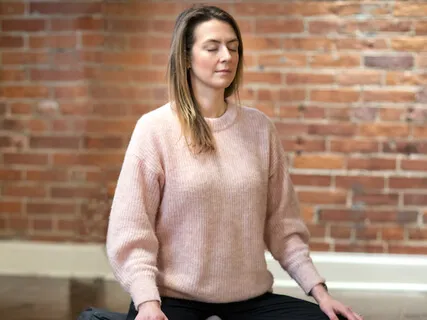
In this guided meditation,
We'll be practicing for about 15 minutes together one of the fundamental practices of mindfulness,
Mindfulness of breathing.
Our breath is available to us wherever we are,
And it actually changes a lot from moment to moment and in all sorts of different circumstances.
So it's a useful point of interest for us to rest our attention.
And it also helps us remember how to be really present wherever we are,
To be in the present moment.
Our minds often are tumbling from one thought to the next,
Maybe thinking about the past or rehearsing the future.
And when we practice mindfulness of breathing,
We can calm and steady our attention and return to whatever is happening right around us or inside of us.
All right,
Let's begin.
Finding a comfortable seat,
Finding a posture that's dignified but also at ease.
And you may want to begin by taking a few full deep breaths.
Maybe lengthening your inhale and exhale or exhaling out through the mouth,
Really an invitation to let go of whatever was happening before you arrived here to practice.
And after a few breaths in that way,
Just letting the body breathe itself.
No need to control or change the breath in any way now.
You may,
Having arrived here,
Noticed certain areas of the body where you're holding tension.
And you could even scan the body,
Just noticing,
Starting at the head,
Any places that might have extra gripping,
Tenderness,
Just letting the light of your attention possibly soften whatever there as you move your attention through different parts of your body and eventually down to the legs and feet.
Turning the attention to the breath now,
Begin by just really watching with curiosity as best as you can what your breath really feels like.
Just watching the next three breaths really carefully,
Gently.
Exist.
And you can continue in this way,
Simply observing with a kind,
Curious attention the physical sensation of the breath coming into the body and leaving out the body.
If the breath feels particularly subtle,
You don't feel a lot of sensation at the nostrils or in the throat or in the chest or belly,
You could try placing the palm of your hand on the belly or the chest and see if you can sense the rise and fall of the breath in the palm of your hand.
You may notice that your attention sometimes wanders.
You get lost in a thought,
You start wondering about something,
Thinking about something that happened earlier in the day.
And if that happens,
It's totally natural.
It's what the mind likes to do.
As soon as you've noticed it,
You've had a moment of mindfulness.
And all there is to do is gently steer your attention back to the sensation of breathing.
It may happen five,
Ten,
Even a hundred times.
And that would mean 100 moments of mindfulness.
Okay.
.
Sometimes you may find it helpful to add a little soft noting labeling of each in-breath or out-breath to keep the mind's attention alert.
And you can do this in a lot of different ways.
You can count the breath in one,
Out one,
In two,
Out two.
You can also label the breath in,
Out,
In,
Out.
Whatever notation you use,
Imagine that the word gets about 5% of your attention and the other 95% of your attention is really on the sensation of breathing.
So it's a really gentle label like touching a glass with a feather.
It's very subtle.
You can explore that now if you're interested.
Really Tower answer while you're Wickford'm,
G.
.
.
.
.
.
You might stretch.
Flutter open the eyes if you've closed them.
Move your body in any way that feels comfortable.