So welcome to tonight's Dhamma talk,
Everyone.
Tonight,
As Nick sent out in the email,
The Dhamma talk is called Lessons from Thailand.
And so I'll be talking about my stay in Thailand.
I just returned from Thailand last week.
I've been back about one week.
So the path of awakening is summarized by the Eightfold Path,
Right view,
Right intention,
Right speech,
Right action,
Right livelihood,
Right effort,
And right mindfulness and right concentration.
So it's also summarized by these three components of the Eightfold Path,
Practicing ethics,
So you get a foundational,
A stable foundation.
Meditation,
Practicing meditation,
Which is the right effort,
Right mindfulness and right concentration component of the Eightfold Path.
And cultivating wisdom,
Which is the right view,
Right intention aspect of the Eightfold Path.
This path is kind of summarized also by considering it is about cultivating the wholesome,
Cultivating,
It's waking up,
It's a path to awakening.
And it's about cultivating the wholesome and releasing and letting go of the unwholesome.
The wholesome is basically cultivating wisdom.
It is basically cultivating kindness and compassion,
Non-aversion,
The opposites to aversion,
The opposites to rejection and condemnation.
It is about cultivating generosity and non-clinging.
And it is also about seeing clearly.
So these are the qualities that we cultivate.
And we also let go of what's called kilesa.
In Pali,
The term kilesa refers,
The literal translation of the word kilesa is distortion.
Distortion,
I remember listening to a talk by Alan Wallace's partner,
And she's a Sanskrit translator.
And she said,
The word kilesa comes from the root to distort.
Kilesa,
Also known as mental defilements,
Mental distortions,
The corruptions of the mind.
Yes,
These tendencies to cloud our mind with our greed,
Ignorance and hatred.
In fact,
The roots of the kilesa are in greed,
Ignorance and hatred.
There are various manifestations of this.
And I won't go through all the possibilities of the mental distortions because I could spend all day here talking about them.
So that's the path of awakening,
Cultivating the wholesome and letting go of the unwholesome.
So recently,
I traveled to Thailand and had a fantastic time,
It was great.
I went for a total of about seven weeks.
And I spent some time with family.
My middle son went across and I spent some time with him and his children and his partner.
I spent some time with my relatives.
I have Thai relatives.
I'm married a Thai woman,
So I still have relatives there in Thailand.
And also spent probably a total of about maybe three weeks,
Maybe more in monasteries,
In temples.
I visited a lot of monasteries,
Yet I stayed in four different monasteries,
All with different kind of patterns around what they're doing,
Like different styles,
Different teachers and different teachings.
And I had the good fortune to stay at a place called,
And Nick told me about these temples,
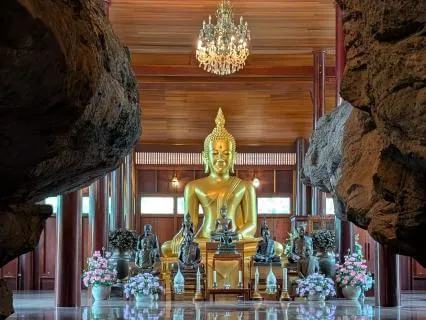
A place called Wat Rattanawan.
And that temple,
The abbot of that temple is an Australian-born monastic.
He's been a monastic for about 45 or six or seven years,
A long time.
And it was really amazing because I prepared to go there and I went there and I didn't know that I actually met him when I was a monk.
I met him as a lay person when I was a monk.
So it was really wonderful to meet him and talk with him.
And we talked a lot about Sanya,
Memories of the times that we had known.
Well,
I only,
I had a conversations,
Had various conversations with him as a monk in 1978,
I think it must have been.
And it was really,
Really good to have those conversations with him.
Anyway,
At this temple,
There was only 10 monastics.
And the other side of the road,
There was a female quarters,
But I stayed in the male quarters,
Of course.
And there were 10 monastics and there was a couple of what's called Anagarika,
Is that right,
Anagarika?
Or in Thai,
It's called Pakao.
Pakaos are people aspiring to be monks or nuns,
I guess in this case,
It was just the monks.
And they hold 10 precepts and they dress with white clothes.
And they're just practicing,
They're just helping out being,
Sticking to the precepts,
Meditating and doing the practice and doing that for about a year.
So in this particular temple,
Because Acharn Philip,
He's called Acharn Philip or the abbot's called Acharn Philip or Lungpho Nyaya Dhammo,
Because he was English speaking,
We'd have instructions in English and in Thai.
So every morning after doing the chores,
After eating the meals,
The Pakaos would come up and sit with Lungpho.
I'll call him Lungpho because that's what he's called.
Lungpho is like a title,
It means kind of grandfather,
Beyond grandfather.
Venerable father.
Venerable father,
Okay.
Lung,
Lung,
Venerable father,
Yeah.
And I think he probably comes to people that are monastics that are over 70 or something like that or olderish.
Highly respected.
Yeah,
Highly respected.
So anyway,
There were two Pakaos,
One was from Russia,
One was from Canada,
And the third one was from Thailand.
So there would be instructions every morning,
Well,
Most mornings.
And one morning,
Lungpho was saying,
There are three Thai words that you should become very familiar with,
Very familiar with these three Thai words.
And they were otton,
Otton.
The next one was patipat,
And the next one is turuman.
And what I'd like to do now is explain the meaning of these three Thai words,
And also provide some examples of how I practice these and integrated them in some respects.
So the word otton,
Well,
I'll tell you a little bit of a story about this word otton,
First of all.
There is an English born monastic that I've been listening to for about three or four years,
Listening to his Dharma talks in Thai,
Because his Thai is fantastic.
This is Acharn Jayasaro.
He's an English born monastic.
He went to Thailand about the same time I was in Thailand.
We didn't actually meet,
But we would have crossed paths.
There was some strong,
Timely similarities.
He only went when he was very young,
And he went and stayed with Acharn Cha then,
Or now he's called Lungpho Cha.
So he didn't speak any Thai in the beginning.
And the first words that he learned,
Because he heard Acharn Cha saying it a lot in a Dharma talk was otton,
Otton.
So he asked someone after the Dharma talk,
What's this word,
Otton?
And one of the English speaking monastics said,
It means to endure.
It means to tolerate,
To hang in there with it,
To,
It also means patience.
So that was the first word he learned,
And now he can speak Thai probably better than a Thai person in terms of Dharma anyway.
I mean,
It's fantastic to listen to him give Dharma talks.
So this word otton,
I think it's really important to understand it.
And I was a monastic once,
Only for a couple of years,
Only for almost two years.
And I noticed that I had to endure.
When I got,
I was living in the Northeast of Thailand,
Living without any other foreign monks.
I was living in quite an ascetic monastery.
And,
You know,
There'd be times when I'd,
We'd have one meal a day,
Times when I'd get hungry,
I was quite skinny.
At times when I got very sick,
I got,
I had,
Had,
I was,
I got malaria around that time from Southern Thailand.
But when I was staying in this temple,
It's called Wat Doi Dharmachedi,
Or Wat Doi for short,
I began to experience the symptoms of malaria.
So that was pretty difficult.
In a foreign country,
You know,
Nobody really speaking English and having to learn Thai and just having the symptoms of malaria,
It's really quite difficult.
And then I was there,
Later on when I was there,
I got Hepatitis A,
So it was quite a lot to endure.
I realised while I was there getting,
I was sick and I was hungry.
And also we,
I wasn't,
My body wasn't very used to sitting on the floor.
And in Thailand,
You sit on the floor all the time.
And,
You know,
You sit on hard tile floors and I,
Sometimes you sit for hours listening to Dharma talks.
And there was a lot of pain for me in being in that monastery.
But I learnt that you just had to endure.
I mean,
What else are you gonna do?
You had to,
You do what you need to do,
Of course.
Like when I was sick,
I visited the doctor and took the medicine that I need to take and so on.
But what else can you do?
You just have to endure.
And when you can endure,
You start to realise that it's all impermanent,
It all changes.
And it's strengthened,
It gives you a strength,
It gives you a capacity to endure.
And so I was a monk there.
I was learning that enduring is the way it is.
In fact,
In our lay lives,
We need to endure.
We,
You know,
What are we gonna do?
And we have,
We meet up with lots of situations that are just unpleasant.
I remember I've been working,
I'm recently semi-retired,
But I've been working full time for about 35 years.
You know,
Sometimes I wake up in the morning and think,
Oh God,
I wish I could have a day off.
But you just continue,
You continue.
You've got appointments,
You need to go to them,
But sometimes you don't feel like you wanna go,
But you just gotta endure.
I mean,
What else can you do?
And this is one way of overcoming dukkha,
Overcoming,
Becoming free.
So I know that Anna gave a dharma talk last week,
Didn't you,
Anna?
And it was on the topic of patience.
So,
And I'm not sure if I'm gonna say the same things that Anna said last week,
But the word for patience in Pali is kanthi.
And oton also means patience in many respects.
And patience often,
In the West anyway,
Often refers to this sense of putting up with difficulty,
A sense of forbearance,
Like a sense of tolerating and hanging in there with the difficult experiences as I was been describing with endurance.
However,
I did listen to a dharma talk by Acharn Amaro,
Who is another one of those amazing monks from the time of Acharn Chah,
And he's the abbot of Amavati in the UK.
And he talked about patience in the English language,
It's all about forbearance and so on,
It's often about that.
But there's a nuance to the word kanthi in that it means also being very present,
Completely present,
So that you're,
You know,
You have patience because this is all there is.
This is the reality of the situation right now.
We're just here now.
And when you can be,
One can be here now,
You're not craving for something in the future or something in the past,
You're not craving to,
You know,
Have the pain in your knee disappear,
You're just being present with it.
It is just the way it is,
It's just this.
And it becomes like there's nobody here other than just this experience.
So I thought that that particular slant and nuance of patience is another way of describing otton,
Like being present,
Completely present with the experience of life as it is,
Whether it's pleasant or painful,
It's just hanging in there.
So that's otton.
I think it's a really useful word as Luang Por Nyai Damo was saying,
To learn the meaning of that word.
Chan Char used that word a lot.
Other words he used were,
Another word he used,
And I described it before,
Is patipat.
Patipat,
Patipat,
Refers to practice,
The practice.
And something I noticed when I went to Wat Rattanawan and the other monasteries,
That there was certain periods of meditation,
Of course,
But a lot of the time was just spent doing what you're doing.
At Wat Rattanawan,
We had to kind of clean up periods.
We had to clean up the cookies and there was always sweeping.
Every morning there was sweeping and every afternoon there's a bit of sweeping.
And,
You know,
There's things to do.
And it's just about doing these things,
Both in meditation,
Like formal meditation and daily life,
In the best possible way,
In a way that reflects the Eightfold Noble Path.
Not that you have to,
You know,
You're practicing on the Eightfold Path.
It's a way of life.
It's a whole bodily and,
When I talk about mind,
Heart,
Mind,
And speech and actions all together.
Living the Eightfold Path.
And I,
You know,
While I lived at Wat Doi Dhammachedi,
I've mentioned that,
I lived with a teacher.
When I lived with him,
We called him A Chan Ben.
And he was a pretty amazing being to live with.
And he was really into Padipat.
And we didn't,
You know,
When I'd go and talk to him and,
You know,
Have Dharma talks and listen to Dharma talks and so on,
I didn't hear much about formal meditation,
To be honest.
You know,
One time I talked to him about meditation.
He said,
I just practice Buddha,
You know,
And it all becomes light and just practice Buddha.
Okay,
So,
But he talked a lot about doing things in the right way,
In a way where you're fully engaged,
Fully mindful.
And he was quite into work,
Like we had to work.
You know,
When you do your work,
Whatever you're doing,
You're doing it fully and completely in line with the Eightfold Path,
Perfectly mindfully.
And doing it well,
Like whether you're folding up,
Foot driving,
Drying cloths or washing a bowl or sweeping,
Sweeping,
You're doing them in a way where you're with that perfectly.
I remember,
And I,
Though this is an influence by Achan Ben,
I was listening to a talk by Achan Mahabua,
Who was another great Achan,
Who lived to,
I don't know,
I think he was 97 or very old age.
And I remember him talking about Padipat.
Like if you just sloppily fold up the cloth,
Then go back and do it again.
Like,
And I found myself doing that when I was living at Wat Doi.
Like sometimes I'd do something unmindfully.
And I think,
Oh,
Hold on a minute,
I can't even remember what I've done there.
So I'd go back and do it again.
So it'd be kind of perfectly mindful.
In fact,
One day,
One day we were going Pindapat,
And Achan Ben,
This is,
You know,
We'd go Pindapat,
Pindapat is going arms around down to the village.
And this time,
Achan Ben said,
I'm not going today,
You guys go.
Or not you guys,
But you know,
Basically you go,
You go and,
And on that day,
Achan Ben went out to my,
I was staying in a cave on this very big temple,
Very,
You know,
Probably about three kilometres in diameter,
Maybe,
I don't know.
I can't,
Can you remember?
Oh,
Right.
Okay,
So it's very,
It's a very big temple and it has a big wall around it.
But I was out in the cave right off,
Right off way from the other huts.
And there was a little hut on the cave,
Close to the cave,
But I just stayed in the cave.
And I kind of made the,
Made the cave kind of comfortable for myself.
Like there was a big kind of seat that you could sit on,
And I put a cushion up against the back of the seat so I could lean my sword back up against it.
And I must've left some things around that looked a bit untidy.
Anyway,
Achan Ben went out to my cave while we were all pinned apart,
We were all going pinned apart.
And then after the,
After the morning meal,
He called me,
He said,
Malcolm,
Well,
He used to call me,
Come actually,
Come,
Come.
You've got to have more respect,
More respect,
More respect for your place of,
Where you're practicing.
You've got to clean it up.
And he was,
He was ordering me to do that.
I happen to do an exercise,
He said,
Every day,
At the end of the day,
Reflect back to the morning and go through every action you've done.
And think about,
Reflect on the actions,
Whether they've been wholesome and healthy,
Whether they've been unwholesome.
And just remember what you did,
Like remember how you did it,
How you did your various actions,
Like folding up the clothing,
Or folding up the cloths,
Sorry,
And washing the bowl and preparing the place for eating and so on.
We call it in here.
So I used to do that exercise and I started off with about five minutes.
And over time,
It just got longer and longer.
It's had to be about two hours.
But the really interesting thing about it was that I would go through every action as much as I could remember.
And in fact,
This was cultivating mindfulness,
Because the next day,
I would be remembering what I'm doing.
I'd be present for the action and being aware of the state of mind while I'm doing,
You know,
Getting the things ready for.
I'd be thinking about,
Oh,
This is what's happening right now.
So I can remember that later.
So it was a really wonderful exercise and I still do it to this day,
Not so much recently,
But,
You know,
I still occasionally sit.
Before I go to bed,
I go through the day and think about what I've done and how I've done it.
So the emphasis here on Puttybutt is about living the path.
Right intention,
Right speech,
Right action,
Right livelihood,
Right effort,
Right mindfulness and right concentration.
Being completely present,
Mindful and doing the best way possible.
So now,
Another word called Turraman.
Turraman.
And Nick knows what that means,
So.
Turraman means torture.
So what's the meaning of this?
Why are we talking about torture?
Why is Lungponya Adamo saying this is an important word to understand?
And yeah,
Well,
Maybe I can talk about this by relating a story.
And it's the story of me going to Wat Doi Damajedi just a couple of weeks ago.
Well,
When I say a couple of weeks,
Probably a month ago now.
So I put in a lot of effort to arrange where I could go before I went.
And as I was saying to Nick,
While we were coming here,
I wrote letters.
I wrote letters in Thai to send to all the monasteries.
But my Thai,
I can read a little bit of Thai.
I can speak enough Thai to get by.
I can understand enough Thai to understand the Dhamma talks.
And I can read enough Thai to get by.
I'm not fantastic.
But writing's really not very good.
I mean,
I've forgotten how to spell things.
But what I did was I wrote everything in English and then I just put it through AI.
I said,
Give me a Thai letter to the abbots of this temple so I can go and visit them.
So the letters included to the abbot of Wat Doi Damajedi,
Abbot Lungphor Ban passed away a couple of years ago.
So I wrote him,
I wrote a letter and I could read through it and I could change the things that I didn't think were right.
And I sent it off.
And then I put my email there and somebody sent me an email and they said,
Yes,
You're welcome to come and stay at Wat Doi Damajedi as long as you stick to the eight precepts,
Which means basically,
Have the one meal a day and stick to what the practice of the temple,
The protocols and the practice of the temples and what we do here.
I said,
Of course,
Yes,
Of course.
So after what Ratana won with the English,
The Australian abbot,
Where I spent about 10 days,
I travelled up north,
Further up north to Soekondokon and then on to Wat Doi Damajedi.
And when I arrived there,
That was sweeping.
I arrived there about two o'clock and somebody come up and met me,
A monastic come up and met me,
Said,
Just see that guy over there.
You know,
He'll put you,
He'll tell you what to do.
And it was a lay person,
It was a lay Thai person.
So we just went up and I said,
Oh,
Okay,
Look,
I'll help sweeping.
So I arrived there about two o'clock and we kept sweeping until about 5.
30.
Well,
Five o'clock actually,
Because I had to go back to my,
I had to get set up in where I was staying,
Which was like a little dorm with this other Thai,
Lovely Thai man.
And,
You know,
I washed up and then we had to get back and do some chanting and then sit and meditate.
So,
You know,
That's really cool.
Like I noticed I got there,
I thought,
Oh,
Fantastic,
I'm sweeping again.
And then after about an hour,
I'm feeling a bit tired here.
I'd really like a drink.
And,
You know,
I said,
When are we going to stop and have a drink?
Oh no,
We had them before.
We had them at two o'clock.
So the schedule of what doing is you wake at three in the morning,
You wash up and you get down into the hall and there's some chanting and then there's meditation.
Not a lot of chanting in the morning,
But there's some chanting and there's meditation.
So we meditate until five and then get ready to get the food together,
Everything ready to have a meal.
But this involves the monastics going off to the villages and going Pindapart.
And it also involves us preparing things.
And if there's anything to sweep,
We sweep.
And also,
So there's that.
And then the monks come back and everyone puts in,
There's a lot of people that come to the temple now or putting food into the bowls,
The Pindapart bowls.
But there's so much food that you carry a big tray around so the monks can empty the food into that.
Then you have all these big trays of food and you put them down and you sort them out.
And a lot of the villagers come up and take the food home after all.
So a lot of people are fed through that.
And I noticed that some people were fed in the local hospital,
Which Acharn Lumpur,
Ben built a whole unit,
A hospital unit.
And he got the monks to build it in Sikkonakon.
Anyway,
Cutting a long story short,
There's a lot of things to do.
And then before we eat,
We sit down and listen to a Dhamma talk.
The Dhamma talk goes on for about maybe,
Well,
This teacher is about,
Used to give Dhamma talks of about 50 minutes.
And then there'll be chanting and then you eat and then you clean up.
And then you probably sweep a bit more to clean up the temple.
So I'm doing more sweeping.
And then by about maybe 10.
30 in the morning or 11 o'clock,
You can go back to your room and meditate and clean up and so on.
But then two o'clock it's out again,
You can have a drink.
It's like a hot tea or they had a lot of juices.
There's some,
I'd be drinking juices and they're sweeping in.
So,
I mean,
I know you're laughing and I was there for five days.
And I started to,
Like I said,
The first couple,
Sweeping is a wonderful meditation.
And when I lived there with Lungpo Ben or Acharn Ben,
Then,
Of course he was only 50 something when I was sleeping with him.
There were about 30 monastics,
30 other monastics.
So this big temple,
It's on a hill and there's a lot of rock.
And over the years it's become a lot of trees.
So there's a lot of leaves.
So you just sweep them up,
You sweep them up.
And back then,
We'd probably sweep for about an hour and a half every day and a little bit in the morning.
But now we're sweeping.
And now when I went to this temple,
There was only six monks.
So there was a lot to sweep.
And I got warned about it from someone at Watanawan.
He said,
Ah,
You better help them sweeping.
So there I am sweeping,
Sweeping.
And like I said,
The first hour's fantastic,
It's good exercise.
But after an hour,
You start to feel pretty exhausted.
And then,
I was averaging between four and seven hours sweeping a day.
And it's a hot climate.
I'm really,
I'm just,
I'm nearly 70.
And not that that's a problem,
But I'm not used to doing so much physical work.
I'm a clinical psychologist.
I sit down all day,
Listen to people.
I was getting pretty tired,
Pretty exhausted.
And my mind would be going,
What am I doing here?
I've come all the way to Thailand to sweep.
And you come back the next day,
The leaves are back.
You sweep them up and you put them somewhere and the leaves come back.
Even on windy days,
You're sweeping up and they're just coming,
Blowing back.
So,
I remember thinking back in those days,
This is great meditation.
It's really being present.
You're just doing it.
And it's true.
You just do it.
So I had a lot of complaining thoughts coming up.
Like,
Oh,
Maybe I'll die of exhaustion here.
Or maybe,
I really would really like a cool drink.
Maybe a lychee juice,
That'd be so nice.
A cool lychee juice.
Or,
Maybe I can try to get some brocca,
Because I'm feeling really phased out,
You know.
One meal a day,
I'd really like something to eat.
And so on and so forth.
And I just kind of noticed the complaining mind.
And every now and then,
I'd go,
Just be present.
And it was that.
I could just be present.
And I could be mindful of just one sweep.
Every moment,
Just this,
Just this,
Just this.
And I discovered that the more I could be present and mindful,
The more the complaining thoughts didn't arise.
When I could be completely present,
Completely present,
It was like the kilesa were being starved.
There's a thing about kilesa,
A thing about the metal defilements.
You feed them and they grow.
If you starve them,
They don't grow,
If that makes sense.
So,
This is what I think is meant by turaman,
Torturing,
Torturing the kilesa,
Torturing,
In Thai,
It'd be the kilet.
They talk,
The way they say it in Thai is kilet.
Torturing the kilet.
And it's about not nourishing them,
Not feeding into them,
Not making them into stories.
And the result is,
You become very present.
One becomes very present.
In fact,
It's kind of like,
It's so exhausting to feed them.
The best alternative is just to be present.
Just to be here now.
It's like,
If you have a pain in your knee,
And it's hurting,
And you create a big story about it,
And you can do what you need to do if you've got a pain in the knee,
But by creating a big story,
It just makes it worse and worse and worse.
But any of those people,
Any of us people who have done some vipassana retreats,
We know that if we can just observe pain,
It changes.
There's no story about it.
It becomes really tolerable.
It's just this sensations.
Pain is the label we put on it.
So that's the meaning of Turaman Kilesa.
Turaman Kilesa.
Or Turaman,
The defilements,
Or the mental distortions.
So I did actually,
I stayed there for about five days.
And as I was leaving,
I made the decision that I'd spend a bit of money to get to Wat Ba Dan Wiweg,
Which is where this lovely,
Lovely old teacher,
He's 93 years old,
Lung Po Tui,
He was staying,
And when I went and saw Acharn Philip,
Or Lung Po Nyai Damo,
I said,
Oh,
Look,
I'd really like to go there,
But it's so difficult to get there.
It's so,
Sort of right up near the Lao border,
And it's so far away,
And I was looking at all the different ways I could get there,
And every which way was gonna be difficult.
It was gonna take me a couple of days,
Even from Wat Doi,
And I decided I'd inquire about how much a taxi would cost.
So I actually hired a taxi to take me for a three-hour drive,
Three-and-a-half-hour drive through the back ways to,
Directed to this place.
Anyway,
So I said I was gonna go there,
And then,
But I had it,
The night before I was leaving,
It was,
We sat till,
We sat till 11 o'clock at night.
So it's up at 3 a.
M.
,
Working,
Meditating,
Eating,
Working,
Sometime back in your hut to meditate if you get some chance,
And then back sweeping,
Then you go to chant at 7 p.
M.
,
And usually you have a meditation through the night,
And that's the general thing.
But on this occasion,
The night before I was leaving,
On that occasion,
We were gonna sit up until 11 p.
M.
,
So it was like four or five hours sitting,
And because the king's mother had died,
And we were doing that in respects of her.
So I pulled a chair into that sit,
Because I thought it's gonna be hard,
And I managed to roll up my jacket and put it behind my back,
Because I've got a weird back.
It gives me pain.
I like to support my back.
Anyway,
And I probably shifted once or twice during that sit.
The next day,
I was saying goodbye to the chant at that moment,
And then he said to me,
You know,
I know you've got a sore back.
You can probably tell.
And you know that it's impermanent.
All you have to do is let it be.
Let it be.
It'll change.
You don't have to do anything.
Let it be.
Let it change by nature.
This is nature.
This is the teachings of Luang Porban,
Letting things change according to nature.
And what he did was he picked up a bottle of water,
And he poured it on this highly polished floor.
It's just a little tiny puddle.
And he said,
See that?
If you don't do anything with that,
And you don't wipe it up,
What will happen to it?
And I said,
Well,
It'll evaporate.
It'll disappear.
And he said,
Yes,
According to nature.
That's it.
That's it,
According to nature.
So the journey with,
At Wat Doi in Dhammachedi was very much about facing up to dukkha.
Facing up,
For me,
It was facing up to discomfort.
I had a lot of that when I was a monk there.
And I,
To be honest,
I had a bit of trepidation to return to Wat Doi,
Because I was afraid of that.
And the very thing that I was afraid of actually happened.
But it's this process of working through the four noble truths.
And the process of the first truth is to understand it by turning towards it.
So when we turn towards our dukkha and understand it,
We see that it changes.
We see the three characteristics of existence,
Like the three universal characteristics of existence,
Anicca,
Dukkha,
Anatta,
Anicca being impermanence,
Dukkha being unsatisfactoriness,
Or the incapacity,
Or the,
It's not,
One's not able to find enduring happiness from impermanent things,
Like it's of a dukkha nature,
And not-self,
Meaning there's no thing in all this.
There's no single abiding thing in experience.
So I had a valuable lesson from Wat Doi Dhammajedi.
And I,
You know,
I had a lot of realizations there actually,
Because,
You know,
I spent so much time there.
And when I left there,
I decided that I'd stop over in Sokondokon and spend a night in a hotel.
So I booked a hotel and spent a night and I had a good night's sleep,
Because I was only getting like a couple of hours sleep at night at Wat Doi.
And also,
You're sleeping on hard mats,
And the pillows I was using was a rolled up,
Rolled up jacket or something like that.
So you're getting,
I had a sore neck,
And I just had a,
I spent a night in Sokondokon,
And then I went to visit this wonderful,
Old,
Beautiful teacher for a couple of nights,
Two nights.
And he allowed me to stay because I could speak Thai.
He said,
Because you can speak Thai,
I'm permitting you to stay.
And we had a lot of fun.
We had some fun conversations.
So I hope I've conveyed the understanding of the words,
Otton,
Patipat,
And turaman.
And I hope that we can all sort of use those words and the meaning of those words in our daily practice,
Because that's what we need to do.
So thank you very much for listening.
And let's have a few moments silence,
And then we can have some discussion.