So welcome to this Sunday suite slow flow.
We're going to start just in a comfortable way to sit.
So I'm going to sit on a blanket,
But you're welcome to just sit on the floor or your mat.
And I'm also going to sit in half lotus,
But you're welcome to just have your legs crossed or if you'd like to sit more comfortably like in deer pose with one leg behind you.
Really this is all about finding comfort.
There is no specific way that you have to look or should feel that you have to look in practicing yoga,
Especially when it comes to restorative.
This is really about nurturing and feeling into our bodies.
So half lotus for me is just stacking kind of one foot on top of the other leg.
If it feels like too much and you do have a blanket or bolster near you,
Go ahead and set your hips up on that.
Even if it's just like a couch pillow,
It allows your pelvis to tilt forward and create some space in the hips,
Which is really nice for me.
And if you feel comfortable to do so,
Maybe just allowing your eyes to fall shut or softening the gaze.
And if you're in front of something really that you just don't want to let go of with your sight,
Then feel free to use that as your focal point.
Allowing your bodies to gently arrive to this practice.
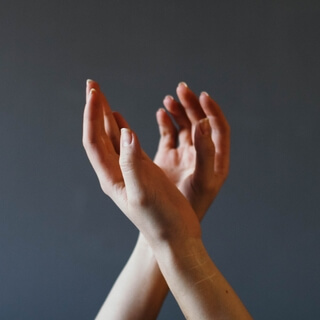
Go ahead and turn your palms facing up towards the sky.
So if they're supporting you in any way,
You can leave them down.
But if you have them resting somewhere,
Turn them up towards the sky.
And just notice if any,
Shift happens just from the simple act of facing down to up.
And it might just be a sensational like the temperature that you might feel on your palms versus the top of your hands if the palms are up.
Or it could be something more energetically.
There is something about palms facing up,
The idea of welcoming and being with.
Go ahead and take a deep breath in through your nose and exhale out through the mouth.
See if you can do that again really with that ocean wave sound on the exhale.
With a big sigh out,
So breathing in through your nose,
Filling up to the top and exhaling out through the mouth.
Really a complete full exhale out.
So if anyone is a mother in any capacity,
It doesn't have to be a label,
Really just tuning into the sweetness of Mother's Day today.
And for those of us that perhaps maybe aren't mothers of children,
Maybe just tuning into the sweetness of the mothers that we have or the mothers that we know in any capacity.
Again,
Mother is such a broad term,
So we don't have to limit it in who or what could be a mother to us.
And see if you can allow this sense of nurturing to be welcomed.
I think of a mother,
I think of nurturing and caring selflessly.
I think of the mother nature adapting and shifting to stabilize us,
To bring us beauty,
To bring us shade or sun.
I think of peacemakers.
And so with that idea of nurturing,
See if you can allow this next hour to be that for you.
Time and space dedicated just to lean into your body,
Your breath,
Your heart space,
Your mind.
And your tenderness and care.
You're welcome to leave your eyes closed or open for different pieces or parts of this practice.
Tune into what's going to feel restorative for you.
So we'll begin by inhale,
Reaching our palms up and around the sky.
Find some length here and settle the hips back down and in.
And just because we land somewhere with our hips for the first part of this practice doesn't mean you can't shift.
So maybe you might notice your hips are feeling tight or sticky.
So perhaps you shift or switch what leg is on top.
And as you start to continue to reach up towards the sky,
See if you can allow your shoulders to soften.
So rather than having the shoulders really close up by the ears,
Feeling this reach,
But almost a relaxed sense through the shoulders and through the shoulder blades.
Let the knees be heavy wherever they're at.
Just breathe naturally here.
So maybe breathing in through the nose and out through the mouth or in through the nose and back out through the nose.
Notice if there's the mind wanting to move to the next posture.
And just bringing that sense of wonder and curiosity.
What is it about this posture?
Maybe it's the shoulder tension,
Maybe it's hands tingling,
Or hips are aching to move.
See if you can sit with this.
And then taking a big breath in through the nose,
Exhale,
Start to walk the hands forward.
So letting them come down and then walking forward,
Allowing your hips to stay grounded on the mat or the bolster.
And just allowing your head to kind of pour forward and down.
And then your shoulders and back can kind of start to round.
Let your head go.
There's a tendency,
Especially with videos,
As I'm talking I'm kind of lifting my head only to ensure that you can hear my voice.
But there's a tendency to look up at the video.
Don't worry,
You're doing it just fine.
Let your head go.
And then we'll do a small cue and we can roll out of this.
And then go ahead and gently start to walk your hands over to the right.
So still in this forward fold,
But just walking them over.
And check out if that left hip is trying to kind of come up off the mat.
See if you can set it back down,
Even if that means walking your hands back towards you a bit,
Still allowing your head to hang.
There's no gold star if you can reach your forehead to the ground or the mat.
And then just starting to walk your hands back a little bit towards that right knee and allow that right hand to stay planted.
Left hand's going to come up and over.
And so you just kind of start to maybe turn your head down to look over that right shoulder or you can turn it up to look right on that lifted hand or arm.
Or somewhere in between,
You could look forward and you might just move the neck looking down and then up,
Allowing those hips to still be heavy.
You might be tempted to really lean in.
And you can always walk that right hand out a bit further.
Maybe you can drop down on that elbow if you have the openness and space.
And it might not be,
I don't have it,
But maybe right now it's not present.
Or just in this moment,
That flexibility isn't there.
Tune into the sensations,
If any,
Of that lifted hand.
It's tingling a little bit.
And then as you exhale,
Start to walk that left hand down,
Turning the heart down back towards the mat.
And just walk your hands back through center.
Walking your hands over to the opposite side,
So over to the left.
Let your head hang.
Let the right hip be heavy.
And see if you can relax the shoulders,
Even if that means walking your hands back towards you a bit.
And then simply walking your hands back up.
That left hand's going to plant.
Right arm's going to swim up and over that right ear.
And maybe just walking the left hand out a bit,
Maybe dropping down on the elbow.
Allow the hips to still be heavy.
And finding which gaze point,
Even if the eyes are closed,
Feels good for the chin.
And it's easy for some in these postures that we really open up the heart space to kind of collapse down like we were in that forward fold.
See if you can allow the heart to stay turned open,
Forward,
Or maybe even up if you have the space.
It's also natural for that left shoulder to really come up by the ear.
Let it rest down,
Intentionally reaching the shoulder down and away from the ear.
So this time on an inhale,
Pressing up through that left hand and just walking up,
Reaching both palms up and around the sky.
Palms come together.
Take a breath in.
Exhale,
Palms touch at heart center.
I'm just taking a few breaths here.
Notice if anything is pulling the mind.
And ask what would be of service right now for me in this practice to allow myself to soften or to be present.
Go ahead and let's bring our palms back to our knees and we'll just find some seated cat cow or rainbow spine.
So as you inhale,
Lifting the heart,
Lifting the chin,
Kind of using your knees to pull your heart forward.
And as you exhale,
Rounding the spine,
Chin drops towards chest and maybe using your knees for balance as you maybe lean back a bit too.
And so just moving here,
Inhale,
Lifting,
Exhale,
Rounding.
It doesn't have to be huge movements.
It can be slow and easy.
Maybe slow and simple is a better term.
Slow and simple.
Or it can be really exaggerated movements and maybe even hold a few spaces and just breathe a few rounds in cat and breathe a few rounds in cow.
Coming back up through center,
Roll the shoulders up by the ears,
Allowing them to slide down the back.
And doing this a few times,
Rolling them up,
Maybe exhale as the shoulders slide down.
So we're really getting that focus on letting go.
Breathing in and out.
Exhale,
Allow them to soften and maybe changing directions,
Rolling the shoulders up and forward,
Down and back.
Allowing the shoulders to then soften down and away from the ears.
And just gently tilt your head to right ear towards right shoulder.
And maybe extending that arm out,
Left arm out.
Like a 45 degree angle,
Extending that out.
So we're getting this nice stretch along our side.
Opening up through the shoulder.
And then rolling the chin down through center,
Allow that hand to plant on the knee.
And just shifting the chin or ear to the other shoulder,
Extending the right arm out.
Finding that length.
If it feels sticky,
Notice that you can always drop the palm closer to you.
You could reach it back or forwards.
Do some gentle motion.
Coming back through center,
Allowing the head to come up to neutral.
Let's find a way into hands and knees,
Tabletop.
So maybe just unwinding,
Maybe the hips feel a little creaky,
So you might extend the legs out first and maybe kind of windshield wiper the knees side to side.
Or you might flex the feet,
Roll the ankles.
So tabletop,
Hands and knees.
Palms underneath shoulders,
Knees underneath hips.
And I say ish when I give cues like that,
Because the knees might want to be wider.
And go ahead and just feel into table for a moment.
Let your days be down.
So the neck is nice and long.
And then notice what it feels like to really press into your palms.
And then notice the difference if we're not really pressing into our palms.
You kind of collapse into our shoulders.
Feel into that and then press into your palms.
So we're kind of getting this nice lift through our upper back.
And then engage the belly or engage the core by drawing belly button in towards the spine.
And notice that shift.
So let go of the belly and then draw the belly in.
In our nice low back.
And then go ahead and move through some cat and cow here.
So we just did this seated.
So it's the same thing but on hands and knees.
Inhale lifting the heart,
Dropping belly.
And exhale start with belly.
Start to draw the belly in and then travel up through shoulders and allow the head to drop.
Inhale,
Drop belly.
Drop shoulders,
Lift heart,
Lift chin.
And you can do this at your own pace.
I'm just kind of moving slower to show the process.
In restorative yoga,
We really have the opportunity to dive into the small nuances and postures that can make a huge difference in any practice.
Whether it's vinyasa,
Slow flow,
Yin,
Ashtanga,
The other hundred and that many.
And coming back through center,
Go ahead and inhale your left arm,
Reach it up to sky.
Feel this.
So there's a tendency to want to rush this,
That's normal because this can be really a hard pose by pressing into that right hand,
Lifting up through the left hand,
Opening up the heart space.
And exhale,
Go ahead and weave the left arm underneath the right,
So threaded needle.
I'm just going to turn so that way I can face you.
And let the temple or forehead drop down.
That right hand can stay planted.
Eyes can close or they can stay open.
And so just breathing in to the shoulder here.
You're welcome to take that top hand if you feel balanced and wrap it up and around the low back.
And if that feels like too much and you tried it,
Just taking it back maybe to an elbow or you can reach that right palm out long in front of you.
Kind of like you might in child's pose.
We'll take two more breaths here.
So that top arm is wound behind the low back,
Go ahead and unwind it.
And then pressing into right palm,
Go ahead and lift the left arm back up towards the sky.
Reach it up,
Exhale,
Plant the palm down back into table.
So go ahead and change sides.
Right arm reaches up to sky as left hand plants kind of stay here,
Really pressing into the palm that's on the mat and reaching up through the fingertips that are lifted.
And you can gaze up at the hand or gaze down at the hand on the mat.
See if you can focus on the heart space here,
Just kind of opening through the front side of the body.
Pressing your breath on an exhale,
Go ahead and take that top arm,
We've got underneath the left arm rolling down on the right shoulder into threaded needle on the side.
Letting the temple rest down.
See if there's the tendency to kind of find tension in the lower half of the legs.
Allow them to settle.
You can just be heavy on the mat.
And that left palm can reach out long in front of you.
It can stay planted and rooted.
Or if it would feel nice,
You can reach it up to sky and weaving that across the low back.
Just feeling into your breath here.
Two more breaths.
That top arm is across the low back.
Go ahead and unwind it.
Plant it back.
Inhale,
Unwind.
Right arm reaches up to sky.
Inhale back into tabletop.
From tabletop,
Let's find child's pose for a moment.
So tucking toes together,
Touching toes together,
Sinking hips back.
Knees can be wide apart or they can be together.
Reaching the heart forward and down,
Allowing the head and forehead to hang or touch down.
So if the head is really hanging,
Here's where a blanket or a prop might feel really nice just to rest down on.
If it feels like too much on the knees,
Just walk out of this,
Shifting your hips.
And just using maybe your hands as a pillow as you bend the elbows and tops of the hands gently cradle the forehead.
And really just start to feel heaviness in the hips.
There's so much carried around in the hips.
Not only physically if you're carrying things around all day or carrying children around,
But also emotionally stress tends to manifest in certain places in the body.
And hips happen to be one of the most popular spots for that.
So just allowing your body to start to tap into that.
And signaling with each exhale that sense of releasing.
It's just like when you think of a garden and you want to plant a new garden or fresh flowers,
You really have to tend to that old stuff in there from the year before.
That's what we're doing here.
We're tending to the sticky stuff before we can allow ourselves to move forward.
Allow ourselves to maybe grow,
Whether it's physically finding length in our body or just emotionally,
Spiritually,
Mentally finding growth.
Go ahead and start to come back up into tabletop pose.
Walking your hands back up,
Hands underneath shoulders,
Knees underneath hips.
Maybe just swaying the hips side to side.
Child's pose can be a little tight in the hips or just bringing some awareness to tightness in the hips.
So being gentle and kind.
Taking as much time as you need and kind of savoring the transitions in between each posture.
We're going to find puppy pose next.
So think of downward dog,
But still staying on your mat.
Walking your arms forward and then allowing your heart and head to come down.
And so they don't have to touch the mat.
They might,
The head might,
The heart might,
But leave the hips high.
There's a tendency to want to just go back in child's pose.
Leave the hips high because this is really the heart opening posture.
In child's pose,
It's more focused on hips.
And if you want to take child's pose,
You can at any point.
So head might come down,
Heart might come down.
You might use a blanket underneath your arms or your head or your heart.
And so these are poses that can really be sticky and tough in different ways than like warrior a standing strong pose might be tough.
These poses tend to be not only physically challenging,
But also really mentally challenging because we're just sitting with this stickiness or stretch of a pose.
So see if you can allow your breath to really be your focal point to soften,
To find space,
To nurture.
Taking three,
Four,
Five,
Six,
Seven,
Eight,
Nine,
Ten.
Taking three more really deep breaths here.
So we're going to start to slide forward so this might feel a little awkward to come down,
Bringing your hips down,
Forearms are down on the mat,
Legs are out long,
Shoulders are down and away from the ears.
And if this feels like too much on the low back,
Walk your palms out further so your heart comes closer or they can go out wider.
Your arms can create a wider base.
Anyway we just want to find length in the low back rather than crunching into the low back.
This is not about what it looks like.
And so the chin can stay neutral looking forward or you can look down allowing the head to hang.
Taking a few more breaths here and slowly just starting to walk the palms out.
Bring the elbows nice and wide and allow your right temple to rest down on the hands.
Just making a little pillow.
Notice if you're holding anything through your feet or your calves.
Maybe just shifting your feet side to side or lifting your feet up and resting them down.
And taking a full breath,
Really allowing it to start in the belly and travel up into the upper back.
So feeling this like lifting through the upper back.
So breathing in through your nose,
Filling up.
And exhaling letting it go,
Shoulders back down through belly.
And go ahead and turn the chin back to neutral and bend the left knee.
So taking the left knee up towards the sky.
And if you can come back onto the forearms and reaching back with the right hand or that foot.
And so pressing in to that arm still.
So this is more of an active posture.
So we're pressing into that palm that's on the mat.
Pressing into that elbow that's on the mat.
And then also catching the ankle or the foot.
And maybe you don't catch it.
So it's just the act of flexing that foot and reaching for it.
And if you definitely don't want to reach for it or you can't reach it yet,
Just leaving that palm on the mat and staying there.
If you do have the right foot in the hand,
You can start to press your ankle into your hand and your hand into your ankle.
So it creates this natural lifting of the heart.
And see if we can just stay here for a few breaths.
This is a posture that a strap is really helpful if you don't have your foot with your hand.
You can just use the strap as extra length so that you can still hold onto a strap and have the strap around the ankle.
You can use an old tie or something if you don't have a yoga strap.
That's perfectly fine.
And notice that the foot wasn't flexed or is flexed.
See if you can change it.
So if it wasn't flexed,
Flexing that foot.
And then gently exhale,
Allowing that foot to go nice and slowly,
Dropping it down.
And we'll just change sides here,
Maybe rocking the hips until one side might feel differently than the other.
So just kind of being aware of that.
Standing into that left foot,
Reaching that foot up towards the sky.
This might be enough.
Check in with the low back.
Feels like too much.
You can kind of back out of it.
You can walk your arms a bit further.
You can take that hand and reach back for the ankle or the foot.
If you do have it,
Press into it.
Press your ankle into the hand,
Hand into the ankle.
Maybe flexing the foot,
Pressing through that hand on the mat and the elbow down on the mat.
So this is half bow pose.
Couple more breaths here.
Exhale,
Start to gently unwind,
Letting the hand go,
Letting the foot go nice and slowly.
And then coming back down,
Allowing your hands to make a pillow,
And this time resting your left temple down on the mat.
And taking those same deep breaths,
Filling up through the belly,
Up to the heart,
To the chest,
To the shoulders.
And exhaling,
Letting it go from top to middle to bottom.
And go ahead and turn your chin back to neutral,
Forward in front of you.
Reach the arms out long in front of you,
Just resting your head down on the mat,
Forehead rest down or hangs down.
And go ahead and bend the elbows,
So fingertips come together towards the sky,
Forehead still down.
And so this might be where you stay with hands up towards the sky,
Or you might start to allow the thumb to travel towards the back of the head or the neck.
Slowly taking the palms back down long in front of you,
And walk the hands and elbows back up to Sphinx Pose.
And so we're going to find our way into downward facing dog.
So you can pass through tabletop,
Where we've been a couple times,
Or you can start to come into cobra,
Palms by your ribs,
Elbows hugging in towards you,
Pressing and lifting up through the heart space,
Tucking the toes,
Lifting the hips,
Finding downward facing dog.
And you can always pass through table like I am,
Where knees come down first,
Hips lift,
Head weight hangs.
And in downward dog,
Go ahead and allow the head to really hang.
Take a few deep breaths here,
Maybe coming up on your toes and then sinking the heels back down,
Finding length.
Slowly pressing through the palms.
And so we're gently coming forward into plank,
Gently tapping our knees down.
And let's start with the right foot,
So drag the right foot up in between the palms.
So we're in this low lunge,
And you can leave that left knee right underneath the hip or you can drag it back.
Untuck the back toes though.
We're going to walk the hands on the inside of the right foot and just start to walk the hands a bit more to your left and maybe you start to walk them out forwards.
Let your head go.
You might really walk your hands forward.
You might come down onto your forearms.
If you have any props,
Blankets,
Pillows,
Resting,
Heart,
Hands,
Arms down,
Head down on there.
And if not,
Just using your palms,
Maybe even using your fingertips for balance and bending your elbows.
You can always walk the right foot further or wider.
And just gently walking the hands back in towards that foot,
Letting the chin come up and we'll change sides.
So maybe walking that left knee back in underneath your hip and sliding that right foot back and taking the left foot forwards and out and around the hands.
Maybe walking the right knee back a bit and starting to turn the heart over open to the right,
So I'm going to switch sides once again.
You can come on the fingertips,
Come onto your palms,
Bend the elbows,
Come down onto the forearms,
Sinking into the hips.
And maybe taking three more nourishing breaths here.
And as you said,
To allow yourself to come up,
Walking the hands back in.
And we'll just slide that front foot back next to the other knee's parallel and maybe just finding child's pose one more time,
Sinking the hips back,
Head weight hangs and rest down,
Arms can reach out forward or just become a pillow for you.
Take a slow breath in through the nose.
Exhale,
Let it go through the mouth.
Gently coming back up through table.
We're going to find our way into our comfortable resting posture and so that might be lying on your backs or bellies.
Really it can be any way that feels restorative for you.
If you have a blanket or bolster,
You can use that over top of you.
You could use it underneath your knees to just create some elevation which releases tension in the low back.
And so,
Savasana,
Final resting posture.
Allowing the feet to just hang,
Allowing the palms to rest either open or somewhere down on the body,
Maybe the hips or the heart,
Belly.
Just for a few minutes,
Seeing here what it's like to rest in stillness.
This is the pose that really allows the practice to nourish your body.
It's like watering a plant and allowing the water to really seep and sink in until it pours out the bottom of maybe the pot or seeps down into the roots.
It might be tempting to skip this but just know that you deserve this.
You deserve a far longer savasana perhaps too.
And so staying in savasana.
And allowing your eyes to stay shut.
Let's read some words that Rupi Kaur wrote in honor of the mothers out there.
This is the recipe of life said my mother as she held me in her arms.
Think of the flowers you plant in the garden each year.
They will teach you that people too must wilt,
Fall,
Root,
Rise in order to bloom again.
And just for a moment,
Seeing if you can bring to mind a mother figure that you honor.
You can be as abstract or concrete as you like.
And just thinking of a virtue that they offered you.
And if you're a mother figure to anyone yourself,
Maybe thinking of the virtue that you offer those that look up to you.
Those that look for you for nourishing and care.
And slowly starting to come up into a comfortable seated posture.
So if you're on your back maybe rolling off to one side and gently finding our way into a comfortable seated posture once again to close practice together.
When you get there maybe allowing the eyes to fall shut or soften the gaze.
Bringing the hands either to heart center or just opening up the palms like we did when we started.
Either at heart center or resting down on the knees.
Just soaking in this practice.
And sending extra love,
Extra self-care and nourishment to all of the mothers out there.
The biological foster,
Adoptive,
Blended aunties,
Sisters,
Grandmothers,
The ones waiting,
The ones wandering.
The fur baby mamas,
The garden mothers,
The teachers,
The leaders,
The friends,
The caretakers.
The ones with us,
The ones we lost.
You will always be held.
So grateful for you,
We honor you.
Take a deep breath in through your nose.
Exhale out through the mouth.
And from my heart to yours,
Wishing you a week of health and safety and lots of love.