So this week I've been in preparation for our weekend retreat.
We've been exploring the harmony,
The overlapping practices of Zen and Vipassana.
And Tuesday I shared a little bit on how Zen practice is very much grounded in the body and we talked about when you put your body in a particular posture,
It has an effect on your psychology.
The example that I used is if you put your hands in front of your heart and lower yourself over and over and over again in a bow,
Then it's very hard for the heart not to begin to open.
Somehow there is a dropping of humility or pride and a certain amount of respect begins to develop,
A certain amount of gratitude.
So a teacher in Vipassana might give a Dharma talk on gratitude and how important it is to be grateful,
The ideas of it.
And in Zen they don't teach you about gratitude,
They tell you to bow all the time.
So with Zen practice we give ourselves over to this activity,
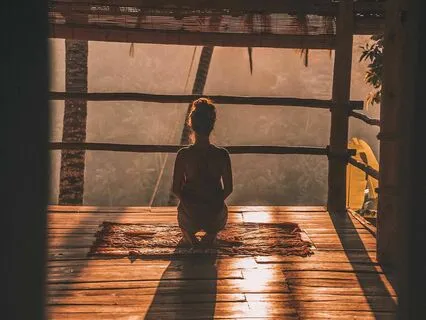
The posture of sitting,
We give ourselves over to it.
And this is where some of the training occurs.
In my experience I found the grounding in the body was my first training in Zen practice and it really supports the mindfulness training that I later received in the Vipassana tradition.
So Vipassana,
This word,
It comes from the ancient Pali word,
It's a Pali word for insight.
And the word Vipassana no longer means like the insight that comes from practicing mindfulness,
Now it's become this name for the technique of meditation practice,
For the four foundations of mindfulness,
The mindfulness technique.
And what I've been sharing with you about Zen is that they don't teach much.
You're using your body a lot,
It's part of the practice field,
Everything is a monastery.
Whereas in Vipassana we're putting a lot of emphasis on mindfulness of the body,
But not by using the body,
But by paying attention to it.
So Tuesday I gave the example,
In Zen you sit upright,
You don't slump,
And you place your hands together with one hand over the other and with your thumbs touching lightly.
What happens is if there's too much energy or there's too much tension,
You end up pushing your thumbs together and then there's a tightness,
There's a tension in your shoulders.
And if you're too slack,
Your thumbs fall apart and you're told just keep your thumbs together lightly,
Just lightly touching.
In Zen they don't teach you so much about making too much effort or too little effort,
They just tell you to make sure that you keep your thumbs lightly touching,
That's the teaching on effort.
Or your body being upright and straight,
That will tell you your effort.
In Zen the practice is in some way from the outside,
The physical body,
The posture of the body,
In.
Whereas Vipassana practice,
We're doing our practice from the inside out.
The idea of knowing your body from the inside,
Knowing it from the inside out is different,
It's a different kind of knowing.
It's knowing through our thinking and concepts in a way.
It's not intended that way,
But that's how it goes at first,
But really it's closer,
It's closer to knowing through your senses and your feelings,
Your senses and your feelings.
Right now you can try this,
If you put your finger on your thigh and you push,
Give it a good push,
You can sense the pressure on your thigh.
And the pressure that you feel happens in the place where you're pushing.
The sensation and the sensing are non-dual,
You can't separate them out.
You can't have sensations without sensing.
So one of the things we do in Vipassana practice is learn to center ourselves in the body,
To really allow ourselves to experience it.
And as we do this,
It has an impact back on the mind,
Because the two are really closely related.
And the Buddha was very explicit about this.
He talked about cultivating mindfulness of the whole body,
Opening up and becoming aware of the whole body,
Not just the body that's breathing,
But the whole body,
The global experience of this body.
The Buddha also talked about as the mind gets settled and concentrated,
That you can experience,
And many of you have experienced this,
There's a feeling of well-being and ease and maybe even joy and happiness.
And in part,
The Buddha is saying,
Allow those feelings to spread through the body.
Those are actually beneficial.
Don't push those feelings away.
You may feel a lot of discomfort,
And then every now and then feel this well-being.
You can cultivate that well-being,
Seeing it,
Cultivating it,
Letting it be.
Don't cling to it,
Because it will change.
But Vipassana practice,
We bring attention to whatever the compelling physical experience is in the moment.
We pay attention and notice if it's pleasant,
Or if it's unpleasant,
Or if it's sort of a neutral experience.
We bring attention to sensing and feeling into the parts of the body that have strong sensation.
And what happens is that if we do this over time,
Different parts of the body will speak up and show themselves to us.
And we'll really get to start to see the changing nature of sensation and feeling,
The coming and goings of it,
By bringing careful,
Like this careful attention,
Just opening,
Allowing the sensations to be there,
And not reacting or forcing them or trying to push them away.
That's an interesting thing,
That pushing away.
We do this.
We don't want to feel the pain.
But if we actually just sort of like relax,
And just feel the sensation,
Slowly the body begins to wake up,
And there's more to sense and feel.
We experience mindfulness of the body as the body.
One of the primary things that I learned,
Or brought to Vipassana meditation,
Coming from a Zen background,
Was to just be fully present with what I'm doing.
Just be fully present.
I still sit in Zazen with my thumbs lightly touching.
It's my physical reminder of energy and effort that's needed to stay present.
And in that full presence,
Things unfold.
And just to drop into seeing the body as a feeling,
Sensing,
Changing flow of energy from the inside out,
And to have the body in its stillness and its form,
Upright,
Thumbs touching as an expression of balance and presence from the outside in,
Both have been so valuable in my practice.
And I hope that this offering is valuable for your practice as well.
I hope that those who can join us for retreat will get to experience this expression,
This dance without moving that is Zen.
And I hope that those that are not on retreat will also start to play with this,
This expression,
This dance without moving,
The body from the outside in and the experience of the body and the practice from the inside out.
Thank you for your attention.
I welcome your comments.