So,
As many of you know,
Roaring Fork Insight is hosting a weekend retreat next weekend with the Soto Zen teacher Christian Dello,
Who is also the guiding teacher of the Boulder Zen Center.
And so I'd like to explore with you this morning the harmony between Zen practice and Vipassana insight practice that we do here.
And as many of you know,
I have been involved in both of these wonderful traditions for many,
Many years,
And I have tremendous respect for both paths.
The way that I experience these traditions is in the imagery of two circles that overlap,
And one circle is Zen teaching,
And the other circle is Vipassana teaching.
And I don't really know how big that overlap is.
I think it depends on who's defining it.
But where there's overlap,
There is harmony,
And it's very complimentary.
So Zen is not so much something to understand as it is to do.
Zen is not found in understanding.
It's found in the doing of it.
So it really requires this level of engagement.
I think it's useful to study some Zen.
Zen Mind Beginner's Mind is very small.
It's a very small book.
I think,
I'm just going to look at how many pages,
Yeah,
It's just about 130 pages.
It's a very small book.
It's useful to study some of it,
But the studying might not help you understand so much.
It's like if you've never been backpacking before,
And you decide to go and hike the Pacific Crest Trail,
It would be helpful to learn a little bit about what you're about to embark on,
But the point is not to study it.
The point is to hike it.
That's how it is with Zen practice.
Another example is to kind of look at a dancer or a performer.
The point is not to get,
For the dancer,
The point is not to get to the end of the performance quickly.
When you're doing the performance,
If the motivation is about getting to the end,
Then chances are the performer might fumble,
So the performer has to let go of the motivation and be fully in the moment.
They have to let go of the goal,
To let go of the motivation that brought them to the stage in the first place,
And just be fully in the performance.
It's not done,
The dance is not done to attain something.
It's not done in the spirit of getting to the end of the performance,
Or trying to figure something out,
And so Zen is this way as well.
It's more like being in the dance,
But without movement,
Without moving.
So Zazen,
Which is the name for Zen meditation,
Zazen,
We're not trying to get somewhere with meditation,
Just like the performer isn't trying to get to the end of the dance.
In Zazen,
We let go of any motivation that got us to our chair or cushion this morning.
And there might be really important motivations,
Like you want to overcome your suffering,
That's why you come to sitting.
But once you sit on the cushion,
We let go of our motivation so that we can be fully in the experience.
There's a saying in Zen,
You practice with no gaining idea,
No gaining idea.
We're not trying to get anywhere with it.
Zen meditation is more of an expression,
Just like a performer.
And when it's going really well,
It's an expression that comes out of the performance.
When we're really engaged in our practice,
Our Zazen,
There's a vitality and aliveness that is expressed.
And so the training,
Zen training,
Is first and foremost through the body,
Through our posture.
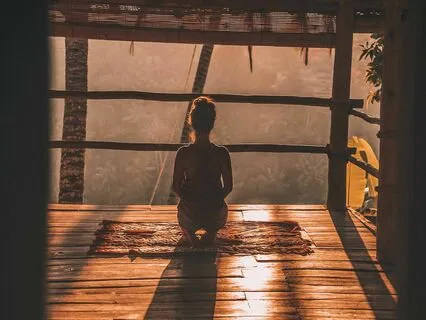
Your sitting posture in Zen is very important.
And classically,
You would take a posture of full lotus with both your legs crossed up by your hip bones,
Your feet by your hip bones,
And your back would be very straight.
And a lot of us cannot sit in that posture.
I am sitting on a bench,
And I sit very straight,
And the chest is open,
And your hands are in a very particular mudra,
Where the left hand sits on top of the palm of the right,
And you make a circle with your fingers and with your thumbs,
And they touch together.
The thumbs are touching gently,
And your eyes are opened in the Zazen practice,
But they're unfocused in this kind of very refined way,
Or just sort of like they're open.
There's open awareness,
But unfocused.
And the importance is that you're actually engaged in this posture.
It's not so much watching the posture,
But being the posture.
There's a lot of learning that can happen in our body that changes our psychology.
There's a dynamic relationship between the physical body and our minds.
So if you're fidgeting a lot during practice,
This reinforces restlessness in the mind.
Or if you're sitting all day long with your shoulders slumped over,
And your body is withdrawn,
And there's a depression in the body,
The posture of that slumping reinforces the depression.
But if you sit upright as best you can,
The chest open as best you can,
Fully engaged in the activity of the moment,
Still and not moving,
It begins to change your psychology.
It begins to change your psychology.
Isn't that fascinating?
So when you put the body in a particular posture,
There's an effect psychologically.
So for example,
I sat a couple of practice periods at Green Gulch Farm Zen Monastery when I first started practicing.
And after sitting in Zazen,
We would go and we would work on the farm.
And anytime you're walking around a monastery,
And you run into another student,
The practice was always to stop and to bring your hands together and to bow to each other.
And if you're walking around a lot,
And there's a lot of people working on the farm,
Then there's a lot of stopping and bowing.
And there is something about putting your hands in front of your heart and lowering yourself over and over.
It's very hard for the heart not to be open.
Somehow there's this dropping of humility or pride.
A certain amount of respect begins to develop a certain amount of gratitude and appreciation.
So a teacher in Vipassana,
In insight practice,
Might give a Dharma talk on gratitude and how important it is to be grateful,
The idea of gratitude.
In Zen,
They don't teach you that very much.
They tell you to bow all the time,
You see.
In Vipassana,
We might give talks on how important it is to balance your energy and your relaxation.
In Zen,
They don't tell you that,
But what they have you do in meditation is put your hands together in an oval and the thumbs are lightly touching.
The thumbs are ever so lightly touching with just enough contact to hold a piece of paper between your thumbs so that the paper won't fall.
That's the instruction for balancing energy and relaxation.
Isn't that cool?
So over and over again in Zen,
It's what you do with your body and mindfulness,
What we're doing here.
It's not so important in Zen practice.
It's not that it's absent in Zen,
But it's a little bit more like a byproduct of being alert and present.
If the full presence of all our faculties are operating,
There can be mindfulness as well,
But it's not put at center stage in Zazen.
Where in our tradition,
The insight tradition,
Vipassana,
Mindfulness is put right in the center stage,
Which can lead to some confusion.
We confuse mindfulness with self-consciousness,
Self-conscious attention or logical attention or thoughtful attention,
Whereas in Zen,
We're protected from that because the main thing is non-cognitive,
Non-conceptual activity in the moment,
And that's where the welling up of energy and vitality come from.
To the extent that cognitive awareness is going on,
It's just kind of a piece of a puzzle rather than the primary thing.
So I'll stop here and take questions that you might have about this or anything else that's coming up with regard to the intersection,
These overlapping circles of Zen and Vipassana.
Thank you.