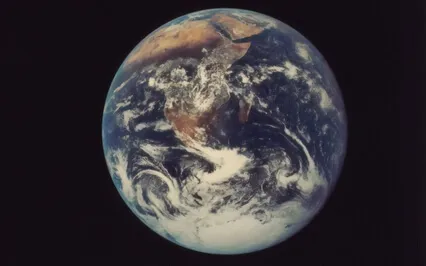
So the Earth,
You know,
This is the home that we share.
And maybe,
Maybe some of you know that the prefix,
Eco,
Like in the word ecology,
Is Greek and it means home.
And so ecology is the study of our home.
And this is an area that I have a lot of reverence for.
You know,
People,
When they live together in a home,
Families or roommates,
Even our pets,
There's a whole different relationship to the home space that we occupy,
The mutual care of it.
You know,
We keep it clean,
We create an environment,
Hopefully,
That's peaceful for everyone that lives there.
It's nice for everyone.
And there's caring,
There's caring for the people that come into our home,
That live in our home.
We're caring for those under our roof.
And so we also share this global home that we call the Earth.
As I was thinking about this week,
This week of Earth,
Where Earth Day lands on a Friday,
And there's a lot of talks and things happening around ecology and the ecology of Buddhism,
And I'm tuning into all of these lovely talks on,
You know,
Webinars.
And I was reflecting on this just for myself.
It's like,
Okay,
So what feels important to bring?
And so I went through my files and I came across this image.
So in 1990,
The spacecraft,
The Voyager 1,
It was about to leave our solar system,
And it turned around for one last look at the home planet.
And the Voyager,
It captured this photo of the Earth some 4 billion miles away as this tiny little point of light,
A pale blue dot.
Here's what Carl Sagan had to say about that.
Look again at the dot.
That's here.
That's home.
That's us.
On it,
Everyone you love,
Everyone you know,
Everyone you've ever heard of,
Every human being who ever was,
Lived out their lives on this pale blue dot.
The aggregate of our joy and suffering,
Thousands of confident religions,
Ideologies,
And economic doctrines,
Every king,
Every peasant,
Every young couple in love,
Every mother,
Every father,
Inventor and explorer,
Every teacher of morals,
Every corrupt politician,
Every superstar,
Every supreme leader,
Every saint and sinner in the history of our species lived there on a moat of dust suspended in a sunbeam.
The Earth is a very small stage in a vast cosmic arena.
Think of the rivers of blood spilled by all those generals and emperors so that in the glory and their triumph they could become the momentary master of a fraction of a dot.
Our posturing,
Our imagined self-importance,
The delusion that we have some privileged position in the universe are challenged by this point of pale light.
Our planet is a lonely speck in the great enveloping cosmic dark.
In our obscurity,
In all this vastness,
There is no hint that help will come from elsewhere to save us from ourselves.
The Earth is the only world known so far to harbor life.
There is nowhere else,
At least in the near future,
To which our species could migrate.
There is perhaps no better demonstration of the folly of human conceit than this distant image of our tiny world.
To me,
It underscores our responsibility to deal more kindly with one another and to preserve and cherish the pale blue dot,
The only home we've ever known.
Thank you Carl Sagan.
So as we celebrate this Earth,
This pale blue dot that we live on,
I'd like to look at our role in caring for it,
Caring for the Earth.
This Buddhist practice has a strong emphasis on human responsibility.
And responsibility simply means our ability to respond,
To build and create a better world for everyone.
And what is repeatedly taught in almost every tradition is how we're all interconnected,
Right?
We hear this.
I don't know how much we get this.
The welfare of others is clearly important to our own welfare.
And one of the main tasks of this time is for caring for ourselves and caring for our planet.
They're not mutually exclusive.
We depend so deeply on this Earth.
We can't just keep using it and exploiting it and polluting it as if it's a passive recipient,
Absorbing it all.
It rebounds and responds.
It rebounds and responds and it affects us.
Have you noticed how it's affecting us?
All the fires?
The fierce,
Fierce wind that we've been experiencing this spring.
The polluted waters.
Soil that has been just depleted with pesticides.
The Earth is rebounding.
And our health,
Our health depends on clean air,
On clean water to drink.
Our health depends on the land.
It depends on the systems of this Earth to be in harmony.
So the idea of caring for the Earth is like caring for ourselves.
No difference.
And we seem to be a society that's willing to live with a lot of damage.
The unhealthy air that we're breathing in a lot of the time.
We're lucky to live in this valley where we do have pretty clean air most of the time.
But every now and then,
I'm sure you've experienced this,
Trucks driving down the road,
Spewing like black soot,
Black smoke from their exhaust.
That's affecting people with asthma,
With compromised immune systems.
There is water that is unfit for human consumption.
And farms that use pesticides eroding the soil so they become like the dust bowl.
And we're sort of like sitting here willing,
Willing to sort of allow this,
Accept this.
That's all of us too.
I'm not on some pulpit saying,
Okay,
All of you change.
I have to look at my own heart and mind here too.
How I'm contributing.
And there's a trade off.
You know,
There's a trade off.
Do we want to be living on this planet where it's unhealthy for human beings?
We have human rights,
But does everyone,
Does everyone have human rights?
To clean air?
Does everyone have access to clean air and water?
Doesn't it feel like it's a right we should prioritize?
How do we do that?
I don't know.
Like I don't know how we do that.
But we in our small community,
We need to begin to have serious conversations about how we can do things differently.
The idea that we're in this together and it requires us to think together,
To talk together.
This is from the environmentalist,
Paul Hawken.
It seems like only a very small percentage of the population has to change to influence a larger apathetic population.
The poster child for this point is the LBGT rights.
In 2010,
It was an issue that people could run against to get elected to Congress.
Two years later,
Those same people had their tail between their legs and wouldn't talk about it because they knew that they might lose the election.
Two years.
How did that shift happen?
I don't think humanity can shift without a lot of hard work.
But it doesn't take 100% or even 90% or even 50% to make the change.
It only takes 5 to 10% of dedicated people to change the balance of the whole.
When I read that,
I was blown away.
5 to 10% to change the balance of the whole.
That's Aspen.
That's the Roaring Fork Valley.
Maybe?
Social effort may have a much bigger impact than we think.
So if we communicate with our families and communicate with our friends and be in conversation,
It's like what Margaret Mead said,
You know,
Never doubt that a small group of thoughtful,
Committed citizens can change the world.
Indeed,
It is the only thing that can.
So if we really want to be free,
In our hearts,
In our minds,
In our bodies,
We have to understand that there's no liberty without caring for others.
If we're not interested in the welfare of others,
And the world is,
You know,
I think that I can have freedom to do whatever I want.
And I don't really have much interest in what you want.
It's about what I want.
If that's how we're going to live,
Then that's the opposite of freedom.
Actually,
It's the opposite of freedom.
A Zen teacher was once asked,
How do you know if someone is enlightened?
And the response was,
If they help other people.
So this being on Earth,
Being an Earthling in a time like the time that we're in,
Is it time for us to learn,
To learn how to be more loving,
To learn how to see our connection,
Because we don't really see it so well.
To see our connection with everything and everyone,
To learn really how to be compassionate,
But not theoretically.
You know,
We learn when we're tested.
And as we look at what's happening in our world,
We're being tested.
All you have to do is go and look at the newspaper.
And so much of the stress that we experience is seeing ourselves as separate from others.
We think about those people over there,
Right?
Others.
But it's really us.
We all have a fantastic capacity for goodness.
I look around this room and I see and know some of you pretty well,
And I know the goodness that you've provided in our community.
And I'm so grateful for that.
And I see,
During the pandemic,
All of the healthcare professionals that would just show up every day,
Exposing themselves every day to COVID.
And they showed us that we too are capable.
So we link ourselves with those people that are compassionate,
That are giving.
Those everyday enlightened ones that help others.
Caring for ourselves and caring for the earth isn't really a heavy obligation.
It's just during,
Like,
We practice meditation,
We practice being still in the body and in the mind,
And we cultivate this ability to respond.
Responsibility.
That's what we're cultivating.
It actually doesn't weigh us down.
It eases us up.
And it's not popular because,
You know,
Worry is the condition that we identify with.
We're supposed to.
.
.
Care looks like worry,
Right?
Or we care,
And it looks like anger.
I see a lot of activists that are really angry.
But that's not necessary.
Not really.
The freedom from the heart that we're cultivating is just this ability to respond from our own good hearts,
From our own true nature.
That's our birthright.
This is from the Thai forest monk Ajahn Buddhadasa.
He says,
The entire cosmos is a cooperative.
The sun,
The moon,
The stars living together as a cooperative.
The same is true for humans and animals,
Trees and the earth.
When we realize that the world is a mutual dependent cooperative enterprise,
Then we can build a noble environment.
If our lives are not based on this truth,
Then we shall perish.
So we can use our practices,
Whatever those practices are.
For me,
It's meditation.
To prepare ourselves for what's coming.
What we need is a well prepared humanity.
This crisis is coming as far as the environment is concerned.
In our lifetime.
So how do we prepare ourselves?
This is the task of our time.
What we're facing now is as big or maybe bigger than some of the major challenges of previous generations.
In previous generations,
There was World War One and World War Two,
The Great Depression.
What's happening now is on that scale.
And just as those times,
There was so much required of people at that time,
And for our generation,
For all of us.
It's about this earth,
Caring for this earth.
There's this fable,
This myth in the Pali Canon,
The Buddhist discourses,
That illustrates our relationship with nature pretty well.
Once upon a time,
There was a large fig tree.
And it's mythical because it was so large that it reached over like many,
Many leagues.
It was such a big tree.
So people could come along and just pick the figs and more would grow.
And people would eat and they'd go away and they'd come back for more figs.
And at some point,
A man came along who was greedy and stuffed himself with figs.
And when he was finished,
He reached up and broke off the branch.
And he took all of the branch and the figs with him.
And from that day on,
The fig tree stopped producing figs.
So this idea that there is this cornucopia of support that we're getting,
If we break it,
Maybe it'll stop producing and providing for us.
And we keep breaking it.
Maybe not the people in this room,
But collectively.
So there's not a strong separation between being a human being,
An earthling,
And our natural world.
So to be caring,
It's a reciprocal relationship.
I feel like it's time that we talk about this.
I don't want to be Debbie Downer here,
But I feel like it's time that we talk about this.
We can offer up an ethical analysis of what's going on.
We can speak up about what we want this time ahead to look like.
And what the ethical way is to move forward.
We could do that together,
Individually.
So the invitation today or on Friday to celebrate the earth is spend some time in nature.
Please think about it.
This relationship we have with it.
I'll close with a quote from John Muir.
When one tugs at a single thing in nature,
They find it attached to the rest of the world.
So thank you for your kind attention and thank Megan for her beautiful gift of healing sound.
And I'd like to open it up to discuss what I've said,
What you have in your own hearts to say.