So last week,
As many of you know,
I was on retreat.
And as luck would have it,
I had the opportunity to practice with what our guest teachers Brian and Lily talked about.
So Brian spoke of balance,
The spectrum of balance,
And how it relates to what Lily talked about,
Which is the inner critic.
So balance with the inner critic.
That was my practice last week on retreat.
Stability with these thoughts,
You know,
These thoughts about myself,
And my practice.
These thoughts of doubt,
And not good enough.
Old,
Repetitive thoughts,
To just see them appear,
And maybe,
Maybe get lost in them for a minute or two,
Sort of feed this story.
And then notice the feeding and put it down.
Seeing this happening again,
And again,
Observing this occurring.
Oh,
Patience.
Oh,
Good self.
So much of my practice was that.
There is a teaching in one of the suttas that was actually shared during the retreat Dharma talks.
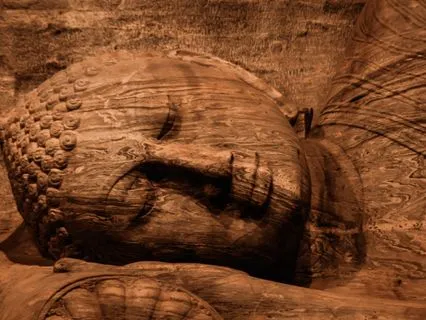
And the teaching described the awakened one.
And the way that it's put together,
The language used to describe the awakened mind,
Buddha,
Is in the absence,
In the absence of something in the absence of holding on to anything.
So the phrase used is that an awakened one,
A Buddha,
Doesn't take a stand on anything that arises.
Be it a sight,
Or a sound or a taste or a smell or a sensation.
And most importantly,
Which is going to be our focus for a little while,
A thought doesn't take a stand on anything that arises.
Like,
What would that be like,
For us?
Not to stand?
Not to take a stand for the inner critic?
Not to stand for the story that feeds the inner critic?
You know,
I know in my experience,
The story of not good enough is really old.
I was told it and I believed it.
I believe that I wasn't good enough.
And before I came to this practice,
I thought I could outrun the story,
Or at least outsmart it.
I was going to prove to you that I was good enough.
And before I came to practice,
I didn't have much of an ethical compass.
Back then I would lie and I would manipulate to get my needs met.
That's kind of how I ruled.
And the lens that I went to,
To keep the not good enough story at bay.
Wow.
It was a lot of work.
And underneath it,
Underneath it,
Ah,
It's still there.
The inner critic letting me know,
In a mean voice,
What a loser.
What a screw up.
So last week,
Lily offered some really beautiful tools to work with the inner critic.
She spoke about curiosity and love.
And I got to work with both of these on this last retreat.
So it's very much alive in my practice right now.
So love,
Loving.
Like Lily,
The default position for the inner critic is a strong aversion.
Don't like it.
It feels uncomfortable.
It feels painful when the inner critic is appearing.
I want to push it away.
But as we know,
Pushing it away just kind of makes it stronger.
So how do I love it?
So to kind of stay with the way in the suttas are often presented in this language that represents the absence of something.
For me,
Love is the absence of hatred.
That's it.
Love is simply connecting to what's here.
Connecting to what's here.
In my experience,
Love is just caring.
Simply caring for the way in which I suffer.
I care about how old the story is.
I care about the little girl who was criticized and believed it.
I care that it's showing up again.
Wanting to assert itself.
Wanting to take a stand.
Wanting attention.
I care about my suffering.
And by caring about my suffering,
I can let myself feel it directly in the body.
It's not going to consume me or take me down a road and render me helpless.
What I do is I just take a breath.
Just return to the breath as a stabilizer.
The steadiness of breathing in and out.
Arriving back in the present,
Away from the story is running,
But I'm here with this,
With these sensations,
With this breath.
So curiosity in the moment doesn't look like sourcing the story.
Investigation is a here and now experience.
It is not a cognitive experience.
We are not doing an inner therapeutic process in the moment.
If we are,
We're not in the moment.
We're in our thinking,
We're in our remembering,
We're in our sourcing,
And figuring out.
What generally happens is the inner critic appears as a thought.
And it's a simple,
Habitual process.
It arises.
It's a habit pattern.
That's all it is.
So the inner critic appears and the investigation is direct in the moment.
What's happening in the body right now?
There's this mental formation,
This construct,
This habit pattern arising in the mind.
That's what's happening.
And right with it is an associated feeling tone.
What is that?
What is the feeling?
Well,
For me,
It's aversion,
Right?
How do I access what else is happening in this moment,
Besides the story?
Very simply,
Breath.
I take a breath and wow,
There's the breath.
And at first,
At first the breath is a little jagged.
Because I'm returning to it.
I'm leaving a mind state,
The inner critic mind state and returning to here and now.
And then the breath becomes a little bit longer.
And I start to see and notice the vibration and the pulsing and the areas that start to knot up.
The knot of the inner critic is often kind of right around the prefrontal cortex of my mind.
So there's a little bit of a headache.
Sometimes the knot is in the belly,
Or there's like a little heat,
Or sometimes there's a sharpness in the chest.
Noticing how I don't like any of those sensations,
How there's so much aversion.
And then you know what caring about it,
I care about this,
I care about this suffering that I've carried so long,
I care about this pain.
What would it be like,
If I didn't take a stand in this?
Whoa,
Dropping that in like watch,
Watching the change here,
The change is happening.
So this was my process over the week.
Watching what arises and coming back to my senses.
Again,
And again,
Not adding anything.
Or when I did get hooked in the story,
Unhooking quickly with care.
Simply caring about it.
For me,
Non identification,
Not believing the inner critic is really accessed through the truth of impermanence.
Impermanence has been and is my greatest teacher.
Truly.
Like how can we take a stand for something that is simply arising and passing?
How can we take a stand for the cloud like nature of our thoughts and our stories?
The teacher Joseph Goldstein likes to say that thoughts are a little more than nothing.
Thoughts are a little more than nothing.
I had a really powerful experience of this when my father died.
He was a really opinionated person,
Very strong views and beliefs.
His voice is the critical voice in my head,
Mean and critical.
And one of the first thoughts I had when he died,
Was where are his views now?
They're gone.
Just gone.
Thoughts are a little more than nothing.
So our practice is to see the inner critic.
Often,
We'll be living into some perception,
A past story.
And you know,
This is where the inner critic grows its roots in our perceptions,
In the stories we tell ourselves.
So to the extent that you can,
And this is where meditation practice is really helpful.
When you come to practice,
Keep dropping the story.
Keep putting down the story,
And keep returning to your direct experience on the level of the senses over and over again.
We have all these stories that play out in the mind.
You know,
You could say,
I could be making a cappuccino instead of sitting here.
This is a story.
Or I don't know why I do this.
I get so bored.
This is a story.
Or my body is tired,
Or I'm so tired that I can't practice.
This is a story.
So we bring our mind to ease by dropping into the breath and into the body.
Every time we see the storytelling mind emerge,
Coming back.
Coming back from our perceptions,
Coming back from our ideas,
Coming back from our concepts and our views and our beliefs.
Just this rhythm.
As boring as you may think,
That is just a story arising.
Just breathing in and breathing out.
Feeling your way back to your senses and relax.
What's happening now?
In this moment?
My teacher started the retreat by sharing a phrase from one of the Burmese teachers that he studied with.
The phrase is,
If it's not simple,
It's not vipassana.
Simplicity.
We complicate things with our big brains.
So just keep it simple.
Ground yourself in the ease of this aliveness.
This wave that is lapping at our shores all the time,
Rising and falling.
Just practice floating on the wave.
Simple.
Not easy,
But simple.