Hey,
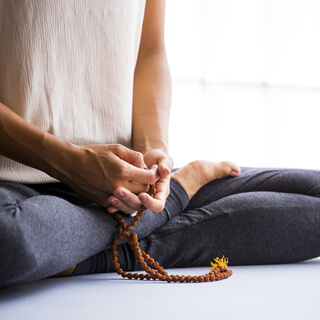
This is Ish and today I want to talk to you about how to create a long lasting meditation practice.
So if you've been meditating for a while,
It seems like second nature to meditate.
I know for me it seems like it's something very natural,
It almost feels like brushing your teeth.
But if you're very new to the practice,
It can feel like an uphill battle and almost a struggle to meditate.
Because when you're new,
It's very hard to settle your mind into a one-pointed focus and actually be able to sit without distractions.
So it feels like you're kind of fighting your mind in the beginning.
But gradually over time,
It becomes much easier if you've built that momentum.
And it's like anything,
Any kind of skill in life where if you've been practicing consistently,
It just becomes easier and easier and takes less effort.
But in the beginning stages,
In order to create a long lasting practice,
You want to do a couple of different things to ensure that you're able to meditate long term.
So I'll come up with a couple of different reasons.
And one of them is called habit stacking.
And I got this concept from James Clear's book,
And it's called Atomic Habits.
And essentially what you're going to be doing is if you want the meditation practice to stick,
One thing you can do is to combine one habit that you would be doing anyways with meditation.
So for instance,
If you journal every morning,
What you can do is you can journal and then meditate afterwards,
Or you can meditate first and then journal afterwards.
So you're kind of combining both of them.
And this allows you to implement meditation a lot easier because it doesn't take that much effort of your brain because you're going to be doing something you're going to do anyways,
And then you're going to meditate.
Then the second thing you can do is to find different times of the day that work well with you.
So if you work in the mornings,
Then meditating right before you go to work might be a little bit difficult.
If you can,
That's great.
But if the evenings are better,
Then obviously you would set some time to do it in the evening and then just stick to that schedule.
Or if you work a night shift like a bartender,
Then maybe meditating in the mornings would be easier.
But basically,
You want to find a certain time where you're not distracted and you're not thinking about the day,
And you can just have that space just for yourself to meditate and then do that consistently.
Then eventually your brain will realize that,
OK,
It's 4 p.
M.
This is time for a meditation.
And it'll feel kind of like an autopilot thing where you'll just go to meditate at that hour.
It feels very natural.
And one thing to keep in mind is you want to be consistent with this.
So if you pick a time,
You're going to do that at that certain time every day.
Hopefully you've built up that long-lasting practice.
Otherwise,
If you skip one day,
Then it turns into two and three and then goes on.
And that leads me to the next point of consistency.
So you want to be meditating consistently,
And that means meditating on your good days and bad days.
So obviously when you're having a really great day,
It can be easy to meditate.
But the challenge is often meditating when you're having a really bad day.
And in that sense,
You can keep your meditation sitting time a little bit less,
A little bit shorter,
And maybe even a couple of minutes.
And the whole reason behind that is that you want to create a long-lasting practice.
And meditation should be something that you just do.
And you're training yourself to meditate both when you're having good days and bad days.
So it becomes more of an objective kind of thing rather than something you do only when you feel good.
So that's how you create a habit.
And it's totally OK to start off really small at first.
So even if you're just doing 20 minutes a day,
That's fine.
As long as you're doing that 20 minutes.
And if you're having a really bad day,
You can just do 10 minutes even.
But it just matters that you're actually sitting and meditating.
And the most important step would be to have a lot of fun.
And you want to start off,
If you're not having fun,
Then you're not going to keep meditating long term.
So I know for me personally,
I have incense and candles in my meditation room.
And I make it really fun for me.
Because if you think about it,
Meditation is your personal time.
It's a space where it's just you.
And oftentimes in our busy days and schedules,
We don't have that much time for ourselves.
This can be a very nice space that you can set up.
Ideally,
If you can,
You would set up a space just for meditation,
Like a meditation room.
But if you live with other people or you have more of a common space,
Then at least set up some kind of corner where it's just your meditation space.
And I mean,
There's a lot of things you can do.
Like for instance,
You can light up your favorite incense.
You can look into research different incense.
There are sandalwood,
Patchouli,
Jasmine,
Rose,
To name a few.
So you can really find the perfect incense that you love smelling and just light that every day.
You can also have a bunch of plants around in your meditation space.
So you can look into those indoor plants that I somehow managed to kill,
But the snake plants and zz plants and all that.
And I also recently got a indoor bonsai tree.
That's been really fun watering that.
And you can also play around with crystals as well.
There's tons of different crystals out there,
Different colors and meanings.
So you can really find the ones that resonate with you and that you like.
You can have that around your space.
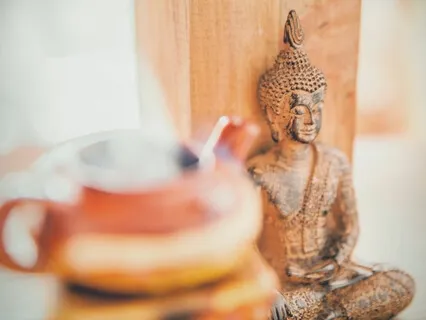
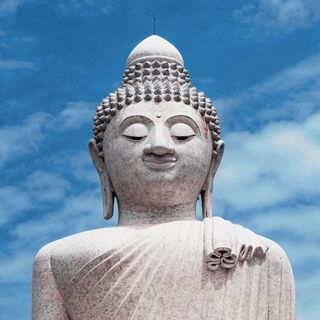
Another thing you could do is you can have different statues or pictures of different deities like the Buddha or pictures of loved ones that you can generate loving kindness towards or practice gratitude.
So there's lots of different options.
You can also have an indoor fountain.
I've just got one recently and that's been fun listening to the stream in the background.
So there's really no limit to the different customizations you can have towards your space.
Because if you think about it,
That's your space,
Your unique space and your practice that you can do just for yourself.
And you can really customize it and make it fun and personable.
So those are my recommendations.
And the big thing is you want to make it really fun in the beginning and still obviously make it fun towards the end as well.
But especially in the beginning just so you can keep that long-term practice going.
And just make sure that meditation is accessible and easy.
So you can pick by that's by picking a time every day to do it and also coupling it with another activity that you do normally.
So essentially just making the practice very accessible and easy for you to do.
And over time things get a lot easier and you don't really have to force yourself to meditate.
In the beginning it's pretty hard,
But once you've established the stable foundation and stable practice that you can keep coming back to,
It kind of becomes almost like autopilot after a certain time.
So I hope this talk helps and I'll be making other meditation talks soon.
Thank you.