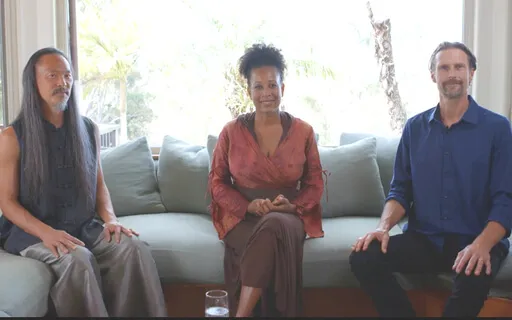
Welcome to the Woven Foundation Course.
This course was co-created with two of the other co-founders of the Woven,
Heather Salmon and Shems Hartwell.
It is a three-part course that shares understandings and practices fundamental to healthy,
Authentic communication.
I hope that this course is of service to you in deepening your connection to and relationships with others in your life.
So the first piece we want to share is about listening.
And when we speak of listening,
We're speaking of listening from our hearts,
Listening with our full beings.
We found that what can happen when we get too caught up in only taking in what we hear with our minds is that our minds will spin out into our own stories and our own reactions and our own ideas.
And pretty soon we find we're not really listening anymore.
We're simply processing our own traumas.
We're simply processing our own triggers.
And so instead we invite you to feel your full body as you're listening,
To be with whatever emotions and sensations may arise when somebody speaks something that might trigger you,
Instead of allowing that trigger to become an emotional turmoil that takes your mind away from what's happening before you,
That takes your mind away from fully receiving the one who is speaking.
So as Livan was sharing this piece,
I'm doing my best to listen to the sound of his voice and not just the words.
I'm doing my best to breathe into my belly and almost listen for what he's feeling while he's speaking.
There's a way that we can expand our range of experience while having conversation.
Most of us don't realize that we've gone to a place where we often disassociate when we're listening because we're thinking so quickly and it hijacks our experience.
And our practice here is to cultivate this ability to slow it down and listen in a way that's generous,
That there's a lot of space for me to literally let Livan's words land as he speaks or let Heather's words land.
And I want to listen for the message beneath the words,
Not simply just the words that were said.
I think it's very important when we're listening to tune into our own physiology,
To notice what's going on for us,
To notice where you're starting from.
I've taught children compassionate communication and what we always explored with them was the acronym HALT.
Are you hungry,
Angry,
Lonely,
Tired?
Where are you starting?
How are your needs?
How has your day been?
Because this can affect your listening in the moment and your willingness to listen.
So we want to start from a place where we are present in our hearts and present with another.
And so if we're able to keep our awareness on how our bodies and our emotions are responding as we're listening and not get pulled away by the responses or reactivity in our mind,
By the anticipation of what we might get to say or when we might get to say it,
Then we're able to be fully present.
And in that simple step,
There is already a healing happening.
We are always communicating.
We think we communicate through words.
However,
We're communicating through body language.
We're communicating through the quality of our eyes and we're communicating through the transmission of our presence.
And we don't realize that often we've got almost two conversations going on.
We've got one background conversation of some thoughts about dinner and food and other things I have to do.
And that's splitting our presence or attention away from the foreground conversation of me being with Heather right now.
And so part of our cultivation,
Our practice is learning how to bring everything here with the person we're with.
When we're not doing that,
We're sending mixed messages or missed signals.
So if I were to model something like this,
I might be listening to Livan and shaking my head and acknowledging what's said,
Although I'm halfway here,
I'm thinking about other things,
I'm thinking about what I want to say back to him.
So as simple as listening is,
It's also a highly refined art and an experience.
And the more that I'm in that experience in myself and with Heather or with Livan in this experience,
They feel it and they receive that information from me on some level.
And what it does is it creates an environment for them to be even more real,
Honest,
Authentic,
Or even to say less.
We also don't realize how often when someone's not really present with us,
We may fill the space with nonsense,
With more words,
With more information,
With more things,
Because we actually don't feel the presence or the full attention of the person we're with.
So part of this work here is we're learning how to be as here as fully as possible and to notice our own experience and even to be very attentive to their experience.
So Livan's there and as I'm talking,
Can I be attentive to his experience,
How much he's breathing,
How much eye contact.
So there's a lot of art to this that there isn't necessarily a right or wrong.
However,
There's a lot of possibility that we want to invite you into.
You know,
When we do listen to it like this,
I think it is important to kind of chunk things down for people.
Sometimes we can end up being long winded and rattling on and expect people to understand everything we said.
So maybe for our practice,
We chunk things down,
Make sure that each thought or each piece really lands.
Yeah,
Beautiful Heather.
I really hear that.
We don't want to captivate someone's attention too long in a certain sense.
So the more that we also skillfully speak and name what's happening for us,
You know,
We're taking up someone's attention when we're connecting.
And so we want to be mindful and wise of what we share.
So this is the other side of listening is that when someone's really listening to me and I'm watching what I say land,
It's good for me to,
Like you said,
Chunk it down and stop at this point and see that it landed.
See that what I shared,
You know,
Was heard.
If we share too much and we keep going and going and going,
It's not so easy for a group or another person to stay with us.
And then their attention will wander and there won't be as much presence.
Yeah,
Heather,
I so appreciate you bringing this to awareness.
And I feel like for me,
The key is awareness,
Just as I want to be aware when I'm listening.
I want to practice awareness while I'm speaking to so that I'm not just being pulled along by this train of my mind,
Roaring down the track of whatever story it is that I feel I must complete.
And instead,
I'm being aware of how I'm feeling as I'm sharing something.
I'm being aware of how my listeners are receiving it.
We listen not only from our heads,
Also from our hearts and with our gut.
Our mind understands and takes in the data of what's being transmitted.
Our heart brings in the emotions and the feelings that are being shared.
And our guts know at a deeper level what need is beneath what is being shared.
And when that person feels that that deeper need is being met,
Then they are able to open more fully.
Then they are able to feel the impact of our deeper care.
So you may be wondering,
Like,
This is all nice and all,
And all this loving and heart listening and all that.
And so we also want to say that we're building a foundation so that actually we can be with anger or frustration.
And one of the reasons we want to listen not only from our mind and our heart from what's felt,
We also want to know what's the need beneath that that Livan so beautifully shared.
So if Livan was angry and I was listening to him,
I want to listen for what might be beneath the anger.
I don't want to be caught just hearing the anger and reacting to the anger,
Which is what many people do.
They feel someone's angry and then they meet them with their own reactivity and anger.
And so part of being able to listen in this what we could call integrous way,
Mind,
Heart and gut,
Is it allows us to be able to respond without quickly getting reactive.
So if I was talking with Livan and he was really upset and charged,
I may acknowledge,
Like,
Wow,
There's a lot of anger here.
There's a lot of big energy here.
And I may be wondering while I'm listening to,
Huh,
What else is there with that anger?
What's the want beneath that anger?
Maybe he wants to be heard.
Maybe he maybe I broke an agreement with him.
Maybe I said something that activated something.
And if I'm listening for that,
When I hear his anger,
In some ways I'm already helping that anger to settle.
And to speak to that,
Too,
There's also a big difference between anger and aggression.
So it's one thing to be angry is another thing to be like,
You are like this.
Why do you do this thing?
And so what most of us get caught up in is that we actually feel someone being aggressive towards us with their words or their behavior.
And that's when it's OK to be like,
Hey,
I feel I feel your energy.
I feel I feel that anger.
And it feels like it's coming out as aggression.
And so I'm when I'm listening generously through my mind,
Heart,
I'm also I also have a bigger capacity to be with big energy,
To be with charge,
To be with intensity,
Because we're not you know,
We're not here to be lovely and nice all the time.
Of course,
We're going to be in situations where there's tension,
Where there's heat.
Can I provide enough space inside of me to be with an upset in another,
Whatever those emotions might be?
And when we're able to feel beneath the need of where that anger is coming from,
Very often anger is masking grief or masking shame or masking some other pain beneath it.
What a lot of us don't realize also is that we are feelings are cumulative.
So I may feel angry about talking to my dad last week and then even deeper than that,
It might have been the times he yelled at me when I was really young.
And then Heather may say something that touches some anger.
And however,
My anger is really 10% with what Heather said and 80% with what happened last week or earlier today.
And so that's also part of our work here with the generous listening in this deep way is that we want to dissolve some of that initial emotional static that many of us may be harboring or carrying.
They're going to realize and that's where presence and generous listening and being with in some ways,
It creates an optimizing force that helps to clear some of the initial layers of static to get curious and be open to what else am I feeling maybe in the deeper waters of my being.
And that's part of our work here is creating a space again where we are encouraging us to look a little deeper.
What else is in me?
You know,
What else?
Like someone is making a comment about this piece I feel really strongly about politically.
Okay,
I'm noticing the anger there and then,
You know,
I'm also really sad that there's so much divide going on.
But my first wave is frustration and anger.
And so this is part of our work here is we're learning to keep inviting each other to listen,
Look and feel deeper into our experience and be able to share that more fully with one another.
And also when we are expressing for ourselves,
There's times that we're going to be triggered.
And so listening for our own deeper emotions and needs.
For example,
You know,
If there's an issue of social injustice,
I can get outraged.
I get this anger,
This frustration,
This need for respect,
This need for connection and to really drill down to what is beneath it all.
I think this is a very important and powerful skill to have at this time.
So as we're describing these experiences in this listening,
I think we all know inevitably something may trigger reactivity in us,
You know,
And we'd be saints if we said we didn't get reactive.
Right.
And what we want to do is we want to,
You know,
Close this particular part of our share here with listening and then move into a next segment that is actually specifically about reactivity and empathy and our ability to respond to what's going on,
Both within and with the others in our group or one on one that we're with.
So welcome to the second module.
And this module is really about how to take care of yourself when you are in reactivity,
How to take a time in or a time out,
How to empathize for yourself and what kind of self-care practices that we can do and to really examine how you've reacted before.
If you were triggered in a situation and maybe this is going to be able to give you an opportunity or some ideas as to different things that you can do to get different results.
Most of us have had little to no modeling of how to actually skillfully be with an upset,
A frustration.
Most of our parent modeling,
Our TV,
What we've learned through movies and media,
We see a lot of reactivity.
And in some ways,
At least in the Western culture,
Reactivity is welcome and allowed,
Even though no one likes it.
There's constant modeling of it.
So we don't realize that it's kind of an autopilot.
And what we want to share with you is that you actually can rewire your nervous system to meet reactivity in different ways.
And there's three primary things that we've discovered that work really well.
And we want to share those basic ones with you.
You know,
The first one is simply self-empathy.
Can I,
You know,
Be compassionate and accepting of my experience that I am upset?
And while I'm doing that,
My hope is that I'm breathing a little deeper.
I'm allowing myself to settle and calm my body and my being by using breath.
There's few things more powerful than oxygen and breath.
It's one of the number one ways we can actually change our state.
So if I start getting tense and I'm tracking my experience and my gut's getting tight while I'm listening to Heather or while I'm in a tense conversation,
I want to start breathing into that tension.
I want to acknowledge it and feel into it.
I don't need to say something necessarily about it.
However,
I want to track it in myself and I want to bring more breath,
Awareness,
And acceptance to it.
The next thing I want to do along with those is I want to move into it rather than contract around it.
So I don't realize how often,
Let's just say something's happening and I start to kind of contract and pull in and disconnect or lock up and tense up and get into some kind of position that actually freezes me to lock the experience of reactivity.
So what we want to do is we want to move with reactivity.
If there's tension or something going on,
On some level we want to meet it and breathe into it and discover about it while it's happening.
As soon as we stop moving and we breathe less or don't breathe,
It's almost like we put a cage around what's going on inside of us and then it's almost impossible not to be reactive and not to kind of,
In some ways,
To get intoxicated by the charge in the body or in the system.
So we want to burn through that and so any wave of reactivity could have all kinds of history.
So that's why we start with acceptance because I really don't know why I'm upset.
There could be all kinds of reasons.
They usually were loaded more than we believe and so we want to learn to recognize it.
Can I first lead with acceptance?
And this goes both ways.
Can I accept if Livan or Heather are upset while I'm talking to them when I'm seeing reactivity?
Can I accept them,
Not only myself?
So this is a two-way street practice,
Is increasing the capacity inside of myself to be with reactivity and increasing my capacity to be with someone else where there may be reactivity or discomfort that on some level I'm feeling or sensing.
So I really love the way you just put it,
Chems,
The intoxication of reactivity.
And for me,
It goes back to the importance of awareness.
Can I be aware of that rising intoxication that just wants to pull me into the drunken reactivity?
And if I can,
Then I have space to really feel what emotions are within,
To really feel what emotions are happening inside myself.
And Heather,
I love your presencing of the importance of empathy and self-care and acceptance of whatever it is that I'm feeling.
That acceptance allows me to be able to be with that feeling.
So I'm not judging it.
I'm not criticizing myself for it and thereby adding to the fuel of reactivity that may be there.
I think for me,
A powerful way of practicing self-empathy is to,
I talk to myself.
So I say,
Oh,
I'm noticing I'm feeling charged.
I'm noticing I'm feeling angry.
I'm noticing I'm feeling frustrated.
What do I need in this moment?
I really need to be understood.
I need to be respected.
Can I communicate that to this person in this moment?
I can try.
Or maybe I am not ready to speak in a way that expresses my needs and feelings that would really land.
Maybe I'm just going to continue to trigger the situation.
Maybe they're triggered and I'm triggered.
So,
You know,
We call that taking a time in to check in with yourself and notice what's going on.
As I was sharing before,
Hungry,
Angry,
Lonely,
Tired.
What can I do next to take care of myself?
Maybe I do need to take a little time,
Take a little walk,
Get something to eat,
Sleep on it,
Play some music,
Exercise,
Talk to another friend,
Get some perspective,
Get some empathy from somebody else.
So when I am able to come back and be more present in mind,
Heart,
Gut with the other person,
Then I'll be able to continue the conversation.
Thank you for that,
Heather.
One thing I really appreciate about that is that distinction of noticing when there is reactivity and you're watching your thoughts,
You're watching that.
In some ways,
As soon as we have an awareness on our reactivity,
We're a little more free.
So I see these two options of can I stay in and stay engaged and be able to do a time in and slow myself down and breathe so I can stay in the conversation.
Or did I reach a threshold in myself where there's enough upset or enough reactivity that I do need to step away and take a walk and go outside.
And that's also really valuable tracking.
And of course,
In this experience of being in a woven,
We want to see how we can stay in and lean in a little bit.
And in our life,
We have to track how do I need to not end this conversation with my partner or who it is and take a walk.
Or how do we lean in and stay in the heat when I'm in a container of folks and I'm watching all the things going on with me and I can name that.
And maybe I just back off and don't speak for a little while,
But stay in the room,
Stay engaged and do some breathing and maybe stand up and walk so I can not leave.
Because one of the dances we don't realize is that we do a lot of fight or flight unconsciously.
We fight,
We come in stronger,
We come in more intensively,
We come in more aggressively as a protection mechanism.
Or the opposite is that we flight or freeze or flee where we stop,
We pull in,
We kind of something in us,
We flow,
It's almost like an animal in the headlights.
And we want to watch either one of those,
The one that wants to come in and say more and prove a point or the one that's like.
And both of those are a form of intoxication in a certain way by fear.
And our work here is to be able to breathe into that and meet that and stay in the conversation or stay in the container when possible.
One of the practices of empathy,
Both for ourselves and for each other,
Is the practice of being able to hold each other's emotions without judging them.
Anger is not necessarily aggression.
Anger can be just an emotional experience if we're not projecting it out as aggression on another person.
It can be safe for me to simply reflect to Heather,
Wow,
I'm feeling some anger as you say that.
I'm not judging Heather.
I'm not putting any aggression towards Heather.
And if Heather has the capacity to simply accept my emotional response,
Then there's a moment of connection that we're creating simply by allowing that emotion to be here.
And if that emotion is allowed,
Then there's the opportunity for it to dissipate.
If that emotion is being rejected or suppressed,
It may not appear into the container at this moment.
However,
It will stay there,
Stewing and churning in Tummo and arise in other unexpected places.
Thank you,
Leven.
That was really powerful.
And I think when we are working to have empathy for others,
It's the same process.
It's like we can start by guessing.
You can say,
Wow,
Leven,
I'm imagining or guessing you're feeling angry right now from what you're saying or your tone or your body language.
I'm imagining what I said just triggered you.
Is that right?
And this way we can practice empathy for others.
And to speak it is important.
It's an important aspect of it,
Because then you know that I have a willingness to try to understand you and to understand what's alive for you.
When I feel you feeling me,
I feel seen,
I feel held,
And my anger may not fully dissipate in that moment,
But I know it is being accepted.
I know it is being heard.
I know that there is a safe space for that here.
We don't realize how there can be a quick like,
Oh,
There's anger versus OK,
There's anger.
The difference between those two is really huge.
And we again have kind of some autopilot responses often that we get to dismantle because many of us have had some trauma from aggression,
From the way that anger was directed at us in environments.
You know,
Whether we're men or women,
We've had anger directed at us.
And so we've got some alarms that can go off when someone has anger.
And the empathy and the acceptance are a beautiful collaboration.
You know,
Because the empathy is like,
All right,
I'm willing to be with and feel that.
And I'm also willing to accept your experience.
So I'm acknowledging,
Accepting,
And I'm also hopefully doing that within myself.
And the more I do it at home here,
The greater my capacity to do it with Heather or with Livan or with anyone else in a circle with us.
Yeah,
I'm really getting from that in this conversation and just reminding me of the importance of kind of owning all your stuff.
So it's I'm feeling angry.
This taking ownership of your feelings and your needs and your values is so important.
Often we may have a feeling,
Well,
I feel angry because you said this versus,
Wow,
I'm feeling angry and I'm not actually fully sure why I'm angry.
I might think it's because of what was said.
And again,
What we spoke about a little bit earlier is that most of us are loaded with some emotional static from all kinds of experiences.
And so it's not fair to say it's all this.
And that's why it's when I take ownership,
It's like,
OK,
This is my anger.
I got anger.
And then what happens is that the other person isn't made wrong for their behavior or what they said.
It's simply that we're acknowledging our own experience.
And I really feel like that's a valuable part of this in that sense of ownership.
We're able to connect together through this emotional experience we're sharing.
We can both be angry.
We can both be angry about different things.
And we can both be here fully with each other's anger.
That's powerful.
It really is.
And I think the more we do that,
We can the more we can also piece together,
You know,
Parts of our lives that are repeating or past trauma that is coming up.
Self-awareness is really powerful.
I love that you just brought this piece in because I don't really we don't recognize that we often have the same conflict or the same thing over and over again with people in different ways.
And then we think it's the person.
We think it's the situation.
We think it's this marriage.
And a lot of our work here is considering this a discovery process.
Whenever something goes off and there's a disconnect,
There's tension,
There's reaction inside of us.
It's this opportunity for curiosity,
For wonder,
For discovery of what's going on.
And the more we have that open mind about things,
The more we're willing to be curious and empathetic and accepting.
It's like this doorway opens into new possibilities.
And if we don't have that empathy or acceptance,
We tend to close that door and continually recycle and repeat the same kinds of reactions and conflicts and tensions with various people and situations.
In our lives.
Jens,
As you speak to this discovery and this curiosity,
And as that lands for me after Heather speaks of the past traumas that may be playing a role in our current emotional experience,
I'm also reminded of how if we're able to hold each other in our anger,
Then we're also able to allow the emotions that may be beneath that anger to be seen and to be felt.
And when I'm projecting that anger out,
It's often because I don't want to go there to those deeper,
More painful places.
And so if we're able to hold each other through that layer of anger,
Then maybe we can also allow each other to share and to support each other in our grief,
In our sadness,
And through our deeper pain.
You know,
As we drill down deeper,
We open a possibility of a whole new way of relating to ourselves and to another,
And that this piece of empathy and self-care is key to that practice of shifting things up and creating a more authentic and truthful way of being.
We'll see you in the next module.
So in the first two videos,
We're going over generous listening.
We're going to be with ourselves and be present with the other and to listen wholeheartedly,
Ultimately,
With our whole being.
And then we moved into how to be more empathetic and understanding and even accepting of our own reactivity or experiences,
As well as the other.
Now we want to move in how do we respond?
Many people don't realize that we're often reacting rather than responding.
We're coming back with a quick knee jerk like,
Well,
I didn't do that or that.
And what we're learning to do is while we're doing generous listening and while we're doing self empathy and acceptance with the other,
We're preparing ourselves to be able to actually respond authentically from what's going on inside of us.
And that's the goal here is when we come to responding,
We're checking of like,
What's important to me to really share with this person in relation to what I've heard,
What's happened inside of me?
What do I want them to know about my experience so that we can keep building a bridge between our differences or between our viewpoints or whatever is going on in the environment we're speaking into?
Often people can't hear what we're saying unless they feel understood to begin with.
And then we can share.
We're acknowledging so we're practicing our listening and our reflective listening.
And then we're also offering empathy,
If need be.
And from there,
You've created kind of a beautiful pathway to respond with anything else you want to add to the conversation.
Acknowledging another for being vulnerable and being honest and being present is a very powerful thing,
A powerful way to create a connection.
And I feel that's very important for me as well.
And I feel this is a very important point that Heather is presencing.
If we've skillfully practiced everything that we've spoken about in the first two videos,
Then there's already a foundation of connection there.
Perhaps we're angry,
Frustrated about the same things and simply have different ideas about how to resolve those situations.
Is that really a conflict that we're having?
Or is that a meeting point?
Where we can see each other for what our needs are and come to new solutions about how all of our needs can be met.
Thank you,
Leven.
One thing I want to highlight in this with you is that simply the intention for resolution,
The intention for mutual understanding,
That intention is already a response.
My sense is every time that we lead with the positive intention with response that we have a goal,
Which is on some level of connection or mutual understanding,
It frees us from the tendency to go into ping pong of back and forth,
Which,
Oh,
You said that in this.
And ping pong goes fast and always almost always speeds up.
And a lot of our back and forth when there is a disagreement or a different way of seeing the world or our own experience,
It tends to be a constant like you have to see it my way.
Don't you see it my way?
Don't you get how I'm getting it?
Part of responding is acknowledging that I see what's going on for you to the best of my ability in this moment.
And so my response wants to come from in the way that I can to share that I do understand to the best of my ability right now where you're coming from and what you've shared.
It may or may not be 100 percent accurate.
However,
Simply that intention,
It breaks the cycle of what gets into often like kind of a drama back and forth of blaming the other or assuming that we know more than the other,
Which is often the primary cause of disconnection is that we sense that our view of reality is more accurate than the other person's.
And so one of the things I believe that really works well in responding is that your view of reality is as valuable as mine,
Even if it's different.
And can I start there and dissolve any place in me that thinks you need to see it the way I see it?
And that's one of the steps in being able to celebrate the differences rather than highlight what we think we understand and know,
Which is almost always limited.
So I think the power in this is to recognize that,
Yes,
You might not always agree with someone.
And I think that when we are drilling down and practicing our communication and listening for those needs,
That we can maybe instead of getting into this strife with people,
We create greater understanding when we do listen for the needs.
So you can say,
Oh,
All right,
I might not fully align with what you're saying,
But I can see that your need for safety is strong here.
So you believe that you will be safe if X,
Y and Z happens.
That is going to meet your need for safety.
And my need for safety might be different.
I have a need for safety,
But we and we both have a need for safety.
We are all trying to have fulfilled through our strategy and hence through our beliefs and our ideas,
Powerful idea to practice and way of communicating and way of listening and way of responding is that we are looking for it.
It's like looking for the goodness in others.
We want to create a space that we're entering with an intentional willingness to discover our own experience and to learn from ourselves,
To learn from each other,
And also to help hold each other in this quality of connection.
And one of the beautiful aspects of this is that when we meet in a group environment,
We've got lots of hearts and eyes and presence that are observing what's happening.
And so we want to bring in an agreement for feedback that it's okay to share some feedback of like,
Hey,
I noticed something may have come up for you that you didn't notice.
And we want to,
You know,
As we talk about these topics and we have these beautiful presenters that guide us through exercises and experiences,
You know,
We're going to discover things with ourselves and we can all be these supportive allies for one another to help see what we don't see.
And so the more that we do that through deep listening,
Through being able to be present with each other,
We create a catalytic group field.
And when we're doing that from a place of care and love and looking for the bridges between each other,
There's a lot of healing that can happen.
And that's our intention is healing,
Dissolving some of the polarity that isn't really helping us,
You know,
As a culture,
As a society,
As a species to thrive in the world.
And so we'll go over more agreements as we go.
However,
One of them basically is that we are learning from each other and we're learning with each other and we're all on the same team.
And then we have our own continual self-evaluation.
How am I doing through this?
What am I learning from this?
What can I harvest from this experience?
Where do I still have some to grow through this?
How can I resource myself?
How can I ask for more support with this group,
For this environment,
For myself to have more awareness of how I'm showing up so that my learning gets accelerated?
There's a possibility for solutions to arise that we may not be aware of,
That we may not be able to simply imagine in our minds.
But they must arise from this more profound place of connection.
And I feel this is how we can bring out more conscious,
More dynamic,
More impactful change to our communities,
To our world.