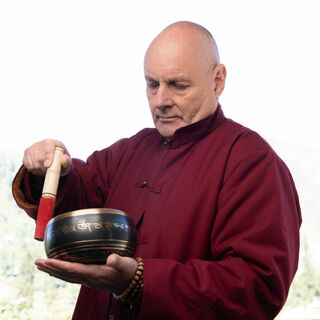
This episode is called The Four Immeasurables,
Equanimity and is part of the Buddha Dharma series.
This episode includes a guided meditation practice.
In Buddhism,
We are taught to avoid and eventually abandon negative states of mind,
Such as the three poisons,
And encourage to cultivate positive ones,
Such as the four immeasurables,
Which are kind-heartedness,
Compassion,
Open-hearted joy and equanimity.
These immeasurables are basically four individual meditation practices.
Traditionally,
They are taught in the order I mentioned above.
However,
I believe the fourth one should come first,
Because if we have equanimity,
The other three will naturally fall into place.
Buddhism states that equanimity is not only a very deep state of mental balance and stability,
But also as an interconnectedness with everything.
So,
Let's start by looking at equanimity.
Our lives are full of ups and downs.
If we can face the downs as well as the ups,
We will be able to cultivate an open and calm mind.
We all know that it is easy to face the ups,
But not so easy to come to terms with the downs.
But if we don't,
All we are doing is adding to our own suffering.
When we look at the world,
We can clearly see how hard it is to attain a balanced mind,
As we are continuously in a flux of rises and falls.
These lift us up one moment and fling us down the next.
This is true for everyone.
We are all the same.
So,
If that's the case,
Why do we discriminate against others?
We are all in the same boat here,
All trying our best to ride the same waves of life.
So,
Equanimity is where we do not distinguish between our friends,
The people we dislike,
Or strangers,
But regard everyone as equal.
This is not easy,
Because when we are not being aware of what is happening in the present moment,
We get tossed around by our prejudices and emotions.
We need to have a complete openness to our experiences,
Without being carried away with reactions such as,
I like this and dislike that,
Or I love you and I detest you.
A balanced mind will mean we are not going to be disturbed by the eight worldly conditions,
As was mentioned in the previous podcast.
What we are trying to do here is remove the boundaries between ourselves and others by discarding our discriminations.
What we are not trying to do is become detached or feeling indifferent to others.
This is a common misunderstanding of what is meant by equanimity in the Four Immeasurables.
We have to look upon ourselves as equals and see they have their ups and downs just like us.
If we can do this,
Equanimity will be able to grow.
The following meditation practice will help you see everyone as equal.
So sit comfortably and lightly close your eyes.
In Buddhism,
Equanimity means a very deep,
Very profound state of mental balance and stability.
The cause of much of our upset and emotional instability is clinging to people we like and aversion and negativity towards people we dislike.
We also have an unhealthy indifference to strangers who may also need our help.
In this meditation,
We learn to examine our feelings towards people and correct them where they are mistaken.
This leads to a more balanced,
Wholesome and helpful viewpoint.
It also cuts off a lot of emotional turmoil at its root.
We are going to meditate on three types of people,
A loved one,
Someone we dislike and a neutral person.
We are going to examine and correct our feelings towards these people.
So to begin with,
Focus on a friend and look into all the reasons you like this person.
Try to see if any of the reasons are about things this person does for you.
Always they uplift your ego.
Ask yourself if these are really the correct reasons to like someone.
Now do the same thing with the person you are having difficulties with at the moment.
Look to see if you can find things you like about them.
Notice where your ego is involved in your judgement of this person.
Finally,
Do this with a person you are indifferent towards.
Check to see the reasons for your indifference.
Again,
Notice where your ego is involved in the judgement of this person.
Next,
Ask yourself whether you consider each of these relationships as permanent.
Would you still like your friend if they did something terrible to you?
What if the person you dislike did something nice for you?
What if the stranger became close to you?
Think about all the relationships in your past in which your feelings about that person have now dramatically changed.
Now visualise the person you like doing something you dislike or that is unacceptable to you.
Would you still be their friend?
Remember that many people have changed from your friends to enemies in the past.
There are people who you used to like but now you dislike.
Think about how there is no special reason to feel good about a person who is only temporary part of your life.
Think about how there is no special reason to feel good about a person who is only a temporary part of your life.
Now visualise the person you are having difficulty with doing something very kind for you.
They may visit you in hospital or help support you when you are in trouble.
Can you imagine this?
Can you feel positive emotions towards this person?
Can you remember times in the past when someone you disliked became a friend?
Is it necessary to feel that your strong dislike of this person will last forever?
Isn't it possible that they could someday become a friend?
Now visualise the stranger.
How would you feel about them if they did something very kind for you?
Isn't it the case that all your current friends were at one point or another total strangers to you?
Isn't it possible that a stranger could become your best friend?
Think carefully about how everyone deserves to be treated equally as human beings.
It is very likely that your emotions around a person will change many times,
So why hold on to them so rigidly?
So now just slowly open your eyes and try doing this meditation a few times to help yourself build equanimity.
This meditation is a formal practice and what I want to do now is introduce a practice you can use while you are going about your daily lives.
When you feel your prejudices coming up have a set phrase to mentally repeat to yourself,
Something like,
They are no different than me.
They,
Like me,
Are subject to the ups and downs of life.
We're all equal.
It's better for you to have your own phrase as it will resonate with you.
By mentally repeating your set phrase you will stop your discriminations in their track.
After a while you will naturally see all as equal but that's going to take some time.
So for now use your set phrase and the formal meditation to help build equanimity.