I guess they were expecting about,
They were expecting high numbers of casualties the first day of the ground war.
They were expecting basically that they were going to get hit with gas and all kinds of stuff going through on that first day of the ground war.
And so I had to go do a couple of things.
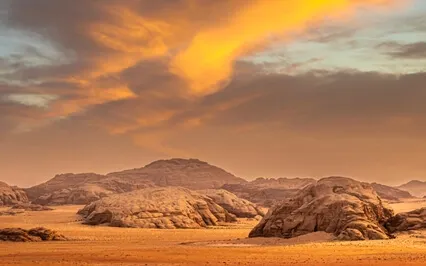
I was in a place called Al-Khanjar,
It's in Saudi Arabia,
And it was kind of like a logistical base.
And I had to make a run up to an area that we probably,
For lack of a better term,
Call a staging area for the morgue.
And I rolled up and here are hundreds upon hundreds of stretchers with zip body bags on top of them.
I was brought up in a,
We would say progressive,
Other folks might say liberal,
Theological household.
So I'm always skeptical when things come along and they seem too easy.
I grew up at a time when we were very skeptical of the people on the religious television channels too,
You know,
The high pink hair and you know,
The big fingernails and the whole nine yards and being able to say Jesus.
And it was like a 25 syllable word.
But by the same token you know,
I think one of the things that's most interesting is,
And I believe it to be true,
Is that sometimes your faith is the only thing at the most crucial points in your life that you have to hold onto.
Most of the folks in the Marine Corps are roughly about 18 to 21 years old,
The younger enlisted.
And so I was on the tail end of my enlistment for the Marine Corps.
So I was kind of old.
And when we were in Desert Storm before the ground war kicked off,
We got a box of what looked like business cards and on it was the 91st Psalm on one side.
And then it was another,
On the other side it was this little small Baptist church in Florida that had carry this for your protection.
And it was kind of on a sanctuary kind of whatever.
But you know,
In my helmet liner,
I had that with me.
Well,
The thing is,
I guess they were expecting about,
They were expecting high numbers of casualties the first day of the ground war.
They were expecting basically that they were going to get hit with gas and all kinds of stuff going through on that first day of the ground war.
And so I had to go do a couple of things.
I was in a place called Al-Khanjhar,
It's in Saudi Arabia,
And it was kind of like a logistical base and we had everything there from aircraft,
Food,
Basically beans,
Bullets and band-aids,
The whole nine yards.
And I had to make a run up to an area that we probably for lack of a better term called a staging area for the morgue.
And I rolled up and here are hundreds upon hundreds of stretchers with zip body bags on top of them.
They've already got them ready.
You know,
The thing for me was that made a huge impact on me.
And it wasn't so much,
You know,
The visual of that was huge.
When I came home for me,
It was one of those things,
It wasn't so much just the miracle that we had made it through relatively unscathed after everything,
The invasion and everything like that of Kuwait,
But also that reminder of how precious life is.
I think maybe through the pandemic,
Hopefully we've all been reminded,
All of us reminded of how precious life is as we've survived it.
But fast forward about 25 years later,
I'm at a Institute for Youth Ministry seminar in Princeton,
New Jersey,
And a guy that I read a lot that writes about youth and youth ministry.
He was speaking and his thing was talking about getting a letter from his,
One of his former students,
Who was this was during our time in Iraq.
And it was right before the big,
I guess this would have been 2003,
2004.
He was looking at and asking himself the question,
He got a letter from this kiddo,
It was sent on a piece of cardboard because in a war zone,
You can write any letter you want,
And you can write free in the upper right hand corner,
And they'll mail it.
And when he got that letter or that card,
He was wondering what he'd given this kid in his time at church,
What he'd given this kid that would carry him through the most traumatic time in his life because the kid was talking about listening to artillery rounds,
Being fired out and things like that.
And you know,
At church,
We do youth groups and things.
We do silly games with whipped cream and we do all of those kinds of things,
Which is great.
That's group building.
But what things do you do with someone that at the most important times in their life,
They have that solace that they know,
No matter what else is going to happen,
I'm going to be okay.
And that dumb little,
That dumb little card from the 90,
You know,
Of the 91st Psalm from some little Baptist church in Florida came to mind because I thought,
You know,
What a generous gesture,
Probably not someplace I would visit on a Sunday morning because our theologies might be very different.
But you know,
That's kind of what had guided me through not so much the story of a miracle,
But the idea of a presence bigger than myself.
And the other thing is that on that side too,
That doesn't mean that God wasn't with other people on the other side during our time out there either.
In the Marine Corps,
Let's see,
I joined in 86,
Or I went to boot camp in 86.
So I was 20.
I was still a couple of years older than most folks,
But I'd gone to college kind of on the John Belushi plan,
Which was,
You know,
Go to college,
Fell spectacularly.
When you,
When you get a 1.
25 for your first semester in college,
My dad opened up my grades.
TCU had a thing at the time where they sent your grades out and they were famous for arriving on Christmas Eve,
No lie.
So that whole week before we got,
You know,
Before grades came,
I was meeting the mailman or I was watching the mailbox trying to see if I could just pull the grades out of the mailbox.
And I thought we'd slid by because,
You know,
It's Christmas Eve,
We're getting in the car to go to the Christmas Eve service with my mom,
My dad,
My sister,
Myself,
We get in the car,
We pull out.
Well,
At the end of the street,
It's almost like a TV movie.
My mom says,
Oh,
There's the mailman.
And I'm like,
And she's like,
Let's wait a minute.
We'll see who we got Christmas cards from.
This was before we care.
You know,
Now you can't do anything with your kids since they're 18.
But at the time TCU didn't care.
They just wanted the money.
And so they go through and my mom's looking through the Christmas cards.
I'm like,
Okay,
Don't see it.
Don't don't see it gonna make it down the very last thing.
It's TCU.
My dad's like,
Hey,
Let's look at this.
Let's see.
And I'm like,
I knew I was dead.
So we opened it up.
My dad looks at the grades.
It's like 1.
25 Did you do that all by yourself?
Because you got to have help to make a 1.
25.
You know,
I couldn't argue with him.
I mean,
I would be ticked to as a private school.
It wasn't it wasn't cheap even in 1984.
But I knew after that first year that college was no place for me.
I worked a second year to make sure my grades were good.
And I went on what was called the delayed entry program.
And then I went into the Marine Corps.
And then when it came time to get out,
They extended me over my end of active service date for Desert Storm.
And so when it came time for me to be able to get out to the war was over.
They're like,
You know,
Would you like to absolutely you're sure absolutely got out went back to college and it was a miraculous thing.
Some hat speaking of miracles,
I somehow got through college and decided that as as as Dean warmer tells butarsky Hey,
Fat dumb and stupid is no way to get through college.
I survived.
Thanks so much for listening to Episode 38 of bite sized blessings.
The podcast all about the magic and spirit that surrounds us,
If only the open our eyes to it.
And whether you choose to listen to our bite sized offerings for that five to 10 minutes of freedom in your day,
Or the longer interviews,
We're grateful you're here.
I need to thank Pastor Keith Lewis for sharing all of his stories today as well as the creators of the music used Sasha and Raphael crux and Alexander Nakarada for complete attribution.
Please see the bite sized blessings website at bite sized blessings.
Com.
On the website,
You'll find links to people,
Art,
Artists and books I think will lift and brighten your day.
Thank you for listening.
And here's my one request.
Be like Keith,
Large or small.
Recognize all the miracles around you.
If you like what you hear,
Please consider leaving us a rating and a review wherever you find your podcasts,
Ratings and reviews help others find us out there in the great big wide world.
Thanks again for listening to Episode 38 of bite sized blessings.