My guest today,
David Furlano,
Doesn't take himself too seriously.
You can see this just by investigating his Facebook page.
He has a post of a very sweet monkey running around with a piece of chalk,
Drawing willy-nilly all over the pavement.
On this post,
It says,
This basically summarizes my artist statement.
Anything beyond this is overthinking it.
Our conversation is by turns witty,
Wise,
And provocative.
David is truly a Renaissance man.
He's not only a jewelry designer with a very successful line,
He's also a painter,
A movement artist,
Among many other things.
To check out his music,
Please visit his Bandcamp page.
His music is otherworldly,
Inspired,
And provocative.
He has very graciously allowed us to use some of it in this interview.
I hope you find this interview as interesting as I find David.
And now,
Episode 61 of Bite-Sized Blessings.
There is something much greater than me that insists I show up in the studio.
That,
For me,
Has been there since I was a little kid drawing pictures.
And my pictures got really weird fast.
In high school or early,
Early high school,
I was making acrylic paintings and I was doing weird things like decapitated heads in holes in this desert environment.
And they all,
I mean,
They were like decapitated heads,
But they were alive.
They were like living beings or something.
And later to find out that my teachers were asking my mom if maybe I was doing acid.
Who are you as a human being?
Like,
If you were to go to a party and you had to introduce yourself to people or introduce yourself to someone that you've never met anywhere,
Who,
How do you self-describe?
Who are you?
It's funny because it is,
You would think the question is really quite simple,
But it's so not.
And I answer that question differently depending on who,
Who's asking.
And I think it's,
For me personally,
It's because I am interested in so many things.
You know,
I'm,
I'm in the art life,
The art world.
There are many art worlds.
So I'm in several of them.
It covers a lot of ground.
So if a specific person,
Maybe from the visual world is asking who I am,
I may sort of cater that answer to that person because maybe they don't,
They're not interested in the music end of things.
But if I'm talking to musicians and they say,
Well,
What do you do?
Then I probably won't talk as much about the visual stuff.
You know,
If I want to throw a loop in the,
In the conversation,
Maybe if I'm in the jewelry world working with fellow craftspeople and somebody says,
Somebody asked that question and I say something about music,
I often will get a double take,
Like you do music.
Or if I talk about movement work,
I don't even want to call it dance because I'm not really a dancer.
So I might drop that one and people will go,
Huh,
Well,
That's totally surprising.
I would never would have seen that coming.
But for me,
It's never surprising.
I guess because it's me because I do these,
I do all of these things.
So I'm not surprised by me.
You know,
It's just everything is interesting.
My jewelry life was born out of best friend from art school.
Two years after art school in 1988,
We started a jewelry business.
And we got out of art school thinking we're entering the fine art world now.
Painting,
Printmaking,
That's the world we thought we were going to be in.
So we started making jewelry as a way to make money.
We figure,
Well,
Let's get this figured out so that the money thing figured out so we don't have to work for somebody so that we can have art studios making our actual art,
Our real art.
Soon enough,
The money making thing turned into our real art.
And we had to sort of almost,
We had to respond to that.
The trajectory just took off like wildfire.
We started with a material that was pretty well unknown,
Not used a lot,
Polymer clay,
Because we launched it thinking,
Okay,
This needs to make money so that we can go make our real art.
And that's still going,
We are kind of winding down after 30 some years of doing that,
It had a wonderful tidal wave of success.
And we are still riding that tip of that wave,
But we're also sort of,
We're now 57,
We're both the same age,
It's a long partnership,
It's a long collaboration,
Not that we're tired of each other.
We've had every fight that one could have between two people.
So we have worked out,
There is nothing that can throw us off center.
We've done it all.
So back to kind of who I am in the world as a human being,
I think my earliest,
Earliest memories of who I am and what I want to be is this kid that liked drawing.
I like to draw,
And I was very encouraged.
I come from a very,
I think I was born with a passion for drawing,
And I was very encouraged by that.
I come from a very unremarkable middle America white family in the suburbs outside of Philadelphia.
So I haven't,
There's no like childhood trauma.
There's no thing working for me that drives me to conquer the world because this happened to me.
It's like,
I look back and go,
God,
Nothing happened to me.
I just got,
So why am I driven?
Because I've got no sort of thing to make up for or problem to solve.
There's something much greater than me that insists I show up in the studio.
That for me has been there since I was a little kid drawing pictures.
And my pictures got really weird fast in high school or early high school.
I was making acrylic paintings and I was doing weird things like decapitated heads in holes in this desert environment.
And they all,
I mean,
They were like decapitated heads,
But they were alive.
They were like living beings or something.
And later to find out that my teachers were asking my mom if maybe I was doing acid,
Which I just thought,
That is the funniest thing because drugs was never a thing for me.
Music was always around.
My dad was a piano player,
Still is a piano player.
For him more as a side thing,
He's a retired dentist.
He retired quite young as a dentist and got into real estate and some other things.
So music was always around.
The piano was in the house and my dad would play a lot.
There were times that we would just lie on the floor while he played.
And I would just listen to that piano just lying there.
And he'd play certain things that would move me so deeply.
And they're just,
They're common sort of classical pieces that we all know.
I'm the family of four brothers total.
I'm the second of four brothers.
Three of us took on instruments pretty early on.
If I look back on pivotal moments as a kid,
I would take a sketchbook out in the woods.
We had about three acres of woods behind our house.
And I would go back there by myself with a sketchbook and I'd sit for hours drawing the roots of trees.
Things happened there in those moments that I think were little messages to me that said,
There's something bigger here.
The longer I would sit,
The more I would see.
It would sometimes really freak me out.
And I would just feel like,
Oh my God,
It's like there's so much happening.
I'm getting freaked out.
There are people around.
Like I would feel,
I guess you could say I would feel ghost.
I would feel the presence of something else or someone else.
And I'd actually have to kind of bolt out of the woods and say,
Okay,
I'm done drawing for the day.
This is way too freaky.
I do want to just go back to you going into the woods and drawing those roots.
And I think what's really interesting is it sounds like from a young age,
You were able to really,
Really deeply see,
But also deeply appreciate.
And I can say,
I don't know many kids that would spend that many hours staring at one cluster of roots.
I do think that when you engage with something that's living like that,
I think those beings that inhabit that cluster of roots or that tree,
They notice that they're being noticed and appreciated.
And so I wonder if those ghosts that you were seeing,
You were waking up the forest.
That's a really good point.
They notice that they're being noticed.
I love that.
That's a really interesting way to put it.
So I grew up in a Catholic family,
Going to Sunday school,
Going to church every Sunday.
It never felt like a burden that was put on me by my family.
It was sort of like,
This is what we do.
I think it wasn't until,
Again,
High school,
When things really start shifting is the young kid starts recognizing he has a voice and he has opinions.
And I started having opinions about what this was.
I didn't hide them.
I made them well-known.
And there was no resistance.
Like,
No,
You are going to church.
You are a Catholic.
You believe in Jesus.
You are doing this stuff.
It was just like,
OK,
Let's dialogue about that.
What makes you angry about what the priest just said today?
And I had parents,
Not so much my dad.
He was not that kind of conversationalist.
But my mom,
For sure,
Was I could engage in long conversations with my mom.
In fact,
As a very young kid,
I would treasure moments.
She was a very early riser.
I would treasure those first morning moments up before anybody else in the house to sit at the kitchen table with my mom and talk about life.
She,
In a way,
Was my sounding board for challenging the world.
She was interested in the questions I had.
And she opened the door,
Never shut down the question.
If I had something to say about what the priest said,
She'd be like,
Let's hear all of it.
Talk about it.
Yeah,
Grew up Catholic,
Left it,
Never looked back.
But for some reason,
I always sustained a very deep spiritual connection to something that I don't know what.
I don't need to know what.
I always ask this question because I'm a foodie.
But when you were growing up and you were still attending the church,
Was Sunday a big food day?
Would you come home from church?
And would there be a big meal and a family dinner?
Sometimes there would be if we were to go visit my dad's parents.
But I do remember visiting my grandparents,
My dad's parents,
Because that was the big Italian meal.
She was his mother's first generation and spoke very little English.
She died way,
Way young of some really unusual skin disease or something.
So I did not know her long,
But I knew her as a young kid.
And I knew going to my grandparents' house for,
It was always raviolis,
Which she made by everyone by hand for,
I don't know,
20 people or something.
Just her.
Her husband was no help.
He could not make toast.
So we'd go,
And she was in her pink house dress,
Stirring the pasta sauce.
And after she was on her feet all day making every one of those raviolis,
I have her ravioli maker.
I have the one that she made all of those raviolis on.
Magic and miracles.
In some ways,
I kind of feel like it comes down to,
Well,
What were you paying attention to at the time?
What was in the forefront?
OK,
So here's one thing,
Which I'm sure everyone's had this.
We had a pet die years back.
A cat died.
It was late.
She was old.
It was late.
It was Debriana's longtime beloved cat.
And we came back from,
We were out at dinner or something.
And I remember we had the instinct.
We may have thought about going to a movie or something.
We said,
Oh,
Maybe we should just get back.
And we got back.
And the cat was in really bad shape,
Obviously waiting for us.
And she was 21.
She couldn't hold food down.
And so it was like,
Oh,
She was blind.
There was something going on that felt urgent.
So we rushed her to the vet and found out we really had to put her down within those hours.
So it was going to be a late night.
And that happened.
And it was very difficult.
And the next morning,
I'm sitting on the couch.
The back door is wide open,
As we always do.
And Monkey Noodle was the cat.
And she would always kind of wander out the back door and sit there on the back porch and enjoy the sun and come back in.
And that was sort of her zone,
That back door,
Open back door.
And I'm sitting there.
And suddenly,
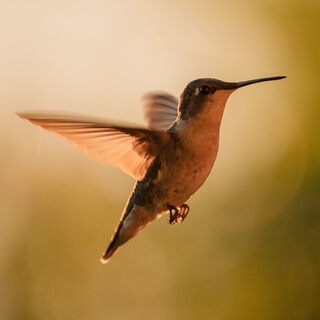
This bird comes hopping in.
It doesn't fly into the house.
It lands and hops in to where Monkey Noodle would sit,
Right on her spot,
And just started chirping like crazy,
Looking at me,
Looking around.
And it was just like a trumpet announcing,
I'm good where I am.
I'm OK now.
Thank you.
And Debriana was in the back room.
And I was just paralyzed with,
Oh,
My god,
Oh,
My god.
She has to see this.
But I couldn't get her out in time because I didn't want to scare the bird by yelling.
So I tried to say,
Come out here,
Come out here.
I want her to come out.
But it was crystal clear to me.
It was crystal clear.
So it's a matter of believing it or not.
Anyone could explain that away.
And I can explain that away and make it a very practical,
No,
That wasn't Monkey Noodle.
That was blah,
Blah,
Blah.
But why would I do that?
That's the wonder of living.
First,
I have to say that I love the name Monkey Noodle.
Yeah.
I think my most creative name for a cat was Fatty Lumpkins.
So I really appreciate,
Yeah,
I appreciate good cat names.
I also have certainly talked to many people who have lost a beloved pet.
And later that week or a few months down the road,
That pet has come to them in their dreams.
And kind of just saying,
Hey,
I'm OK.
Here I am.
I just want to say goodbye.
And so I think there's a whole level of intimacy and a different level of intimacy and love that a pet gives you.
Because it's the most unselfish love.
And you can love them.
They never judge you.
It's just this complete,
Beautiful,
Amazing way of loving.
And so I've certainly had my heart more than broken when I've lost a pet in the past.
It's kind of this grief that you never think is going to go away.
And when they came to me and said goodbye,
I felt so much better.
There was another moment that I would talk about,
That when my mom's father was passing,
He was sort of in and out of a state of kind of a consciousness and unconsciousness,
Able to sit upright and sort of converse.
But my mom would sit with him.
And there was a time where he started speaking to past relatives.
And I think even as a child,
Speaking to friends,
Like when he was maybe 8 or 10 or something.
And my mom quickly recognized that.
And this is a testament to my mom.
She recognized it and encouraged it and started asking him questions.
So what's so-and-so saying right now?
She wants to borrow my bike.
Stuff like that.
Like this sort of dialogue went on.
And my mom just traversed that territory with him as it unfolded.
And to me,
Again,
That's like,
I never want to explain that away with some sort of theory or anything.
I just want to be in wonder of that and go,
OK,
We talk about that ability to cross and have communication with those who have passed.
And I'm all for it.
Like,
I love that.
I think that's,
Why not?
What harm is there to say,
No,
That's not possible?
That's impossible?
I think that's probably a position I take on everything.
I mean,
As long as someone is not being harmed by a belief,
Including that self,
That person,
Is not harming themselves in some sort of hard belief,
I think being able to sustain wonder and questions,
Let them remain questions,
That drives me.
That's the reason to show up.
It's interesting.
When I was in seminary,
Of course,
I took many,
Many different classes.
But in one of the classes,
I had to read an article.
It had been written within the last five years about a new approach to death.
And it was fascinating because this article was saying that death is more complicated than we actually understand.
And it doesn't just happen,
The process doesn't just happen one day at 2.
39 PM.
That for patients in hospice,
For those in senior care centers,
Sometimes it lasts for a few weeks.
And the caregivers and nurses observe the patient or the individual they are having those conversations with their beloved ones who have already died,
With childhood friends who've already passed over.
And it can take weeks.
They will engage in these conversations.
Are they memories?
Are they actual conversations?
Nobody knows.
But the point of the article was death is more complicated than we realize,
That there are things going on potentially that we don't understand and we don't have a language for yet because maybe as a culture we can't go there yet,
As far as the ancestors coming to help people pass over.
But it is a frontier that is vastly more creative and life-giving and interesting than we have words for right now.
So I think that makes it kind of exciting.
Absolutely,
Yeah.
Yeah,
When you say than we have words for right now,
I love that because this is sort of right now,
Currently very much a focus of my work is the unnaming,
To not name what's happening.
And I'm trying to carry that over through visual work,
Movement work,
Sound work.
And that practice of not naming,
For me,
Allows the fluidity of a moment to be constantly in flux.
The moment,
The activity is the thing that's living,
Not the goal to get to a place,
To finish a painting,
To record a piece of music and call it done.
For me,
Those things aren't so interesting.
Those are almost byproducts of the activity of being in it,
The process.
And that process,
If I can sustain the not naming through that journey of making,
It's constantly unfolding.
Like you were just describing death,
There's no beginning,
Middle,
And end of it.
It's constantly unfolding.
And that's not to be kind of morbid about that we're always,
We're all dying.
Of course we are.
We're also all being born at the same time.
I think one of the things that I think,
One of the things I'm hearing or observing about you,
I guess,
Is the right word.
It seems like ever since you were a child,
You've been kind of attuned to the wonder and beauty in the world.
And you've been kind of drawn to it.
Yeah.
So much so that you've wanted to interpret it for yourself,
Whether it was through drawing or making jewelry or movement work.
And I think living with that wonder,
And being in that wonder,
And bringing that into the world,
It keeps you childlike forever,
Which I think is very hard to do in this day and age.
But I think it is a superpower.
Yeah,
I mean,
Sometimes it's interesting.
Sometimes it feels like a superpower.
I like that.
I'll take that.
You know,
There are many times along that journey where I've felt kind of guilty about it.
And in addition to that,
I have,
And this sounds really strange,
But sometimes I look at it and I think,
So many people around me have experienced such tragedy,
Such hardship.
And I never have.
I just have not.
And I look at that and I think,
Well,
What?
OK,
So what's that?
What's that about?
You know,
Sometimes there's this wave of guilt that crosses over.
It's like,
Oh,
God,
It's so hard for so-and-so.
Why didn't I ever have to take that on?
I'm not,
Of course,
Not wishing that something happens or that that comes on me,
But it's a weird thing.
It's a thing that kind of pecks at me a little bit and says,
OK,
So what is that about?
Part of that might be that superpower,
That kind of saying,
Well,
You're already hyper-tuned in.
That might take you down if X,
Y,
Or Z happened to you.
I think,
Essentially,
You're observing and there is a lot of trauma and a lot of discord and a lot of intensity in the world right now.
But I think your superpower maybe allows you to always recenter in this place that is hopeful.
So if that's a superpower,
I'll take it.
I guess my next question is,
Do you own a cape?
No,
But I think I should.
So here's a funny thing.
Liberace is related to me.
Speaking of capes,
I should own a really nice cape.
With lots and lots of rhinestones.
Exactly.
I should have one of his capes.
Thank you so much for tuning in to episode 61 of Bite-Sized Blessings,
The podcast all about the magic and spirit that surrounds us.
If only we open our eyes to it.
I need to thank my wonderful guest today,
David Furlano,
For sharing his stories with me and his music.
If you'd like to listen to more of his music,
Please go to Bandcamp and type in David Furlano.
Music in this episode is from his albums Blue Snow,
Ixmix,
Shiver Like Dust,
And A Landscape Sheds Its Colors in Winter for a Chance at Nostalgia.
I also used music from creators Brian Holtz Music and Sasha End.
For complete attribution,
Please go to the Bite-Sized Blessings website at bitesizedblessings.
Com.
On the website,
You'll find links to other music,
Other artists,
Books,
And change makers I think are hopefully making this world a better place.
Thank you for listening,
And here's my one request.
Be like David.
Live in the whimsy.
Live in the realm of imagination.
Be still,
Be silent,
And listen to the woods.
Because if you listen long enough,
The woods are sure to tell you their secrets.
He should have bequeathed one to every single person in his family.
In the family,
I think so.
Yeah.
Man,
Oh my gosh,
That's amazing.
You leave that for the last moment.
It's a weird little family detail.
Oh my gosh,
Did you ever meet him?
I did not.
He was,
I think,
Becoming quite untouchable,
Famous,
That level,
When I was probably when I was just born,
Or pretty young,
A few years old.
He was at,
You know,
I talk about those Sunday meals with my grandparents.
He was there.
You know,
He would show up there at those Sunday meals in Brumal,
Pennsylvania,
At my grandmother's house.
I don't remember him,
Because it was before my time.
But we have,
I have a photograph of him standing with my parents,
Holding my older brother as an infant.
And he was,
Even at the family dinner,
He was sequined.
I think this was probably before he really got jeweled up.
So it was sort of like,
It was a mild Liberace,
But it was like,
Oh,
You could see it coming.
You could see that,
Oh,
This is gonna get good.