Welcome to Episode 67 of Bite-Sized Blessings.
In this episode,
I get to interview Jeffrey Gould.
If you go to his Facebook page,
You'll see that he studied at Brooklyn College and studied anthropology and philosophy at the New School for Social Research.
After that,
He worked for the New York City Department of Education.
But as with all lives and all stories,
The truth is far more complex.
In my far-ranging conversation with Jeffrey,
It became very clear that most of all,
He is a storyteller.
I was enchanted and delighted by the stories of his ancestors,
Stories that are by turns triumphant as well as tragic.
This episode touches on many different subjects,
But the one that has stayed with me is Jeffrey's stories of his ancestors and how they've been forced off their lands time and time again simply because of their religion.
With what is happening in Ukraine right now,
With untold millions of people being forced to flee their lands,
Their houses,
Their cities,
Essentially leaving their identities behind,
It begs the question which is haunting me.
And watch out because I'm going to get on a little bit of a soapbox here.
When are we truly going to be good to one another?
When is that going to become our default?
When are we going to start looking at strangers and enveloping them with kindness,
With no judgment?
When are we going to start looking at people and just see their insides,
Not see their affluence or their poverty,
What kind of clothes they're wearing and how that defines them,
What kind of job they have and how that defines them?
When are we going to start looking at people and see the multitudes that they contain?
I hope that we can see the magic and the miracle that I hope for one day,
That we look at people,
We know that inside them are universes of potential,
And if we operate in this way,
That truly the future for human beings and our relationships with each other and with the planet,
It can only be a good thing.
And so that's one of the miracles I wish for,
That this podcast can remind people that we all can strive for that.
Okay,
Soapbox finished.
And now,
Episode 67 of Bite-Sized Blessings.
I looked at all of the tubes that were keeping him alive,
The intravenous tubes,
The electrical tubes,
Everything,
And I finally said,
No,
No more,
Because he'd been in a coma for a very long time,
And he'd been in and out of the hospital many times anyway.
And this was a Catholic hospital,
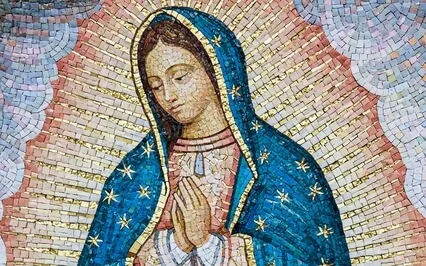
So I went down to the chapel where they had a plaster cast of the Virgin Mary,
A typical plaster cast painted blue with flesh tones,
Typically thin,
You see,
And I dropped on my knees in front of her and I said,
It's enough,
Take him.
And there was suddenly an incredible seizing of me after a moment,
And it's only later that I heard the words,
But I know what the words were,
And the words were,
Behind the noise there is silence,
Beyond the tumult there is peace.
And then two days later,
He died.
How do you self-describe?
Well,
That's interesting,
Because the self-description at a party would be different from the self-description I would give you.
The self-description at a party would be more about my history.
You know,
I was,
I'm from New York originally,
Moved to Portland six years ago,
Raised,
Being born and raised in New York,
Becoming a teacher of middle school,
Having a succession of life partners,
Gay life partners,
That's the story I would give in the elevator.
But to someone like you,
I would say it would be a different kind of approach.
I would say I'm someone who's sensitive and who is compassionate and who receives and tries to stay aware of what's coming my way.
And I also do a lot of meditation to help me become more mindful of the things that I do,
The things that I say and their impact upon other people.
I was born in 1945,
So it's just the end of the war,
And I was born to a second generation of Americans from Russian Jews.
After the war,
Because of all of the history and atrocities that had happened to the Jews in Europe,
There was a strong desire among middle-class Jews,
Which I grew up in Brooklyn,
New York,
There was a strong desire among most of the people in my parents' milieu to assimilate,
To not be stand out because of the terrible things that had happened in Europe when they stood out,
When their ancestors stood out.
And so it was not a religious household.
It was very definitely a Jewish household.
There was a strong sense of identity as a Jew,
But not a strong sense of religiosity.
So I had a bar mitzvah.
We would go to temple twice a year,
Once both 10 days apart,
Once Rosh Hashanah,
Which was the New Year's,
And once Vyom Kippur,
Which was the Day of Atonement,
And that was 10 days later,
And those were called the High Holy Days.
And then we'd go to the temple to say whatever we mumbled out,
As far as I was concerned,
And then went back home.
People dressed up for the temple as if they were going to a theater event,
And then we'd come home.
My bubby,
My mother's mother,
Would come over and light candles on the Sabbath.
And we were not kosher.
We didn't observe most of the rules of Judaism,
The household rules.
We would try to do a Seder once in a while on a Passover.
Sometimes it worked,
Sometimes it didn't.
We'd eat matzah,
Though.
So it wasn't really a religious household,
Although it was definitely identified as a Jewish household.
Now,
May I ask,
Did your father serve in the war?
No,
He did not,
And I don't know why.
I know he was here in New York,
There in New York for,
They were married in 1941,
But I don't know why he wasn't in the war,
And that was really never discussed,
So I never found out exactly what it was all about.
I did have relatives that served in the war.
An uncle of mine,
My father's sister's husband,
Lost his whole platoon in the war.
He was a sergeant.
So people came back with stories.
And then my grandmother,
My father's mother,
Lost seven brothers and sisters in the war that were left in Russia.
She came here before the war started.
So she came here in 1916,
Actually,
Even before the Russian Revolution.
But she still had seven brothers and sisters left behind,
And all but one of them were killed.
So there was a strong sense of what we lost during the war,
Even though my father wasn't really part of that war.
I'm going to assume that when she emigrated,
She spoke Russian.
Is that true?
Yes,
She did.
She was an authority for me on Russia before the revolution.
She was an incredible storyteller.
And I'm so grateful to her because what she did was she opened my eyes to the magic of storytelling,
And she didn't mean to do it as a storyteller.
She was just telling me her life.
But she had seen it,
Saw her,
And she was a little girl.
She remembers him riding the back of a train and stopped in her town to wave to the folks.
She hid in the basement during one of the pogroms,
Along with the rest of her family,
So that they wouldn't be either beaten up or killed by the villagers.
I have a fabulous story of hers,
And she was telling me these stories over and over and over again.
So they are so ingrained in me.
But one of the stories was her father was an engineer in a Russian town.
And because he was skilled,
He was given permission to live in this town where no other Jews were allowed to live.
So they were considered middle-class Jews,
Middle-class people within this town,
But they were the only Jewish family in the town.
And he died one day.
He caught pneumonia,
And within two weeks he died.
And there was no Jewish cemetery in the town.
And so Jews have to bury their dead in a Jewish hallowed ground,
Which is a Jewish cemetery.
So my grandmother's mother,
Bless her soul,
What she did was she didn't tell anybody he died.
She dressed him up in his best clothes,
Set him up in a wagon,
And drove him out of town so he could be buried in a different town in a Jewish cemetery.
That was just one of the stories she had.
It's out of some kind of a Grimm's fairy tale.
You know,
Exactly.
It's just,
That's the way it was.
And that's the way it was for a lot of people in Eastern Europe at the time.
My other grandparents,
And this was never,
Those grandparents never told me any stories,
But I got it from my mother.
That they were grocers in the part of Poland that Russia had taken,
In the,
I believe it was the 1700s or 1800s.
They had Russia,
It was called White Poland,
White Russia,
But it's really a section of Poland that belonged to Russia.
And there was also a pogrom in their town.
And so what they had to do was pack up all their belongings and carry them into a river and cross the river.
To get away from the pogrom and then immigrated to America.
So as you know,
I never was quite clear as to whether the river was up to their ankles or up to their chest.
I don't know.
But regardless,
They had to flee also.
So it was a troubled time for Jews,
And a lot of Eastern European minorities at the time as well.
Thank you.
I can only imagine I didn't really have close relationships with my grandparents,
But I am a huge fan of fairy tales from all over the world.
So on my bookshelves behind me,
I have collections and collections of fairy tales from pretty much everywhere you can imagine.
I'm a voracious reader of them.
And so I listen with envy to your story about this,
You know,
Kind of sitting with your grandmother and,
And just bequeathing you the family stories and her stories.
Yes.
I mean,
Lives are precious,
And every life is a story.
And the fact that she saw fit to share that with you,
That's just treasure.
It is.
And then there were stories of when after she had come to America,
Etc.
I mean,
She had a whole trove of stories.
She carried,
She was a history book in herself.
And she was a link to not only a different generation,
But a completely different world.
When there was still an emperor of Russia,
I mean,
Something like that,
She was still a link to that.
I remember when Khrushchev spoke at the United Nations in the 1950s,
And she listened to the speech,
And she said to me,
Oh,
He speaks like a farmer.
She could tell from the dialect of his Russian that he was not an educated politician,
He was more like a farmer.
But she,
You know,
She had these insights still into her homeland,
Even after she was here for so many years.
And I have to say,
My parents,
Because they had heard the stories before,
And because I was spending a lot of time with my grandmother at her knee,
Literally,
Listening,
My parents wanted her to stop because they'd had enough of hearing it.
And I just wanted her to keep going on.
So I would go visit her Saturday afternoons at her apartment by ourselves,
And she would tell me the stories over and over and over again.
They were precious times,
And I'm grateful to her as a spirit for having given me so much,
So much of what she had,
And also making me a storyteller in that sense as well.
Why did your grandmother come here?
She married a man in Russia who was an educated man,
Early college,
I'm not exactly sure what that meant,
But he was very well educated,
And he came from a very well educated family.
And for Jews,
Education is the whole point of life.
His brothers and sisters were doctors and lawyers,
And his own father was a lawyer.
And for Jews in Russia at the time,
That was an amazing thing.
And his intent was to come to him,
She married him when she was 16,
And he was 17,
Which was a typical age to get married in Russia at the village at the time.
And his intention was to come to America because he'd heard that the streets were paved with gold.
This is her words.
And so he told her,
We're going to America,
And she said to her mother,
I don't want to go.
I want to stay here with you.
And my grandmother said her mother slapped her face and told her,
Where your husband goes,
You go.
She came to America,
They came on a boat,
And she said she got seasick on the boat,
Terribly seasick.
She couldn't eat.
He had to carry her around everywhere,
But he bought her oranges,
And it cost a dollar an orange.
It's the only thing she could keep down,
And yet he bought her an orange to eat every day.
And I have to say she was very,
Very much in love with him.
She loved him to the end of her days.
Unfortunately,
During the Depression,
He abandoned her.
He abandoned her with three children.
As she said to me many times,
As much as I loved him,
I hated him three times more.
And yet every time she would talk about him,
She would start to cry.
So the love never really went away.
It was always just twisted into this other kind of darker feeling.
In the end,
This is when I was still a child.
He had become a gangster.
He's quite a rogue,
Actually.
He's a very interesting man.
I've seen photographs of him.
He's extraordinarily handsome.
He must have been a lady killer when he was a young man.
He became a gangster when he came to New York.
So that may be part of the reason he left her.
He was leaving because he was pursuing his gangster activities.
And he was eventually arrested and sent to the penitentiary.
The family suspects it was because he had shot somebody,
But we're not quite sure.
It was all very shrouded.
And of course,
She divorced him.
When he was let out of prison,
I was still a child.
My grandmother was in her 60s.
I was still in my early years.
And he found out where we lived.
And he tried to visit my mother,
My father,
And me.
And my grandmother found out and told him,
Told my father,
Don't let him visit you anymore.
You have to choose between him and me.
And so one day when he came to the house,
My mother had to tell him,
Pa,
I can't let you in.
Ma,
Ma,
Ma,
Meaning my grandmother,
Said don't let you in.
And so what he did was he went up a building and jumped off and killed himself.
And so my grandmother,
When she would tell that story,
She would both cry and sob.
And yet also there was so much love,
So much unresolved love there,
You know,
Because he was so good to her at the beginning.
And of course,
He was her protection while they were in New York City at the beginning as well.
She would tell me when he first left,
She would bury her face in his clothes in the closet and cry.
My grandfather's name,
When he was in Russia,
The one who killed himself,
His name was Kastelan.
Now,
Kastelan in Russian is the Russification of Kastelan,
Which means he was descended from Jews who came from Spain in 1492 who were Castilian.
And what the Jews did when they were expelled from Spain,
A lot of them were forced onto ships in the Mediterranean.
And Turkey,
The Ottoman Empire at the time,
Which was sympathetic to Jews because they were good business people,
Ferried them to other parts of the Mediterranean.
Some of them were unfortunately met with ship captains who were not the best of men and robbed them and then tossed them overboard.
But some of them made it to Greece and then moved north in Greece into Thessalonica,
Which was a city in northern Greece,
Where a lot of them stayed.
And then some of them also went further up into what is now the Ukraine,
Which became part of Russia.
And my stock was part of that because the name Kastelan was really Castilian in Russia.
So there's a tracing of the name there.
When he came to America,
The people at Roosevelt Island couldn't spell Kastelan.
And so they gave him the name Gould.
They just made it up,
Gave it to him.
And I've been a Gould ever since.
I just thank you for sharing that story of your grandfather.
It's very heartbreaking.
And I imagine it was heartbreaking for your whole family when it happened.
And,
You know,
And I'm listening to your story here about the diaspora or the forced removal from Spain and,
You know,
Then the pogroms that happened and your grandmother coming to America.
And it just seems it is unfortunate and it breaks my heart.
But it's the story is one of trying to find a home and trying to find a place to build a life and endlessly being chased away.
And it just it's makes my heart ache a little bit.
So anyway.
And also the endurance.
There's both being chased and the endurance.
And actually that that resonates with me when you just mentioned being chased.
That resonates me with the reaction of America to AIDS when it first when it first arose,
Because this the COVID,
COVID is the second plague I've lived through.
There was a there was a much more personal plague.
You know,
It hit home over and over and over and over again.
So when it first became apparent that gay men were dying,
There was such such fear among the general population.
The post-sarcoma was called the gay cancer.
And I guess that kind of meant us as well.
Homosexual men were blamed for bringing this into the world,
Spreading it into the world.
Of course,
We did help to spread it,
I have to say.
But but it wasn't something we created.
It was something that might have spread anyway.
So,
Yeah,
There was that reflection that you actually just I just got that connection of being pursued.
And yeah,
We were pursued as a population of gay men as well,
Because besides being gay,
Which was also taboo,
There was this other stigma of carriers of disease.
And so we had to kind of go through that as well.
I remember when when Reagan would not recognize AIDS as a national problem.
And I remember ACT UP,
Which was an organization of gay men in New York City and around the country.
But it was very active in New York City who started demonstrating both in New York and in Washington about you've got to save us.
You can't just let this go.
And I remember both the fear and the exhilaration and also the horror of all of that.
You know,
You see men who are finally standing up and yet dying as they're standing up,
You know,
Being knocked off,
Knocked off,
Knocked off.
There was some hope there,
Too,
Because there was the beginning of the of the gay movement when when Stonewall happened.
The very first gay pride marches were not the big blasts that you see today because I was witness to them.
So I'm kind of like an eyes that saw what really what they were really like.
The very first gay pride marches were maybe 100,
200 people walking silently along the street carrying a banner about gay rights.
And then Ben,
Who was my partner,
A previous partner before he died,
He came up with this wonderful idea that at the end of the gay march,
At the back of the march,
He was going to rent a flatbed truck and he was going to put large speakers because disco had come into play at that time,
Disco music.
And he was going to put large speakers on the back of that flatbed truck and aim out this loud dance music.
And he called it the Disco,
Kazoo and Marching Band Truck.
And that is the first time music appeared at the gay march.
And all of a sudden you had hundreds of people following and dancing along.
Let me give him credit.
His name is Ben Kogospotl because he deserves the credit for that.
Brings a tear to my heart and a lump to my throat.
But he definitely deserved the credit for that.
And he played the tambourine so he would the music would be blasting and he'd be playing the tambourine on the flatbed along with some of his friends.
And then there'd be hundreds of people behind him dancing along.
And so the gay parade morphed into something much more joyous and much more overt than simply solemn commemoration of Stonewall.
There was this joyous emphasis on we're alive,
We're still here.
And then Ben himself died in 1986.
For me,
There was anecdotal evidence at the beginning of HIV when they were beginning to study it and there was nobody had any medicines for it.
Nobody really knew what it was.
So doctors were kind of leaning from wherever they could.
And there were all sorts of small organizations in New York City that were trying to collate information to present them to investigative bodies about here's what we found out.
Can you use this information?
I remember one pharmacy in particular in the Lower East Side of Manhattan that was actually selling herbs to HIV positive men in the hopes that these herbs would.
And that became almost like a meeting place for minds for HIV stories.
And one of the stories that was coming around was that people who had an Eastern European background in their genes seemed to have a slightly better natural resistance to HIV than people who did not have those genes.
And so I think I survived,
Partly because,
Again,
Grandma gave me those genes.
Besides the story,
She gave me the genes.
Then when the meds started to come out in the early 90s,
Those kind of investigations stopped because they weren't necessary anymore.
So I don't know if anyone ever pursued them anymore.
But that was one of the reasons I did okay for a while.
Another reason we did okay was because Christos had a dear friend who had bone cancer.
Sorry,
She had breast cancer and it was beginning to metastasize.
And so she found this doctor and his name was Dr.
Emmanuel Rovisi.
And he was an elder doctor.
He was 94 years old when I met him.
He was still practicing.
He had been the doctor to the King of Romania because he himself was from Romania.
So in the 1930s,
He was the doctor who treated the King of Romania for cancer.
He was a cancer doctor who had this completely unorthodox method of treating cancer.
And because he was an expert on blood,
He was also starting to treat HIV patients.
And so he had cured Christos' friend's breast cancer.
He had also treated the mayor of New York,
Mother,
And he didn't cure her,
But he put her into remission.
I met many people in his office whom he cured of cancer.
But the AMA,
Because it was not a traditional cancer treatment,
The American Medical Association tried to take his license away.
And in court,
His own supporters showed up in the courtroom to try to get the jury,
The judge,
To not allow that.
In the end,
He was allowed to keep his license and he continued to practice.
But I remember going into his office,
Christos said,
Well,
Let's go see him.
So we went to see him and in his office,
And I swear this is true,
You go into the back room where he was sitting at his desk.
And he had little chicks in coops behind him.
Baby chicks.
He was doing experiments on God knows what he was doing,
How he was doing it.
But what he would do,
He would send you home with a little vial,
Drops that he would make himself.
And he would say,
Put four drops of these and six drops of these into a capsule and take the capsule three times a day.
And you go home and you do what he said.
And the proof is I'm still here.
Actually,
I had developed Kaposi sarcoma,
Which was called a gay cancer.
It was a form of cancer that only severely immuno immuno compromised people get.
And I had developed it.
And so I went to my proctologist who said,
You have Kaposi's.
I said,
OK.
He said,
We don't know how to treat it.
So you'll just have to kind of live with it.
I said,
OK.
I went to Dr.
Avicii.
I said I was just diagnosed with Kaposi's sarcoma.
He said,
Oh,
OK.
He put he said,
Well,
Take three drops of this and four drops of this and go home and take it for this many months.
And I did.
And then came time for my checkup to go back to the proctologist.
Might have been several months later.
I remember him putting me.
He didn't put me under.
He put me on something that made me a little bit,
You know,
Just so I wouldn't feel the pain.
But I wasn't under.
I remember him looking at where it used to be.
And then I heard him say to the nurse,
It's gone.
He whispered to her,
It's gone like it.
It was almost a secret.
I credit Ravi C for that as well.
He got rid of my Kaposi sarcoma.
Christos was a was a was a member of the Greek Orthodox Church and in the Greek Orthodox Church,
The Virgin Mary has a very high place to the Catholics,
But even I would.
From it as an outsider,
It seemed to me even more so.
She was greatly venerated and he would talk about her off.
And he had an icon of her as a matter of fact,
The book from Greece.
And we would go back to Greece every summer because I had off during the summer because I was a teacher and he was a jewelry designer in New York.
And in Greece,
He would bring his designs back and work,
You know,
Work and vacation in Greece.
And then we come back in September and we both live here for the winter.
So one of the times we went to Greece,
We went to an island called Tinos,
T-I-N-O-S,
And it's an island where they supposedly,
Not supposedly,
They found by digging up in the earth,
An icon of the Virgin.
And she was reputed to have healing powers.
And so the Greeks built a huge cathedral for her on top of a hill on the island.
And she was called Our Lady of Tinos.
And the icon was sitting on an altar.
And there was this particular time of year and it was during the summer and I had been there during the summer.
The boats would come from all over Greece and people would get off the boats,
Orthodox Christians get off the boats.
Some of them would literally crawl on their knees up the hill because they were pilgrims.
Some of them did not.
Some of them walked,
But I watched them.
They did it.
And I walked because I was not technically a believer,
Let's say.
And so,
But I did get online in the cathedral and you walked into the cathedral and hanging from the cathedral were all sorts of votaries.
Many of them were in silver and some of them were in gold and some of them were,
Some of the gold pieces were actually on pill,
Pillows around because a host of wealthy people had come there seeking help.
Seeking cures from their own ailments.
And so I was online to get up to the Virgin and you wait and it's a slow procession and the priests are standing alongside you,
The monks are standing alongside you.
And you finally get,
You climb the stairs and somebody goes ahead of you,
Somebody goes ahead of you.
And then it came my turn.
And when I got to the altar,
There was the icon behind glass and draped inside of the glass were all of these precious jewels.
There were rubies and pearls and corals that were just kind of inside between the icon and the glass.
And I went to kiss it.
And as soon as I got close,
I noticed that on the glass there were all these smudge marks from hundreds of other lips that had kissed it before me.
And I had to think really fast.
Do I kiss?
Do I not kiss?
And I kissed.
I actually put my lips to the glass and I kissed.
And then as I leave,
I turn around and I watch the person behind me.
And what she did was she gave an Italian air kiss,
You know,
Without really touching her lips to the glass.
And I thought,
Oh,
My God,
What have I done?
And I what I thought was I think there was a play by Ionescu of a woman who kissed the toe of a holy statue and called the syphilis of the mouth.
I don't know if that's real or not.
Somehow I kind of got that idea.
Maybe I heard that somewhere.
I'm not sure it was Ionescu.
But I thought to myself,
I've just given myself syphilis of the mouth.
And so what I did was for the entire time I was leaving the cathedral,
I was wiping my mouth,
Trying to get whatever.
And it just wasn't working.
And I was building myself into a stew.
OK,
You come out of the cathedral and there's a fountain there.
And Christos was there.
He had also kissed the Virgin.
And another friend of his was there who had also kissed before me.
I saw the water in the holy fountain.
I said,
What do you do?
He said,
We wash our hands here when we leave.
And I took the water and I washed my lips because I needed to get all of that stuff off.
And suddenly I was hit by this incredible release of an all went away,
All of that horror,
All of that fear,
All of that self-generated momentum of craziness just went away.
And I thought,
Oh,
And I was just present.
That was that was the first time and not the last time because I'll tell you another story,
Too.
That was the first time the Virgin spoke to me.
When I say my attitude with her is not so much as the mother of Christ,
But the mother,
The mother,
The holy mother who envelops us all,
Who will accept all of us no matter what we bring.
And we say to us,
You are OK.
I forgive.
I don't even have to forgive you.
You are OK to begin with.
Here.
Here's my love.
Take it.
That's what that became to me.
That image of the Virgin became this universal image of acceptance,
The feminine part of the world.
There were several other instances when I in Christos had been hospitalized in Greece for AIDS,
And there was an icon in the hospital who became very important to me as well.
The most important part was in America when he was in the American hospital and he was dying.
And I was told by the nurse,
The doctors aren't telling you,
But he's he's dying.
I've seen this.
I know he's on his way out.
She actually took me into a dear hearted nurse.
She actually took me into the storeroom where they stored all of the gauze and the Band-Aids and nurse.
And we both lit up cigarettes in the hospital,
The storeroom and smoke.
And she said,
Because I need to tell you the truth.
Here's a cigarette.
And she said,
He's dying.
You need to know.
And so I went back to the room and a day or two passed.
And then I noticed that all of I looked at all of the tubes that were keeping him alive,
The intravenous tubes,
The electrical tubes,
Everything.
And I finally said,
No,
No more,
Because he'd been in a coma for a very long time and he'd been in and out of the hospital many times anyway.
And this was a Catholic hospital.
So I went down to the chapel where they had a plaster cast of the Virgin Mary,
A typical plastic cast painted blue with flesh tones,
Typically thin,
You see.
And I dropped on my knees in front of her and I said,
It's enough.
Take him.
And there was suddenly an incredible seizing of me after a moment.
I was exhausted.
I was very strung out.
I was at my wit's end.
I was very open to whatever.
And so something seized me.
And it's only later that I heard the words,
But I know what the words were.
And the words were,
Behind the noise there is silence,
Beyond the tumult there is peace.
Those words came to me later.
And then two days later,
He died.
And so,
Yes,
In a more concrete way,
I have experienced miracle of communion with the Holy Lady,
The Holy Lady of the sky and of the earth and of the world,
The Holy Embrace.
Yes,
She took me in,
Too,
And said to me,
Yes,
This is going to happen.
But beyond that all,
There is still peace.
I love your kind of description and depiction of her as being kind of beyond the Catholic idea of just Mary,
The mother of Jesus,
The Virgin Mary,
That she's a more expansive and abundant mother,
You know,
Mother to everybody,
No matter who you are or what you've done,
And that there's total acceptance and love there.
And at the end of everyone's life,
A gathering of yourself and your soul into this,
What I imagine is an abundant realm of love and just acceptance.
And it's going to be OK.
And you're safe.
At least that's what I'm hearing you say.
Yes,
It's going to be OK if one needs an answer,
If one needs some kind of,
That there is one.
But the answer is not something that you can be told,
Something you have to feel.
It's something that will come in a holistic way.
It's not going to be a theology or a line of.
It's going to be something that is felt and understood and accepted.
And it's only an acceptance by opening up and accepting that you'll find out what the answer is.
And at that moment,
That's all I could do was just be there,
You know,
On my knees in front of her.
There's no more abject position to be in that.
And I was alone.
It was midnight.
You know,
There was there was nobody else around.
It was the chapel was essentially a small chapel.
I remember going down there in the elevator,
Opened the door,
Went in myself.
You know,
There was nobody there,
Closed and just felt because I needed I needed her to do something for me,
Which was to let him go.
And essentially,
She told me in a roundabout way,
I will.
I don't think many people are aware,
But at least I have had the experience of having a veneration for the Virgin Mary and,
You know,
Visiting a Catholic church.
It's called the Grotto in Portland.
Have you been there?
No,
I have not.
It's actually a fabulous place.
It's carved into the side of a cliff.
It's in northeast Portland for quite a long time.
I am not Catholic,
But I did date a gentleman who was Catholic and the Grotto is just so peaceful and lovely.
And I would go and sit in the church and pray to the Virgin Mary.
And she listens.
She listens.
And it was one of the few times in my life praying to a deity or making supplications that I felt heard.
And she,
You know,
I was in the middle of feeling sorry for myself and crying and feeling sorry for myself if I didn't mention that the first time.
And all of a sudden I heard this voice,
A female voice,
Said to me,
For every time there is a season.
And I just looked around and,
You know,
There's maybe four other people in this chapel because I would go during the week and I thought,
What is going on?
I am losing my mind.
I don't know what that was.
And then I thought,
What does that mean?
And I thought,
OK,
I don't know what just happened here,
But I'm going to just I mean,
I stopped crying.
I stopped feeling sorry for myself.
I was shocked and I just kind of left.
I thought,
I think that's from the Bible,
I think.
And so I did.
I found the passage where but then but also internally,
I thought,
OK,
I know exactly what you're saying to me and I need to chill out.
Like she's telling me that whatever is going to happen is going to come and I need to chill.
And so I attempted to chill with varying degrees of success.
But she is a powerful,
Powerful force.
If you start praying to her,
You have to make sure that you're going to be OK with whatever answer comes.
You do.
It's true.
Thank you so much for listening to Episode 67 of Bite Sized Blessings,
The podcast all about the magic and spirit that surrounds us and Jeffrey.
As long as we open our eyes to it,
I need to thank my gracious and generous guest for sharing all of his stories with me,
His own life and his ancestors as well.
As well as the creators of the music used,
Sasha End,
Alex Productions,
Frank Schroeder,
Music Al Files,
Dream Heaven,
Alexander Nakarada and Lyran.
Without these musical creators,
These episodes would not be as fabulous as they are.
For complete attribution,
Please see the Bite Sized Blessings website at bite sized blessings dot com.
On the website,
You'll find links to books,
Artists,
Change makers,
And I've included a link to the book by Dr.
Emanuel Ravisi.
You can click on it,
See what all the fuss in the hubbub was about.
He was quite a groundbreaking scientist who studied at the Pasteur Institute.
But apparently his views,
Studies and findings did not line up with the American Medical Association.
And so he was banned.
He was blackballed and he was called a kook.
I'm going to provide a link to his website and the book that he wrote.
You yourself,
Dear listener,
Can make those determinations yourself.
I have great confidence in your ability to discern what is right for you.
But in the meantime,
Let's live with the idea and in the magic that cancer can be cured,
That it can be eradicated,
And that it's the people on the edges that have the ability to move in those spaces where they can investigate things that are different from what conventional medicines determines and has determined is the truth with a capital T.
So ends another episode of Bite Sized Blessings.
Thank you for listening.
And here's my one request.
Be like Jeffrey.
Live with your ancestors.
Live with the resilience,
Their bravery,
The determination,
And then carry those traits forward in your own life.
Remember,
We are each of us a universe.
We each of us contain multitudes.
We are each our own miracle.
And each of us,
Every day,
Is creating our own story.