The next day,
The funeral director called Marcy's daughter and said,
Did your mom have a thing about bees?
And she said,
Why?
Well,
When we opened up the bedding,
A swarm of bees flew out.
Now,
I peeled those flower petals.
There was no way there was a bee in there or a swarm of them.
And her daughter said,
You know,
Now that you mention it,
She lived in a house once that had a kitchen window,
And she said a bee would come and visit her.
In fact,
She would let it in,
And she said it let her pet it.
Miracle.
Mystery.
There's no explanation for that.
I'm steeped in gratitude.
Every breath I take is a breath of gratitude.
I've learned the greatest lessons about living by being with people who are dying.
And that alone has transformed my whole life.
I think that death came to visit me as a child.
I had my first death experience at the age of five,
And I think she said,
I want you to walk with me.
My first experience was when I boiled a bunch of guppies by cleaning,
Putting,
I was washing their bowl.
I must have been pretty little because I had to use a stool to reach the sink.
And mom said,
Wash the guppy bowl,
And she didn't like all those guppies.
Anyhow,
There were more of them every other day.
And I transferred them very carefully with the net into the clean water,
And it was too hot and they bounced up.
And of course,
You know,
I murdered all my pets and she just flushed them down the toilet,
I think joyfully.
That was my first experience.
It stuck with me.
Here I am,
72,
And I still tell that story.
I mean,
When I was five,
Three weeks after my older sister's wedding,
In which I was the flower girl and the whole family had gathered,
You know,
For the celebration,
My 30 year old aunt Will was killed in a head on collision with a drunk driver.
And I can still see being at her funeral,
I can still see in my see myself and my little cousin on the floor in the closet at my aunt's house.
And everybody was crying and we just we couldn't understand what was happening.
And it was frightening.
We knew it was awful.
And we were hiding from it.
And her funeral,
I've never I mean,
I remember the flowers,
Just so many and the fragrance of the flowers and and how my uncle and my dad had to support my mom walking up to the casket because she couldn't walk on her own two feet.
Her grief was so painful.
I remember that.
And I think that's when I started just watching how people reacted to somebody dying got embedded in me,
That whole casket and funeral thing was very hard because the adults don't know how to talk to the kids about.
I think it was it was reasonable and and wise to have me there at these experiences.
I know a lot of parents don't want the kids to see all this and be part of it.
But I think,
You know,
It's life.
So,
Yeah,
I think death is it's such a part of life and we don't recognize it.
And we've made it a bad thing.
And it's the second most natural,
You know,
Birth and death.
The most natural things a human or any living thing does.
It's how we do it that changes the naturalness of it and the goodness of it and the sacredness of it.
My parents never missed seven a.
M.
Sunday morning mass.
I went through Catholic schools from kindergarten to senior year of high school.
And were we a religious household?
We we were Catholics and I don't think we were over the top in any ways.
My parents sacrificed to send us to church.
And I think that's what I think.
I think that's what I think.
I think we were over the top in any ways,
My parents sacrificed to send me and my brother and sister to Catholic schools.
Educationally,
It was a better choice also.
So that mattered to them.
But in the late 60s,
I graduated from high school in 67.
The women's movement was happening and I was very aware of how underappreciated women in the church were by the men in the church.
And the civil rights movement was happening.
And the church told priests in the south to be quiet,
Don't get involved.
And after that,
I just didn't feel being Catholic suited me.
And I do see the divine in everything,
But I have definite Buddhist leanings.
When I started getting interested in learning,
Studying dying,
The only writing I could find about dying was from Buddhists.
Christians don't write,
They write about sin and punishment and heaven and hell,
But they do not write about death and caring for the dying and being with dying.
So that even reinforced my sense of how sacred dying is and how it transforms living.
It was the AIDS epidemic that did it for me.
Actually,
Even before that,
I got married in 1975 to a lovely man.
We were terribly in love and he'd been gay all of his life.
He was 37.
But before we met,
He wanted to change his life.
And I walked into a straight bar one night and we met.
We fell in love.
We lived together.
We got married and then we got divorced.
He got depressed.
We got divorced.
He wasn't living his authentic life and he moved to California from Chicago and was before the internet,
No emails.
So we would send cards once in a while.
And I got a call one day that he was dying and he was asking for me.
And it was,
This is 1988.
I'd already known about AIDS because I worked in the Chicago Merchandise Mart and I was in a home fashion industry full of creative people and a lot of them were gay men.
So I had loads of gay friends.
So when I got the call,
I,
Yeah,
It was,
It was,
It was,
It was life changing is what it was.
And I was deciding what to do.
Should I go or not?
You know,
He was skinny.
It had gotten into his brain.
He was in the hospital.
And just as I was trying to discern what to do,
He died.
And I said to myself,
No one who wants me with them when they're dying,
Because I knew a lot of my other gay friends were going to be dying.
It was what's happening.
You got AIDS and you died then.
So that was just a promise I made.
Yeah,
Honoring my close relationships.
And then by 1989,
When I turned 40,
I'd been to a dozen funerals or memorial services already for men I cared about.
And there were more around the country I didn't even,
You know,
Attend.
Two of my best,
Best,
Best friends,
Men,
Became positive in 1987.
And I just knew that we all thought they were going to be dying within a few years.
So I started volunteering on the AIDS ward at a hospital in Chicago.
But I learned there because it was AIDS and the AIDS community supported each other.
But in the AIDS community,
Everybody was young.
A lot of them had partners.
They certainly had a lot of friends because in the 80s,
It was still a pretty closed community,
80s and 90s.
And so there was a lot of support.
The doctors were gay.
Some of the nurses were,
Not all.
And I remember the first day I showed up for volunteer work,
I was shaking hands,
Introducing myself to everybody.
And this was 1995.
And I came up to one of the AIDS.
And,
You know,
The AIDS are the people who wash people and they clean the bedpans and they do the hard work.
But they're also the closest to the patients.
And usually they engage more easily in a relationship with the housekeepers than they do the doctors and the nurses.
Although this unit was so friendly and people kept coming back.
That was the other thing.
They'd get well,
They'd go out,
They'd come back,
They'd die.
And I came up to Linda and I started to shake her hand and she was from the south.
And she said,
Honey,
We hug here.
And she wrapped her arms around me and I could smell dusting powder on her.
And she was soft and warm and a little bit shorter than I was.
And I just felt so safe standing in the suffering of other people.
That's what our health care workers do every day.
And that's why so many of us are afraid to touch dying.
It is the ultimate suffering.
Not only are we suffering physically,
Which most of us do before we die.
We're suffering spiritually and emotionally and psychologically.
It's this whole stew of the unknown,
Of mystery.
And I think one of the goals should be to make that mystery sacred and a beautiful process instead of something to be scared of.
And so many of us are afraid of afterlife.
I've supported a lot of Catholic nuns through death.
I've got attached to a particular community 20 years ago through hospice volunteering,
Actually.
And a lot of them take a really long time to die.
And I'm not sure if it's I mean,
You know,
They spend their whole lives married to God and not eager to take his hand to cross over the veil.
It's fascinating to me.
And I've had some of them say really strange things about death,
Not positive.
When I was a kid,
I would help my mom in the garden.
And so it was always this huge production,
Having to go to the nursery and getting these flats and flats of flowers and then dragging them into the yard and planting them.
And so at an early age,
I learned the terms annual and perennial.
And I always thought,
Why?
Oh,
Why would there be anything that's an annual?
Because it seems wasteful to me.
But,
You know,
After a while,
I thought maybe it's to teach us about the brevity of life,
You know,
That you're here to shine for one moment and your brilliance then fades away.
But I thought to myself when I was a kid,
Are we annuals or are we perennials?
And it has haunted me since I thought of it.
And I have come to the conclusion that we are perennials.
That is what I think.
And death care,
That's another thing we don't do well.
Now in Jewish tradition,
They have people who are trained to wash a body,
They sit with the body overnight.
It's never alone.
They have beautiful rituals,
I think.
Yeah,
The shiva where people come and visit,
And that used to be a week long or two weeks long,
And now it's just a couple of days,
But it's where family are supported in their home.
They're not sitting in a strange place with too much air conditioning or not enough heat.
Funeral parlors.
In Mexico,
Funerals are still mostly done in the home.
The casket is brought to the living room where the furniture has been pushed out of the living room,
And the casket is there.
People are buried within,
I mean,
No more than 48 hours.
Yeah,
There's no embalming done here.
The church bells ring,
A special ring,
Dirge ring.
Once somebody has died,
The body's removed to a funeral parlor where it's prepared and dressed,
And then the casket comes back.
There's a glass covering over it because it's not embalmed,
And it's open so people can see the body.
There's ice under it so it can last for the day.
A canopy is set up on the street outside the home where the body is.
White plastic chairs,
And people come and sit,
Say the rosary,
Say prayers,
Visit.
If it goes through the night,
The family will put food out for people,
And then in the morning,
The body is put into a hearse or a van,
And people walk behind it to the local church.
There's a mass said,
And the body is put back in the car,
The purse,
And people process to the cemetery where more prayers are said.
And then the body is buried,
And usually there are people,
Sometimes friends,
Digging the grave.
Usually there's some drinking already going on,
But then after,
There's a celebration of life.
You know,
We have the Day of the Dead here.
Day of the Dead.
Death is very present in this culture.
There are all sorts of roadside shrines where someone's been killed,
And they're usually refreshed.
They're kept going.
I'll put a sign up,
Cross with the day of birth and death of the person.
And the cemeteries are Day of the Dead.
Families go in the week before,
And they clean the grave sites.
And then the Day of the Dead,
They bring fresh flowers and fresh silk flowers and wreaths and bouquets.
And it's like going through a crayole factory.
It's amazing.
It's hard to be sad in a Mexican cemetery.
It respects and honors the sacredness of being dead.
They were here.
They're not here,
But they're here.
When I was a kid on Sundays,
Once a month we'd go visit Aunt Will's grave.
She was the aunt who was killed when I was five.
And my cousin and I would go run around and pick flowers off of fresh graves,
Because they'd be,
You know,
Flowers would be mounded up,
And we'd go get some.
We'd bring more to Aunt Will.
It was,
You know,
We'd run around the cemetery.
It felt like,
You know,
An okay place to be.
And there used to be really pretty monuments,
The new cemeteries,
The eliminated monuments.
Yeah,
Visiting the dead,
We just don't do it.
Some of us,
I know people who have ashes in their homes from loved ones,
Not sure what to do with them.
There are companies that turn ashes into jewelry now.
And the Neptune Society will turn your ashes into a coral reef.
Well,
My mom's dying was a very interesting experience for me.
And she moved into long-term care in 2000.
Couldn't get up and walk anymore.
She was 88.
She was in a nursing home for six years.
And she came to enjoy being,
She was in a good nursing home,
And she came to enjoy it.
She felt she was treated like a queen.
She had a private room,
Which didn't make a difference because she was a private person.
My mother was in hospice three times before she died,
In the year before she died.
The first time she was shipped to the hospital nonresponsive,
And they thought,
And tests showed nothing happened.
Nothing had happened to her body to make her unable to wake up and eat.
And a doctor came into me one day,
Pulled me into the hall and said,
Your mother's not eating,
She needs a feeding tube.
And thankfully,
I was already aware.
I'd been a hospice volunteer long enough.
I'd studied dying long enough.
I'd read enough.
I said,
No,
We're taking her back home and calling hospice.
And I did that.
And a week later,
She woke up and said,
Where's my lunch?
And then we were back in business.
She just wasn't ready.
You know,
I believe that each of us knows when we're ready to die.
We can let go.
And then a few months later,
She was doing so well,
She got discharged from hospice.
And a couple of months later,
The same thing happened.
She just wouldn't wake up.
Back to the hospital,
Another doctor feeding tube.
I said,
No,
Let's take her home.
And a week later,
She woke up and said,
Where's my lunch?
And I said,
Mom,
This is exhausting.
Make up your mind.
And they brought her back in an ambulance that day.
And I was busy in her room.
I brought flowers and treats.
And I was straightening things up.
And I'm really busy.
They put her in bed and left.
And I said,
Mom,
What can I do for you now?
And she said,
Just be with me.
And I took off my shoes and got in bed with her.
That is truly what any of us wants,
Even when we're sick.
Just be with me.
Don't try to fix me.
Try to do things.
Or just be with me.
Just be with me.
Hold my hand.
Be with me.
Understand what's happening to me.
It's not happening to you.
And a couple of months later,
She truly did have a stroke.
And we brought her back to the nursing home and kept vigil with her for 10 days and had a lovely experience.
She was comfortable.
She was peaceful.
She didn't want to eat.
We didn't make her eat.
And I was able to be with her at the moment she died.
Not everybody has that gift.
And some people want to die alone.
My dad did.
He waited until I left.
Died an hour later.
And I feel her all the time.
Today,
I used a cookie sheet that my mother,
It's really old.
I used it to cook my lunch on.
And I put anchovies,
Which is something my sister and I always had on our pizza.
Nobody else I know likes them.
So they were both with me today.
And my sister's deaf.
My sister woke up one day with yellow eyes.
And a week later,
She was diagnosed with stage 4 pancreatic cancer.
She was a retired nurse.
And she went into chemotherapy pretty willingly and quickly.
And she did well for about 10 months.
And then she wasn't doing so well.
She and I continued to visit the nursing home my mom lived in for 12 years after mom died.
We made friends.
And we kept going.
And she and I love old people.
She was there,
And she fell and fractured her pelvic bone.
And I met her at the hospital emergency room.
She was in a lot of pain.
And while I was there,
A doctor came in and said,
We can't repair this.
We're going to send you to a nursing home rehab so you can heal.
And I could see the look on her face going,
I don't want to do that.
She didn't say a word.
And I said,
Oh,
Well,
You can go to where we visit all the time.
They know you there.
You'll get great care.
And she said,
Take my things and go home and call me in the morning.
And I did.
I called her.
I said I'd be there later.
Bring my glasses.
OK,
Anything else?
No.
And an hour later,
I got a phone call that she had no pulse.
Hurry over.
And my sister was a pretty strong woman.
She'd been widowed already 20 years.
She raised two kids and three grandchildren.
And I got to the hospital.
And the sign on the door said,
See the nurse first.
And I ignored it.
I walked in.
And they had not cleaned up the room or set her body to look any way that anyone who loved her would want to see her.
And there was a light over her head and trash on the floor and a garbage can full of soap.
They hadn't tried to resuscitate.
She had to do not resuscitate.
But they had tried something.
And as I turned around closing the door,
A nurse ran up to me and said,
The doctor wants to see you.
And I said,
How could you let anyone walk into that scene?
Open the blinds slightly,
Turn off the lights,
Clean up the mess,
And make her look like she's asleep.
And as she scurried away,
Two doctors came up to me,
A tall,
Thin man who looked like Dr.
Welby.
I mean,
He looked like you want your doctor to look.
And he had a name tag on that said,
Doctor loving her.
And with him was a small,
Petite woman with a name tag in which her first name was huge and her last name was a normal size.
And her first name was Anna,
Which is our mother's name.
I'm standing in the hall outside my sister's dead room with a doctor loving her and our mom.
And I start to laugh and cry.
And they are very confused by this.
And I finally caught my breath and said,
Would one of you hug me?
That's our mother's name.
And they were stunned too,
And both of them wrapped around me.
And by the time we all let go,
The nurses had straightened out the room.
They sorted the bed out.
My sister looked beautiful.
She still had her hair done from the day before.
Her lipstick was still on.
Her eye makeup was on.
And she truly looked at peace.
And I'm convinced she just decided she did not want to go to a nursing home for the last two months of her life.
Doctor loving her and Anna.
I had a woman at the nursing home that became our friend when mom was still alive.
They were both in hospice at the same time.
And she had had Parkinson's for 25 years.
And her last 10 were not easy,
But she was always in a good mood.
How you doing,
Marcy?
Good,
Good.
And she took a walk.
She was also in hospice off and on.
And in the last few days of her life,
Her daughters and I were sitting vigil with her.
And the night she died at the nursing home,
I was actually staying in my mom's room.
And I went into Marcy's room,
And I said,
Call her daughters.
She's changing.
I could see she was starting to muddle,
Where the blood lays in the hands and the feet,
Because it's not circulating anymore.
And they came over,
And we're in this double room.
And we're squeezed between the wall.
One of them's at the wall trying to hold their mom's hand.
Hard to do.
And the other one is up against the curtain to the roommate,
Trying to hold her mom's other hand.
And I'm at the foot of the bed,
And we're chit-chatting.
And all of a sudden,
I looked at Marcy,
And she went breathing.
We didn't even notice her last breath.
It was so quiet.
We didn't notice it.
And one of the daughters looked over and said to her mother,
Good job,
Mom.
And I said,
We have to do something.
And by then,
It was 10 in the morning.
They'd been there all night.
Good job,
Mom.
And I went around,
And the nurse came in and cleaned her up.
And the daughters and I went around,
And we told all the other residents if they wanted to come in and say goodbye,
They could do that.
And I went to my mother's room,
And I always had flowers in her room.
And I got a Kleenex box,
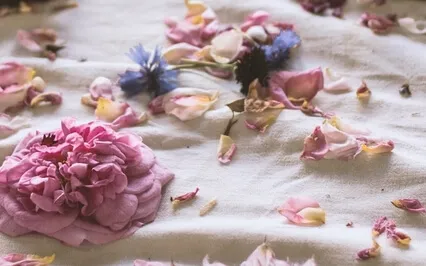
And I pulled all the petals off the flowers in her bouquet.
And I put them in the Kleenex box,
Went back to Marcy's room.
And as people came in,
I said,
Take a hand,
Take some flowers,
And put them on her bed as your last gift to her.
And this went on for like an hour.
Residents,
Nurses came in.
And when everybody was done,
Marcy's bed was covered in flower petals,
Which is what the last thing her daughters saw before the funeral director came.
And they wrap all the bedding around the body and put it in a plastic bag.
Unfortunately,
We weren't tuned in then.
I recommend nursing homes get some sort of a comforter to cover the plastic bag.
Some of them make quilts to cover the bag so that when it leaves the nursing home,
It can go out the front door instead of the back door.
And it doesn't look like a body bag like you see on a police picture.
The next day,
The funeral director called Marcy's daughter and said,
Did your mom have a thing about bees?
And she said,
Why?
Well,
When we opened up the bedding,
A swarm of bees flew out.
Now,
I peeled those flower petals.
There was no way there was a bee in there or a swarm of them.
And her daughter said,
You know,
Now that you mention it,
She lived in a house once that had a kitchen window.
And she said a bee would come and visit her.
In fact,
She would let it in.
And she said it let her pet it.
Miracle.
Mystery.
There's no explanation for that.
I gave one of my first workshops was in New Orleans at a Catholic retreat center.
And it was about hospice awareness.
It was in 2003,
I think.
It was an all-day event.
And after it,
A couple came.
There were about 50 people there.
A couple came up to me.
And the woman said their son had died of AIDS.
And she said,
No,
No,
No,
No,
No,
No,
No,
No,
No.
I'm not going to go to the hospital.
I'm not going to go to the hospital.
I'm not going to go to the hospital.
And the woman said their son had died of AIDS.
And they're using their experience by creating a support group and education for other parents who have children with AIDS.
And she said,
When my son died,
And I talked about butterflies then,
About,
You know.
She said,
At my son's funeral,
A yellow butterfly landed on my shoulder.
And his favorite color was yellow.
And I just love that story.
And I went back to my room.
It was one of the last conversations I had with people at the retreat.
I packed up my things.
I walked to my room.
I had to go out the back door of the retreat center and walk about,
I don't know,
Maybe 100 feet to my room.
And as I opened the back door,
This is January in New Orleans.
Not warm,
Not cold.
And all of a sudden,
There was a yellow butterfly behind the door.
And this butterfly flew along the side of the building as I walked to my room.
And when I got to my room,
It took off.
And I felt that was a validation for what I was doing.
I had to keep doing it.
Well,
I think it was a year before my mom died.
I was sitting in a room,
And she looked toward the doorway.
And I said,
Who's here?
And mom said,
I don't know.
Who's that woman?
And she followed with her eyes to the foot of her own bed.
And I'm sitting next to her on the other side.
And she smiled.
And she said,
It's my mother.
And my heart went,
Oh my god,
She's coming for me.
And she hadn't seen her mother for 40 years at that point.
And then it was gone.
And she stopped smiling.
She never talked about it.
I was with a hospice patient who was dying of AIDS.
And he was sitting up.
And I was across the living room,
Which was pretty empty except for his bed.
I was on a little loveseat.
And I was reading.
I was studying for a course on death and dying.
And I was doing homework,
Reading the book.
And I looked up.
And he was looking around the room as though it were full of people.
I remember not being able to breathe.
And I remember being uncomfortable that I was in the crowd.
And I got up and went to the side.
He continued to look around.
And then he stopped and smiled,
Connecting to something or somebody.
And he died two hours later.
I wasn't there.
But he died two hours later.
That's really beautiful.
I think I just was interviewing someone a few weeks ago.
And it's really interesting,
The new scholarship.
It's fascinating and way overdue,
The new scholarship being done about the months and weeks and days leading up to someone dying.
Because there is a pattern amongst a large portion of people of talking to people who aren't there or maybe seeing people who aren't there.
And it's part and parcel of the process of they suspect now of saying goodbye to this life,
Of making that transition.
And instead of equating it to old wives' tales or this isn't real or everybody's making this up,
They're starting to take it seriously as a legitimate part of the process of dying.
So I think that's good news.
Yeah,
Like I said,
Lamaze for dying.
Gwendolyn London,
A chaplain.
Actually,
She was at Duke University for years.
She said,
Dying is a spiritual experience with medical implications.
And so many of us see it as a medical experience.
And it's really,
It's a medical event maybe.
But we are just not,
We're not preparing for dying.
We're not recognizing the dying.
We're making it hard.
Some of us are having brutal deaths.
I've had nurses say,
I think we torture them before they die.
And there's statistics about that.
That's what gave rise to hospice,
But it's still the competition between medical treatment and comfort care is great.
You know,
It's our loved ones who won't let us die.
I mean,
I am an advocate for medical aid in dying.
I think we need that choice.
Some death is very hard.
And what I consider,
I think Steve Jobs had,
I don't know,
His whole dying process,
He suffered for 10 years with a rare form of pancreatic cancer.
He was diagnosed at 45,
Young guy.
Had,
I mean,
This guy was amazing.
He was rich beyond anybody's means.
He had power,
He had love.
And when he finally started to die,
I mean,
10 years later,
His sister reported this.
He was on his death bed,
Surrounded by loved ones.
And at one point he looked past all of them and said,
Wow,
Oh wow,
Wow,
And died.
Thank you so much for listening to another episode of Bite Size Blessings.
Episode 54 is a special one for me.
I have been interested in learning more about death and having those conversations around a topic so considered taboo.
So I was very grateful when Loretta Downs said that she'd be a guest on my show.
I hope that you found this conversation as helpful as I have.
And I look forward to having other guests and having more conversations around this topic.
I need to thank Loretta for her wise and wonderful words and her compassionate heart.
I also need to thank the creators of the music used,
Winnie the Moog,
Agnese Filmatia,
Music L Files,
Chilled Music,
And Sasha End.
For complete attribution,
Please see the Bite Size Blessings website at bitesizedblessings.
Com.
On the website,
You'll find links to other episodes,
Books,
Music,
And change makers I hope will lift and inspire you.
Thank you for listening.
And here's my one request.
Be like Loretta and remember that we are spiritual beings,
Having a human experience and at the end of each of our lives,
What does a good death look like?
Does it look like medicines and machines being used to prolong and extract every drop of life that we can possibly have?
Or does it look like quietness,
Being surrounded by family and friends,
Being surrounded by people who love you,
And being held in their arms and in that space so that we can have a good death?
One that is filled with love,
One that is filled with humility,
One that is filled with humility and one that is filled with the knowledge that it is only the beginning of a grander adventure.