Trogo is an ancient word that means to continuously chew on or gnaw on.
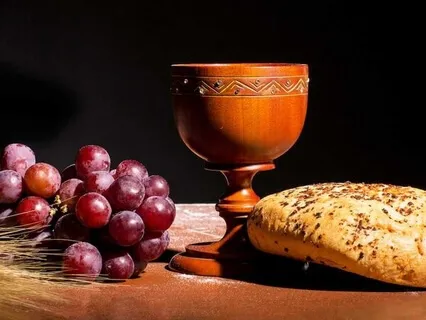
It's a word that Jesus used to describe the Eucharist,
The continuous remembrance of the living eternal truth.
And the essence of Raman's teaching is continuous practice.
Continuous practice which to the mind seems like an impossibility.
It's an impossibility to continuously practice with the demands of everyday life.
And the truth is continuous practice has nothing to do with mind or action.
It has nothing to do with mind or action.
It's the complete surrender of mind and action to the living presence of the heart which in the context of the Eucharist is symbolized by bread,
Bread of life,
The bread of life,
The eternal presence that feeds your spiritual evolution,
Right?
And this is really no difference.
There's no difference between the teaching of Christ and the teaching of Ramana Maharshi.
They are pointing to the eternal presence alive in your heart.
And the challenge is to keep focused on that initially,
To become first aware of awareness.
This is the beginning.
You have to become aware of awareness for the radical shift in your consciousness to begin.
And this is an organic evolution.
So trogo is organic because it's always now.
Trogo means the eternal now,
The constant remembrance of that which is eternal,
The awareness of the awareness and beyond awareness or the Toria Tita state.
If you've been exposed to Ramana's teachings then you are very aware that you can have moments of bliss or moments of profound realization and those moments seem to evaporate when you return to normal everyday life,
When you get real about your everyday life,
Right?
It's a return of the mind,
A return of the ego,
A return of the vasanas which are unconscious tendencies.
And the vasanas are 95% of your actions and reactions as you move through your day.
95% is basically unconscious.
It's hardwired behavior,
Hardwired behavior in your brain.
So the synapses in your brain basically have been wired for suffering,
Wired for specific reactions,
Wired for repeating emotions like sadness and fear and anxiety,
Stress.
And the practices of Ramana Maharshi are a return to the Toria state which is the effortless presence of pure awareness in your heart,
Sac-chit-ananda,
Being,
Consciousness,
Bliss,
Right?
It's beyond the emotional experience or a state of bliss that comes and goes.
The challenge is the mind is so powerful and you are so under the spell of your own mind.
You are so influenced by what you think that this awareness remains for the most part invisible to you.
It is invisible.
The Toria state is not something that you can see with your eyes.
And this omniscient presence is always here,
Always now,
Always alive,
Always fresh and always new.
And this means you have to relinquish the past entirely.
The past is dead.
As Papaji said,
The past is the graveyard.
If you keep giving your attention to the past and projecting that onto the future,
This cycles of suffering,
The patterns of suffering that you experience as you move through life will continue.
A momentary glimpse of Toria or a momentary experience of the bliss of the Toria state in your heart does not last because the vasanas,
Which are 95% of your conscious awareness that's unconscious,
That's in your subconscious,
Is in charge.
So until you address the vasanas entirely,
Then you will be at the effect of that.
It's really that simple and that challenging because if you are unconscious about these tendencies or this hardwired programming of your brain,
Then how are you going to overcome patterns of suffering?
Is that even possible?
And it's not possible from the perspective of mind and ego.
Mind cannot overcome mind and ego cannot overcome ego.
Vasanas cannot overcome vasanas because they are unconscious.
And so an aspect of Rama's teaching is total surrender to the source,
Total surrender to the pure awareness in your heart again and again and again until the vasanas are completely and fully evaporated,
Right?
Evaporated or drained.
Ramana used the metaphor of a pot and vasanas is the water and the surface of the water in a pot reflects the environment,
Reflects what you see,
Right?
So you can't see the bottom of a pan because it's reflecting the light on the surface.
So the reflective nature of vasanas make them invisible to you because it's reflecting the environment,
It's reflecting what you perceive,
It's reflecting what you think,
What you remember,
What you project onto the future and it's unconscious.
And Ramana was very clear about this liberation or moksha does not occur until the pot is completely drained of vasanas.
So this experience of bliss that comes and goes,
The reason it comes and goes is the vasanas take over,
Right?
The mind traps you in the grand illusion of you and it is a reflective consciousness that hides the depth of you or your eternal nature.
So the way to overcome vasanas is sadhana,
Right?
Sadhana doesn't require action because you can't do it.
If you think you are the meditator or you are the practitioner or you are the one that's going to overcome your suffering,
It's like being on a treadmill.
You think you're getting somewhere but you're actually getting nowhere.
You haven't addressed the vasanas.
So action can't do it,
Ego can't do it,
You can't do it.
So how do you overcome vasanas?
How do you overcome that which is unconscious?
And it's simple.
It requires total surrender of your mind and ego to the source.
Total surrender of what you want.
Total sense surrender of your desires.
So vasanas are desires that reemerge again and again and again and because of its reflective nature it's hiding the true self or this living presence,
The Toria state in the heart because of the reflective nature of ego and the reflective nature of vasanas.
So the ego itself is reflective consciousness and you've heard me speak of this before.
This is one of the most important aspects of Ramana's direct realization.
Ego is reflective consciousness and what that means is everything you are perceiving is reflected in the deep visceral sense,
The deep feeling that you are your physical body.
The body is who you are,
The past is who you are,
Your potential future defines you,
Right?
But this you that you think you are is part of the reflection,
The grand illusion that keeps you from the direct realization of Toria.
But not just a glimpse.
Permanent realization is not possible as long as the vasanas remain intact,
As long as trauma remains stored in your limbic brain,
As long as your your brain is wired for suffering the suffering loop will keep you trapped in the past even when you think you are focused on the present because it's of its unconscious nature.
So what are the practices that Ramana recommended?
Surrender absolutely is essential.
So your practice must have an intention and the intention that Ramana was very specific about is moksha,
Liberation from the karmic wheel of suffering.
This is no small thing.
Awakening to conscious awareness is quick like a finger snap.
Instantly you can become aware of your awareness.
You can become aware of consciousness itself.
But that has nothing to do with permanent realization or the ultimate release from the grand illusion of mind and ego.
Liberation,
Moksha,
Is the grand release from the illusion of mind and ego,
The deep visceral feeling of you as an individual.
And this grand release does not happen instantly unless for lifetimes upon lifetimes you devoted yourself to spiritual practice.
This is a fact.
Whether you believe it or not this is a fact.
So in very rare cases an individual can awake to the awareness and it is the grand release all in one finger snap.
The grand release and the awakening are the same in very rare instances.
But for the average person the parabdha karma which is your predetermined destiny,
The vasanas,
Unconscious tendencies,
Must be addressed through practice.
Through practice and surrender.
So you need the omniscient awareness to assist in the release.
If you try to do this yourself it's like you're trapped on the treadmill.
Thinking you're going somewhere and actually going nowhere.
You cannot do it.
It does you.
The omniscience is what can release you from unconscious tendencies.
So without surrender,
Without understanding the context and the purpose of the sadhana that Ramana recommended,
You're literally spinning your wheels.
Making it going nowhere.
Making no real progress.
Not really addressing the vasanas.
So awakening is often equated to moksha and it is not the same thing.
There are three fundamental phases that you go through.
Awakening is the very beginning and then there's a deepening of that awakening which is self-realization and then the ultimate release or the grand release is liberation or moksha.
So surrender is an essential aspect of sadhana.
Intention is another essential aspect.
Intention and surrender are essential for your sadhana.
The intention of moksha is literally informing this vast indescribable quantum realm,
This intelligence we refer to as God.
It's an informing of your intent to be liberated from the karmic wheel of suffering which is eons upon eons of suffering.
Birth and death and birth and death again and again and again.
So what was the sadhana letting go so there's no effort,
There's no practicer,
There's no doer.
The mind can't free you,
The ego can't free you but the omniscience has the innate power to free you,
To resolve,
To drain out the pot,
To evaporate the vasanas,
To see through the reflective nature of your own ego.
It has that power.
That power is within you.
You have to surrender to that in order for that to release you.
You don't release you.
That's a grand illusion.
That's a very predominant in the West.
I am meditating.
I am practicing.
I am letting go.
It's this I am that is not addressed in that I realized bliss.
I realized teria.
Who is this I?
Who is realizing?
Right?
So this must be surrender to the omniscience.
It's a letting go.
An understanding that sadhana is letting go,
Trogo is the living presence of now.
It's chewing continuously giving your attention to the source.
In Ramana recommended self-inquiry.
Who am I questioning the me?
Questioning reflective consciousness.
Who is this me that is meditating?
Who is this me that is realizing?
Who is this me that is experiencing?
Right?
This is the nature of self-inquiry.
And then the mantra is essential.
The mantra is essential.
The sound of the mantra scientifically rewires the synapses in your brain.
This is the ancient science that way predates Ramana Maharshi.
Ramana had the direct experience of the living truth of teria and beyond teria tita.
He was a living presence of teria tita.
The omniscience that knows.
A profound radiant invisible energy.
And so the mantra is essential.
It naturally returns your attention to the source again and again whether you sing it out loud or you sing it silently.
But as an inquiry it is extremely potent.
And Ramana was very clear about this focus on the source of the sound of the mantra and then it is a form of self-inquiry.
So he saw everything as self-inquiry.
Meditation was self-inquiry.
The questioning of ego self-inquiry.
Focusing on the source of the mantra self-inquiry.
All of it was self-inquiry continuously.
It really is the bread of life.
Teria is the bread of life.
So you have to continuously return your attention again and again and again.
And that process of returning to and surrender to the omniscience is what addresses what you know nothing about.
What you know nothing about.
How are you going to address avasana that you are unaware of?
It's one thing to address the sadness and the fear and the anxiety and the stress.
That is very surface level.
And it's powerful to examine what is sadness?
What is anxiety?
What is stress?
How does that happen?
This is a form of inquiry.
But the deeper inquiry is into the Teria state itself.
What is your ego?
Right?
How are you going to see through an illusion that feels real?
How are you going to do that on your own?
And the answer is you simply can't.
So surrender is an essential aspect of Ramana's teaching.
We tend to set out on the spiritual path to get rid of what we don't want.
The sadness,
The fear,
The anxiety,
The stress,
All of it.
We want to get rid of it.
And we have moments of bliss which can last in some cases for as long as six months or even a year.
But then something triggers the ego and you fall back into the illusion because it's an extremely potent illusion.
Extremely potent.
The visceral feeling of you.
So to see the truth of you requires sadhana,
Letting go,
Inquiring again and again,
Eating the food.
What is the food?
What is the bread of life?
The bread of life is Teria in your heart.
If you continuously give your attention to that and surrender your intention to that,
It resolves all forms of suffering.
All anxiety,
All stress,
All sadness evaporates if you give it enough time.
It is an organic evolution.
It is not instant.
Awakening is instant.
Moksha is an organic evolution of your consciousness that requires surrender to the omniscience with intention.
Surrender and intention draws your attention in to the source and the source itself,
This vast indescribable presence,
Is what sets you free from the grand illusion of you and reveals the eternal truth of you.
Om Shanti Shanti Gau.
You