Hi Phoebe.
Hi Kerik.
Let's start today's podcast with a little story.
At the end of one of my yoga classes one time,
A student came up to me and she was really sweet and she was very sincere about the question.
She came up to me and she asked me,
Why do you say dumbest day at the end of every class?
And I had to think about it.
I was like,
Dumbest day?
Why do I say dumbest?
I don't say dumbest day.
Oh my goodness.
She's confusing namaste with dumbest day.
So then the next natural question was,
Okay,
Well then I told her I was saying namaste and then she's like,
Well,
What is that?
And then I had to explain.
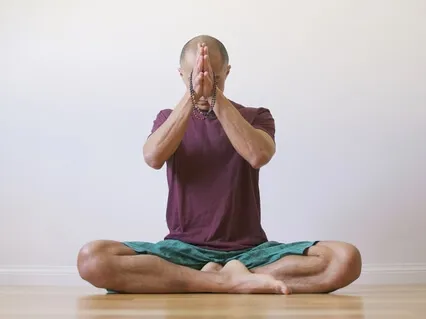
So today I thought we could chat about what exactly does that mean when we're saying namaste at the end of every yoga class?
What exactly do we mean?
I'm glad we're discussing this today because the word namaste has been,
Like we were talking about before,
Really integrated into the narrative of yoga,
Incorporated into the sort of spiritual narrative and we say it at the end of every class.
It's my impression that a lot of people don't actually know what it means.
There's a lot of different meanings we can talk about.
The one that you taught us in training and the one that I use to explain mostly is that namaste means the divine light in me honors and recognizes the divine light in you.
That is one of my favorite ways to translate,
For sure.
Yeah.
So what made you choose to teach us that definition versus the other ones?
Well,
I don't even know where I first heard that translation.
It's a very common translation though.
That could have come from anywhere.
I like that it is,
To me it's a very reciprocal greeting and really not greeting,
But I use it at the end of the yoga class,
So it's this parting goodbye,
But it also implies gratitude.
It implies that it's a two-way exchange.
It implies recognition.
It implies not reverence,
But respect and not just students respecting the teacher,
But also the teacher respecting students because whenever we say namaste,
Both the student and the teachers say it.
It's not one way.
Yeah,
I really like it as an acknowledgement at the end of class because it implies that we as teachers are getting the same thing out of the practice that the students have.
We've gotten to revel in the light that students have shared in the same way that students have reveled in the light that we've shared by teaching.
I also really like it as an acknowledgement of the sort of egalitarian nature of yoga,
That we're all equal and that we as teachers are not better or higher or different than students.
We are simply the ones dispensing the practice of delivering it and that students have the ability to really be their own teacher.
We talk about the term guru quite a bit and guru simply translates,
The translation that I like is changing from darkness to light.
As yoga teachers,
We have that ability and as yoga students,
We have that same ability.
I think it's important to note that technically in the word namaste,
There is no light.
We have superimposed and I don't know if it's just yoga,
Like American yoga that's done that or if that's a tradition that goes further back to the origins of yoga philosophy,
But namaste when we break down the word doesn't technically have the word light.
It doesn't mean that we can't translate it without the word light.
I think the use and meaning behind namaste,
It's all about intention,
Just like yoga.
The things that we do in yoga,
In the yoga practice are often symbolic of something deeper or something higher and that something deeper or something higher would not be there without intention.
Same thing with namaste.
Namaste can be very reverent and spiritual and respectful if the intention is behind it.
If the author isn't the intention behind it,
Then we get some of the pop culture memes that we see all the time.
Let's just shout out a bunch of them that we know.
Namaste in bed.
Namaste in bed,
Which is a funny one,
Right?
It makes us laugh.
I feel like as yoga teachers,
It's important that we can laugh at it.
We're not so sacred.
This word is not so sacred that we can't laugh about it.
We should be able to laugh.
The other one that I always see that's kind of funny to me too is namaste,
Bitch.
You see t-shirts and memes and things like that.
See,
That one makes my heart sink a little bit.
I know,
Again,
It's all intention and it's still such a beautiful word to have it followed by bitch is a little bit of a stretch.
Some of those things they do,
They detract from the word and then,
Again,
It goes back to the intention.
If you're using namaste as that meme,
The intention is just so different,
Right?
That's why it stings a little bit.
Right.
Well,
And it's interesting too because I always say it at the end of class and then I have students sometimes who kind of repeat it and they're kind of looking over and they're like,
What is this that she's making us say?
You can tell that they don't really understand what it is.
They're just repeating it.
In that way,
The intention is lost a little bit.
It's important for people to understand what it is that they're repeating beyond just what the teacher has said and other people in class are saying.
It's interesting,
I told you a little bit about this before.
I had a student,
I think last week in class and I said namaste at the end and she was of Indian descent and she said actually namaste is just really a colloquial greeting in India and in the West it's taken on this sort of spiritual meaning to it that isn't necessarily existent in India.
I thought that raised a really interesting point.
When I was in India last year,
People said it to me quite a bit colloquially and I just assumed it was because I looked like I did yoga or I looked like I was a tourist.
They're making fun of you or something behind your back.
Right,
They just saw my yoga mat and were like oh namaste but it turns out it is pretty colloquial.
I like what you said.
It really is the intention behind it.
You could use it as just a greeting or you can use it as a very meaningful spiritual acknowledgement at the end of class.
Let's look at the word a little bit and break it down.
Namaste is a Sanskrit word and by the way we are not Sanskrit experts.
This is just kind of the little that we know about it.
So namas means to bow or bow.
Nama means to bow and then as means I and te means you.
So namaste is I bow to you.
Even as I think about that translation,
There's a lot that those words imply to me.
If I'm bowing to you,
That is more than just like oh hey Phoebe.
If I'm bowing to you,
I think of like I'm Japanese American so the Japanese culture always comes to mind.
When the Japanese greet each other formally,
They literally bow to each other as this sign of respect.
So if you're saying I bow to you,
Then I think that that implies this sign of respect.
It's more than at least in origin,
It's a little more than just a colloquial hello or hey what's going on?
Right,
Right.
Which is beautiful at the end of a yoga class coming from a yoga teacher because you're saying I acknowledge all the work that you've done on your mat today and then when it comes to a more colloquial use,
Yeah sometimes you don't want to just go around saying I bow to you to everyone necessarily.
You want to really mean it.
So it's yeah I'm glad we're making this distinction because it can be just sort of thrown around.
Like you said,
It's the intention you put behind it.
I hope that students listening will sort of think about what it means to them so that when they are saying it back to a teacher in class,
They actually know what it means and they're not just saying it because everyone else is.
I think after discussing this even just for a little bit,
I realized that I need to define namaste a little more often for my students so that at least those who are regulars don't start to think that it means this is the end of class.
It doesn't mean class is over.
It doesn't translate as class is done.
Right,
Or that it's some sort of cult initiation.
It's something,
Yeah I think,
So when would a good time,
Should we define it at the beginning of class or maybe right after people come out of Shavasana?
Well I've heard you,
You'll sometimes say namaste,
The light in me bows to the light in you.
Right so you'll like translate it immediately after you say it.
I've heard you do that.
Yes,
I've done that sometimes.
And as we're talking about it,
I'm realizing that it may even require definition beyond that definition because if people don't understand what light means in this context,
Then it may actually be even more confusing.
Sure.
I think that bowing to the light in each other is really,
It assumes a lot.
It assumes that students experience and feel the yoga practice as something more than just physical.
Right.
Which hopefully they do.
Right.
I mean I don't think that's too far out of the realm of possibility,
Especially if you're working with a theme and you have regular students and they're there for the themes and the spiritual lessons that go along with the physical practice.
I don't think that's unreasonable to think of,
But.
.
.
We shouldn't assume that everyone understands that.
Right.
Which leads me to another definition that I was reading that said it's acknowledging our souls in acknowledgement of the souls in front of us.
And so maybe soul is another term that may resonate with people more than light or may make people feel even more confused.
In this context,
How would you define are soul and light the same things in the context of namaste?
I think so.
I think this goes to almost a deeper philosophical question or maybe even a personal question for people of who are you?
Okay,
So when we're saying namaste,
Let's take the light out for a second.
Just the root of the word bow,
You,
I,
You.
Yes.
Bow,
I,
You.
So I bow to you.
So then who then is bowing?
Are we,
Is it just my body making a bowing shape to you?
Or is my mind sort of acknowledging you or am I acknowledging you and thanking you and bowing to you from the deepest place?
The deepest place being something that everyone needs to define for themselves.
I'm bowing from my heart.
I'm bowing from my,
The light inside of me.
I'm bowing from my consciousness.
My spirit bows to you.
I think that's something for everyone to sort of figure out for themselves or,
Or define for themselves.
So I do think that as we think of yoga as this holistic practice of body,
Mind and spirit,
Whatever you want to call that third component,
When,
When we say namaste,
I bow to you.
But what part of me is bowing to you?
Right?
Who is the I and who is the you?
Exactly.
And what's,
What's the same about I and you and what's different about I and you?
So it's,
It's acknowledging that we,
We are the same and that we are different because I am me and you are you.
And so the same part of me that is similar to you as is different than you is bowing to you.
I feel like I've twisted myself up into a philosophical knot.
No,
I know what you mean.
So it's really,
It's really this connection of the things that make us the same,
That inner light,
Which is just as bright in both of us is acknowledging,
Connecting even more than the stuff outside the way that we think or what we look like,
The more external parts of ourselves.
That's not where we're bowing from.
Right.
So we're putting a lot of meaning into this,
This one word.
And that's probably a lot to explore or explain or define at the end of a class.
But I think over time as students attend classes regularly and want to learn more about yoga philosophy,
Listening to the podcast and things like that,
I think that it's important for people to think about like,
Okay,
I say this thing,
I say this word,
Namaste at the end of almost every yoga class.
What do I mean by it?
And it's really good to just pause and,
And take a look at the intention behind,
Behind the spoken word.
Right.
So as we take namaste off the mat and sort of into our lives,
It's,
I really like the fact that we identified it's,
It's both the acknowledgement of our similarity and our difference.
And as we do,
We like to apply yoga philosophy to our lives and our professional endeavors.
It's interesting to think of namaste in this context,
Especially when it comes to business and professional endeavors where often there is quite a bit of hierarchy.
If you're working,
If you're a yoga teacher and you're working for a studio owner or you're,
You own a business and you're working on a team,
Namaste is a really important acknowledgement,
Whether you're actually saying it or not to remind us that we,
We are as similar as we are different.
I integrate that quite a bit into my approach to business in thinking about working with vendors or contractors.
And something that's really important to me is always treating people in a way that acknowledges we are both similar and different at the same time.
And when I've worked in environments where that was not the prevailing idea,
It starts to turn into more hierarchical and separated situations that sometimes don't really work that well.
How does namaste resonate for you outside of yoga?
It is a very challenging concept to practice.
Seeing people beyond the external,
Even beyond mindset or thought patterns,
Because it's really at the very core that we're the same,
That that light,
That spirit is the same because we all think differently.
We all have different opinions.
We all look very different and,
And seeing beyond that can be very challenging.
The most challenging thing for me,
I think is attitude.
When I think that someone's attitude is misaligned with mine.
Like if someone has a poor attitude,
It's really,
Really hard for me to see the light in that person.
When someone's happy and willing and accepting and kind,
It's very easy to see that light what makes us similar.
But certainly I have my days where I'm not happy and accepting and kind.
And I have days where I'm upset or grumpy or my attitude is not my highest self.
And it's just this external.
So seeing beyond that is really challenging.
I feel like things like seeing beyond the physical and even beyond people's opinions is one thing,
But it's really the attitude that's really hard for me to see beyond.
I can't think of too many examples from outside of yoga because so many,
So much of my experience is in yoga.
But the most challenging yoga students for me as a teacher are the students who just have a scowl on their face the whole class.
They don't seem like they're enjoying themselves.
They don't listen.
They seem like they have a really bad attitude.
And I get a feeling from them that they don't want to be there.
That's really hard for me to connect to see the light in them.
However though,
I do practice trying to put myself in their place and giving them the benefit of the doubt.
And so often I'll get a student who I think is just hating class and after class they'll come up to me and say,
Oh my gosh,
I love class so much.
I feel so much better after class.
And I'm like,
Really?
Like I really thought that the student wasn't connecting with me.
I thought that I couldn't see their light.
It seemed very cloaked.
But then after class you see this totally different side of the person.
That light comes out and to me it just shows that you can't make assumptions and you can't always,
I can't always see very clearly that light inside.
That true core being because of something else that's going on.
And I've made the mistake many times and I'll probably do it again.
And it's one of the biggest challenges for me.
To really live that one word,
Namaste,
Is really hard.
Right.
Well I would attribute almost every issue of the human condition when it comes to dealing with other humans to forgetting our connection at some level.
When you treat anyone poorly,
You're forgetting your sameness.
Something that I've been thinking about quite a bit.
I've been extra nice and kind to anyone I have to deal with on the phone.
Whether it's calling T-Mobile or the internet companies or something because the,
I think because of the anonymity of phone calls,
People are terrible to telephone operators.
And so we forget our sameness even when we're in the same room as someone and so then through the cloak of telecommunications you're forgetting even more.
And so people I think who work at call centers for various things are just treated terribly.
And so I've really been making it a point recently to just say like,
How are you?
You know,
How's your day going?
Thank you so much for your help.
And of course then when they tell me some news that I don't want to hear that I owe extra on my bill or something,
I do my best to articulate to them that I understand it's not their fault,
It's the structure that's really upsetting for me.
Anyway,
For me it just illustrates another instance of when people forget our sameness.
People also do that in the car quite a bit.
It seems like the car is a very dense illusion for people and we forget our sameness which accounts for a lot of behavior on LA freeways.
So it's something that we all forget and throughout the day we're sort of like forgetting and remembering and then when someone really acknowledges you,
You know,
Even if it's just at the grocery store or something like that,
You're like,
Oh right,
We are all the same.
So maybe every day is sort of like a balance of forgetting and remembering our separation and our connection which makes the word even more replete with really beautiful meaning.
Just going back to some other ways or similar words that we use in yoga to namaste,
Very often we'll start a class with Surya Namaskar which is sun salutation.
So in that context namaskar literally translates to something like salutations or greetings.
So when we do Surya Namaskar A,
Sun salutation A,
We're greeting the sun which is a little bit different.
We're not bowing to the sun,
Like we're not somehow offering ourselves to the sun god.
We're simply greeting the sun in maybe that more colloquial way and then on the maybe the opposite end of the spectrum another use of that root word nama or namas,
Om namah shivaya is,
It's actually the start of the Anusara chant which Phoebe and I are both Anusara teachers so sometimes we'll start class with an invocation which is really an invitation for spirit to join us in the class and it's this little song that we sing.
And the first line is om namah shivaya.
Om namah shivaya is the first line and om namah shivaya is sometimes used as a greeting more formal than namaste and we'll probably do a whole other podcast on some of these other words like om but om it represents just everything,
The universe,
The one big spirit.
So om namah is like namaste,
I bow,
And then shivaya is,
Shivaya,
Part of the word comes from Shiva who is one of the Hindu gods,
Like one of the main gods,
But in this context as we use the word shivaya,
Om namah shivaya is I bow to something bigger than myself or something greater than myself.
Shivaya meaning the auspicious one,
The one spirit.
Not necessarily that you're worshipping Shiva but the root word comes from shivaya.
So om namah shivaya can be used as this greeting to again say like I'm bowing to this grand spirit in you.
It doesn't even have to be directed to someone like we use it in the invocation and we're just sort of offering that greeting or that salutation or that reverence to something bigger.
So for sure you get this much more spiritual context with om namah shivaya because you're bowing to that you're acknowledging om and shivaya,
This auspicious nature of the universe.
So to contrast om namah shivaya with namaste,
We're saying that om namah shivaya is more an acknowledgement of spirit.
Well I think it goes again it goes back to intention so I feel like namaste can be just as spiritual of a greeting as om namah shivaya but om namah shivaya it I guess we could say it's maybe more formal and it definitely is more charged just by looking at the words if we break down like the each of the words like om and shivaya.
Whereas namaste I feel like you can make it very spiritually charged if that's your intention or it can just be more of a passing greeting as you mentioned earlier in the podcast.
Sure I've also taught and I think taking your class where you've taught om namah shivaya as a mantra and it's really helpful if I'm holding people in a really difficult pose I'll have them recite it in their heads and I've gotten feedback from students that's been really positive so om namah shivaya can be a really powerful mantra maybe in a way that namaste could be but we may not teach repeating namaste over and over and over again in plank pose.
Super good point so om namah shivaya I think I've heard and I could be wrong but I'm pretty sure that om namah shivaya it's one of the most common mantras given to students to focus on to repeat to meditate on and because of that because hundreds of thousands maybe millions of people have used om namah shivaya as a mantra over hundreds of years it carries this power because so many people have used it with the intention of it being a spiritual galvanizing force it becomes very powerful so that I totally forgot that that om namah shivaya as a mantra is really important.
So it seems like we're back where we started which is that it depends with the word namaste and really any word that you use that it really comes down to the intention behind it so we are encouraging you as practitioners to take namaste and make it your own so that you don't feel like you're simply being forced to repeat something at the end of class and we're not saying that you can't buy shirts that say namaste away from me but that you at least how many of those do you have baby?
You have more than me.
Yeah it reminds me of an overheard LA post I saw recently where someone said what does namaste and then the other person said I think it means thank you in yoga so many interpretations none of which are totally wrong maybe some are just a little bit more meaningful and really what this reminds us to do is to be really intentional about all of our words because namaste can be laden with spiritual meaning or it can be a really colloquial casual term in the same way that other words that we use can be laden with meaning or be really colloquial so as we progress as yogis and then just as professionals in the world may we put a lot of intention behind the words that we use whether it be in the yoga studio or out in the world.
Namaste Kerik.
Namaste.