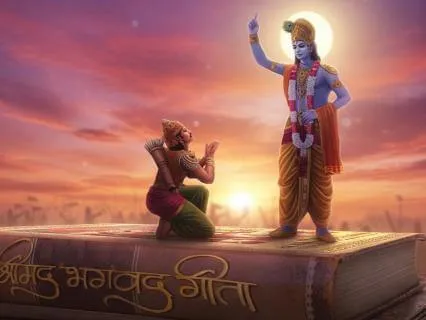
So in our journey we're looking at the Bhagavad Gita as a metaphor of deeper understanding of a spiritual journey.
So the two sides of the battle are Arjuna and his brothers who are the sons of Pandu and they are all about the brightest parts of us.
Our love,
Courage,
Righteousness in the way of alignment,
Honesty,
Integrity,
Spiritual connection.
The other side are Arjuna's hundred evil cousins.
Within us these are all of our attachments to our sensory experiences in the world,
Our desires for pleasure,
Our fear of pain,
And all the things we do to try to make sure that we maximize pleasure and minimize pain.
And now to fully understand that there's nothing wrong with pleasure and we shouldn't go around seeking pain.
The differences are unhealthy attachments to them.
So for example you might love chocolate.
I love chocolate.
But what if someone said it'd be a really good idea to stop eating chocolate for a while.
You know maybe we're pre-diabetic,
Maybe if we found out that we're allergic to something in it,
Maybe there's a reason.
And some part of you's like,
I'm not living without chocolate,
Now we have a problem.
Maybe you have a relationship that you desperately want to work but they're abusive.
Or there's something about the relationship that's actually incredibly unhealthy for you,
Your family,
Your children,
Whatever.
But there are patterns inside of you that are clinging to certain desires for security,
Or pleasure,
Or prestige,
Or status,
Or whatever.
Those attachments,
Even if it's not genuine pleasure,
Keep us stuck.
And that is what the true battlefield is.
The battlefield is called Kurukshetra.
And it is the battlefield of the soul where every one of us lives all the time.
And the challenge is,
And this is the story,
If you read the story or you listen to the previous talks,
The story is that the senses have taken over.
Our attachments have taken over.
And we are being driven through a world that is full of suffering.
Because we aren't accessing our highest selves,
We're not accessing our courage,
And our integrity,
And our truth,
And our honesty.
We're allowing our karma,
Our past habits,
Our everything to simply drive forward in a blind way.
So in our story,
Arjuna has come into the center,
Looked around the field,
And said,
I can't kill all these people.
I will not fight.
I am tired.
I'm exhausted.
I will not do it.
And he slumps down in the chariot.
So I'm just going to read,
We're going to go back a little bit,
And then go forward to where we're going to look today.
Now,
I am reading Stephen Mitchell's version,
But you can use any version you'd like,
Any version you enjoy.
So we're going to back up a little.
Arjuna said,
When the battle begins,
How can I shoot arrows through Bhishma and Drona,
Who deserve my reverence?
It would be better to spend the rest of my life as a pauper,
Begging for food,
Than to kill these honored teachers.
If I killed them,
All my earthly pleasures would be smeared with blood.
And we do not know which is worse,
Winning this battle,
Or losing it.
Since if we kill Dhrishtarastra's men,
We shall not wish to remain alive.
I am weighed down by pity,
Krishna.
My mind is utterly confused.
Tell me where my duty lies.
Which path I should take.
I am your pupil.
I beg you for your instruction.
This is where we left off last week.
He has prostrated himself to Krishna.
He's given up,
Or has he?
And he continues.
For I cannot imagine how any victory,
Even if I were to gain the kingship of the whole earth,
Or of all the gods in heaven,
Could drive this grief that is withering my senses.
And again,
If you're new to this,
To understand,
We aren't talking about actually killing people.
When he talks about killing his teachers,
And Bhishma is his grandfather,
These are the ancestral patterns of our families,
Of our society.
Drona is a teacher of his.
All the things we have accumulated,
The ideas we've accumulated in our lives,
That maybe aren't actually serving us.
Are we willing to let them go?
So where this is really placing us is that transition point where we all find ourselves at some point.
We've been living the life we've known.
We've been living the life that our parents expect of us,
Or we're living the life that we chose out of rebellion against our parents,
Which is still about our parents.
Whether we choose to do what they say or rebel against them,
They are still holding all the cards.
This is not freedom.
Maybe we're doing all that.
We're living the life that we have created in our mind because we believe it's true based on all the reading we've ever done,
Or the people we've ever studied with,
Or what we learned in church,
Or what we learned in school,
Or what we learned from work.
And we believe,
No,
This is right,
This is right,
This is right.
Even though we're exhausted and we're depressed,
And our days are filled with things that just make us more tired and sicker and more despairing about the world,
We will continue this until one day we give up and we say,
There's got to be another way.
There's got to be a light.
And the thing is,
Every one of us has that light inside of us.
It's always been there.
It isn't that we have to find it out there.
There's always some part of us inside that actually wants to be alive,
Actually live in this world,
Not just be a slave to it,
To be a slave to everyone else's expectations,
Be a slave to our own expectations,
To be just literally unable to live the life that would bring us joy.
And this is where Arjuna finds himself.
I don't want to spend the energy to get rid of all these bad habits.
I don't want to let go of my joy of all these attachments,
Or addictions,
Or relationships,
Or patterns,
Or habits.
I don't want to give them up.
How often we fight hard for that.
It's like,
No,
I don't want to change my diet.
I don't want to start exercising.
I don't want to do the yoga.
I don't want to take time to meditate.
I don't want to.
I don't want to,
You know,
And we fight really hard,
Even though it's almost like there's two sides of us.
There's one side of us that says,
I know this is a really good idea.
And something about that other side says,
I actually can see myself in this really happy place.
So we have these glimpses of this really happy state of being that is bright,
And shiny,
And joyful,
And my body feels good,
And I'm not in pain,
And I sleep well,
And I have friends,
And there's great food,
And I,
You know,
We can feel that in our hearts.
And that is the North Star.
It's that something inside of us that knows something else is possible.
But in order to get there,
We must engage.
We must fight.
We must,
And I know that word is loaded,
It's loaded for me when I say it too,
But we must engage.
Because if we don't,
The hundred evil cousins of sensory pleasures,
Addictions,
Expectations,
Self-denial,
Struggles with self-worth,
All these things will win.
We all know that.
And so this particular part of the book is reflecting back to us that the fact that we're struggling,
You know,
It's like you start a new diet,
Or you decide you're going to start journaling every day,
Or I'm going to walk every day,
Or I'm going to go to the gym,
Or I'm going to do whatever to really regain my mental,
Spiritual,
Physical health.
And then something,
Quote,
Happens.
Something,
Or nothing,
Happens.
And the old habits just win.
And then we circle the block again.
Then we circle the block again.
And so this is why I kind of love the talks right before this,
And then the part we're going to look at,
Because we can hear it in ourselves.
Arjuna said,
When the battle begins,
How can I shoot arrows through Bhishma and Drona?
How can I give up the ways my family has always been?
How can I give up all the time and effort I've spent learning this other way?
I'm really good at it.
How can I do that?
It would be better to spend the rest of my life as a pauper begging for food than to kill these honored teachers.
Why would I want to live if I don't get to enjoy myself?
Why would I want to give up everything I know?
I mean,
What will life even be like if I killed them?
All my earthly pleasures would be smeared with blood.
How often do we think that?
If I give up all the sugary foods,
And the fried foods,
And my Coca-Cola,
Or whatever it is that we do,
Or my smoking,
Or my drugs,
Or my drink,
Or my,
I don't know,
Sedentary lifestyle,
Whatever it is,
Or my emotions,
Or whatever it is that we don't want to give up.
We have this story in our head that life will suck if we do that.
I mean,
This is what gives me juice,
Right?
There's this like,
And then he says,
And we do not know which is worse,
Winning the battle or losing it.
Because if we kill all these bad habits,
I won't even want to be alive.
There'll be nothing to live for.
These are the voices of the habits of the addictions.
If you've ever struggled with any kind of addiction,
Whether it's smoking,
Drinking,
Drugs,
Food,
Shopping,
Gambling,
Gossip,
Doesn't matter what it is,
If we have ever had any of those addictions,
Doesn't that exactly sound like the voice in our head when we think about giving up the addiction?
Life will suck if it's not like that.
Why would we ever want to do that?
It will be terrible.
It'll be so boring.
We'll have sucked all the marrow out of life.
Busyness is an addiction,
Exactly.
So then,
All of a sudden,
He realizes like he's exhausted.
Do you know like even when you become tired of hearing all the excuses for why you don't want to do it?
So then Arjuna shifts.
I am weighed down by pity,
Krishna.
My mind is utterly confused.
And then he looks at Krishna and says,
Tell me what to do.
He says,
Tell me where my duty lies.
Which path should I take?
I am your pupil.
I beg you for your instruction.
And so then today,
We are talking about the next phrasing.
For I cannot imagine how any victory,
Even if I were to gain the kingship of the whole earth,
Or of all the gods in heaven could drive away this grief that is withering my senses.
So I'm going to read to you another interpretation of it.
And this is by Paramahansa Yogananda.
This is his interpretation of it.
I behold nothing that will do away with this inner affliction that pounds my senses.
Nothing,
Not even my possession of an unrivaled and prosperous kingship over this earth,
And lordship over the deities of heaven.
Not even my possession of an unrivaled and prosperous kingship over this earth,
And lordship over the deities of heaven.
So this is what we're going to look at today.
Possession of an unrivaled and prosperous kingship over this earth,
And lordship over the heaven.
So when he's talking about the earth,
He's talking about us,
My experience,
This earth,
This body,
Mind,
Spirit,
And the unrivaled joy and pleasure and everything of that body.
Here he's referring to three inner rivals that get in the way of all of our happiness and joy.
The first inner rival is impaired inner subtle life forces.
Impaired inner subtle life forces.
So what are the inner life forces?
The subtle air prana.
We've all heard of prana.
We do meditations that are pranayamas.
Pranayama actually means to expand the inner life force.
So the prana runs in 72,
000 energy channels through the body called nadis.
When they are flowing easily,
We have energy,
Life force,
All this beautiful divine energy is nourishing and healing all the cells of the body all the time.
But when that flow becomes impaired,
Bad things happen.
We become nervous inside.
We become anxious.
We have illness.
We have issues with aging.
We can't think straight.
So just imagine that.
Imagine we have this physical body we see,
But imagine overlaying that or replacing it with this beautiful energy body.
72,
000 channels of energy,
Almost like a hologram of your physical body,
And the energy has to be flowing through that all the time.
And that that is actually our life force.
The problem is we do so many things in this world that throws this subtle energy off.
One of the things is an overindulgence of the senses.
So when we have over stimulation of the senses,
Now where does this happen?
Sight.
Constantly looking at things.
How much are we staring at our phones,
Watching videos,
Watching movies,
Watching this?
How often during the day do we just close our eyes?
If all we did was close our eyes and stop all the sensory stimulation of the eyes and just close our eyes,
How often do we eat too much or we eat food for the sensory stimulation as opposed to nutrition?
How often do we eat salty foods?
Because I just love salty foods.
Maybe your body is calling for salt and maybe we should have some salt,
But probably not the bag of chips.
And this isn't a lecture.
This is simply understanding that when we overindulge in sight,
Hearing,
In the mouth,
Everything.
It could be even a sex addiction or something like that.
It throws off our inner subtle channels.
Like just imagine if you had this,
Imagine a beautiful pond and the water is just,
It's just this beautiful pond.
And every so often,
You know,
A dragonfly comes down and touches the top of the water and these subtle vibrations go across the pond.
And then all of a sudden a golden retriever just jumps into the pond.
Or then a motorboat goes through the pond and then something else happens to the pond.
This is the state of our nadis,
Of our pranic body,
Of our astral body that holds the prana.
When we are constantly stimulating it externally,
Imagine if we always have music on or we always have a podcast going because we have to be efficient.
We have to always be stimulated,
Stimulated,
Stimulated,
Stimulated.
So we live in this perpetual pranic imbalance,
Disruption.
It's like we constantly are in a river where there are 400 motorboats going and we're trying to just rest,
Float and listen.
So this is where if we want to calm the inner self and have this happiness,
Just to really make sure we take time where we aren't overstimulated.
Every day,
Whether it's a walk outside with no headphones,
No music,
No podcast,
No Garmin tracking your steps,
Nothing.
Just existing with just natural stimulation.
Trees aren't flashing at you.
It's not like that.
They're just trees and you get to observe it instead of it stimulating you.
To imagine food and drink and to deeply connect with what we're putting into our bodies.
Are we doing this for stimulation?
Are we doing it for nourishment?
Are we doing it for joy?
It's okay to eat for joy,
But to really watch what is this doing energetically inside of me?
Is it making me hyper?
Like I know for me,
I do love sugar unfortunately and I love chocolate as long as it's in my system.
If I go off of it,
I can't stand it.
But while it's in my system,
It lives and it just grows like I'm an alcoholic.
It's just crazy.
And eventually I'll end up with a headache.
The overstimulation will actually throw me out.
I'll end up and I actually think it's connected with my insulin and pancreas and all that.
And I'm not diabetic or anything,
But it does something really amok in my system.
My organs are overstimulated.
Everything's overstimulated.
And so there's really something to understand the connection of our inner health and our mental health and our happiness.
That when our body is trying to digest all these highly stimulating substances,
Our nervous system is on edge.
This is why changing our diet can deeply affect our mental and emotional health because the pranic channels are now able to flow unencumbered by all this excess stimulation.
Chronic stress completely disrupts the prana.
Worry,
Listening to the news and then talking about it over and over and over and over and over and over and over again.
You know,
I remember back when the Twin Towers fell and all that happened and children were being traumatized because they thought that towers were being bombed over and over and over and over again,
That thousands of people were being killed over and over and over and over again because they kept showing up on the screen hundreds and hundreds of times a day.
That's what we do to ourself.
When we repeat whatever it is we're angry about,
Whatever it is that's disturbing us,
Every time we talk about it,
One,
We aren't getting anywhere closer to helping it and all we're doing is disturbing the life force within us over and over and over and over again.
So we have to be very aware of this,
Be very conscious of that.
We have to be very conscious of our habits because every time we have a habit our life force is being forced into a pattern,
Into a groove and very often it's causing more disruption in the body or it's a direct leak outward.
It's like every time you get mad at that person for the 400th time your life force is like on a superhighway straight out of your body.
Like there's a reason we're exhausted because we're doing all these things that are throwing our energy out of our bodies,
Out at that thing over there and out at that person over there and out at that stranger over there,
Out at that tv personality and that politician and that thing over there and and our energy is just going out like this and we feel all manner of emotions and everything.
Where does it leave us?
Disturbed?
Anxious?
So what do we do?
This is the great question.
Well we're here on Insight Timer.
We practice meditation.
We practice yoga.
This is the whole challenge with the North American understanding of yoga and meditation,
Especially yoga,
That we think it's an exercise program to get stretchy.
Yoga,
The alignment of yoga,
Whether it's hatha yoga,
Kundalini yoga,
Ashtanga yoga,
Doesn't matter.
It isn't about the body.
It's about clearing the channels of the pranic body so that the life force flows through us so that we'll be healthy.
The physical body is a manifestation of the pranic body.
All yoga is designed to clear that body.
It will also heal the physical body but it's through the energy and this is where we don't want to get caught up in what it looks like,
Comparing ourselves to other people or anything like that.
We want to heal the pranic body.
Yes,
Bonnie,
The eight limb path.
Exactly.
Patanjali's eight limbs of yoga.
The first two,
The yamas and the niyamas,
And these are all about living in the world in peace.
They're about choosing,
Making choices where we can live in truth,
Not grasping at things,
Not being attached to those things,
And then allowing yourself to be comfortable in your body.
Asana,
Living in comfort,
Sitting,
Walking.
How do you hold yourself?
Pranayama,
Being aware of the pranic body and actually expanding it.
They actually sometimes talk about mastering it,
Like really deeply understanding that we are an energetic being and we want to keep that pranic body clear.
Pratyahara,
This is withdrawing of the senses just like we talked about.
Allow ourselves time when our eyes are not being stimulated,
When our ears are not being stimulated,
When our mouth is not being stimulated,
That we're actually able to be still inside.
And meditation,
Dharana,
Allow yourself single focus.
Don't do 400 things at once.
Don't even do two things at once unless you're a,
You've got small children and there's no point,
There's no other option.
Dhyana,
Allow yourself to be absorbed into whatever you're doing.
Like completely just let yourself melt through single pointed focus and all that and allow ourselves bliss.
It's almost like when you actually sit quietly.
Imagine you've done a meditation here on Insight Timer and you feel so blissful.
Let yourself sit there a little longer.
Let your whole being bathe in that energy because what that does is it expands the power of that inner light which guides us further.
Like the feeling of ecstasy will guide us for faster and give us more incentive to make change than any philosophical teaching.
So anything that brings that beautiful genuine ecstasy.
Another thing we can do is to really be aware of our diet.
When we eat foods that have life,
Vegetables,
Fruit,
Things like that,
This is life-giving.
When we fill our bodies with non-food,
Just sort of products that have been fabricated,
You know,
To fill calories,
Our bodies just become damp and stuck.
So it's really important to,
No matter what we're doing,
Just make sure we eat life-giving food.
And it's really an interesting thing to look at what I'm going to eat for lunch.
Because I mean for me,
Especially if I'm busy,
I just like to eat toast.
Not the most life-giving food in the whole world.
Like I probably could just look in my fridge and say,
Oh actually maybe I should eat those carrots before they go bad.
Because they actually have life in them.
So our diet is actually a huge part of the health of our pranic flow.
Another huge thing we can do is be careful about our company.
Be careful who we talk to.
And this includes podcasts,
Tv shows,
News,
Books,
Articles,
Everything.
Who are we listening to?
Because they say that energy is contagious,
Vibrations are contagious.
And if they are anxious and angry and furious,
What does that do to your pranic body?
It just creates disruption.
And if you have friends,
Find happy company.
And maybe right,
Maybe you have great friends,
Maybe you have great family,
Like who knows.
But if you don't,
Kind of look out into the world and where are people who love to help?
Are they volunteering?
Are they building cool things?
Are they in the little theater?
Where are they?
Are they artists?
Are they joining gyms and crossfits?
Are they going to yoga classes?
Go to those places.
Find company of people who are growing and expanding and are optimistic.
Because those vibrations are contagious and they will shift our consciousness.
And to really understand neuroplasticity,
That habits form with every single action we take.
Every thought we have,
Every action,
Every single action we take forms a habit.
That habit can be a new habit that is life giving,
Or that brings us to a higher self or a more expanded,
Happier self,
Or it deeply entrenches an old habit that actually harms us,
That creates more blockages.
And to really deeply own this,
Like the spiritual path is a very active path.
It isn't passive.
And this is the whole point of Arjuna's struggle.
Because as long as he doesn't fight,
All the old habits win.
Samskaras are basically habits and patterns that we have done for lifetimes.
And so it's very interesting to sit with that and say,
Now this habit I have,
I fully understand all the sensory pleasures that it brings me.
Sometimes I also understand the challenges and the blockages that it creates.
What do I choose in this moment?
What do I choose?
Am I willing to let those go?
Am I willing to fight to let those go?
Now this could be anything.
This could be a habit food wise.
This could be a habit exercise wise.
Maybe you work out to such a point you're always injuring yourself.
You just are so worried that you have to do it and you have to be the top and you have to be this.
You are perpetually injuring yourself.
Or maybe you have such a hard time getting active.
Our bodies were designed to move.
We were meant to live outside and be constantly moving our bodies so all of our organs actually need to move to be healthy.
The fact that we have moved into this sedentary life,
And I am brutal at this because I teach online.
I write books.
I do zoom counseling.
I sit all day long.
It is such a challenge for me to say to overcome the inertia of sitting at work all day and say let's dance Katrina.
Let's go to the gym.
Let's just walk around the block instead of going and getting that piece of toast to entertain me.
This is a real thing that we struggle with.
So sometimes we don't move the body enough.
Sometimes we move it far too much and we actually wear ourselves out.
Maybe it's a thought pattern.
They're all thought patterns but maybe you have the pattern of worrying.
Maybe there's something going on in your life.
Maybe there's something going on in the world and your mind is in a groove and it is chewing on this and every person you see you talk about it.
Everything you repeat this story over and over and over again.
How long do we want to do that?
How long before we choose something else?
And this is where a neuroplasticity is so important that we stand up on that chariot and we say I choose a new pattern.
But this is where the brilliance of this part of the study is so great because the fact that we still struggle is real.
Arjuna has given up and he's like tell me where my duty lies.
Which path should I take?
I am your pupil.
I beg you for your instruction.
This is that thing where we finally go that's it.
I'm going on the diet.
I'm starting the exercise program.
I'm doing it.
And the next day we wake up and we go for I cannot imagine how any victory.
So we're back in the drama.
Back we are.
For I cannot imagine how any victory even if I were to gain the kingship of the whole earth even if I was perfectly healthy and my whole life was awesome.
Nothing could drive away the grief of losing all these pleasures.
So he's still kind of coming up for air one last time.
And the next phrase is having spoken thus to Krishna Arjuna says I will not fight and fell silent.
It's interesting what it takes and this is not this is not a teaching of shaming us for our bad habits or shaming us for the way we are.
It's understanding the struggles we have.
We aren't dealing with something simple here.
So the three rivals that Paramahansa Yogananda teaches that we that we could actually release one the struggle of the prana.
That our prana is disturbed and this causes great challenge inside of us due to all the things we've talked about.
The second our karma our habits samskaras all these patterns that are working through us which could be ancestral many lives and the thing the simple habits we have in this life right now that take us out of the driver's seat that suddenly it doesn't matter where I want to take the chariot the habits are driving me or the patterns of my parents are driving me or my grandfathers or whoever or maybe just I just don't want to and I just want to do the thing I've always done and I'm just going to put my head down and just do it.
These are these are strong patterns and the third rival that we didn't really get to and we won't talk too much about they actually call it ignorance or avidya or the lack of knowledge and what they're talking about is it's all connected this incessant identification with the body that we don't really get that we are spiritual beings we really don't get it and deep down we actually do think that our physical body is who we are and we think that and so we think yeah but but I need that thing because you know that's just who I am and and I just drink a lot of coffee and I love sweets and it's Christmas time and this is what I do and and that's just what it is and we think that this person that's talking because of all these physical aspects or the mental aspects we think that's who we are but when we meditate and we sit quietly or whatever your meditation is maybe it's resting on the couch with a cup of tea maybe it's going for a walk to the beach maybe it's riding a horse maybe it's going for a run maybe it's tucking in with a book maybe it's doing yoga maybe it's sitting and listening to great music whatever your meditation is when we quiet our mind and we go inside we know that we are so much more we are so much more than this physical life we are we get to live in this beautiful vehicle to live and experience and all that but we are not the vehicle which means we also get to be in charge and we get to make choices and that means that when a habit rises we see it that it's just a habit and we can make a choice to do it or not do it and there's no wrong answer there's no right answer there's no hurry we don't have to you know become enlightened tomorrow or something we're here for the journey we're here for the whole thing all the ups the downs that's the point but this is what he's saying and this is what Arjuna is showing us that it's all good we'll go up and down and then when we come back in our next talk and we start looking at how does Krishna respond then an interesting dialogue begins between our highest self who is Krishna and us our soul and we continue the dialogue and we continue the discussion it doesn't just end you don't suddenly just surrender to everything listen to the divine and your life is awesome after that it's a journey and so going away from this to just be aware be aware of the things in our lives that disrupt our energy our prana food people discussions everything look at the company we keep look at the tv shows we watch look at the radio we listen to just observe it and then observe our habits and then just remember that we really are these divine eternal people does anyone have any questions i know we're just over the hour but if you have any questions i'm happy to chat about it is all the plastic surgery voluntary just insecurity botox washing out your gray hair i don't know i don't have the influences that a lot of people have you know i don't i remember talking to a man once who lived he was from columbia i think and down there girls would get their first plastic surgery as their high school present their graduation present it was so cultural i don't live in that culture like it's almost not even a question and then there's other places that people get it because they they feel ugly or they feel old or they feel something and i don't know it's a toughie when presented with multiple options how do we choose the right path is there a right path you know what i believe the right path is so the funny thing is is imagine in our heart chakra atman our true sense of self in this place there's no duality there is no right or wrong there's no right path wrong path it's just the next step on the path and the challenge with the world is is that we're presented with all these options and then we're told the right path is this the wrong path is this but the truth is righteousness isn't about righteousness and wrongness the actual word righteousness means it's in alignment with your soul in that moment so for example i love smoking i think it's because i'm so in my head all the time and when i smoke it calms me but my body hates it when i smoke i don't smoke now it makes me sick i become gray i become tired my joints hurt so i don't smoke but i actually really enjoy it i wish it was really healthy i've had times in my life where i was deadly against smokers especially after i had a lot of people die of cancer in my family like a lot and after that a couple years of constantly being in hospitals and funeral homes i became one of these insane militant non-smokers like i would actually walk up to a friend and rip a cigarette out of their mouth and stomp it and shame them i have been that person so in general not smoking is the right path for me it's in alignment with who i am not smoking makes me healthier it's a good thing it's better for me to meditate to find that quiet grounding than to smoke but one time long time ago one of my nephews was born stillborn and for many of the kids in the family this was their first experience with death and one of my other nephews who was about 20 at the time was really struggling he'd been on the street he'd been struggling with meth he'd been homeless he'd just been really really having a hard time and he came back into the family shortly before this baby died so he'd been he was a real black sheep no one would talk to him they were all really judgmental of him and after the funeral he was out on the porch having a cigarette and he and i were very close he lived with me for a time when he was struggling and he knew that i was a crazy non-smoker at that time i was like just not okay but with it and i went out and he was standing there and he was completely like catatonic like he had completely pulled himself completely inside of himself and he wouldn't talk to anybody and i stood there with him and i said hey you know how you doing and he wouldn't even look at me he just turned his back to me and i pray for guidance right this is the only way i know how to navigate and all i saw was me having a cigarette with him so i said to him hey can i have a drag and he turned and looked at me with this look on his face like okay and he had he passed me the cigarette and we shared the cigarette and then he started crying smoking isn't right or wrong eating chocolate isn't right or wrong worrying isn't right or wrong it's just what's right in this moment for us what's on path it's about staying awake and not falling into patterns and being unconscious that's all we need to know we can't look for the magic bullet answer well thanks everybody see you guys