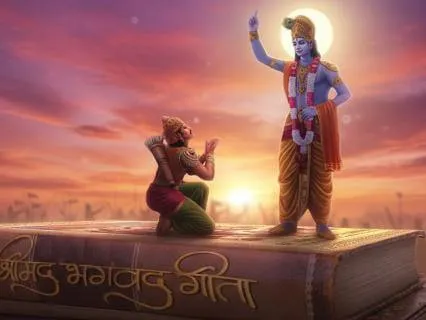
Today is the first day of our study of the Bhagavad Gita,
And this is a very exciting journey.
For the last few years we've been studying the Radiant Sutras,
Which had a single verse that we were able to dive into every week.
And the Bhagavad Gita is very different.
It's part story,
Part lesson,
And it's also a part of the great Mahabharata,
The great epic of Hindu scripture.
And so it's actually very helpful to understand some background as to where the Bhagavad Gita sits in that.
So our classes going forward are going to be different than before.
They're going to be different than the Radiant Sutras because we're going to flow with the lessons more than we're going to do this particular sutra or this particular stanza.
We're going to flow a little bit,
I suppose intuitively,
Because it's not a huge book,
But it's worthy of some very deep dives.
So today we are reading the first chapter,
And this first chapter gives us the foundation or the context for the entire teaching.
I am reading specifically out of the Stephen Mitchell version of the Bhagavad Gita,
And you can use any version.
It really doesn't matter.
It's not,
This isn't like the Radiant Sutras where we're diving into a particularly beautiful poetic translation.
It's not like that.
I love Stephen Mitchell's work.
The reading on Insight Timer of the Tao Te Ching that I did is also Stephen Mitchell's version,
And so I really enjoy him.
But all versions are interesting.
All versions have something juicy to say.
So even if you don't have this particular version,
And you don't need any version at all,
By the way,
You don't need a book to be a part of this class.
Just being here,
Questions,
Thoughts,
All that,
It's perfect.
You don't need a book.
So today I would like to read the first chapter to you,
But it's very important that we have some kind of idea as to why this story in this book is happening.
So the majority of this book is a conversation between Arjuna and Krishna,
And Arjuna is this great archer,
This great,
And he's in a great chariot,
And the charioteer is Krishna.
Arjuna is us.
Arjuna is every single one of us as a human on a journey of life.
Krishna represents our highest self,
Our Atman,
The God that lives within,
Our highest wisdom.
So for all intents and purposes,
This whole book is a discussion between you and God,
You and spirit,
Whatever that interrelation is.
So the background of this particular story,
In short,
There's a great battle between these two families.
Arjuna is on one side,
Others are on the other,
And at one point Arjuna says to Krishna,
Take me in to the center of the field of battle.
Let me see what's going on.
Let me see.
And in many ways Arjuna was a great warrior.
He was of the warrior caste.
This was a huge part of his duty,
What he was meant to do.
So some say that he was,
He asked to go into the center so that he could get a sense of it all.
He wanted to know who the,
Where the great warriors were,
Where were the leaders positioned.
He wanted to see.
And he got out there and he looked around and all he saw was family and friends and neighbors and cousins and grandfathers and teachers.
And he looked around and he thought,
How can I kill these people?
These are my family.
These are all the people I've known my whole life.
What good will come of this?
By the end of the chapter he slinks down in the chariot and says to Krishna,
I can't do it.
I can't fight.
The second chapter begins with Krishna saying to him,
You must fight Arjuna.
This is important because very often this is where the Bhagavad Gita is very confusing.
You think,
Why would God or our highest self tell us to fight?
This doesn't make any sense.
And this is where it's really important to understand that the Bhagavad Gita is a metaphor.
It's a metaphor for our internal journey,
Our internal battle between the parts of us that want to move forward in our dharma,
In our true path,
And what we might call our lower selves or our blind selves or our lost or ignorant selves that perhaps are caught in karma.
There's always parts of us that are caught in old patterns,
Anger,
Jealousy,
Hate,
Frustration,
Self-doubt,
All these things.
And so essentially inside of us,
There are all of these parts of us that are struggling and angry and they get caught up in all kinds of us versus them and we get all righteous and you know,
We all have that.
And then there's the part of us when we sit quietly in meditation that knows better,
That knows that we're bigger than that.
I mean,
That knows that this isn't what life is about.
Why am I getting caught up in all of this drama?
What's going on?
And the reason Krishna tells Arjuna that you must fight is because if we don't engage in this tension between us,
Guess who wins?
Karma will win if we take our foot off the gas.
If we struggle with not getting off the couch,
The couch will win.
If we struggle with working too much,
Doing too much,
And we don't slow ourselves down,
Overwork will win.
If jealousy,
If we're prone to jealousy,
And if we don't sit with it and whatever we call doing the work and sort it out,
Jealousy will win.
And this is a huge part of this entire journey that we're going to go on,
Is understanding that we have to stay engaged.
We have to stay engaged.
So there are characters in our story,
And the characters matter.
The battle happens in a place called Kurukshetra,
Which essentially means the battlefield of the heart.
The Kurus are the people who are warring,
And they are descendants of King Kuru.
Kuru means the heart.
Kurukshetra,
It's like the place you pilgrimage to,
Or the place that you head to,
Kurukshetra.
So the descendants of King Kuru were two brothers,
Vritashtra and Pandu.
Now Vritashtra was born blind,
And he was the eldest,
So theoretically he should have been king,
But he was blind.
So the kingdom was passed on to Pandu.
Now first of all,
To understand the metaphor here,
That Vritashtra,
He represents our blind senses.
It's kind of like those parts of us that struggle in those karmic cycles that we're lost in.
Those parts of us are blind,
Left to their own devices.
They're just going to chew on each other.
They're just going to go,
Go,
Go,
Go.
There's no light in that.
If you've ever experienced depression or anxiety or struggles or anything like that,
I certainly have,
You know that on their own,
But we can't resolve them.
Blind spots,
Exactly.
So Vritashtra represents our entire being of blind spots.
Now he had a hundred sons,
And essentially his hundred sons represent all the aspects of that blindness.
Anger,
Jealousy,
Envy,
Self-doubt,
You name it.
His sons are all of those.
But Pandu had five sons,
And all of them were righteous.
The eldest was named Yudhisthira,
And he represents righteousness.
Then there's Bhima,
And Bhima is strength.
Like to realize this is all inside of every one of us.
Righteousness being,
Meaning that you're in line with your truth,
Not like a weird Puritan righteousness.
Arjuna,
Who is our hero,
He represents skill and valor.
And then there's twins,
Twin brothers,
Nakula,
Who represents beauty,
And Sahadeva,
Who represents wisdom.
So Pandu died.
The father of these five boys died.
So the kingdom was going to be left to the five brothers.
Well,
The eldest of Vritashtra,
Who is named Durodhana,
He was particularly evil.
Just let's just imagine whatever the quality is.
It's ironic that last week we literally talked about loving your shadow,
But this is a whole other teaching.
Imagine the part of you that,
If in doubt,
Will always get you in trouble.
That always just wants what it wants,
No matter what.
And if in doubt,
Oh,
That part of me always wins.
And then two weeks later,
I wake up going,
Oh,
I knew better.
That's Durodhana.
Well,
Durodhana was so enraged that he wasn't going to get to be king.
Women didn't exist in this world.
Alas,
There are so many women in this story,
And yet we don't talk about them.
It's an ancient,
Very patriarchal society.
Yes,
I also noticed this.
So Durodhana decides that he's going to kill the five brothers because he wants to be king.
His dad was the rightful king.
Pandu never should have been king anyway.
So he wants to be king,
Not these guys.
And this is a lot of the stories of the Mahabharata,
The journey of these people.
And so I'm just going to give you a little bit of background,
Just so we understand the battle.
So the first thing Durodhana did was there was a religious festival in a kingdom a bit away.
So he built a castle that was extremely flammable and told his five stepbrothers or cousins,
Really,
That they could go and stay in this palace because he just made it for them.
So they go and they stay there with their mother.
But luckily,
Before the whole thing got burnt to the ground,
Someone told them the sons of Pandu are called the Pandavas.
And so somebody gave them a clue.
They escaped into the forest.
Durodhana thinks,
Right on,
They're dead.
Now he takes over his king because the five brothers are dead.
So he now takes over the kingdom.
Now,
First of all,
Imagine the state of the kingdom.
Imagine if you're very worst quality.
And I say that with love.
Honestly,
We all have them.
We all have some aspect of ourself that gets us in trouble.
Now,
Imagine you give that one aspect.
They're king and everybody must bow to that.
So needless to say,
You can imagine where the state of the kingdom went under the leadership of Durodhana.
Anyway,
The Pandavas are in the forest and they're hiding because they don't want them to know that they're still alive because they realized that they tried to kill them.
When the meantime,
A neighboring king decides to have an archery tournament so that he could find a wonderful husband for his daughter Draupadi.
And this king's name was Drupada.
This matters because they were actually going to be mentioned in the reading that we're going to do.
So Drupada is the king.
His daughter is Draupadi.
Well,
Arjuna,
Our great hero and archer,
He wins the tournament and wins the hand of Draupadi.
So here's our first woman.
It's a funny story,
Weird story.
It's not really a point in the Bhagavad Gita,
But as the story goes in the Mahabharata,
The five brothers with Draupadi,
They're all excited and they're heading home through the forest to where their mother is,
Kuntu.
From afar,
They're like,
Mother,
You wouldn't believe the wonderful treasure we found,
Speaking of Draupadi.
And the mother,
Not knowing what the treasure was,
Said,
Well,
You five boys had better share it.
And so they took this seriously and Draupadi became all of their wife.
But that's another story.
So anyway.
So in the meantime,
Dhristarastra and Duryodhana,
The blind king and the evil first son,
Here obviously realized that they are alive.
Darn it.
Well,
Duryodhana is like,
That's it.
We've got to make another plan to kill them.
And his father talks to the wise uncle,
Bhisma,
Which also is important in the story.
And Bhisma,
He's like the grandfather of everybody.
He's the wise one and da da da.
And Bhisma says,
No,
Don't do that.
I think it's time to end this.
This is nonsense.
Split the kingdom in half,
Give the Padavas their half,
And you guys keep your half.
Even though they really had no right to any of it at all,
But this was sort of how to keep them happy.
So they gave them the worst part of the kingdom,
Like basically a swamp.
And of course,
What did they do?
They turned it into beautiful splendor.
Everyone was thriving.
It was absolutely wonderful.
Well,
This really pissed off the first son big time.
And he was like,
That's it.
I need to get this all back.
I need vengeance.
Apparently the eldest son of the Padavas had a gambling issue.
I guess,
You know,
You got to have some fun juiciness for the story.
Duryodhana,
The first son,
Invited the boys over for a game of dice.
But of course it was rigged and they cheated and the bad guy cheated.
And over a horrible long,
Long period of time,
Eventually won back the other half of the kingdom,
His brothers,
Everybody,
And Draupadi,
He won all of them.
And that still wasn't enough.
Something else happened,
A whole pile of stories.
And then they had another dice game.
And in this moment,
They lost everything and they were exiled to the forest for 12 years.
It turned into 13,
But again,
Not really important for our story.
And in the meantime,
While they were in exile,
They worked hard and deep on all of their virtues.
It's kind of like that person that goes to jail and reads every book and gets fit and does an amazing,
You know,
They returned and they said,
We would like our half of the kingdom returned to us.
Shocker,
The son said,
No.
Battle started beginning amongst the elders and the teachers.
And they're all like,
You really should give it back.
And he's like,
Absolutely not.
I will.
And you can imagine now the state of the kingdom.
People are suffering.
Bad things are happening.
They don't have a good king.
So this is the foundation of the battle that we're about to read about.
So there's another little story I want to tell you,
And then I'm going to read it.
Remember the King Drupada,
Whose father is Draupadi,
Who has the kingdom beside,
Who had the archery tournament,
You know,
To find a good husband for his daughter.
The head teacher of the Kurus,
Of the Pandavas,
And so the other side are called the Karavas.
Imagine like all these boys are being raised together,
Right?
The hundred sons and the five sons are all being raised together by all the same teachers,
All the same martial artists,
All the same everything,
Right?
They grew up together.
Drona was the main teacher and or the martial arts teacher.
He grew up with Drupada,
The other king.
They were buddies,
Like they were friends when they were kids.
And Drupada was going to become king one day,
And as children,
Drupada promised Drona that once he became king,
He would give him half of the kingdom.
And Drupada said,
No.
So anyway,
Drona went and worked for the Kurus,
Worked for the people,
The boys,
And sent one of them away to capture Drupada.
So they capture him and he just takes half the kingdom.
So they become mortal enemies.
So like I said,
There's a great big book called the Mahabharata,
And you can dive into all of these stories in depth.
But now we're going to read the Bhagavad Gita,
Our story.
But that just gives us a little bit of background as to where we're at.
So now you have the Pandavas on one side,
The five virtues,
And then you have the Karavas on the other side,
The hundred evil sons and the blind king.
Well,
Of course,
There's a lot of people who are simply like Bhisma,
This grandfather,
He believes in duty.
And so he has to stay with the evil side because they are the ones in power.
This is his duty.
Even though he loves the Pandavas very,
Very much,
He has to stay here because it's his duty.
All the people who work and have been raised within that king,
They stay.
So then other kings come and they support the Pandavas.
Other people in the kingdom who support the Pandavas,
Support the Pandavas.
So now you have this great battle of Kurukshetra between evil and good,
And it's sort of evenly matched,
Kind of.
All right.
Chapter one.
So King Dhritarashtra is sitting in his castle,
Way away from,
He's not on the battlefield,
He's way away.
But he has a poet or a seer with him named Sanjaya.
And Sanjaya has the ability to see what's happening on the battlefield,
Even though they're in the castle.
King Dhritarashtra Dhritarashtra said,
In the field of righteousness,
The field of Kuru,
Tell me,
Sanjaya,
What happened when my army and the Pandavas faced each other,
Eager for battle?
The poet Sanjaya said,
Seeing the ranks of the Pandavas forces,
Prince Duryodhana,
Remember the evil first son,
Approached his teacher Drona and spoke these words.
Look at this great army led by the son of Drupada,
Your worthy pupil.
So I'm just going to back up a sec.
So remember his,
Drona's now ex-friend,
Drupada,
Who is the father of Draupadi,
His son is leading the Pandavas.
Basically,
Duryodhana is saying this to really piss off Drona.
Like,
You know,
Look at this great army led by the son of Drupada,
Your worthy pupil.
Many great warriors stand ready to do battle.
Many great archers,
Men as forbiddable as Bhima and Arjuna,
Duryodhana,
Virata,
The mighty Drupada,
Dhristhatekathu,
Chakitana,
The heroic king of Benares,
Purujit,
Kuntibhoji,
Shabaya,
And that bull among men,
Bold Yudhamanyu.
Uttamadhyus,
Famous for his courage,
The son of Sabhadra and the sons of Drupadi,
All of them great warriors.
Now,
Most honored of priests,
Look at the great men on our side,
The leaders of my army,
You first of all,
Then Bhishma,
Karna,
The always-Victoria Kripa,
Ashvatthama,
Vikarna,
The son of Somatatha,
And many other heroes,
All of them skilled in war and armed in many kinds of weapons,
Who are risking their lives for my sake.
Limitless is this army of ours led by Bhishma,
But their army,
Led by Bhima,
Is limited.
Wherever the battle moves,
All of you must stand firm and make sure that Bhishma is well protected.
So now,
Bhishma is that,
I was saying it Bhisma,
It's Bhishma,
This is this grandfather of all of them.
And so of course,
This is sort of Duryodhana's tricks,
Right?
He's getting Drona all upset because,
Don't you just hate that guy?
And he's saying to everybody else,
Nobody likes this guy,
Like no one likes Duryodhana,
Everybody knows he's evil.
So he has to get them on his side and say,
All of you must protect the grandfather.
Then Bhishma,
The aged grandfather of the Kurus,
Roared his lion's roar and blew a powerful blast on his conch horn,
And Duryodhana's heart leapt with joy.
Immediately,
All the conchs blared,
And the kettledrums,
Cymbals,
Trumpets and drums,
A deafening clamor.
Standing in their great chariot yoked with white horses,
Krishna and Arjuna blew their celestial conchs.
Krishna blew the conch called One from the Demon Panchanjaya.
Arjuna blew God-given,
All the conchs have names.
Ferocious wolf-bellied Bhima blew the mighty conch called King Poundra.
Prince Yudhishthira blew unending victory.
Nakula and his twin Sahadeva blew great noise and jewel bracelet.
I'm sure these all sound way better in Sanskrit.
The king of Benares,
That superb archer,
The great warrior,
Shikhandi,
Dhrishtadyumi,
Virata,
The unconquerable Satyaki,
Drupada,
Draupadi's sons,
The huge armed Ibumanyu,
All of them,
O king,
Blew their conchs at once.
The uproar tore through the hearts of Dhritarashtra's men and echoed throughout heaven and earth.
I love that.
I don't know what that feels like to you guys.
It's almost like you have all,
If you imagine all of what's inside of you,
That is strong and clear and all of those parts of you stand up.
It's like if you've ever had a reason to be righteous.
You know,
If someone was being harmed and you mustered every aspect of you and you stood in solidarity with them and you protected them and you cared for them,
There is so much power in that part of us.
And the reality is that that,
And I'm going to say pure only because what I mean by pure is purely you,
Purely your soul,
Everything else,
Everything that the evil sons and all these guys,
All of that that's inside of us,
The rage,
The jealousy,
The self-doubt,
Things like that,
Those are impurities.
They're not who we truly are.
It's like somewhere along the line,
Perhaps over many lifetimes,
We got globbed onto.
And so they're actually on shaky ground when our clarity rises.
You know,
You have those moments where you're really clear.
And so imagine all of these amazing aspects of who you are.
Oh King,
They all blew their conks all at once and the uproar tore through the hearts of Dhritarashtra's men and echoed throughout heaven and earth.
To really know that we have that power,
We are that connected to oneness.
All right,
The two sides of battle.
I realize it's a lot of names and a lot of confusion,
And we don't actually talk about them anymore after this chapter,
But I feel like it's really interesting to really be able to visualize the field of battle.
And then Arjuna,
Looking at the battle ranks of Dhritarashtra's men,
Raised his bow as the weapons were about to clash.
So now the conks have been sounded,
All the arrows have been raised with the bows,
And everyone's about to begin the battle.
And then time stands still for a moment.
Arjuna,
Looking at the battle ranks of Dhritarashtra's men,
Raised his bow as the weapons were about to clash and said to Krishna,
Drive my chariot and stop between the two armies so that I can see these warriors whom I am about to fight draw up and eager for battle.
I want to look at the men gathered here ready to do battle service for Dhritarashtra's evil-minded son.
After Arjuna had spoken,
Krishna drove the splendid chariot and brought it to a halt midway between the two armies.
This is where time has stood still in some beautiful poetic Hollywood joy.
After Arjuna had spoken,
Krishna drove the splendid chariot and brought it to a halt midway between the two armies.
Facing Bhishma,
Drona,
And the other kings,
He said,
Look Arjuna,
From here you can see all the gurus who are gathered to do battle.
So now imagine this.
Arjuna is looking at Bhishma,
His grandfather,
Who he loves.
But Bhishma is bound by duty and must fight for the other side.
Drona,
The man who taught him how to be an archer,
Who taught him from a child.
So he is staring at his grandfather,
His teacher,
And all these people he grew up with.
Arjuna saw them standing there.
Fathers,
Grandfathers,
Teachers,
Uncles,
Brothers,
Sons,
Grandsons,
Fathers-in-law,
And friends,
Kinsmen on both sides,
Each side arrayed against the other.
In despair,
Overwhelmed with pity,
He said,
As I see my own kinsmen gathered here,
Ready to fight,
My legs weaken,
My mouth dries,
My body trembles,
My hair stands on end,
My skin burns,
The bow Gandiva drops from my hand,
I am beside myself,
My mind reels.
I see evil omens,
Krishna,
No good can come from killing my own kinsmen in battle.
I have no desire for victory or for the pleasures of kingship.
What good is kingship or happiness or life itself when those for whose sake we desire them,
Teachers,
Fathers,
Sons,
Grandfathers,
Uncles,
Fathers-in-law,
Grandsons,
Brothers-in-law,
And other kinsmen,
Stand here in battle ranks,
Ready to give up their fortunes and their lives.
Though they want to kill me,
I have no desire to kill them,
Not even for the kingship of the three worlds,
Let alone for that of the earth.
What joy would we have in killing Dhrishtarastra's men?
Evil will cling to us if we kill them,
Even though they are the aggressors.
It would be unworthy of us to kill our own kinsmen.
How could we be happy if we did?
Because their minds are overpowered by greed,
They see no harm in destroying the family,
No crime and treachery to friends.
We should know better,
Krishna,
Clearly seeing the harm caused by the destruction of the family.
We should turn back from this evil.
When the family is destroyed,
The ancient laws of family duty cease.
When law ceases,
Lawlessness overwhelms the family.
When lawlessness overwhelms the women of the family,
They become corrupted.
When women are corrupted,
The intermixture of castes is the inevitable result.
Intermixture of castes drags down to hell both those who destroy the family and the family itself.
The spirits of the ancestors fall,
Deprived of their offerings of rice and water.
Such are the evils caused by those who destroy the family.
Because of the intermixture of castes,
Caste duties are obliterated and the permanent duties of the family as well.
We have often heard,
Krishna,
That men whose family duties have been obliterated must live in hell forever.
Alas!
We are about to commit a great evil by killing our own kinsmen.
Because of our greed for the pleasures of kingship,
It would be better if Dhritarashtra's men killed me in battle,
Unarmed and unresisting.
Having spoken these words,
Arjuna sank down into the chariot and dropped his arrows and bow,
His mind heavy with grief.
And that is the first chapter of the Bhagavad Gita.
And I'm going to stop the reading right there.
And I would actually like to open it up to questions.
If you guys have any questions,
We're going to do a little bit back and forth.
Like I will dive into a few of those passages that are important.
But I would love to know just what your feeling is hearing that.
You know,
What stirs in you?
Like,
Can you relate?
Or do you have questions about what was said?
Family betrayal.
I am going to speak to the fact that Stephen Mitchell,
The author,
The translator of the Bhagavad Gita,
He writes,
I guess,
I'm going to say it like in a gender fluid way,
In that even though in his version of the Tao Te Ching,
It's almost always he,
He,
He,
He,
He,
He actually alternates she and he all the time.
This book,
He actually talks about it in his introduction.
He did stay with the patriarchal version,
Because that is the time they were living in.
And so he didn't want to change it,
Because the truth was,
It wasn't open to women.
Everything was about the men.
And so just to know that Stephen Mitchell intentionally kept it in the original patriarchal version.
It kind of reminds me of the Civil War.
Exactly.
It seems very fitting to do these times in society in the world.
The corruption of women caught my attention.
The Aswarian version only talks of social chaos,
Not going into any details of castes.
So the caste thing is really,
It's something I really struggle with.
And he does talk about castes a bit later too.
But the best explanation I heard of it was that we are seeing the world from Arjuna's eyes.
And he is seeing the world from a world that is heavily driven by caste.
And if you don't know what caste is,
In India,
For thousands of years,
There has been this system where there are four levels of people.
And the top are the Brahmins,
The priests,
Kind of,
And then the next are the warriors and the Kshatriyas.
And that's what Arjuna is part of the warrior caste.
And then if we were to put this into kind of Western terms,
Then you sort of have the white collar workers,
And then the blue collar workers,
You kind of the skilled workers,
And then the unskilled workers.
And then beyond that,
They have what they call the untouchables that are not part of any caste.
The untouchables call themselves Dalits.
And that does a whole discussion of caste structure.
But it's a very,
Very oppressive structure.
But it was the world Arjuna lived in.
So to him,
He's been taught that if you mix the castes,
All hell will break loose.
Whether we believe it,
It doesn't matter.
We're hearing it from his perspective in his time.
And to him,
This was the teaching.
Again,
Of course,
The corruption of women,
Because,
You know,
It's always about the women.
I think it's really valuable to deeply understand that it was his perspective.
And so we could almost replace it with something that we have been taught was very important.
Let's say,
For example,
Because if we look at it,
Like this angst we have,
Isn't it funny that if you were to imagine the parts of us that really harm us,
And we all have them,
I mean,
If you don't have them,
That's awesome.
I do.
I have aspects of me that are so clear.
And so,
I don't know,
Awesome.
And then there are other aspects of me that I will sit at the end of the day and look at myself and look at the things I did and think,
Did you fall asleep,
Katrina?
Why does that get you again?
What is it that torments you?
But it's funny,
Those aspects of us.
They seem to rule us,
Like it's curious,
Right?
So I like that the Iswaran version that he put it as social chaos,
Because again,
Very often we've internalized ideas about the world.
And it's almost like there's this whispering inside of us that,
But if I don't do what I was raised to do,
Everything's going to fall apart,
Right?
Isn't that true?
Isn't it true that if,
Like,
Let's say you were raised in a particular church,
And you were taught that if you don't do this thing this way,
You're going to end up in hell.
Or maybe you were raised in a cult,
Or maybe you were raised in a family that was all about working hard.
And if you don't work hard,
You're going to be a loser,
And you're going to end up,
You know,
Not being able to feed your kids.
Like,
The fear of going outside of what all of us were taught is huge.
And that I take as what Arjuna's struggle is.
He has been so deeply born into this system.
What if I'm the one that ruins everything?
What if I'm the one that,
You know what I mean?
Like,
There's huge angst there.
And the evil side always has the advantage of a lack of conscience.
Exactly.
So again,
Looking within ourselves,
When you think of the parts of us that always get us in trouble,
Whatever that is,
And it could be anything.
So let's say,
For example,
Let's say you have family conflict.
Let's just say.
And every time your mother,
Father,
Sister,
Brother-in-law,
Uncle,
Whoever says this one thing,
You always get triggered.
And now the day is ruined.
And now,
You know,
When you really deeply look into that trigger,
What is it?
Like,
What is it that's actually holding you?
Because that thing,
Whatever it is,
Has no conscience.
It doesn't care that it's going to take you completely offside.
It doesn't care.
If you were actually in your clearest self,
You would look at this person and look at them and say,
Wow,
I've seen this play out.
We've done this 4,
000 times.
I'm not going to play.
Because our clearest selves,
That is connected to our conscience.
Wow.
Great introduction.
I read this book 45 years ago in a philosophy of religion class and had no idea what was going on.
Oh,
Awesome.
What a profound story.
And your storytelling is part hilarious and part deep.
There's so much anguish and love and passion.
Why is war always a solution?
It's an internal war,
As above,
So below.
Why have we still not learned our lessons?
This chapter feels like a story about the origins of all societal,
Familial,
And communal struggle.
Jung's favorite quote,
Until you make the unconscious conscious,
It will direct your life and you will call it fate.
That's so good.
And so just to start from the beginning,
That this is a battle on Kurukshetra.
It's also called Dharmakshetra,
The field of our consciousness.
And again,
What's going to happen next is Arjuna is going to be slunk,
Sad in the chariot,
And Krishna is going to say,
You must fight.
And that's the very confusing part.
And we'll talk about that next week.
But just for all of us that have been thinking about this war idea,
They aren't talking about how great war is.
Most of the wars that happen on this earth,
You know,
They happen for all kinds of reasons we don't even know.
In this book,
We're talking about engaging and bringing to consciousness all the parts of us that are playing,
And to always stay connected.
For example,
In this book,
And we'll talk about this again,
They use the word yoga 150 times.
But they don't mean Hatha yoga,
Or Kundalini yoga,
Or Raja yoga.
They don't mean the yoga that we think.
They mean the use of the word yoga as truly in yoke.
What are you yoked to,
In a good way?
What are you working towards?
What are you trying for?
Is there some aspect of you,
Maybe part of those karmic,
Messy aspects of you that always trip you up?
Just when you're going in the right direction,
Some old training pops in and takes you offline.
Well,
Let's say you decided to apply yourself to that thing,
Whatever that is,
That always makes you stop the diet,
Stop the exercise program,
Stop the meditation practice,
Respond back in anger,
Instead of taking a breath and breathing,
Whatever those things are that always trip us up.
If you were to do the yoga that was needed to heal it,
It would be like yoking your soul to that part and diving in.
What is really going on?
I'm going to bring every aspect of myself into it.
What is it?
This is the war.
And maybe we don't like the word war,
But let's imagine it as a battle.
You're engaged with it completely.
And maybe there's something about calling it battle that makes us take it seriously.
Like I'm not just engaging with it in my time off.
I'm not engaging with it after I get all my work done and the house is clean and I've whatever.
This is serious.
I have got to solve this.
This is really,
Really serious.
And it's interesting when I was reading about how when Arjuna was looking out and seeing all these people that he loved and like,
What good is it killing them?
And we can understand this on a physical level.
But think about the weird attachment we have to these habits.
And I'm going to say righteousness,
But not in the good sense of being in line.
But like personally,
Righteousness is absolutely one of my failings.
I love being right.
I love a good soapbox.
Like just give me a topic that I'm particularly passionate about.
I will go on and on and on and on.
I have to be very careful because if I get high enough about it,
I can get pretty insulting.
So righteousness has been something I've had to really look at in my life.
Seriously look at,
Because otherwise I'll never be able to resolve an argument with my partner,
With my children,
With my dad,
With the world,
Because I will become so blinded by righteousness.
I won't be able to see clearly.
And what's interesting about righteousness is it kind of feels like a relative that I like.
It feels like family.
It feels like it's part of me.
It feels like,
But I can't live without it.
It's my best friend.
Righteousness protects me.
Righteousness makes me feel good.
Righteousness tells me all the things I want to hear.
We have almost familial attachment to all those aspects of us.
So then all of a sudden,
Someone says,
Well,
You shouldn't be so righteous.
And I suddenly become defensive.
It's like,
What are you talking about?
That's my brother you're talking about.
So it's interesting to recognize that even though these aspects of us harm us,
We treat them like they're family.
And then we don't want to get rid of them.
So our inner battle of Kurukshetra,
This is what we're going to be journeying into.
I feel this way about irritation,
But I want it gone.
This was a great beginning.
Now I feel like I need to read the 70 pages leading up to this chapter in my book.
I highly recommend it.
There are so many interesting versions of the Bhagavad Gita,
And there's hundreds of commentaries on it.
And the crazy thing is,
They don't all agree.
There isn't an accepted version of what the Bhagavad Gita means.
Like for example,
I have two books here.
This one is the Maharishi Mahesh Yogi on the Bhagavad Gita,
Is Paramahansa Yogananda's version of the Bhagavad Gita.
And I'm not recommending them,
But they're very heavy,
And they may not be what you're looking for.
And they're very different.
Both of those two teachers have extremely different perspectives on what the Bhagavad Gita means.
So going forward,
Deeply know that in your heart,
That what rings for you is really important.
Well,
Thanks everybody.
Hope you have a wonderful day.