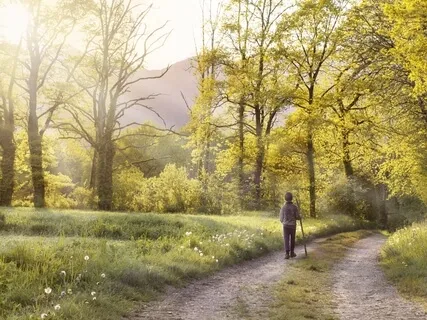
So today we're talking about allowing people to have their own paths.
And this came as a request from the community,
Because it's a real challenge.
We live in a world where somehow we were trained that everybody else's business is our business,
Or how they live their life is our business,
Or that how we live our life is other people's business.
This idea that we aren't allowed to have unique paths is part of the paradigm we were raised in.
So all of a sudden,
I want to do something,
I'm suddenly like,
One of our number one fears is,
What will people think?
Oh,
How will I explain that to this person?
How will I explain it to my partner?
What will my parents think?
Oh my God,
You know.
And then we're afraid to actually live our life.
But in the same way,
We do it to other people too.
Suddenly,
Even our children.
We think that we have an idea as to the best way they should live,
Or our parents,
Or our neighbours,
Or our friends.
And we waste so much energy trying to understand their choices,
Trying to change their choices,
Arguing about it.
So it's a very interesting topic to actually be able to let that go.
To let go of the entire paradigm that anyone else's path is anyone else's business.
It's interesting,
So when I wrote Tantric Intimacy,
And I didn't know how to start the book.
I'd been teaching Tantra for a while,
But I was sort of missing something that create the proper foundation.
To have a Tantric connection with someone,
And this isn't something spiritual and mystic,
Not really.
It's just connection.
It's just heart,
Open,
Loving connection.
But for some reason,
Whatever I was teaching,
Or however things were working,
People were really struggling with that.
Especially couples.
Eventually I realised that the first thing I have to talk about in the book is love.
And the first kind of love we have to talk about is Agape.
And Agape is the foundation of all human connection.
And Agape is honouring each other's paths.
It's looking at another human through God's eyes,
Or having God's love for someone.
That's what it means,
However you interpret that.
So if you imagine that,
So we're not looking at each other from the eyes of other humans.
We're looking at the other person from above,
Not from judgement,
But from a higher purpose,
From a higher,
More expansive,
Universal perspective.
So all of a sudden,
We're looking at this human in their entire soul's path,
Which could encompass many lifetimes,
Or many dimensions,
Or maybe many aspects of this person,
Or maybe their ancestral history.
We're looking at this person from this huge perspective,
As opposed to,
I'm a human,
And you're a human,
And my judgement of your path is this.
This is sort of that human to human perspective.
But instead,
When we rise up and we look at this person,
And we see them through the eyes of God,
Or through the eyes of the cosmos,
How do they fit into the big picture?
This is agape.
And what that means on a really practical level,
Is that we respect their path.
We respect that whatever they're doing is exactly on their path,
Whether we understand it or not.
Even if their choice makes us cringe,
Which has no relevance,
Right?
Because it's not our path,
It's their path.
To trust that that soul is on their journey.
This is agape.
And without that,
We can have no connection,
No real heartfelt connection with another person.
Because if another person knows that no matter what they do,
You're going to question them,
Judge them,
Think you know better,
We are always going to keep some kind of energetic distance from them.
So agape is incredibly important.
Like,
It's no small thing.
It was funny,
I was reading a book the other day.
What they were talking about was teaching,
Air quote,
Higher and advanced meditation techniques.
And they were saying how a person,
They don't actually teach these meditation techniques,
Nor write them down,
Because they cannot be taught to people who haven't accomplished a certain level of personal experience in meditation.
It's like,
Yesterday we did a meditation in class to try to access the primal sound of the universe.
The unstruck chord,
The sound that is always there.
But the challenge is,
Is if we still have a monkey mind,
If our brain is going at a million miles an hour and our consciousness is wrapped up in it,
It's impossible to hear the subtle sounds of the universe.
So any meditations that would focus on hearing the subtle sound,
Anahat,
In the world,
Wouldn't be taught to someone who hadn't done enough pranayama or enough practice to actually have a calm mind.
Not because they're not good enough.
It's not a judgment.
But the problem is they won't be able to hear it anyway.
Because there's a block,
Because of this massive,
Massive chatter in the mind.
Which is really different.
It's not that you have to just simply go through the motions and achieve this.
You actually can't experience this other meditative experience unless this foundation is here.
That's just the way it is.
And in many ways,
Agape is the same.
If for some reason,
Respecting another person's journey is hard,
Or impossible,
Or you think it's crazy,
Then you actually can't go forward in any kind of deeper connection.
Because oftentimes what we want to do,
Especially on spiritual paths,
Is we want to skip steps.
We want to skip the hard steps.
We're like,
Okay,
Okay,
I know,
I'm not really good at that.
I know I'm kind of a busybody and I really want to control everybody and I want to do all that.
But I really want to have a tantric connection with my partner.
And it's like,
But you can't have that without this.
It's not something you can just jump over.
So this is actually a really,
Really important topic,
Even though it sounds really simple.
So let's look at it.
One of the first things we have to look at is why is this so hard?
Where do we get into trouble?
And one of the challenges,
We get into trouble in ways that are quite insidious.
And for anyone who English isn't your first language,
Insidious means it's like it's hiding.
You're not just saying it outright.
It's hiding in the programs we grew up in.
So someone might say this,
But there's some other things coming in the background.
It's like if someone says something and let's say it's really patronizing.
It's kind of insulting.
But what they said,
They only said these three words,
But there was this whole thing behind them that came through the transmission.
Besides just the words they used,
Those other things are insidious.
They're kind of coming in in the shadow,
Hiding.
So one thing that kind of hides here is that we were raised with real clan mentalities.
The idea that this is how our family does it.
This is how we think.
This is what we do.
This is what we think is normal.
This is what we think is strange and aberrant and wrong.
We think this is right and that is wrong.
This is a real thing that we actually think there's some version of normal.
What the heck is normal?
There are infinite refractions of God,
Of the universe,
Of the galaxy,
In human form,
In a carbon-based life form.
What the heck is normal?
What's functional?
What's successful?
But when we belong to a certain family,
Society,
Church,
Thought process,
We believe that there's some kind of we and we think this.
And so what this does is it makes us think that we can look at other people and say,
That's not right.
You shouldn't be doing that.
That's a bad choice.
You shouldn't be having that.
Why would you have that job?
That's a terrible thing.
And we think that we know anything about another person's soul's path.
But because we have this clan mentality that we're all like little puzzle pieces that fit in the machine,
And if you change,
The whole machine will change,
And then what?
And this is a real problem.
Because what it means is not only do we spend a ridiculous amount of time judging other people's journeys,
That includes children,
Friends,
Parents,
Colleagues,
Bosses,
Neighbors,
Everybody.
We spend all this energy looking over the fence,
Seeing what they're doing.
Oh,
That's bad.
What are they doing?
They shouldn't be doing that.
That's wrong.
That's sinful.
That's evil.
That's horrible.
What are they?
You know,
All that.
But even worse,
We judge ourselves if we have desires outside of the clan mentality.
What if I want to do something completely different?
So I used to run a lot,
And I love running barefoot.
And I studied it,
And I even taught barefoot running classes and workshops.
I would run races barefoot,
And people would stand on the sidelines and literally gasp.
And they would gasp because I was running barefoot.
And it would be like this little din,
And then I'd go running along,
And all of a sudden there'd be dead silence.
And then someone would whisper,
She doesn't have any shoes on.
Do you see that?
She doesn't have any shoes on.
Like I was running naked.
Or like my shirt was on backwards.
Or whatever.
And it was so bizarre.
It was like,
I just don't have shoes on.
But the clan mentality is so deep,
And our programming is so deep,
That this is normal and that's not normal.
It's crazy.
But it's deep,
And it's insidious.
And that's what's really important to note.
That if we are looking at someone else's life and saying,
Well isn't that strange?
Well that's no good.
We have to check ourselves.
Are we checking this against a clan mentality?
That I believe that I know what's normal,
Or okay,
Or successful?
Because these aren't our thoughts.
This is brainwashing.
This is a program.
We are infinite beings.
We are meant to live with some kind of limited filter that thinks that this tiny subset of all the infinite possibilities is normal and acceptable.
The kind of corollary to that idea is that we have some idea of what an ideal life is.
So we can say this is normal and that's not normal.
But we also have an idea that this is ideal.
And very often this is where we get into trouble with our children or people we love.
This is an all evil clan paradigm.
Sometimes it's people we really care about and we really want the best for them.
And we see them making choices that in our personal estimation,
Mmm,
Yeah,
That's going to be a tough road.
And we just think,
Oh,
I wish I could just say the right thing to steer them on a different path.
And again,
We have this idea that there's such a thing as an ideal life.
But who's to say why we're here?
We'll talk a bit more about this at the end.
But if you look at a soul's journey,
If you look at this life within the whole experience of the soul,
I mean,
However we understand life and death or reincarnation or not and all that,
It does seem curious to me to imagine that my soul's existence only exists for 80 or 90 or 100 Earth years.
It doesn't quite seem reasonable to me.
So I don't know what the whole answer is.
There's lots of theories that I enjoy and that are helpful.
So then you kind of look at this short little span,
This tiny little maybe 90 years,
80 years of existence.
How does that fit into the whole?
How does it fit into the huge experience of the soul?
And then we look at our kids or our parents or our friends.
Is there really an ideal life for them or is whatever they're living their ideal life?
What if that is the path?
What's the definition of this ideal?
It's when we get into this idea that of being a perfectionist,
That want everything to be perfect.
But what's perfect?
If we all have perfectly unique DNA signatures,
We all have perfectly unique thumbprints,
Wouldn't it make sense that we also have perfectly unique life paths?
So how do we even come up with an ideal?
How do we come up with the perfect choices?
How would we even know?
So there are often a lot of challenges,
Really practical challenges to allowing other people to live their own paths.
One of the biggest challenges is that we end up stuck in relationships that we can't get out of.
And then the other person's life path choices directly impact ours and perhaps even stop us on our own life path.
It's only been in the last 50,
60,
70 years that you could get a divorce without proving the other person had an affair or something like that.
If you were married,
You were married.
And there are still communities like that in the world where you're not allowed to marry or women have no rights and all that kind of thing.
These still exist today in 2023.
Well,
If for some reason you are bound to another person and they have power over you,
And this could be a parent-child,
This could be in a marriage or a partnership,
And you for some reason cannot leave.
Maybe you can't leave because of it by law,
Whatever country you live in or whatever church you belong to or whatever family you belong to.
Or maybe you just don't believe you can leave.
You maybe are afraid to leave for financial reasons or you're afraid to leave because you've never been independent before.
You're afraid to leave because they've threatened you and they've beat you down and you're afraid they're going to hurt you or something.
So many nasty things that happen in the world.
Then all of a sudden you're stuck with this person and you become obsessed with their life path.
And because you're stuck with them,
You try to change it so that their life path doesn't infringe on yours.
And this is really important.
This could even happen if you're caring for aging parents and you feel obligated to care for them.
And they're making all these crazy choices that's really making your life a living hell.
But for some reason,
The obligation program overrules your own path and our souls won't allow our path to be overrun.
And if we feel like that,
If we don't believe that we can change the other person's journey because our paths are somehow connected now,
Well,
Then we're just going to turn to something,
Some kind of drugs,
Medication,
Booze,
Something so that we can kid ourselves.
So our soul,
We don't hear our soul kind of crying out that I'm not actually living my life anymore.
So what difference does it make?
I may as well be numb.
And that's a huge deal,
The feeling of being stuck.
And it's real.
And even if it isn't real in your life today,
What if today you have all the freedom in the world,
You easily have ancestral beliefs and fears that are also living inside of you.
Sins of the forefathers,
Seven generations,
All these kind of things.
However,
We understand that.
And that's really real.
But of course,
So right now,
Especially if you're here today,
It's 2023 at the time of this class.
So theoretically,
We probably do have choice.
So the question is,
Why aren't we making that choice?
Why do we believe we are stuck here?
Why do we believe we cannot change,
We cannot leave or we cannot make the choices we want to live,
Or the life we want to live,
The choices we want to make.
This becomes our journey.
This is the seed thought for our spiritual journey.
I am stuck and believe I have no choice.
Aha,
This is the clue.
And now I begin the deep dive and I start unfurling the things that make me believe I have no choice.
Make me believe that my only option is changing this other person's path,
Because I believe I am tethered to them.
Another thing is,
It's interesting in especially family and romantic relationships.
There's a lot of weird expectations.
So this is a weird example.
But let's say for example,
You have a sibling,
And the sibling is always moving,
And they expect that you're going to help them move.
Well,
My dad used to always joke because my dad collected rocks,
Big rocks,
Not little like crystals,
Big pudding stones,
Like huge hundred pound stones.
And he was quite sure that he ruined a lot of friendships asking people to help him move.
Because it's one thing to ask people to help you move,
And you've got some boxes and stuff and whatever,
It's okay.
And you'll do that,
Like it's okay to help people.
But if all of a sudden you have this friend and you help them move and you realize,
Oh my God,
This person is a collector.
They have 500 of this and 500 of that.
Well,
Like it's a nightmare helping them move.
And then three years later,
They're like,
Oh,
Hey,
You know,
I'm moving and I'd love your help.
And if you do not believe you have the choice to say yes or no,
Because the truth is you don't want to help.
You didn't want to help the last time once you saw all the junk that you were moving.
So this time you're like,
I don't really want to help.
But for some reason you have an expectation,
An obligation,
A contract,
A program inside of you that says you are not allowed to say no.
What are you going to do?
Well,
We're going to bitch about the fact that they're a collector.
What the hell do they have all that stuff for anyway?
Like have they even heard of minimalism?
What the hell?
You know,
What are they moving all the time?
And then we start bitching about their path because for some reason I'm obligated to help them.
But they're making all these choices that I wouldn't make.
But I'm somehow having to pay for that.
But again,
The problem's not them.
The problem's me because I'm not being honest.
Hey,
Can you help me move?
No,
That's the answer.
No,
You'll have to hire a moving company.
They exist.
Hyrupolic teenagers.
Our friendship is more important than me helping you move today.
And that's important.
Or it could be something that you have a friend who is in a dysfunctional relationship.
It's like I've had friends who they're with someone and oh,
They have a horrible breakup.
And their partner screams and yells and got drunk and hit the wall and put a hole in the wall and freaked out and everything,
You know.
And they finally leave.
After you've been listening to it for six months,
A year,
This horrible,
Horrible thing that they've been going through and you've been helping them every step of the way and they finally leave.
And then two months later,
You're chit-chatting with them and all of a sudden like,
Oh,
Well,
You know,
So-and-so called me.
And you know,
Some part of you almost stops breathing.
They're like,
Well,
You know,
So we're back together.
And you're like,
Noire,
Yeah?
And of course,
Inevitably,
A few months later,
The caca hits the fan,
You know.
And they're like,
Oh,
I can't believe it.
And you're sitting there like,
I don't want to hear this anymore.
I don't want to talk about this anymore.
But for some reason,
I feel I'm obligated to continue listening to this that I'm not interested in.
And it's not personal.
That's the problem.
We take this stuff really personally,
Like,
Oh,
A good friend's always there for you no matter what.
And it's like,
No,
I'm not interested in hearing about the dysfunction in your relationship.
You need to go see a counsellor.
You need to get help as to why you cannot leave or why this is happening.
You know,
And to me,
It's no different than someone talking to me about the latest trades in the hockey pool.
I'm not interested.
It's not personal.
I'd like to hang out with you,
But this topic is not interesting to me.
So what happens is if I feel obligated to listen,
What am I going to talk about later to my partner?
Can you believe they're back with that guy?
Blah,
Blah,
Blah,
Blah,
Blah.
They have to do this.
I'm going to spend time talking about my friend's path and the choices they're making that I wouldn't make.
Why?
Because I feel obligated because I'm somehow tethered to the path,
Even though I don't want to be.
So I'm kind of complaining about it,
Thinking that I'm going to find some kind of solution.
But it's actually none of my business,
Even if they want to make it our business.
We have to learn to be honest and just say,
Hey,
You know what?
And genuinely,
I trust this is your journey,
Not,
Hey,
We know it's going to turn out,
But,
You know,
Rock on with your best self.
That's not what I'm saying.
It's not some condescending thing.
This is agape,
That we actually look at our friend and we say,
There must be something so important in this for you.
I really can't talk.
I don't think I'm helping in talking to you about it.
I highly recommend you finding a counsellor if you want to talk about it,
But to really honour people's paths,
You know,
Completely.
The other weird dynamic that happens that causes us to want to control other people is that this other person controlled you.
And this can often happen with parents.
If your parents were very controlling,
They just wanted their nose in on every decision you made and they had a little judgment about everything.
And this is,
Again,
Something very insidious in our society,
That we think that the other person needs our little opinion and judgment about everything.
Oh,
Yeah.
So we're going to move into a condo across town.
Oh,
Really?
Yeah.
So you just wait till they hike the condo.
You know,
You're just going to get some little comment,
Constantly,
Some little comment instead of,
Cool,
What made you decide to move there?
Like,
We're not continuing the conversation.
We're just laying a bit of judgment.
And you're like,
Why do you have to be so negative?
And they're like,
I'm not being negative.
I'm just saying,
You know what,
I've had a bit more experience than you have had.
Like,
We can be so condescending and then justify it.
It's like just making conversation.
I don't know why you're being so sensitive.
But the reality is,
Well,
Then I guess I just won't share with you anymore.
And the distance becomes greater.
But what often happens in relationships is if the parents were super overbearing when you were young,
Well,
First of all,
They're still overbearing.
The relationship didn't change.
They're still like that,
Married,
And then they're overbearing about your children and whatever.
It is really easy to do it right back at them.
And then suddenly we're really sensitive to everything they do.
And can you believe they did this?
And you can't believe my dad's doing this and he's and blah,
Blah,
Blah,
Blah.
But it's all you know with this person.
It's almost like the defining characteristic of your relationship that you judge each other's paths.
And it's just interesting to note.
It's just something to kind of go,
Wait a minute,
Is that,
Is that what's going on?
And they may not change.
They may continue to be overbearing and you just stop telling them anything of any value.
You might tell them the surface stuff just to keep them happy and give them something to chew about over coffee.
But you're not going to tell them the real stuff because you don't need their judgment.
No one does.
But whether we do it back to them,
That's our choice.
Because again,
When we spend time chewing about,
I can't believe my mom's making this choice.
I can't believe my dad did this.
Can you believe he,
You know,
Blah,
Blah,
Blah,
Blah.
The only thing that's wrong about that for us is the energy and the time and the attention that we are wasting in our lives.
Sometimes I think that the most valuable thing we have is our attention.
Whatever we are paying attention to in any moment,
That's the limited thing.
You know,
And that's what a lot of people say even about social media and things like that.
It isn't the money.
It's your attention.
It's the most valuable thing you have for you on your soul's path.
And it is being stolen in every moment that we end up in an endless scroll.
And I'm not anti-social media.
I think there's ways to use it that's really cool and helps to connect people across the world.
But it's the scrolling.
It's the something that our attention just gets locked in and we're not doing anything for us anymore.
And that's the same thing.
If we find ourselves talking about another person's path,
It's our attention that is being squandered.
Because we're not helping.
It's just a waste of our energy.
The other thing that gets in the way is that we have attachment to whether or not people are in our lives.
And this could be a relationship,
Like a romantic relationship.
And it could even be family.
If you're in a romantic relationship and your partner really wants to do this,
For example,
And you don't want to.
Maybe they want to move to another country or maybe they want to be polyamorous.
Or maybe they are actually really unhappy and they don't want to go on vacation.
Or they don't want to have children.
Or they don't want to.
.
.
Something.
But you are really attached to being with this person.
Like,
You really want this person in your life and you want them all to yourself and that's how you want it.
And there's nothing wrong with that.
That's what you want.
Well then all of a sudden you're going to spend a lot of energy trying to get them on your side.
You're going to convince someone who doesn't want to have kids to have kids.
Or vice versa.
You're going to convince someone to live in the city who wants to live in the country.
You're going to convince someone to take holidays who doesn't want to take holidays.
You're going to convince someone to have a high-maintenance home who would really be happy living in the woods in a little single room shack.
Or vice versa.
None of these are right or wrong.
But when we don't actually honor another person's path and we become hyper-attached to them being in our lives,
We need them to be on our path.
We actually want that soul to go off of their soul's journey and join us.
We tell ourselves that they're making bad choices and I'm just doing it for their sake too and it'll be better for everybody in the long run.
And la la la la la.
Like we tell ourselves all kinds of things.
But the bottom line is we're not actually noticing that this is another soul.
It isn't an object in our life.
It isn't just someone who fulfills a role that I desire.
It's an infinite sentient being.
They have a soul's path.
And if their soul's path,
If your paths diverge,
Then why can't I honor that?
And again,
This becomes an interesting seed for a spiritual path.
To say,
Why am I attached to this?
Why am I not able to live my own life?
Why do I have to get other people on board with me?
What's going on there?
It's an interesting question.
Another huge thing,
Huge reason that we focus heavily on other people's paths,
Whether we're trying to change their paths,
Or whether they're simply having an endless commentary on what we think they're doing or that person's doing or this person's doing,
Is we're not moving on our path.
We're not growing.
We've come to a stagnant place for some reason and we've hit a ceiling.
So we're bored.
We've kind of hit a wall.
We've turned our bodies around.
Kierkegaard used to say that a person cannot have their feet pointing in two different directions and get anywhere.
And that's what it's like.
When we're actually on our own path,
Our two feet are heading forward and we are walking forward on our path.
And we are meeting the challenges in our soul.
And we're actually growing and we're finding new things that bring us joy.
And we're having new experiences that expand us.
And our feet are pointed in the same direction.
If we have any fears about our path,
All of a sudden,
One foot,
It's like it turns around and starts heading in the opposite direction.
It's like,
Oh,
I'm not sure.
I just want to kind of sit still and I don't know.
So our one foot turns around and we start analyzing our partner to death or our children or our parents.
Because we're here to live.
So we're either going to analyze our own path or everybody else's.
And then at some point in the journey,
Sometimes both feet get turned around and we're not even thinking about moving forward on our path anymore.
And this is really classic,
Like in a lot of,
Like historically in families,
Especially the women,
Their lives,
They were basically told that their only role in life was to raise children.
That's it.
They have no purpose except to be the perfect wife and the perfect mother.
And then if the child does something wrong,
It's your fault.
And if the child does something good,
It's something to be proud of.
It's all a reflection of you.
So now we are living vicariously through our children because we've been trained.
This isn't our fault.
We were trained that you have no purpose.
Again,
In most societies,
Boy children do have purpose.
They have all kinds of purpose.
But in many societies in the last hundred years and before,
Girl children,
Well,
We'll just find you a good husband.
So very often the idea that I have stuff that I might want to do,
I might have interests that I want to explore.
I might want to,
What?
It's a new idea to actually live at our growth edge.
That's really a thing.
Because I'll tell you,
When you are busy and excited about your life path and you are doing stuff and you're doing new things,
And I don't mean this isn't save the world Messiah stuff.
I mean,
You've taken up pottery and you're renovating the back room into a pottery studio and you've found a new friend that has an amazing kiln and you're going to shows and you're getting new glazes and you're doing all this cool stuff.
And you are just passionate about pottery.
You're not thinking about other people's nonsense because you're all in with the pottery.
Or you've discovered ballroom dance and every weekend you're at different workshops all over and going to dances and learning new things and buying new outfits and cool dance shoes and listening to music and you've got all kinds of Spotify playlists for cha-cha and swing and you are so passionate about what you're doing.
You're not looking at other people's lives.
Your feet are moving forward.
And then maybe you catch up for coffee and they say,
Oh,
This and this and you're like,
Wow.
And they're really depressed or something and you might say,
Maybe you should try dancing.
You want to come to my pottery class sometime,
Whatever.
Like I'm not trying to change your life,
But this stuff's really exciting to me.
It's a huge deal to actually be living our lives.
You know,
It comes back to that heavy training of us becoming spectators of life that we're not actually supposed to do anything ourselves.
We're just supposed to watch documentaries on TV of other people doing cool things.
We're supposed to watch other people play sports and watch other people play music and watch,
Look at other people's art.
But we don't create the art and we don't learn an instrument and we don't go out and play soccer.
And it's a very,
Very different paradigm when we are actively living our lives and growing and expanding.
There's no way we would waste time thinking about other people's lives.
And again,
With the belief of agape,
That they are on their journey.
It's not that we don't care.
It's actually that we care so much that they really fulfill whatever their soul's destiny is,
Which we have no idea about.
No idea what their soul's destiny is.
If we think we do,
We are delusional.
We have made it up in our mind because that's the most comfortable reality that we want to live in.
But it is not true.
No single one of us has any idea what another person's soul's journey is.
And the last thing I want to mention is we have to really ask ourselves what the meaning of life is.
There's no answer for this,
Obviously,
But we have to really assess our own belief system where we ask ourselves,
Do I believe that a perfect life is a life of ease?
It's really interesting.
I was reading about the Vira Shaiva belief system in Tantra.
I believe it was in that one that one of their belief systems is that you have to rid yourself of the desire for ease in life.
I've really been thinking about that.
How often ease and comfort,
We've sort of been sold this wonderful idea.
And maybe it comes out hundreds of years of oppression and working in coal mines and being slaves and indentured servants and all kinds of stuff that ease and comfort obviously are going to be a deep desire inside of us.
So again,
Even that's not a judgment.
But once that's not our situation,
The interesting thing about ease is we don't grow in ease.
Nothing stimulates us in ease.
And ease,
The opposite of ease,
Isn't dis-ease or whatever.
It's not something bad or stress,
But it's the natural tension of life.
It's that Viktor Frankl saying that we are meant to have a certain tension between where I am right now and what I want to accomplish.
And that's the tension of being alive and being in perpetual growth and perpetual expansion.
And again,
This isn't an effort.
This is expansion in things you love.
This is diving into pottery.
This is learning French.
This is studying Tantra.
This is having a new puppy.
This is whatever it is that floats your boat and you're expanding in it.
So very often when we look at someone else's life,
We will judge their path,
Especially if we care about them,
Because we don't think it'll be easy.
But is that really the goal?
Is ease the goal?
It's just something to think about.
Because if that is a belief within us,
It will naturally taint our opinions of other people's paths.
Because sometimes if we actually have really difficult paths,
And it could be difficult childhoods,
It could be difficult relationships,
It could be getting into trouble with the law,
It could be all kinds of things.
What if whatever this is,
It had to be hard enough to help break old patterns of some flavor?
But you know,
Steve Jobs used to say that you can only connect the dots in hindsight.
And when you look back at a certain part of your life and you think,
Wow,
That was so awful,
But I so understand why it had to happen.
We don't understand it at the time.
But for some reason we know that it's really important.
So it's just something to think about.
When we find ourselves looking at other people's lives,
We ask ourselves,
What is it about this that's causing me so much discomfort?
Because it likely has nothing to do with the other person.
It's all about our perspective on what we think life should be all about.
If you guys have any questions,
I'd be happy to answer them.
I just wrote down yesterday,
Easy is right.
Hmm,
A little confused.
Oh,
That's interesting.
So my interpretation of that,
Because I agree with you,
Isn't that ironic?
That it's almost like,
You know,
When you need to make a choice,
And there's one on the one hand,
It's sort of,
Oh,
I feel like I should make this choice.
But this side feels so much lighter and easier.
I would choose the lighter and easier choice.
But that for me,
It's like guidance.
The lightness,
The ease of something feels like guidance on the path,
Like a light telling me this is the way to go.
Because oftentimes,
Even though we feel like that's the way I'm supposed to go,
There may still be a lack of ease on that path.
But it's not hard.
Like we've been trained to take the hard road and the one that's full of obligation and all that.
How do you start to disentangle paths for an aging parent,
And you just worry about them so much,
Even though it's definitely time to leave?
And again,
If it was me,
I would just,
I really do pray about everything.
Like I really do.
There's no one answer.
I would really sit in every moment and ask,
Does it feel right to do this or this?
Do I feel right to do this or this?
Which one is it?
And in this moment,
I choose this,
And then whatever happens,
And then I listen again,
And I choose this,
And then I listen,
And then I choose that.
And I just trust every single step.
And even if I have no idea how it turns out in the end.
How do you know when to leave a once good friend behind who has changed to the point of not respecting your own path?
You know what's funny?
The Dalai Lama once said,
The problem is they think that they have time.
And I have so much respect for that.
And then this good friend of mine,
This doctor friend who used to,
We used to go barefoot running together.
I saw him the other day at roller skating,
And he was reading this book,
Which he's going to lend me,
And then I'm going to talk to you guys about it.
It was all about being mortal.
And they were talking about how there were maybe 4000 weeks in a person's life.
I haven't actually done that math,
But the book was all about how do you want to spend each week of your life?
And that's really interesting.
You have a friend,
Or a person,
They're not a friend anymore.
Then that's important.
There's a person in your life who you have been close to in the past.
You're no longer close to them.
How much time do you want to spend with them in this week that you'll never get back?
This is a week of life that you've been given.
Do you want to spend it with that person?
That's all.
Then we'll know when is a yes and when is it a no.
And it doesn't have to be mean.
It can just be,
I really think we've diverged here.
I really don't think we're helping each other anymore.
It was just like when I told my husband that I didn't want to be married anymore.
I actually believed that our paths had diverged to a point that we were harming each other.
Because I was trying to pull him onto my path and he was wanting me to be on his path.
So we weren't actually helping each other anymore.
And it's the same with people who we've been friends with in the past.
That when it comes to a point that we're no longer helping each other,
We're no longer supporting each other,
Then maybe there's someone else out there that we need to connect with instead.
It doesn't have to be all loaded and you're such a jerk and you don't even care about me.
We don't have to do that.
We can be of sober mind.
Would you talk a little bit about prayer?
I have other practices but prayer is a hard one for me.
So I recommend if you want to read my book,
What If You Could Skip the Cancer?
Because that's my journey from my brain believing or wanting to believe that it has all the answers,
To listening within and walking through my life that way instead.
And the number one thing that Jim,
Who was my teacher,
What he taught me,
He said that there are three parts of prayer.
He said the first is you have to ask.
The second,
You have to listen.
The third,
You have to act.
And it's so interesting because asking alone is hard.
We actually have to know what we're really asking for.
What do I really want an answer for?
Because again,
Prayer isn't just help me take this on and I'll just hang out here.
I pray for guidance.
I want help.
I want to know what the next step is.
So first we have to ask,
Which is a huge deal.
So then once we've asked,
We have to listen.
Then we have to deeply listen within.
That journey alone is interesting because then we have to go,
Well,
Which voice in my head am I listening to?
And that becomes a journey.
For me,
I've told you guys that the voice I listen to,
It's always this skinny guy,
Really tall,
Skinny guy sitting on a child's chair in the corner of this huge room of people arguing.
No idea why that's the vision.
But this person,
He just sits there.
And I ask the question and he looks at me and he just gives a single answer or just him looking at me.
I already know if the answer is yes or no.
And then everybody argues in my head.
And then I look at him again and he just looks at me and he gives me the same answer.
And so anyway,
That's my path.
That's my curious process.
Or sometimes it is that question of ease.
What feels light?
What feels right?
What does that mean to you?
But the third most important part is acting.
We have to take action.
No point asking for help and then not doing it.
Because then the whole process kind of falls apart.
Because then the next time you ask a question,
But you realize you don't really,
You're not careful about the question.
Because you know you're not going to take action anyway if it's hard.
It's a whole process.
It's a great,
Great question.
So thank you so much for being here.
I hope you have a wonderful day.