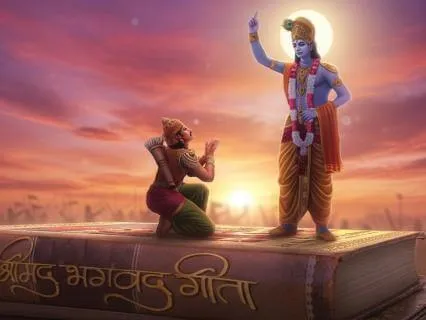
Today we are diving in to the second chapter of the Bhagavad Gita.
The first chapter of the Bhagavad Gita sets the framework for the rest of the story.
So our hero,
His name is Arjuna,
And Krishna is his friend,
But Krishna is also God,
The Lord,
Our highest consciousness,
Spirit,
Whatever that is.
Essentially there are two families.
Now imagine there's two brothers,
Dhristarastra and Pandu.
Dhristarastra was born blind,
Even though he was actually the rightful ruler,
And so his younger brother Pandu was allowed to have the kingdom,
He was allowed to be king.
Pandu had five sons and Dhristarastra had a hundred sons.
And Dhristarastra is blind and his hundred sons are evil.
And Pandu had five sons and they're good,
If we really want to oversimplify the whole story.
And what happens is there's all these stories that you can read about in the Mahabharata,
The huge epic of Hindu history or Hindu teachings really.
It's questionable whether it's actual history or all beautiful stories.
And there's all these battles and of course the evil sons,
Especially the main one,
Duryodhana,
He's kind of always leading the charge,
Trying to,
He's got to survive,
He's the one,
You know,
No one else is allowed to be king.
And the good sons,
Arjuna is one of those sons,
They try everything and they did everything and they were exiled and they tried to kill them and they tried to do everything and they did everything right.
And no matter what the evil brothers just kept taking over the kingdom on them.
And eventually it all boiled into this huge war where the five sons,
Including Arjuna,
Had to battle the evil hundred.
And so what happens is the kingdom split.
What happened is because the five brothers,
Their dad died,
So they were actually raised by the blind king.
So they were raised with their cousins.
So they had the same teachers,
They had the same spiritual teachers,
The same martial arts teachers,
They had all the same community.
And it wasn't until one of them had to become king that all the problems started.
And if you want to hear more about that journey,
Listen to the first recording because we go into an hour's worth of detail and depth into that.
So now we are faced with this great war and the war is happening.
The battlefield is called Kurukshetra or actually it's also called Dharmakshetra.
And it means the battlefield of consciousness,
The battlefield of the heart.
So it's not just this physical,
You know,
Lord of the Rings battle kind of idea.
It's a battle that's happening inside of us every day.
So then Arjuna is on his chariot.
Krishna is his charioteer.
Everything's starting.
Everyone's blowing their conks and the horns and the drums and everything.
And Arjuna says,
Drive me into the center of the battle.
Let me see what's happening out there.
So Arjuna drives him into the center.
Arjuna stands up with his great bow and arrow and he looks around and on all sides,
He sees family.
He sees friends.
He sees grandfathers and teachers on the side with him and against him.
And all of a sudden all this doubt comes in and he's like,
I can't do this.
I can't fight these people.
Nothing good will come of this.
I'm going to destroy humanity.
I'm even going to live knowing that I've killed my teachers,
My grandfathers.
How can I survive?
And chapter one ends with Arjuna dropping his bow and arrow and kind of slinking down into the chariot and saying,
I don't want to.
I'm done.
So that's where chapter one ends.
So I'm going to read six verses.
We're only going to look at the first three,
But I'm going to read six verses.
And I'm reading from Stephen Mitchell's version of the Bhagavad Gita,
But you can read from any version that you have.
So we're looking at chapter two,
Verses one to six right now.
That's what I'm reading.
As Arjuna sat there,
Overwhelmed with pity,
Desperate,
Tears streaming from his eyes,
Krishna spoke these words to him.
Why this timidity,
Arjuna,
At a time of crisis?
It is unworthy of a noble mind.
It is shameful and does not lead to heaven.
This cowardice is beneath you,
Arjuna.
Do not give into it.
Shake off your weakness.
Stand up now like a man.
Arjuna says,
When the battle begins,
How can I shoot arrows through Bhishma and Drona,
Who deserve my reverence?
It would be better to spend the rest of my life as a pauper begging for food than to kill these honest teachers.
I'm going to stop reading there.
It actually goes on into his continued confusion.
But what we're going to look at are the first three verses.
As Arjuna sat there,
Overwhelmed with pity,
Desperate,
Tears streaming from his eyes,
Krishna spoke these words to him.
Why this timidity,
Arjuna,
At a time of crisis?
It is unworthy of a noble mind.
It is shameful and does not lead to heaven.
This cowardice is beneath you,
Arjuna.
Do not give into it.
Shake off your weakness.
Stand up like a man.
Isn't that crazy?
Does that sound weird to you?
Like I'd love to know what your response is to hearing Krishna say that to Arjuna.
Because it seems curious,
Especially from a spiritual teacher to say that.
You'd think that the spiritual teacher was saying,
Oh good,
You're being so compassionate.
You're understanding the futility of war.
The first time I heard this,
I was horrified.
Right?
It's like,
I don't get it.
This doesn't make any sense.
So this is where we want to look at this understanding that the Gita is meant as a story to help us achieve highest consciousness.
This is the point of the Gita.
The point of it is to help us become our truest,
Highest selves.
Could Krishna not understand Arjuna's predicament?
Yes,
100%.
He could.
Because that's exactly what we think.
We think,
Arjuna's right,
Right?
Exactly where I am in my journey,
Time to step up and put away cowardice.
I guess he needed to see himself in the battle.
It's weird.
Is it hyper-masculine or is it a lesson in standing up for oneself?
Is he trying to get him to dig beneath his guilt and shame?
So there's many,
Many,
Many ways of looking at this.
This is the other thing to be really conscious of.
You can read the thoughts of Paramahansa Yogananda,
Of the Maharishi Mahesh Yogi,
Of Gandhi,
Of all these different people.
There are so many people who have written about the Bhagavad Gita and none of them say the same thing.
So just to truly allow yourself to experience the Gita,
Allow everything to rise inside of you,
And then take all commentaries as something to listen to,
But you don't have to agree.
Because nobody agrees.
Just to be really,
Really clear about that.
So I'm going to present some ideas that really ring true for me based on many of those commentaries.
But just to know that there are many,
Many great,
Great people out there who might say,
That Katrina,
I don't think she quite has it.
Just of all the scriptures or the teachings that are debated,
This is one of them.
So one of the great understandings about this is that because Kurukshetra is the soul's battlefield,
The soul's consciousness,
The pilgrimage of where we go to,
To truly find who we are.
The two sides represent the hundred cousins who are evil.
And again,
You can take the word evil with a grain of salt.
These represent our senses.
And the five brothers,
Or the five Pandavas,
They call them,
Including Arjuna,
These are our higher states of consciousness.
And very often through our lives,
We live in a state of dependency on our senses.
It's kind of that seeking pleasure and avoiding pain.
It's wanting to be comfortable,
As opposed to maybe striving for something that is hard.
And so what this is all about is looking at this and saying,
At some point,
We need to go beyond the senses and remember who we truly are.
We're often like when we're very young,
We need to be safe.
And then as we get older,
The world says,
Material goods,
Money,
Success,
Power,
Relationships,
You have to do all these things to be right.
And you're given all these sort of,
It's like,
With someone says,
You know,
Tell me about yourself.
And we might say,
Oh,
Well,
I do this,
I do that.
I wouldn't actually say this,
But you might say,
I'm very rich,
Or I'm very poor,
Or I have five children,
Or I am married,
Or I am this,
Or I am whatever.
And in this time,
Also,
This is in ancient India,
The caste system is very strong too,
Right?
That,
Well,
I am of a higher caste,
And I am this,
And I am that,
Like a lot of pride around material wealth and status.
And the caste system,
For example,
And this exists all over the world,
Not as strong as in India,
Obviously.
But this idea,
Even in the spiritual,
That I am more enlightened than that person,
I am awakened,
And they are asleep.
Like,
We do it all the time,
This weird thing.
So this battle,
In many ways,
Is saying,
At some point,
I have to give up my attachment to all those things.
I have to let all the material wealth go.
Doesn't mean we don't have money and all that,
But we don't have attachment to it.
Because we actually know that there are greater things in the world.
So now imagine you're at a point in your life,
You know,
Sometimes we have dark nights of the soul.
And a dark night of the soul is like,
You were taught all these things,
Beliefs,
Ideals,
What's right,
How to act in the world,
What the proper things were to do.
Like for me,
I'm a super idealist.
So I wanted to go to university,
And I wanted to get married,
And I wanted to have children,
And I did it all,
You know,
I did all the right things,
In quotes,
Right things.
And then,
You know,
I marry a good man,
And we live on the farm,
And we took the farm organic,
And we just,
We did everything right.
And then,
Of course,
I end up sick with breast lumps,
And lots of you guys know that story.
And the truth is,
I was absolutely depressed.
I was Arjuna in that chariot,
Completely despondent,
Like I don't even know what to do next.
I don't know where to go.
I've done everything right,
As far as I understand.
Now,
Krishna coming in sounds really harsh.
He's kind of sounds like,
What are you being so silly for?
You're being such a coward.
What's wrong with you?
You know,
That kind of thing.
Well,
What's interesting about that is,
He's not coming in to be mean.
He's coming in to shake Arjuna up.
And a lot of times,
We all need a shake-up.
We've been telling ourselves stories for decades,
And those stories are building upon stories.
And then there's that time,
Well,
You don't understand what they did to me.
And then this,
And then that person,
And then this,
And then that.
And well,
You don't understand how hard it is right now for me.
And we've been telling these stories for decades.
And then one day,
We're just like,
I don't know.
Well,
If there's anything anybody knows for sure,
That you can't solve a problem at the same state of mind that the problem was created.
And Arjuna is basically saying,
Enough.
Again,
Without getting so caught up in that,
Oh my gosh,
There's real life people out there.
This is a battle of the mind,
Of the consciousness,
Of spirit.
This is inside.
And Krishna is reminding Arjuna of how strong he actually is,
Of how noble he actually is.
What are you doing?
And this is where in our own journey,
Someone enters our depression,
A friend,
A teacher,
Anybody,
And they say,
What happened?
Why are you going there?
Why are you feeling so down?
You're so powerful.
You're so hopeful.
What's amok here?
And that's essentially what Krishna's doing.
He's just saying,
But you're strong.
You're a warrior.
You are of noble blood.
What are you doing?
So one of the interesting things about where we get caught,
Lost in the senses,
In the material world and all that,
Paramahansa Yogananda,
He compares the hundred brothers or the other side,
They call them the Kauravas,
The other side that Arjuna's fighting against.
He considers them the senses and how we seek pleasure and we seek comfort and we seek all these things.
And the truth is there's nothing wrong with our senses.
There's nothing wrong with pleasure.
There's nothing wrong with tasting great food.
There's nothing wrong with love and touch and joy.
There's nothing wrong with that.
So most of the time,
You don't have to put aside all desire for material wealth.
You don't have to put aside your senses.
You don't have to put aside all these things.
But here we are in battle.
Imagine yourself in life and everything's going fine.
And then you imagine yourself when you're at a crossroads.
Now you have to look at them.
So this is where the senses are a bit of a problem.
So Arjuna's standing there and he looks out and he sees cousins.
He sees uncles.
He sees teachers.
So Paramahansa Yogananda says that the senses come in and they feel like relatives.
These are all we've known our whole life from the first time we ate food or we touched something.
Our senses are so intimate to us.
And so on a day-to-day level,
They're wonderful.
But how easy is it for those senses to overtake what else we want to achieve in life?
And so he compares them to like cousins.
And they're cousins because they bring us joy and fun all the time.
But that gives them access to our home.
That gives us them access to our inside self.
And the other challenge is these senses live alongside our higher senses.
Truth,
Virtue,
Beauty,
Love,
Hopefulness,
Dreams,
Expansiveness.
We often live with all of these things together.
So it gets really confusing.
But the hard thing is when push comes to shove on a bad day,
Which one wins?
It's really easy for the senses to win.
It's like let's say you decide you want to start a diet.
You realize that,
You know,
I have to stop eating fried food.
I have to cut back on sugar.
I have to whatever.
For whatever reason,
I've really got to clean up my diet.
So you're sitting one day and you're feeling super empowered,
Super high about it,
Right?
You're like,
Oh,
I've got it.
You know,
And maybe you put out some new recipes and you figure out some things and you create some new things.
So now you're working in your highest self.
In your highest self,
You can see who you truly are.
I can do it.
I'm powerful.
I'm strong.
I know this part of me and I know this is true.
And then you wake up the next day and bed feels so good.
You don't want to get out of bed and go for that run or go to the gym or go.
You don't want to.
Your body is winning.
The old habits are winning.
Comfort is winning.
What happens if we don't recognize this?
What if we don't recognize the power of those senses?
You can stay in bed and then you're going to revisit it three months later when you've gained even more weight or you're in more pain or you're having even more trouble.
That's the challenge is that we have to recognize this,
That on a hard day,
Those senses are going to win.
So we need to really look at that and look at it clearly.
And it's okay to say,
I know you feel familiar and I know you've been with me for a long time,
But you got to go.
I really want something new.
And so he talks about the paradox of being alive.
And one of the paradoxes of being alive is here we are born made in the image of our soul of spirit.
We are made of expansive divine energy.
That's us.
Like when you really think about it,
Even on a very simple atomic level,
We are magnetized,
Electrified energy flying around nothingness.
Even physics says this,
That we are literally energy appearing physical.
We are pure spirit.
And yet our physical senses are so intimate to us how often they drive our lives.
And so it's just an interesting perspective,
You know,
Looking at Arjuna,
Standing there looking and saying,
But how can I kill these relatives of mine?
How can I do that?
I don't know about you,
But that's what it feels like in my heart.
Like if I'm wanting to start something new,
If maybe I want to start writing every day,
Or I want to start walking every day,
Or I want to change my diet or start going to the gym,
Or even,
Even I want to start being kind all the time.
I have a course that's been running for about 14 years online called Foundations for Tantric Intimacy.
And in there,
The very first sadhana,
The first spiritual practice that you have to do,
Is you have to be kind to your loved ones 100% of the time.
And what's interesting is at that time,
People would hand in their homework to me.
And one of the questions was,
How easy is it for you to be 100% kind all of the time?
And do you know that over half of the people said,
That's dumb.
Who would ever want to be kind 100% of the time?
That's boring.
And sometimes I'm just tired.
And sometimes I've had a bad day.
And sometimes they just piss me off.
So I'm allowed to be mean.
But of course,
If you truly want to have a tantric connection with someone,
And I don't mean sexually,
I mean,
Heart open vulnerability,
With friends,
With children,
With family,
With,
With a lover,
You can't hit them emotionally.
It's no different than hitting them physically.
If you hit someone physically,
They're always going to be waiting for the next time you're going to hit them.
So they're always going to have a bit of a guard up.
So if you truly want heart open,
Loving connection with someone,
You must stay kind.
So let's say this is what you're feeling called to.
What if you're feeling called to say,
You know what,
This is my new sadhana,
This is my new daily practice,
Which is what sadhana means.
Do you know how many people fight for their old ways?
Yeah,
But you know,
My defensiveness protects me.
Yeah,
But you know,
I,
My ego needs to be right.
But they wronged me.
I have to be right.
These old programs,
Boy,
Do they ever feel like teachers inside of me?
They feel like people who have protected me.
How could I go against that?
Do you know what it means to feel like it feels familial?
It feels like,
Like it's important.
So it's no small thing to say,
I'm willing to let them go.
I'm willing to remove them from the battlefield.
It's so,
So interesting.
So here's a great quote that Paramahansa Yogananda says,
He's kind of paraphrasing parts of the lesson here.
He says,
Forsake attachment to the senses,
Use the power of renunciation to relinquish all unmanly qualities.
Do nothing that goes against the grain of your soul.
Do nothing that goes against the grain of your soul.
To really think about that,
The difference between what is true in our soul and what the choices we might make out of comfort,
Even security.
And I'm not talking about safety.
If we're in a situation that is unsafe,
We need to do something about that.
But how often do we stay in relationships because there's security there?
Even though our soul is dying,
How often do we continue habits because they're so ingrained in us?
Even though we're alienating people,
How often do we continue to live physically,
Sleep,
Food,
Booze,
Exercise,
Whatever it is we're doing,
Even though it is harming us every single day.
How often do we do that?
The interesting thing is,
You know,
He mentions this whole relinquish all unmanly qualities.
I think BD mentioned earlier kind of about,
You know,
This ultra masculinity thing.
The word that they use in Sanskrit is klabiam,
Which actually means eunuch.
So in the original Sanskrit,
Krishna actually says,
You're not a eunuch.
What's wrong with you?
And why that's funny is that there's actually a story in the Mahabharata where Krishna poses as a eunuch when they're in exile in the woods and stuff.
And anyway,
It's this whole big story.
So he's actually poking at him because of a previous time that he actually did pose as a eunuch.
Now to really think about this metaphorically,
What does it mean to be a eunuch?
And if you don't know what a eunuch is,
They would often castrate a male to care for women or that kind of thing so that they couldn't rape them or impregnate them or whatever kind of thing,
Right?
And so when you think of every one of us,
What does that mean?
Have you ever felt castrated?
Have you ever felt like you couldn't do anything?
Have you ever felt like you're powerless to do something?
This is what he's saying.
And he's not saying be a man.
He's saying,
Engage your masculine.
Engage the masculine part of you.
Every single one of us has feminine and masculine.
And in this instance,
Let's say your feminine,
Your intuition is saying,
Do this.
This is on your soul's path.
Do this.
But that requires your masculine then to do it.
That's what it requires.
One of the great challenges in life is that very often our experiences in life,
Our family,
Institutions we've been raised in,
Belief systems we've been raised in,
Actually take away our power.
They tell us that we can't do that.
Oh,
You can't do that.
You're too weak.
You're too young.
You're the wrong gender.
You're this.
You're that.
You don't have enough money.
You don't have enough learning.
You haven't got the education.
You're whatever.
Or maybe experiences have had,
You've had that,
You know,
People have told you that you're not good enough,
Or you believe you're not good enough.
And your masculine self becomes completely immobilized.
That's what Krishna is saying.
Get your masculine back online.
Whatever it is that makes you think that you can't battle these sensory parts of you,
Or these material desires,
Or the teachings and trainings of your society.
Whatever it is that makes you think that you cannot follow your highest self,
Get that back online.
Enough.
Imagine that.
Like,
If you kind of sit there in your own life and say in those moments that you have felt like you can't do anything about this.
I have no choice.
There's nothing I can do.
This is when Krishna will come in and say,
Of course there's something you can do.
Enough.
Basta.
Get back online.
Basta is stop in Italian.
I don't know if it's but it's in something else.
I do remember that when I was living in Italy.
Down with conditioning.
Exactly.
Enough.
And that's why Krishna's coming in so hard and fast.
I'm going to read a different version of it for a second.
This is the Maharishi Mahesh Yogi's version.
It's different.
It's a bit different than the other one.
Yeah,
There's a few of the versions that talk about basically that you have to rise up,
Rise up.
And what's interesting is they talk about the third chakra,
The Manipura chakra.
And the third chakra is fire.
This is the element of fire.
If you look through the different chakras,
The first chakra where you're sitting is earth.
Your second chakra,
Your sexual organs,
Kidneys,
Just below the belly button,
This is water.
Third chakra at your belly button or your solar plexus,
This is fire.
This is who you are.
Who are you really?
Not what's your definition according to society,
But who are you really?
And to get that fire alive.
And what they're saying is take that fire and bring it up.
Bring it up into the heart chakra.
Up,
Up,
Up.
Enliven your higher senses and live in that place.
And we all have that capacity.
Every single one of us here has that capacity to rise up out of whatever circumstances we are in.
That's what he's saying.
The other thing that's interesting is he talks about the ultimate paradox of being human.
And one of the big paradoxes is that,
You know,
I talked about it earlier that we are these spiritual beings,
But so much of our experience is from the sensory world.
It's so much in the physical world.
And so at one point in the reading,
He says,
It is unworthy of a noble mind.
It is shameful and does not lead to heaven.
When they define heaven,
They see heaven,
Not as a Christian heaven,
But they see it as the unlimited spheres of divine consciousness,
As opposed to the limited experience of the physical life.
And this is interesting.
How often do our thoughts get caught in our physical limitations?
Maybe you're in a relationship that's very hard or empty,
But the time isn't right to leave.
I'm meant to be here right now.
Maybe it's a job.
Maybe it's a situation,
But for whatever reason,
I can't leave it.
Well,
We have two choices.
We can dive into the awfulness of it and engage all these emotional stories and just be like,
Oh,
I hate this so much.
And my partner did this.
And my boss did this.
And can you believe that?
And oh my God,
I have so much pain.
And we can do that if we want.
But it doesn't lead to heaven.
It leads us just in squalor.
We can be in the exact same circumstances and activate our higher senses,
Our hope,
Our love,
Our gratitude,
Our joy.
And suddenly we look at the situation and we say,
Well,
I don't know why I'm here.
I don't know what I meant to learn here,
But there must be something.
And yet here I am,
Alive again for another day,
And I get to have some new experiences.
And suddenly we end up expanding.
And suddenly we realize,
Oh,
You know what?
I'm going to join that book club.
That looks interesting.
And oh,
I just saw there's a new dance class opening up downtown.
I think I'm going to go and join that,
Regardless of my circumstances.
In every moment,
We have a choice.
Are we on the side of the possibilities,
Our inner spiritual selves?
Or do we let ourselves get lost in the physical?
Do we get lost in the senses?
Do we get lost in the fear?
It's a very interesting choice.
And this is essentially what he's saying.
So what I'm going to do is I'm going to just reread.
And I'm going to reread it based on everything we've already said.
And then if you guys have any questions,
I'm happy to have a discussion.
All right.
As Arjuna sat there,
Overwhelmed with pity,
Desperate,
Tears streaming from his eyes,
Krishna spoke these words to him.
Why this timidity,
Arjuna,
At a time of crisis?
It is unworthy of a noble mind.
It is shameful and does not lead to heaven.
This cowardice is beneath you,
Arjuna.
Do not give in to it.
Shake off your weakness.
Stand up now like a man.
I would love to know how this relates for you in your inner journey.
Because that is what the Bhagavad Gita is about.
If you've asked questions earlier,
Please rewrite them.
Because I just,
I can't go back too far in chat.
It makes me wonder,
What does it even mean to be human?
I am realizing it's so vast than the superficial conditioning of it all.
That's exactly what I needed to hear.
Oh,
Awesome,
Paula.
That feels so amazing and curious in my soul.
I find it personally so inspiring.
Because I'm someone who,
I love habits.
I am very habitual.
And it's hard to change habits.
And so it's very inspiring to me.
I've wanted to cave in,
Facing tremendous fears lately,
But I have had to shake it off and rise.
Definitely embracing my masculine and have succeeded in making tremendous changes.
All right,
Here's a question for you guys.
If we were to imagine the highest virtues within all of us,
Love,
Truth,
Honor,
Joy,
Gratitude,
Hope,
Dreams,
Imagination,
Expansion,
Connection to the divine.
And those are just things that came into my head in this moment.
I would love for you to,
In this moment,
Close your eyes,
Take a deep breath.
And what is one of those words,
One of those virtues that will help you rise above whatever you're struggling with?
Love,
Choice,
Joy,
Courage,
Connection to the divine,
Courage,
Kindness,
Gratitude,
Clarity.
What's one word that helps bring you out of those confused moments?
Is non-violent language a possible antidote to treating friends and family with love and still being able to talk about what's bothering you?
Yes.
Trust,
Faith,
Grit,
Resilience,
Stillness,
Grace,
Remember,
Surrender,
Believe,
Patience.
These are wonderful.
Thank you,
Everybody.
In answer to your question,
Lady,
First of all,
I personally have not studied non-violent communication,
But I'm familiar with some of the things.
So the primary thing that I do understand is the idea of instead of saying,
You know,
You hurt me,
To say,
You know,
When you did that,
I really felt afraid,
You know,
That we really express from our heart instead of from our mind.
And I think it's really valuable.
And even if someone hasn't studied non-violent communication,
There is something so important about just taking a breath and looking at this person and remembering that we love them or that we care about them and just saying,
I don't know how to talk about this because I am feeling hurt.
I am struggling and I am afraid that it's going to really damage our relationship if this continues and just sort of allow it to go forward.
So,
But I do think NVC has helped a lot of people find that language without attacking,
For sure.
Self-compassion,
Yes.
Could you speak a bit about breaking habits and karmic patterns?
Might be another talk.
In the context of this talk,
A lot of karmic patterns are deeply connected with emotions.
That's the hook.
Stories and patterns don't stay with us unless there's an emotional hook,
Unless there's a fear around security,
Comfort,
Community.
So,
We will continue a pattern because it is giving us something.
And that something it's giving us is not in our spiritual realm.
It is in the physical realm.
And so,
In the context of this teaching,
To remember your highest self and watch yourself.
Allow yourself to observe from that loving neutral witness mind and just watch and be willing to let it go.
And if you can't let it go,
Ask why.
That's a huge and awesome talk.
I'll have to think about that.
Moving from Utah to Oakland at 13,
I was told I was too nice as if it were a disease.
I spent my life trying to be like everyone else in their grungy,
So wonderful discover that it was a fine virtue that I get to choose to return to.
That's awesome.
Noni.
Krishna here pushes Arjuna out of the overwhelm of the senses.
On the other side,
I sometimes notice I push myself out of balance,
Outside the overwhelm.
Is there a knowing of when to push and when not to?
So,
I'm not sure if this is what you mean,
But this is often when we might say that the pendulum has swung too far in the other direction.
It's kind of like,
I'm drowning,
I'm drowning,
I'm drowning.
And so you're like,
Forget that.
And you fly to the very opposite.
You just become a soapbox virtualist.
Again,
I think there's an awareness.
I know I can certainly be like that.
I can be very extreme.
If I realize something,
I'm just shouting it from the rooftops instead of just allowing the middle ground.
But even that's okay.
If we end up way over on the hard side of life,
And we fly,
The pendulum swings all the way to the other side.
And then maybe we swing back,
But we don't go quite as far into the depths.
And then we swing,
But not quite so far into the high.
And then eventually we do find the middle ground.
I think there's just a wonderful awareness to realize that.
And sometimes we have to pull way higher to get out of the spin of something.
There's an awareness of that too.
Sometimes,
For example,
Let's say you're leaving a relationship.
Especially,
I remember,
I was married for 20 years.
And when I finally left,
You really have to get a lot of negative inside of you in order to escape the orbit of something you've done for 20 years.
And it's easy to stay in that negative space about the marriage.
For me,
It wasn't even so much about the marriage,
But it was about living on the farm.
The farm was a tough time.
And one day,
I was in that far other side,
Like Keerthi is saying.
And my daughter said to me,
She's in her 20s,
She said,
You know,
Mom,
We had some good memories on the farm.
Remember when we used to do this?
Remember when we used to hay and we were on the wagon and you were driving the tractor?
Remember that?
And I needed to remember that.
I needed to come back to center.
I was out of the orbit,
But I needed to remember the good times too.
So thank you guys so much for being here.
And we'll see you soon.