Welcome to Dreambirds,
A series of sleep stories based on the 1917 book,
The Bird Study Book.
Tonight we'll explore the world of birds caring for their young,
A quiet,
Tender scene that will help you unwind and relax.
As you settle into bed,
Take a moment to get comfortable.
Feel the softness of your pillow,
The warmth of your blankets,
And let yourself sink into a state of peace.
Let the worries of the day melt away as you prepare to drift into a gentle sleep.
Imagine yourself stepping into a serene countryside,
In a bygone era.
Here,
Time slows down,
And the only thing that matters is the quiet joy of the delicate silhouettes of birds perched on shadowed branches.
The only sounds are the quiet rustle of leaves and the gentle call of the birds as they sing each other to sleep.
The Domestic Life of the Birds It is a privilege to be so situated that one may watch from day to day the occurrences about a wild bird's nest.
Here,
Feathered life reaches its greatest heights of emotion,
And comedies and threatened tragedies are of daily occurrence.
The people we know best are those whom we have seen at their play and at their work,
In moments of elation and doubt,
And in times of great happiness and dire distress.
And so it is that the one who has followed the activities of a pair of birds,
Through all the joys and anxieties of nest building,
Brooding,
And caring for their young,
May well lay claim to a close acquaintanceship with them.
In watching a nest,
One will learn,
For example,
That with most of our small birds,
Both parents engage in the pleasant duty of feeding the young,
At times shielding the little ones from the hot rays of the sun with their half-extended wings,
And now and then driving away intruders.
There is a wide difference in the relative helplessness of nesting birds,
And a corresponding difference in the methods of parental care.
Some are able to run or swim with their parents almost as soon as hatched,
For they not only have the strength to do this,
But their bodies being covered with down,
They are protected from the sun or cold.
Examples of such birds are the quail,
Grouse,
Sandpiper,
Plover,
And duck.
The young of these and other species like them are able from the beginning to pick up their food,
And they quickly learn from the example of their parents what is desirable.
Soon they are able to shift for themselves,
Although one or both of the parents continue to attend them until grown.
For other birds,
The young are hatched in an absolutely helpless condition,
Being both blind and naked,
And it is necessary that they be fed by the parents,
Not only while occupying the nest,
But also for several weeks afterward.
Flickers,
Hummingbirds,
Doves,
And some others continue to feed their young in this manner.
Most young birds are fed with great frequency.
For more than an hour one day,
This writer watched a pair of Georgia Mockingbirds feeding their young.
The one that appeared to be the female visited the nest with food on an average once every two minutes,
And the male made a similar trip about once in twelve minutes.
He could have done better,
Had he not spent so much time flying aimlessly about and scolding imaginary enemies.
Some birds have what seem to be very curious habits at the nesting time.
The phalarope's method of procedure is first to permit her mate to search for a suitable nesting site.
When some sheltered spot in the ground,
Quite to her liking,
Has been found,
She deposits the eggs and goes on her way.
Little companies of female phalaropes may be seen at this time of the year,
Frequenting the ponds and sloughs they inhabit.
The dutiful and well-trained males are all at home,
Where they are responsible for the entire task of caring for,
And incubating,
The eggs.
The length of time which birds remain mated is a question often asked but seldom answered satisfactorily.
The truth of the matter is that not much is known about the subject.
Apparently a great many birds return to the same yard,
And even to the same tree,
To build their nest year after year.
I say apparently,
Because such birds are seldom marked in such a way as to enable one to be positive that they are the identical individuals which came the year before.
It is probably somewhere near the truth to say that most small birds usually choose the same mates year after year if both survive the dangers of winter,
And in spring meet again on their old,
Trysting grounds.
It is safe to assert that,
As a rule,
Birds retain the same mates throughout the breeding season if misfortune does not befall one of them.
During the fall and winter months,
When the impulses governing domestic duties are dormant,
Birds pay little or no attention to their mates.
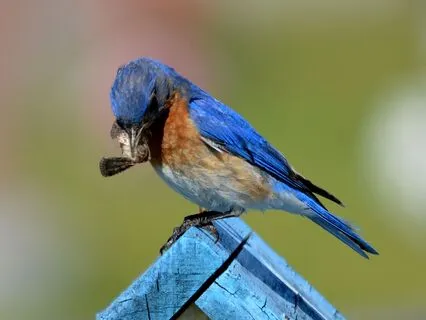
One spring a pair of bluebirds came into our yard,
And to the accompaniment of much cheerful bird conversation,
In the form of whistles,
Twitters,
Chirps,
And snatches of song,
Began hunting eagerly for some place to locate a nest.
Out in the woodshed,
I found a box,
Perhaps six inches square and twice as long.
Cutting a small entrance hole on one side,
I fastened the box seven or eight feet from the ground,
On the side of a young tree.
The newcomers immediately took possession,
And began carrying dry grasses into their adopted sanctuary.
Several days elapsed,
And then one morning,
While standing on the back of a garden settee and peeping into the hole,
I discovered that a pale blue egg had been laid.
When the nest contained four of these little beauties,
Incubation began.
A few weeks later,
Four little bluebirds left the lawn on their own wings.
Along the Atlantic coast,
The raising of Canada geese is a common custom.
Not only do these great birds serve as food,
But they play the part of decoys when their owners go a-hunting.
When a gander has chosen his goose,
And she has accepted his advances,
The pair remain constantly together,
Summer and winter,
As long as they live.
In Currituck County,
North Carolina,
There was,
Not long ago,
A gander that local tradition said was 62 years of age.
The first 30 years of his life,
He remained unmated,
And for the last 32,
He has been the proud possessor of a mate from whose side he has never strayed.
These geese do not mate readily,
And a man who has a company of 30 or 40 may well be satisfied if six or eight pairs of them are mated.
The truth of this statement is proved by the fact that,
On the local market,
A single goose is worth about $1,
While a pair of mated geese will readily bring $5.
A little reflection will make the student realize the fact that,
Out in the fields and woods,
In the swamps and on the mountains,
On the beaches,
As well as far away on the ocean,
There are many birds that are not mated.
Among them are widows and widowers,
Heartfree spinsters and pining bachelors.
Just what percent of the bird life is unmated in any one season,
It would of course be impossible to tell.
The information which the writer has gathered by a careful census of a certain species in a given limited territory enabled him to determine that in this particular case,
Only about three-fifths of the individuals are mated any one season.
Some species have well-developed tendencies toward polygamy.
In the warmer regions of the United States,
There dwells a great,
Splendid,
Glossy blackbird,
The boat-tailed crackle.
The nest of this bird is a wonderfully woven structure of water plants and grasses,
And is usually built in a bush growing in the water.
When you find one nest of the crackle,
You are pretty certain to find several other occupied nests in the immediate vicinity.
From three to six of these marvellous cradles,
With their quiet brown female owners,
Often appear to be watched over by one shining,
Iridescent lord crackle,
Who may be husband to them all.
He guards his own with jealous care.
Evidently,
Too,
He desires the whole country to know that he is the most handsome,
Ferocious bird on the earth.
For all day long,
His hoarse shoutings may be heard,
And when he launches into the air,
The sound of the ponderous beating of his wings can,
On a still day,
Be heard half a mile away,
Across the lake.
One of the best-known polygamous birds of North America is the wild turkey.
In the mating season,
You will usually find a gobbler accompanied by two or more turkey hens.
When a female gets ready to make her nest,
She slips away from the male and the other female members nearby,
And,
Going to some broom sedge field or open place in the woods,
Constructs her nest on the ground beneath some slight,
Convenient shelter.
Day after day,
She absents herself for a short time,
And the speckled treasures grow in number until from twelve to fifteen have been deposited.
All this time,
Her movements are characterized by absolute secrecy,
For if the gobbler by any chance comes upon the nest,
He immediately breaks every egg.
He is perhaps wise enough to know that when his hens begin to set,
Lonely times are in store for him.
One of our wild birds whose domestic relations are not fully understood never has a nest even of the most humble character,
And shuns absolutely all the ordinary dangers and responsibilities of parentage.
We call this creature the cowbird,
Probably because it is often seen feeding in pastures among cattle,
Where it captures many insects disturbed into activity by the movements of the browsing animals.
The cowbird lays its eggs in the nests of various other birds,
Distributing them about the neighborhood.
Here,
They are left to be hatched,
And the young to be reared by the foster parents.
Cowbirds' eggs have been found in the nests of nearly one hundred species of birds,
And nearly always the nest of some smaller bird is chosen.
Despite this fact,
The cowbird's eggs are often first to hatch.
The young grow rapidly.
As soon as the young leave the nest,
The greedy cowbird follows the little mother about the thickets,
Shouting loudly for food.
So insistent is the young cowbird,
And so persistently does it pursue the foster parent,
That it is well cared for and invariably thrives.
It is no uncommon sight during the days of June and July to see a worn,
Bedraggled song sparrow working desperately in a frantic effort to feed one or more great,
Hulking cowbird babies twice its size.
It is little wonder that discerning people are not fond of the cowbird.
Even the birds seem to regard it as an outcast from avian society,
And rarely associate with it on friendly terms.
All other birds display great willingness to attend to their home duties,
And often give evidence of keen delight while so engaged.
One of the most exquisite and dainty forms of birdlife found in the United States is the little blue-gray gnatcatcher.
When occupied in building the nest,
Which is usually saddled on the limb of some forest tree,
The birds call to each other constantly,
And even after the eggs are laid,
There is no attempt to restrain their expressions of happiness.
Unlike the crow and jay,
Which sometimes appropriate the nests of other birds,
These little creatures have no sins to answer for to their neighbours.
One of the most pleasing sights I have witnessed was a male gnatcatcher that had relieved his mate at the nest.
He was sitting on the eggs,
And with his head thrown back,
Saying with all his might.
As we bring tonight's story to a close,
I invite you to keep the tender images of birds caring for their young in your mind.
Picture a cozy nest tucked safely in the branches of a tree,
Where little birds rest under the watchful eyes of their parents.
Imagine the soft flutter of wings as they return with food,
The gentle chirps of the chicks,
And the warmth of the nest that keeps them safe.
If you're still awake,
Let your attention go.
You might settle your focus very gently on your breaths,
Feeling each inhale and exhale slow and steady.
You might wish to count your breaths,
Letting each one draw you closer to sleep,
Allowing yourself to sink deeper into relaxation,
Wrapped in the comforting thoughts of the nurturing care to be found in the natural world.