Hey everyone,
It's Judy Cohen and this is Wake Up Call 315 on August 26.
Welcome.
Today I want to stay with chapter six of the Dhammapada and consider this verse.
Virtuous people always let go.
They don't prattle about pleasures and desires.
Touched by happiness and then by suffering,
The sage shows no sign of being elated or depressed.
And the reason I wanted to talk about this today is because the fires here in California.
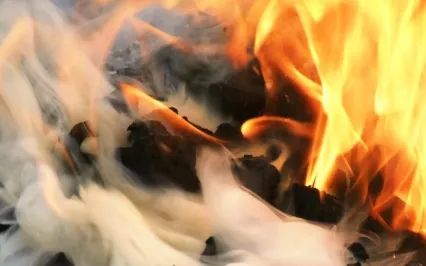
So here is kind of an astonishing picture.
Sometimes the wake up call is happening from our place at Lake Tahoe and I grew up spending summers and winters at the lake and hiking and skiing and swimming and being a little kid and being a difficult teenager.
And then my daughter moved to Tahoe in her mid twenties,
Probably will go back after grad school.
So I really love Lake Tahoe.
And the AQI,
The air quality index at Tahoe has been in the 300s and 400s.
So in case you're not familiar with AQI,
Which I kind of hope you're not yet,
Clear is between zero and 50.
So 355,
Which was what it was when we finally sent uncle and packed up for the summer and came home to Sonoma is an insane number.
At 355,
It looks like this picture.
It looks like tule fog outside,
Only it's not fog,
It's smoke.
And you can't take a deep breath.
You can't really take any kind of breath without coughing or even with a mask.
And everyone who can get one and afford one,
Which definitely isn't everyone is running air purifiers indoors because otherwise it's hard to breathe indoors as well.
So the Dhammapada says virtuous people always let go.
They don't prattle about pleasures and desires.
Touched by happiness and then by suffering,
The sage shows no sign of being elated or depressed.
And I have to say if this is true,
I'm certainly no sage because when the smoke clears,
I feel this elation because breathing,
There's nothing really there's nothing quite like it.
And I know others can breathe like other humans,
But also other birds,
Other insects,
Not other birds,
Insects,
Animals.
I don't know,
Maybe even the fish are impacted and they can breathe better when it clears.
When the smoke is really bad,
The forest is silent.
And then the smoke comes back and I'm depressed.
It's awful.
You know,
I'm depressed.
It's awful.
You know,
I feel horrible also because it's happening and because I'm contributing to it.
Or,
I mean,
At least I'm contributing to climate emergency every time I get in my car,
Every time I get on a flight,
Use a plastic bag,
Buy something in a plastic container,
Which is every household product.
And who knows what else?
And I don't know if we can fix it.
I don't know if we can repair the Earth.
So how to understand this verse in the face of climate emergency right in front of our eyes.
And one key I think is the beginning of the verse.
Virtuous people always let go.
They don't prattle about pleasures and desires.
And the truth is,
This is kind of prattling.
So not only do I want clear skies,
You know,
Pleasure,
But I want permanent clear skies.
I want the climate to be like it was when I was a kid.
And I want it to stay that way.
And so that seems like prattling about pleasures and desires.
Talking,
You know,
All day with everybody around here about what I want things to be like,
How sad I am,
How scared I am,
That things aren't the way I wish they were,
About how terrifying it is to look out across one of the most beautiful lakes in the world and see nothing but smoke.
So,
Touched by happiness and then by suffering,
The sage shows no sign of being elated or depressed.
Is this literal?
Should I be touched by happiness and depression,
The clear skies,
The smoky ones?
Should any of us?
But not show any sign of being elated or depressed even though I am,
Maybe you are?
And should we let go of those feelings entirely?
Is that what this verse is saying?
So maybe,
But I think let's look at it in two ways,
The relative and the absolute.
On the absolute level,
I do think it's true that a sage has all the feelings of depression,
Of hopelessness,
Rage,
Terror,
Confusion,
When there's so much smoke that they can't breathe.
And I think they also have feelings of elation and relief and relaxation and hope when the air clears.
And maybe on this absolute level,
A sage doesn't get caught by any of those feelings.
So sometimes I think of myself as like just embodied with all these pegs inside and out and things flow through me and a lot of things get caught.
So the smoke,
My terror,
My hopelessness,
Those all get caught.
And the relief and the joy,
They get caught too.
But a sage,
You know,
She feels all those feelings.
She doesn't turn away from any of the feelings.
She can reign all the feelings,
But she doesn't get caught.
He doesn't prattle about pleasures and desire or pain and aversion or anything else.
There's no prattling because they see that everything is just arising and passing away.
The moment,
The smoke,
The day,
Their own lives,
The earth itself.
A kind of equanimity,
I think is what the verse is saying,
Virtuous people always let go.
On the relative level,
Things seem different to me.
On the relative level,
There's no smoke without fire and there's internal fire too.
And on that level,
I feel like it's incumbent upon us to put everything we've got into action.
Right.
Wise action.
And what is wise action if not speaking truth to power on a systemic level,
Which we as lawyers and law professors and law students and mediators are uniquely positioned to do?
And what is wise action on a collective level if not speaking up at our firms and in our organizations and schools to implement mitigation measures,
To encourage,
Even incentivize everyone to switch to electric vehicles,
Support organizations on the front lines of climate change and species preservation.
And on an individual level to install solar panels and buy electric cars ourselves and recycle and use reusable compostable bags and use less water in the West.
You know,
All the big and small things that we can do,
Many of which are,
They feel to me like sacrifices.
Right.
So that there's a chance that future and generations can actually live on a habitable Earth.
So I really see this as the smoke and the fire.
It's remembering to be as fiery as we can be and also to take care of ourselves.
Do everything we possibly can,
Then relax and take the long view.
Pretty much all the wisdom traditions say that universes come and go and we're just here for a moment.
So during the workday,
We can take this really fierce,
Fiery action.
I mean,
Basically because we have no choice anymore.
But before the workday,
I think it's also important to remember to be the sage.
Remember that we are just fragile bodies waking up,
Eating,
Walking,
Working,
Making love,
Sleeping.
And one day passing on.
And then after our workday to letting go and maybe just remembering our fiery intentions and maybe chanting the Zen student chant beings are numberless.
I vowed to save them all.
Okay,
So let's sit.
So taking a posture that is supportive of your practice.
And connecting to the earth.
And connecting to each other.
And connecting to yourself.
And letting the mind rest.
You.
Thoughts,
Emotions,
Sensations,
Sounds,
Smells,
Tastes.
Sight.
Come and go.
And as things get caught,
Which they will,
As human mind,
Right?
Just when you notice,
Let them go.
And as they are,
As human mind,
Right?
Just when you notice,
Let them go.
And as they are,
As human mind,
Right?
Just when you notice,
Let them go.
I feel like this little bit of rest that we give ourselves is so important.
So maybe you can approach it as if you're really treasuring.
And this time that you're gifting to yourself.
I feel like this little bit of rest that we give ourselves is so important.
You And being really forgiving of yourself as well because it is always this process of Getting caught and letting go isn't it?
You you you you That's right you Thanks for being here everyone take good care be safe out there and have a good Thursday good weekend I will see you next Thursday