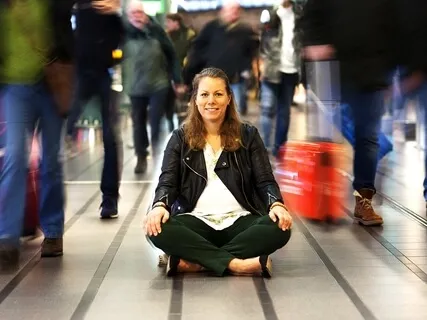
Welcome to this mindfulness meditation.
Taking a few moments to bring attention fully into the body.
And finding a seat that's comfortable for you.
So maybe shifting your seat a little bit,
Placing both your feet flat on the floor.
And it's helpful to see if you can relax the shoulders,
To soften them a little bit.
See if you can relax your hands and let your hands be soft.
Maybe loosening the belly as well,
So that the next breath you're breathing,
It's received in a soft belly.
And this one.
And this one.
And softening the face as best and as much as you can.
Perhaps bringing a sort of smile to the eyes.
Letting the brow be smooth.
Maybe a slight smile at the mouth as well.
And if you hadn't closed your eyes already,
Then seeing if you can close the eyes,
If that's comfortable for you or otherwise,
You can lower your gaze.
And letting go of the focus in your eyes.
So that you can relax the eyes as much as possible and bring your gaze inward,
So to speak.
And maybe you're able to just check out how you're sitting in this moment.
Tuning into your posture.
Maybe you can feel the feet,
The weight of the feet on the floor.
Perhaps you can feel the fabric of your socks touching your skin,
Or perhaps your shoes around the feet,
Containing the feet.
And perhaps you can also sense the weight of the seated body on your chair,
Or perhaps you're sitting on a sofa or a cushion.
Perhaps feeling the connection with the surface you're sitting on.
Seeing if you can maybe sink a little bit deeper into your chair.
And letting go a bit,
As it were.
And then bringing your attention a little further up past the spine.
A spine that is strong and upright,
But still at the same time also relaxed.
Upright without being stiff or rigid.
With a proud chest and relaxed shoulders,
Perhaps it's possible for you to have your posture display a bit of dignity,
Sitting strongly and dignified.
And if you notice that the mind is very busy and you're still transitioning from what you were doing before,
Maybe you were having lunch or a conversation with someone,
Maybe you were outside or inside,
And some of that is still continuing in your mind.
Maybe lots of thoughts or some emotions.
Then just letting that be there for now.
Opening up to what's already here.
It's very common that when we start a meditation that the body is already here because the body is always here.
And the mind,
It takes a little bit longer to catch up,
To land,
And by allowing it to do so,
Paradoxically,
It happens quicker.
As opposed to when we force our mind to be here and to be still.
And then maybe narrowing your attention and focusing your attention on the movement of the breath in the body.
And letting the breath be an anchor for your attention.
And seeing for yourself where you're sensing the breath most clearly.
So perhaps that's at the nostrils where you can feel air moving in and out,
Or the upper lip perhaps.
Maybe you're sensing the breath most clearly in the throat.
Or the chest.
The rising and falling of the chest.
Or perhaps for you it's the belly.
It's the rising and falling of the belly when you inhale and exhale.
And then when you inhale and exhale.
Or if it's helpful to you then you can also place one or two hands on the belly and simply follow the movement of the hands.
When you breathe in and breathe out.
And most likely you'll notice that there are many things coming into your awareness.
Waves of sound and thoughts and sensations in the body.
Perhaps emotions as well.
And trying to keep steady in your awareness.
And calming your mind bit by bit.
Underneath all these different waves.
By placing your attention on the gentle wave of the breath.
And every time you're distracted your mind is pulled away by a different wave.
And bringing your attention back.
Following inhale and exhale.
And imagine And following inhale and exhale.
And perhaps noticing the process of breathing itself.
And inhalation followed by an exhalation.
And perhaps a slight pause before moving back into the inhalation.
And if you catch the mind wandering,
It's what you do next that matters.
Your attitude in bringing back your attention.
Is there blame,
Judgement of the wandering itself?
Or can you see the wandering as something natural that happens inevitably?
And with kindness and a sense of relaxation bringing back your focus.
And if that's the attitude you can bring to it,
That's the attitude that you can bring into the rest of your day as well.
The rest of your approach to what comes your way.
And training your mind,
Training your attention like this.
It's like training a puppy.
And with a kind and patient determination.
And the mind is like a puppy it will bring new interesting things to you and call for your attention time after time.
And reacting to it with kindness and patience is helpful.
And then as a next step letting your awareness on the breath move into the background and bringing your attention into the body.
And scanning the body for any physical sensations.
Perhaps starting with the pleasant sensations.
And seeing if you can sense whatever is pleasant for you.
Maybe it's a warm sensation in the belly or the sense of being carried,
Being held by the surface you're sitting on.
Maybe a relaxed feeling in the face.
Opening up and welcoming to these sensations.
And seeing if you can include the more neutral sensations as well,
The ones that we tend to not notice or ignore.
Maybe a sense of tingling here.
The air brushing your skin.
And opening to those as well.
And lastly seeing if you can open up to the unpleasant sensations as well.
And the ones that we tend to shut the door to as it were.
The ones that are not so welcome in our awareness.
Maybe it's a numbness in some part of the body or shooting or stabbing pain or an itch.
And seeing if you can welcome this too and include that in your field of awareness.
Perhaps it helps for you to say to it,
You're here already anyway,
It's okay.
And then opening up to the neutral and pleasant sensations as well as the unpleasant ones so that you're holding in your awareness.
The whole field of sensations in the body from moment to moment.
And if you're noticing that your attention is more strongly drawn to an unpleasant sensation then perhaps it's helpful to breathe towards that sensation for a few breaths.
Not with the intent to relieve the sensation or get rid of it but to help you focus on experiencing the sensation rather than reacting to it.
Maybe bringing some space to it.
And then moving your attention to physical sensations to the background and bringing your attention to sounds,
To hearing.
And noticing sounds that arise in front of you or behind you.
Maybe even sounds from within the body.
Sounds within the room that you're sitting in or sounds from outside the room,
Outside the building,
On the street perhaps.
So opening up your attention to sounds.
And rather than scanning your environment for sounds,
Seeing if you can let them enter your hearing.
So going from perhaps a doing mode,
An action mode,
To a more non-doing mode,
A receptive mode.
And perhaps you're noticing that the sound has caught your attention and you've drifted off into thoughts about the sound.
And if this happens,
This is where you can see the difference between observing sounds and thinking about sounds.
And then moving back to the observing,
The receptive mode.
Same as you were welcoming physical sensations,
In a way also welcoming sounds.
Noticing how they arise and stay a while and then disperse at some point.
Maybe noticing sounds within sounds or the silence between sounds.
And then letting your attention to sounds drift off and redirect your attention to thoughts,
To thinking.
And seeing if you can remain with this receptive and observing stance,
Attitude.
And just observing thoughts that come into your awareness.
And when you become aware of a thought,
Of thinking,
Maybe using a friendly and soft mental note and naming it or labeling it and saying thinking,
Thinking or simply recognize,
Well,
This is a thought.
And then moving back to observing.
And you can compare it to a blue sky,
The mind being the blue sky clear in itself and thoughts being the clouds that drift by and sometimes they're small and fluffy clouds.
And sometimes the clouds are dark and full of rain or thunder.
But behind the clouds,
There's always the blue sky.
And you can observe the clouds drifting by.
And perhaps you're noticing that the same way sounds arise and stay a while and then disperse,
Also thoughts,
They come up,
They stay a while,
Sometimes longer,
Sometimes briefly and then they go.
They dissolve.
And perhaps you're noticing at some point that you've jumped onto a train of thoughts,
You're immersed in the clouds as it were and the moment you notice this,
That's where you have a choice.
To continue on the train in the clouds or to step back and move back into the observing and receptive mode and just watching the thoughts drift by.
And you might notice other experiences as well.
The sounds of passing cars and feelings of being warm or cool in the body.
Sensations of hunger or digestion perhaps.
And they can just simply be there in the background without drawing you away from being here,
From this moment.
And being aware of the difference of being inside a thought and being awake and alert and noticing thoughts as they pass by.
And the same can apply to emotions as well.
They also arise,
Stay a while and then disperse.
And those can be labeled too,
Emotion or feeling.
And also here,
A simple recognition.
Ah,
This is an emotion.
And then for the final moments of this meditation,
Bringing your attention back into the body.
Noticing sensations of the seated body.
Feet on the floor.
Sit bones on the chair on the surface you're sitting on.
You might be aware of your posture.
Sensations on the skin.
And facial expression.
And then whenever you're ready in your own time,
Opening your eyes and moving to a more active state of being.
.