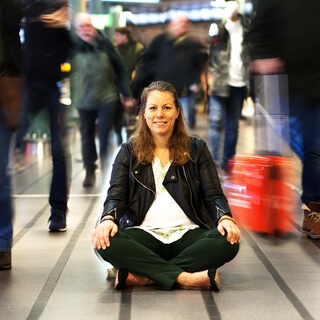
Sitting in a chair,
Making yourself comfortable,
Making sure to choose a place where you will be warm and undisturbed,
And allowing the eyes to close gently or rest the eyes without focus.
Taking a few moments to get in touch with the movement of your breath and the sensations in the body.
And when you're ready,
Bringing your awareness to the physical sensations in the body,
Especially to the sensations of touch or pressure where the body makes contact with the chair.
And on each out breath,
Allowing yourself to let go and to sink a little deeper into the chair.
And reminding yourself of the intention of this practice.
Its aim is not to feel any different,
Relaxed or calm.
This may happen or it may not.
Instead the intention of the practice is,
As best as you can,
To bring awareness to any sensations you detect,
As you focus your attention on several parts of the body in turn.
The first step in mindfulness meditation is always to interrupt what you're doing.
To stop.
And you will notice quickly that when you stop what you're doing,
It's not as if everything around you stops as well.
There's still the sound of my voice,
Maybe sounds from within the room or outside of the room.
And there's lots going on inside you as well.
Your mind will probably chatter along and it won't stop.
But the invitation here is to see if you can allow yourself to let go of anything that you might add to your experience.
As it were to put down your backpack of added thoughts and emotions,
Put it down next to your chair and make space to let yourself be carried by the chair.
To be without doing.
And just with a mild open attention,
Being present in this moment.
And now the invitation is to now pay attention to the sensations of breathing.
To feel how you breathe.
To feel the inhale and the exhale.
The inflation of the belly or abdomen on the inhalation.
And the deflation on the exhalation.
And this is not a breathing exercise so you don't have to do anything in particular with your breathing.
There's nothing to change.
Simply being with the breathing,
The sensations,
With a mild open and non-judgmental attitude.
Just noticing how your breathing is right now.
Maybe you notice that your breathing is regular or you may notice that it's irregular.
Perhaps you notice that it's calm or restless.
And without trying to intervene,
Without judging,
Just being attentive of this and seeing it happening.
You might notice that your breathing becomes calmer as soon as you are attentive to it.
It's also possible that you,
Your breathing becomes restless.
And the invitation for you is to not do anything about this immediately.
Just staying with this,
With this observing,
With a mild and open attention.
Just looking at what happens automatically.
And having connected with the ability to be with your experience without doing or adding to it.
Bringing the focus or spotlight of your awareness down into both legs and both feet.
And out to the toes.
Focusing on each of the toes in turn.
Having a gentle curiosity to investigate the quality of the sensations you find.
Perhaps noticing the sense of contact between the toes,
Sense of tingling,
Warmth or no particular sensation at all.
So there isn't anything in particular that you should feel.
There is only the open question.
How do the feet feel right now,
How do the toes feel?
And then bringing the focus to the rest of the feet.
The heels,
The soles of the feet.
Noticing any sensations that you might experience.
Temperature,
Throbbing,
Tingling,
Itching.
And then with the next exhalation,
Moving the attention up.
To take in the calves,
The shins,
The whole of the lower legs,
The parts above the ankles,
Below the knees.
Keeping a mild open attention to notice whatever sensations are present here or lack of sensations.
And on an exhalation,
Moving the attention further up,
Past the knees,
The upper legs.
Being open to the sensations that you might encounter in this part of the body.
Perhaps you've been standing or walking a lot today,
Or you've been seated,
So the sensations could be restlessness or tiredness.
Perhaps there's itching or tingling,
Warmth or coolness,
Or the sensations of clothing against the skin.
Without trying to change any of these sensations,
Without wanting there to be certain sensations,
Just trying to be curious and open to your experience,
To your sensations in this moment.
And the mind will inevitably wander away from the breath and the body from time to time.
And that's entirely normal,
It's what minds do.
And when you notice this,
Gently acknowledge it.
Focusing where the mind has gone off to,
And then gently and kindly return your attention to the part of the body you intended to focus on.
And now letting go of the focus on your upper legs,
And moving the focus,
The spotlight of your attention,
To the pelvic area and the sit bones.
Part of the body where you might notice tension,
Restlessness.
Perhaps there's relaxedness and spaciousness.
Being open to whatever your experience is here,
Right now in this moment.
And again when you've noticed your mind wandering,
Your attention being pulled away,
Gently acknowledging this and bringing back your attention.
A hundred times distracted is a hundred times bringing back your attention and training your sense of mindfulness.
And then on the next exhalation,
Letting go of the focus of the pelvic area and moving the attention up to include the lower back and the abdomen.
Perhaps there's tension here,
Relaxedness.
Perhaps in the abdomen where many organs are rested,
There's a sense of digestion taking place or perhaps a sense of hunger.
Being curious to what your experience is,
To what the sensations could be that you are experiencing this moment.
Having a mild and non-judgmental and open attention.
Being open to anything and everything that's here.
And when you're ready,
Bringing up the focus to include the upper back,
The shoulders and the chest.
An area where we tend to hold a lot of tension,
Where the muscles can be very tight and tense.
Or that might not be the case for you.
And if there's tension there,
Seeing if you can allow it to be there without wanting to change it.
If there's a neutral sensation for you,
Seeing if you can also let that be without wanting there to be something different than what there is already.
Then on the next exhalation,
Letting go of the upper part of the torso and moving the spotlight of your attention into the arms,
Through the arms into the hands.
And noting and noticing any if any sensations that are present here.
Tingling,
Throbbing,
Twitching.
Perhaps you can sense the fingers in space.
Perhaps there's a temperature sensation or the feeling of air against the skin.
And then slowly and gently moving up the focus to take in the lower arms,
The forearms and any sensations that might be present here and the upper arms.
And if you notice the mind is wandered,
As always,
Firmly but gently bringing back the attention and focusing again on the arms.
And then on the next exhalation,
Letting go of the focus on the arms and moving the spotlight of your attention up to the head,
Past the neck.
And observing with an open and mild attention what sensations could be present in the head,
In the face,
In the back of the head.
Being with those experiences,
With those sensations for a moment.
Is there heaviness or lightness?
Relaxed,
Tense,
Warm or cool.
Tingling,
Throbbing,
Itching,
Maybe pain.
And whatever can be felt with a mild and open attention,
Letting it be there.
Just noticing,
Sensing,
Without judgment.
And then at the next exhalation,
Letting go of the focus on the head.
And expanding the focus to include the whole body,
Sitting here on the chair.
And resting,
Letting yourself be carried in the chair.
And being in contact with the whole body and this moment's experience.
And then getting in touch with the body's ability to move again.
Using the fingers and the toes,
Maybe stretching yourself.
And then realizing that nothing can prevent you from going back to your body every moment of the day in this body scan meditation.
Whenever you want to be in touch with the body and through the body being in touch with the present moment and to sense.
And when you hear the sound of the bell,
At your own pace,
Finishing this meditation.
Whenever you're ready.