Stoicism was founded.
In.
What is called the painted porch or the Stoapolike.
And Initially,
Stoicism was called Xenoism.
Because the person who kind of put it together.
Originally was called Zeno,
But then they changed it to Stoicism because they wanted to make it more of a group effort.
Something that we can discuss rather than something that comes from one individual like a religion or something like that.
So we'll start with the literal translation of the phrase Amalfati.
It simply means love of fate.
Or love your fate.
And so the idea is that when we get into spiritual practice,
Very quickly on in our journey,
We learn that a big part of the path is acceptance.
Mindfulness is kind of acceptance.
To be mindful of something is to be accepting of it.
When you're mindful,
You don't judge,
You don't criticize,
You don't create an opinion about it,
You just watch it,
You observe it.
If you're mindful of your emotions,
You sit with your emotions,
You let your emotions flow through your body.
If you're mindful of your thoughts,
You see them passing like clouds in the sky.
So acceptance is a big part of Buddhism and the spiritual path.
And acceptance is actually a very big part of having good mental health.
If you're not a very accepting person,
Then you're not tolerant.
You're going to get frustrated a lot because reality doesn't meet your expectations.
You don't accept it.
You get angry.
You get frustrated.
So there's definitely a link between the level that you can bring acceptance to life and the level at which you can feel tranquil and at ease and calm.
But love of fate goes beyond just acceptance.
Love of Fate is about rather than just accepting or enduring what happens to you,
It advocates embracing every experience.
As not just something to put up with,
But to love.
To cherish to experience is valuable and necessary.
The person who popularized the idea was the German philosopher Friedrich Nietzsche,
And he said,
Quote,
My formula for greatness in a human being is amor fati.
OK,
So that's the best sentence alone means we should probably pay attention.
Friedrich Nietzsche one of the greatest thinkers of all time.
Is saying very clearly that the formula for greatness is Amalfi.
He then goes on.
Amafati means that one wants nothing to be different,
Not forward,
Not backward,
Not in all eternity,
Not merely bear what is necessary,
But to love it.
It's easy to do this.
He said that in the gay science.
It's easy to do this when life is good,
Right?
We have a pleasurable experience.
And we love our lives,
We love our experience,
We love our fate.
Life is good.
But when things trigger.
Unpleasant emotions,
Sadness,
Anger,
Frustration,
Grief.
It's hard to say.
I'm very grateful for this experience.
Because I guess we unconsciously adapt this frame of mind that's like gratitude when we're happy.
And resistance when we're unhappy.
But we don't actually really think like this because if I asked you to look back over your life.
And think about difficult experiences you've had.
Would you change any of those?
Has every bad experience you've had.
Made your life worse.
In a permanent sense?
Or when you look back,
Do you see that the time that you had the end of that relationship helped you out in some way.
Oh,
And you didn't get that job.
You then went on to get a job that you did like even more.
We've all had experiences like this.
When things don't go well,
In the moment,
We're not happy about it.
But then later on we say,
Oh,
That was such a good life lesson.
I'm glad that happened.
Nietzsche is saying,
Why do we need to wait?
Months and years.
Can't we just trust?
That whatever is happening will probably lead to something good and worthwhile.
And not even just probably,
We can choose to make it worthwhile.
We can actively look for the lesson.
We can actively look for the benefits of it.
Now the idea of Ammo Fatty is not about blind positivity,
You don't go through life going oh everything's great,
There's no such thing as Negative emotions.
It's not blind positivity.
It's about shifting focus from uncontrollable externals to circumstances where you can control your response.
Let's just take an example,
You break down in traffic.
It's fine.
To in the moment be a bit flustered,
Be a bit panicked,
Be a bit anxious,
Be a bit annoyed in the moment.
You can't control your car breaking down.
But then you can adopt the frame of I'm more fatty.
How can I love this?
What can I practice?
Maybe I can cultivate virtues like patience.
Maybe this is the training ground for me to be more resilient.
What would someone very strong and wise do in this situation?
Maybe I can use this difficult life situation to practice acting more like that.
And then,
Hour later you go I'm actually glad that happened because it was hard and I learned some important life lessons there that I can then practice with my family when I go home to them.
While Nietzsche popularized the phrase Animal Fatty,
It traces back to ancient Stoicism with philosophers like Marcus Aurelius,
Epictetus,
And Seneca.
Those are the big three.
Most of what we know about Stoicism comes from these three philosophers.
Not that there weren't many others,
But the texts didn't survive.
But we have a lot of work from Marcus Aurelius,
A lot from Seneca,
And some from Epictetus.
Let's look at each of these now and have a quick biography of them and see how they thought of animal fatty.
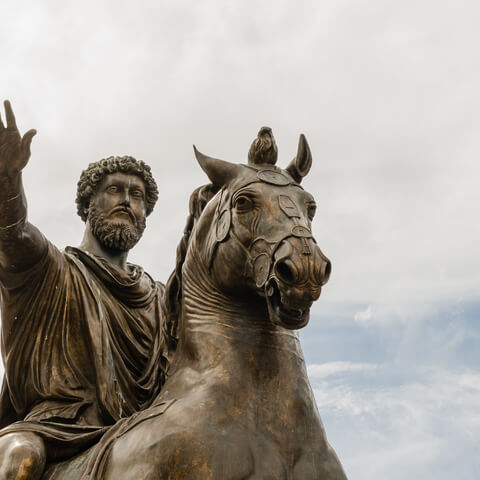
So Marcus Aurelius was a Roman emperor and he viewed fate as part of a harmonious cosmic order.
He wrote in his classic self-improvement book,
Meditations,
Even though it was meant for his eyes only as a sort of personal development journal,
Quote,
Whatever happens to you has been waiting to happen since the beginning of time,
End quote.
So imagine that.
You really,
This frame,
Whatever happens to you has been waiting to happen since the beginning of time.
If you take that on as a core belief.
You become unbreakable.
Fully accept it and trust that there's a cosmic order to life.
That this is happening for a reason.
And you'll find that there's a lot of phrases in self-improvement and also just when we try to cheer each other up.
That sound now cliche,
But a lot of them originated from Stoicism.
Things like.
.
.
Everything happens for a reason,
Right?
That's said all the time.
Oh,
Don't be upset about that.
Everything happens for a reason.
That is actually,
A more fatty.
The danger is when we hear that,
We don't take it seriously.
We go,
OK,
Yeah,
I get it.
But it's important that we rethink deeply about these phrases.
Another one in Stoicism would be Just focus on what's within your control.
You have a bad day,
You're stressed out,
Someone says to you,
Don't worry,
Just focus on about what's in your control.
And we go,
OK,
That's not really helpful,
But thanks.
The reason it's not helpful is because that's just a cliche,
The surface level phrase.
But if you go deep into that,
You will see that there's actually a lot of wisdom in that.
So Marcus Aurelius urged acceptance and appreciation of life's events.
And he saw adversity as an opportunity for growth.
Apetitis.
Was known for transforming suffering into strength.
He was born a slave.
And he was physically crippled.
Some say by his master and he had a broken leg and lived with a limp.
And he said in The Enchiridion is famous stoic handbook.
Do not seek for things to happen the way you want,
Rather wish that what happens,
Happens the way it happens,
Then you will be happy.
That's a.
.
.
Really short sentence.
That if we take that on,
Will literally make us happier in life.
I'll say it again because it's very important.
Do not seek for things to happen the way you want.
Rather,
Wish that what happens the way it happens.
Then you will be happy.
So it's okay to have a preference.
I'd rather be fit than unfit.
I'd rather earn money rather than have no money.
I'd rather have friends than no friends,
It's okay to have these.
Preferences in life.
But not to crave them and desire them.
In a sort of irrational,
Blinded sense.
And there needs to be this part of us that is,
Yes,
We have preferences in life.
But there's a part of us that.
.
.
Also,
Chooses what is.
The life that we have and trust the cosmic order of things.
You can actually play around with this.
As you're going about in your life,
Just play a game where you start practicing really wanting.
What you currently have as if it was something you put as a goal.
Maybe one of your goals is like.
.
.
What are classic goals?
I want to give up smoking,
I want to lose weight,
Whatever it is.
And we focus on these goals,
We get excited about it.
But play a game where.
.
.
You.
.
.
Think of yourself as a lot worse off than you currently are and then you have the goal to be the person you are now.
And then start craving that goal,
Start wanting that goal,
And then you realize you're already there.
That's practicing wanting things to happen the way they are happening.
Finally we have Seneca.
And Seneca was very good at finding virtue in adversity.
He emphasized character building.
Each of these Stoic philosophers had a different kind of stance.
We have Marcus Aurelius,
Whom.
A set attempted to embrace the cosmic order.
You have Epictetus who like to look at suffering and how we can transform that into strength.
And Seneca was looking at how can we build our character,
Our personality through hardships.
He said,
The bravest sight in the world is to see a great person struggling against adversity.
So whatever happens to you in life in some sense is a test.
And Seneca saw that as a test to see what's inside you.
I read a.
.
.
A book a while ago on storytelling.
And One of the ideas in the book was that you need to put your characters under pressure,
Because if there's no pressure,
You don't see what people are made of.
So if you have like a very.
.
.
Compassionate on the outside person walking down the street.
What you need to do with that individual then is put them in a situation where they have an opportunity to save lives and to risk their own life in doing that.
That's when you'll see how compassionate they are.
It's easy to act a certain way when there's no pressure.
It's easy to act good when there's no temptation to do wrong.
It's easy to act brave when there's nobody trying to make you afraid.
And so we can find virtue in adversity.
Just would've liked to refine some of my responses.
Current situation feels like the biggest challenge to date though.
How do we apply it to situations of such deep heaviness?
So somehow learning to embrace determinism.
This is the Ancient Stoics.
Would say that the past is.
Already part of fate,
You can't change it,
It's outside of your control.
The present is already the present,
You can't change that.
The future is up to us insofar as we can control our responses,
Our opinions,
Our judgments,
Our actions.
We can't control the external world.
So it's.
.
.
They have like a half a deterministic view.
They still hold this idea of free will?
But only the internal type.
They also acknowledge that you can't control other people,
Or the world,
Or the environment,
So you just focus on what you can control.
You're trying to practice arm more fancy.
In a very difficult situation.
And It's tricky because.
.
.
The way that we practice Amma Fati ideally is in lower stakes situation.
Like as a daily practice,
Then we build up to it.
A lot of people start meditating when life goes horribly wrong,
But the best time to start meditating for that individual would have been a year ago.
Because then they have the baseline practice.
It's hard to meditate properly when everything's chaotic.
However,
Stoicism works extremely well,
Even if you're new to it and things are really tough.
What I would start doing is.
.
.
A practice called negative visualization.
So whatever's going on in your life,
However challenging it is,
One thing I like to do.
Is just think of how it could still be even worse.
This is a quote that I like.
Whenever something bad happens.
Think of what catastrophe you've also avoided.
And reassuring when applying it to my own life,
Even now when struggling with severe health conditions,
But I struggle when applying it to others,
Especially when it comes to things like genocide,
Babies falling sick and passing,
Etc.
Which then makes me doubt the belief.
Yeah,
I mean it it's interesting because When we say everything happens for a reason,
We often say that to make ourselves feel.
.
.
Better in the moment.
I prefer,
Instead of everything happens for a reason,
As in everything happens for a good reason.
I would probably say something like,
No matter what happens in life,
There will be something eventually good that comes from it.
It feels a bit cruel and callous to say that about genocide.
Of course,
But then.
.
.
If you just look at world wars and things like that.
I'm pretty sure that for the last 10,
000 years,
Humanity has been in a constant war even though 10,
000 years is not a huge amount of time.
From the cosmic perspective.
A certain point people are going to get fed up with that if you look at a lot of the policies that we have.
Science as well,
Like a lot of it's been motivated by things that have gone wrong,
Like healthcare was probably sped up by the plague at a certain point.
Out of every difficult thing,
There are people wanting to kind of correct it and fix it.
That's the power of humanity.
So Nietzsche revitalized amor fati from the Stoics in the 19th century,
Linking it to the concept of what he called eternal recurrence,
This idea of living the same life repeatedly.
That's a good question as well to meditate on.
If you were to have lived the same life that you've lived so far for eternity over and over and over again,
Would that life feel like a hell to you or a heaven?
And would you be able to apply the lens of Amor Fati to that repeating?
Would you be able to choose to love your fate if it was replaying over and over again?
Nietzsche passionately declared in his book The Gay Science,
Quote,
I want to learn more and more to see as beautiful what is necessary in things.
Then I shall be one of those who makes things beautiful.
The key phrase is there is makes things beautiful.
A lot of ass go to life.
Worshipping the external world.
In this way that takes away our own agency.
We forget that we are projecting.
We forget that we are applying a lens always to externals.
And that a piece of art is not necessarily objectively beautiful or not.
Like a chimpanzee or an alien species or a different human might see a piece of art that you love.
And say that it's horrible and disgusting.
Because they're applying a different lens to it.
But life itself is like that.
Instead of wanting things to be beautiful around you,
Why not embrace Amor Fati and make things beautiful?
By altering the lens and the way that you see life.
Here are some real world examples of figures throughout history embracing Amalfi.
Epictetus,
Who we've already mentioned,
Was a slave who became a very influential philosopher and teacher to the wealthy and often the children of very high status politicians.
In ancient Rome and.
.
.
Think of it from a slave with very limited education to then the teacher of the highest status individuals.
In the land By practicing Stoicism and embracing his faith,
It's quite an achievement.
Nelson Mandela was imprisoned for 27 years.
Which I can't imagine going to prison for one year,
But to be in prison for 27 years and then to come out of prison.
And then to lead.
South Africa.
Is pretty crazy.
He accepted his fate and he came out of prison with wisdom.
And then Viktor Frankl was a Holocaust survivor.
He was a therapist who was put into a concentration camp.
And He was put through immense suffering,
Lost pretty much all of his family members.
And He practiced.
A type of amorphity,
A type of stoicism where He famously said,
Between every stimulus and response,
There is a space.
And in that space you can choose your response.
So you're not locked into certain reactions and emotions.
You have the power to choose.
People can literally chain you up.
People can literally torture you,
But you do have one thing they can't take away from you.
Your response,
Your outlook,
Your perspective,
What you choose to think.
That is something that is not bound to the external world.
What could have been worse right now,
What catastrophe may have been averted.
Yeah,
It's a great one to do.
It's so hard,
But it does bring me through and into my feelings rather than a product of the mind chatter.
Yeah,
It is hard.
I do not use everything happens for a reason.
There are people suffering for no reason of their fault.
Yeah,
So.
.
.
Like I was saying,
You don't have to use that phrase.
Instead,
You can just ask the question.
Maybe instead of a statement,
Ask.
Questions are brilliant.
Ask the question.
Over the next 10 years,
Will there be anything productive that comes from this?
And then just let your mind think that through.
So let's look at how we actually practice Amalfati in daily life.
So there are three steps to this.
If you want to take notes or just practice them now as we go through them.
So number one is to reframe adversities as opportunities.
So any setback that comes your way,
Any obstacle,
You can practice it today or tomorrow or this week.
Look for the opportunity.
Ask,
How can I turn this into something valuable?
What is the lesson here?
One game that I like to play.
With my perspective is whenever something negative happens,
I say like the sentence that this is good because I leave a gap.
No matter what happens,
Just to get the mind thinking.
So maybe you twist your ankle and you love to run.
This is good because now I can read those books.
That I've been putting off or now I can take up an interest in rehab and mobility and yoga which I've been putting off.
For example.
My children are really stressing me out and testing my patience.
This is good because now I'm very motivated to become a better parent and research.
How to become a better parent,
And to practice these tools in difficult situations.
So we can actually do that right now.
And then just write,
This is good because step two is to apply the stoic dichotomy of control.
So dichotomy of control was a theme in stoicism,
But it was really flashed out by Appetitus.
And it's this idea that life is divided or experience is divided into two.
Categories,
Things that are up to us and things that are not up to us.
I have a garden,
A long garden,
Quite narrow but it's long,
And I have a neighbour,
A bunch of neighbours with also long,
Narrow gardens.
And I think to myself,
If my neighbor had a plant in that garden,
In their garden that was very unattractive,
And they didn't care for it,
And their garden became messy.
That is not up to me.
The change.
I can tell them,
I can express my thoughts,
But it's not my garden to change.
So instead,
What should I be doing?
I should be focusing on my garden.
It's my garden!
I can cut the grass and plant nice flowers.
Well,
If you think of this analogy in terms of the dichotomy of control,
Epictetus would say that your mind is your garden and anything outside of you is not your garden.
You can't control other people.
You can't control.
To a large extent what your body does,
Any of us could get.
Hit by something when we step outside or we could become ill because there's a strange genetic variant that we didn't know we had.
Even the most Deepest.
Beautiful romantic relationships can end at any moment.
That's part of the agreement.
You know that every day you're with someone,
They could leave.
So could you.
It's a choice.
You don't control that.
Instead you control.
Your thoughts,
Your actions,
Your opinions.
And so whatever happens to you,
You look for the lesson,
Step one.
And step two is you ask,
What is within my control and what is not within my control?
And try to switch the perspective to thinking only about what is up to you.
How can I think about this?
How can I create a judgment around this that is useful to me?
When it comes to step three.
This is where we practice gratitude.
So acknowledge the even difficult events.
Can improve our character and help us grow.
So again,
Amalfati doesn't deny life's struggles.
It transforms how you perceive them.
We're not saying that issues don't exist.
We're saying that we're going to use these issues.
To improve our character and our life.
If you start practicing these three steps,
Reframe adversities as opportunities,
Apply the stoic dichotomy of control,
And have gratitude for every moment.
What are some of the benefits that you can expect?
You will have better mental and emotional resilience.
By reframing adversity positively.
You can reduce your anxiety.
Reduce your depression.
And Stoics assert that embracing fate cultivates inner peace and strength.
How could a person be truly anxious and depressed?
If they love whatever happens to them.
I mean,
It's the ultimate antidote to that.
I'm not saying that it's easy to do.
But the fact that there is a pathway to this and that you can improve on the scale.
To increase your armor fati is pretty inspiring and helpful.
Some individuals would criticize Amalfi and say that it might foster some passivity or complacency,
Especially in hardship or injustice.
Instances of suffering in the world and evil.
Why would I want to have Amalfiati over that?
Surely I should stand up and be really annoyed and fight it.
Well,
The Stoics would say that.
.
.
The Amalfati approach emphasizes active acceptance rather than passive resignation.
So you can choose your response.
And then that response can lead to action.
And leads to you improving your character.
For example,
Something really troubling is going on in the world.
You can say,
Well,
I still love my experience.
I still love what is happening within my reality right now.
And I'm noticing that I'm getting feelings.
Wanting to take action and change this.
How can I do that?
It's an active type of acceptance.
Because the alternative is that life is still forcing you to feel happy or forcing you to feel sad.
So let's do a quick recap.
Amalfi translates as love of fate.
And it's about acceptance and appreciation of every type of event in life.
Nietzsche popularized the term,
But the roots originate with the ancient Stoics,
Marcus Aurelius,
Epictetus,
And Seneca.
And the three ways you practice Amal Fati is to reframe adversity into opportunity.
To focus on what you can control.
And to find moments of gratitude in life.
Amanda says this is good because I have struggled with my role as a mother and motherhood in general,
But this new baby is coming in as a confirmation of my great cosmic role to hold the children in deep reverence and it is motivation to heal all parts of me to be loving and of service.
That's amazing.
That's really powerful.
Being a parent is the hardest job in the world.
So yeah,
Respect.
John says my neighbors Virginia My neighbors,
Come into my garden.
And is very invasive.
I have to keep chopping it down.
I find it annoying.
Well if it comes to DRGarden,
Then that is DRGarden.
If you use the analogy of the two gardens that is then.
Your responsibility.
Because now it's in your garden.
Shan says bed bound now for seven months due to severe health issues.
Sorry to hear that.
This is good because I am now able to rest so the illness And to prevent the illness from progressing further,
I'm able to reconnect with meditation.
I'm learning resilience.
I'm strengthening bonds as loved ones support me during this time.
Yeah,
That's great.
There's a lot of good things that can come from this.
It's all about your perspective,
Right?
You can take on this perspective of.
.
.
I'm bedridden.
I don't have much energy.
Now let me look at all the people jumping around with all this energy and look at myself and look at them.
And compare myself and then I'm gonna make myself suffer.
But then I would always ask the question,
What do I have?
In this situation that they're not getting.
Time to slow down,
Time to think,
Time to process,
Time to be still,
Time to meditate.
There are people right now that are choosing voluntarily to meditate 16 hours a day in a cave.
Even though they don't have to,
They're choosing to do that and they're probably very happy doing it.
One of the things Seneca would do.
Is whenever he was punished because he was exiled twice.
You would be exiled to an island,
And instead of thinking,
Oh,
I've been exiled to this horrible place,
It's terrible.
He would go around and ask people who came here voluntarily.
And then he would go,
If they came here voluntarily,
Why can't I choose to be here voluntarily?
Can't I see this as a holiday?
Why do I have to see this as a punishment?
Amanda says.
Even though I have no idea how to handle my life with three children,
I trust that this child is of God and came through me to bring light and love into my family's life.
I trust that I have all the tools and awareness I need to do this.
You definitely do.
You definitely do.
Difficult life situations will bring that out of you.
You have power within you that nobody knows is there until it's required of you.
Even though that's quite scary,
It is true.
Human beings.
Just look at the history of humanity.
You have that within you.
Think of all the hardships your ancestors had to endure.
You are a product of them.
All the things they had to get through those times you have within you,
But you just haven't activated it yet.
Or maybe you've omni-activated it in certain moments.
The reason why we're alive today is because we all come from a long lineage of survivors.
Chloe says it sounds similar to a growth mindset,
Something I've been practicing these past few months with great results.
Yes,
Growth mindset is amazing.
Comment says left my marriage and worried that your former husband,
I'm not going to say that,
But that wouldn't be very well off.
Or me.
As he is also mentally unwell.
I also had to resign from my job due to a teen girl's not wanting to see him anymore.
Despite the uncertainty and fear,
I'm alive,
My girls are with me full time and as safe as I can make us.
I kind of like not working right now and wanted to change career path anyway,
So I have time over the next 12 months to reset and pivot and practice my boundaries.
The depth of grief from all angles has broken me open to care about myself instead of just others.
Very powerful stuff,
Common.
One of the things you see a lot in recovery circles,
People that are members of Alcoholics Anonymous and things like that,
Is that they say that the best thing that ever happened to them is finding recovery.
And that they would've,
They still would've.
They're happy that they were an addict so that they could then find recovery because there is something really powerful.
But the healing process.
About the lessons you learn when you're going through an inner struggle.
And nobody can take that away from you.
Some really powerful comments here,
Sounds like a lot of us are going through.
Some difficult times and Ammo Fatty is there to help you during those times.
It's something that can be practiced every day.
And a lot of the stoic ideas.
Indirectly pointed anaphylactic even though they don't use that term.
So one of the stoic ideas I like is.
.
.
Epictetus says when something happens like a piece of glass breaks on the floor,
Say you're walking through your house with a glass,
You drop it and it lands on the floor and shatters.
You ask the question.
Is this glass worth my peace of mind?
Say the glass cost you five dollars.
Is $5 worth my peace of mind?
If someone came up to you and said,
Hey,
Can I make you really mad and angry and full of suffering,
I'll give you $5.
Would you say like,
Okay,
Great,
Sounds good,
Give me the $5,
Or would you say,
Nah,
I don't think so,
That's not a deal I want to take.
Most of us would say we're good.
You can keep your five dollars,
I'll keep my peace of mind.
Recognizing that peace of mind and happiness is the most important currency.
And this ties into Amalfiati,
When the glass breaks.
How can I love this?
How can I accept this?
How can I reframe this as I'm actually trading this glass for my peace of mind?
About a year ago,
I had a really busy childcare day,
Looking after my son.
Had like an hour break,
So I thought I'm gonna go get a coffee.
Bought a hot,
Large coffee from a drive-thru.
Put it on my lap,
Went to reach for something,
It spilled everywhere.
Like all over my legs,
All over the car seat,
All over the floor.
And I just froze for a second,
Like,
Oh,
What happened?
Kick in.
And then I just asked,
Is this coffee worth my peace of mind?
Just that thought alone made me go,
You know what,
I'm going to use this as practice.
I'm going to drive off.
And It's funny because I released that in a podcast,
That story.
And someone heard it.
And they were going through something much bigger.
And they'd been ripped off in a car rental company for thousands of dollars and they're listening to that story about me dropping my coffee.
And then they got in touch with me.
And then we're actually still friends today.
So.
.
.
I would never have known the drop in my coffee.
Practicing that technique.
I'm Alfazi.
Sharing that with other people would've then brought me A friend,
Of all things.
But that's just the way that life is.
Claire says,
After decades of often severe ME chronic fatigue,
I am slowly improving.
And all that I've learnt has made me very resilient.
My dad is palliative care,
Lots of challenges and people are thanking me for my level,
Headness,
Kindness,
Etc.
In dealing with this complex situation.
These qualities are due to what my own suffering taught me.
I,
In my personal life,
I like to practice mantras.
So.
.
.
Not in a sort of in a way that's like I'm forcing myself to think things that aren't true.
More just reminding myself of something that is undeniably already true.
I am the pilot,
Not the turbulence.
So that thought just helps me when things get a bit crazy.
And that's a stoic idea as well.
The turbulence is the external world.
My internal world is the pilot,
So just reminding myself that that's my job.
My job is to be the pilot,
Not to add any more chaos and turbulence.
When we get a difficult life situation,
We start thinking,
How can I stop this?
How can I end this?
How can I make this go away?
But instead of thinking that,
Think,
I don't need to end this.
I just need to be strong and sturdy and resilient through it.
And let it take its course.
Thank you for contributing.
I hope you take this idea of Amalfi with you.
Feel free to do your own research into it as well.
And talk to you soon.
Thank you everyone.