Last week,
I got more messages than I've received for any episode in quite a few months.
And they all said the same thing.
That's me.
I know the philosophy,
But it disappears when I need it.
One person wrote to me.
They said that they've read the meditations three times.
They said they've got stoic quotes on their wall,
But yet they still lost their temper with their child and then they felt like a fraud.
A guy messaged me saying that he's been studying stoicism for five years and he still spirals for hours after a critical email.
The gap between knowing and doing,
It's universal and it's painful.
And today I want to go deeper because I think we've fundamentally misunderstood what stoicism is supposed to be.
We think of it like a philosophy to learn,
But the Stoics designed it as something else entirely.
They designed it as a training system,
Like martial arts.
When we think of the ancient Stoics,
We picture philosophers,
Writers,
Thinkers.
But that's not quite right.
Take Epictetus.
Epictetus was born a slave.
He gained his freedom.
He studied philosophy in Rome and then got exiled when Emperor Domitian kicked all the philosophers out of the city.
So Epictetus went to a small town in Greece called Nicopolis and he opened a school.
But it wasn't a school like the way we think of schools.
Students came to live with him,
Sometimes for years.
They didn't just show up for lectures and go home.
They trained.
Every morning Epictetus would present scenarios.
Someone insults you at a dinner party.
What do you do?
You receive news that your business has failed.
How do you respond?
Your friend betrays your trust.
What happens in your mind?
And the students wouldn't just discuss the right answer intellectually.
They would practice.
Role-playing.
Rehearsing.
Training their nervous systems to respond differently.
Epictetus would watch and then correct them.
No,
You're still holding on.
You're still treating that as something that can hurt you.
Again.
This was philosophy as conditioning.
Philosophy as reflex training.
And the Greeks had a word for this kind of training.
Ascesis.
It's where we get the word ascetic from.
But it didn't originally mean self-denial.
It meant exercise.
Training.
Drilling.
Stoicism was ascesis.
It was practice.
Not theory.
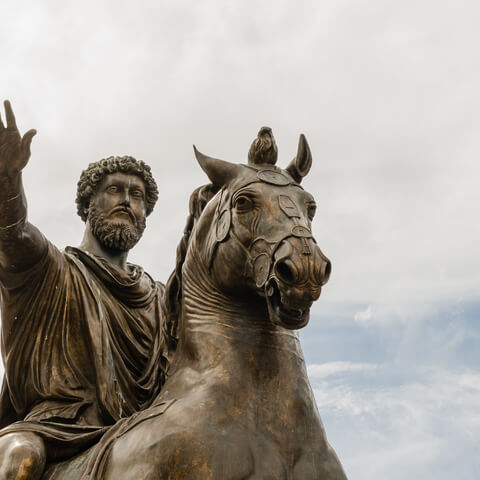
Take Marcus Aurelius.
The meditations weren't written for readers.
They were never meant to be published.
They were his private journal.
Notes to himself.
Written in his tent during military campaigns.
Sometimes late at night after exhausting days.
And look at how he writes.
Today I will meet with people who are ungrateful,
Arrogant,
Dishonest,
Jealous,
And unsocial.
He's not describing his day.
He's preparing for it.
Running the simulation in advance.
This is,
As many of you know,
Premeditatio malorum.
The premeditation of adversity.
It's a practice.
Something you do every morning before the day begins.
And Marcus did this daily for years.
Drilling the same thoughts into his mind.
Not because he didn't understand them.
But because understanding wasn't enough on its own.
He needed them in his reflexes.
Not just his intellect.
Or take Seneca.
Seneca's letters to his friend Lucilius look like essays.
They're beautiful.
But they're actually prescriptions.
They are instructions.
They are exercises.
Practice poverty for a few days each month.
Sleep on a hard bed.
Eat the cheapest food.
Then ask yourself,
Is this what I was afraid of?
Or every evening examine your day.
Ask,
What bad habit did I resist?
What virtue did I practice?
Where did I fall short?
These weren't suggestions.
They were assignments.
Things to do.
Not just to think about.
Seneca's own evening practice was so rigorous that his wife knew not to disturb him.
He describes it,
Quote,
When the light has been removed and my wife has fallen silent,
I examine my entire day.
Going through what I have done and said,
I conceal nothing from myself,
End quote.
Every.
Single.
Night.
For decades.
This is what Stoicism was.
A training regimen.
A system of daily exercises designed to rewire the mind's automatic responses.
Musonius Rufus,
Epictetus's teacher,
Put it this way,
Just as there is no use in medical study unless it leads to the health of the human body,
So there is no use in philosophical doctrines unless they lead to the virtue of the human soul.
I'm going to say that again.
Just as there is no use in medical study unless it leads to the health of the human body,
So there is no use in philosophical doctrines unless they lead to the virtue of the human soul.
Philosophy without practice is like medical school without healing anyone.
It's pointless.
The Stoics weren't just trying to build a library.
They were building a gymnasium.
But somewhere along the way,
We lost this.
We turned Stoicism into another form of content.
We read Marcus Aurelius like it's great literature.
And,
You know,
I get it.
It is.
But it's a lot more too.
We collect Seneca quotes like they're just poetry.
We listen to podcasts,
Including this one,
And feel like we're just making progress by listening.
But are we practicing?
Are we doing the exercises?
Are we training?
The Stoics,
I think,
Would probably find our approach bizarre.
It's like reading fitness blogs for five years and wondering why you're not strong.
Or watching cooking videos every day and being confused about why you can't cook delicious meals.
Knowledge without practice is not Stoicism.
It's entertainment.
Or infotainment.
I say this as someone who made this exact same mistake.
For years,
I read everything.
I highlighted passage.
I took extensive notes.
I felt wise after a good reading session.
And then an email would land.
Something critical.
Something unfair.
And I'd spiral.
Refreshing.
Ruminating.
Composing angry responses in my head.
And all that reading hadn't changed my reflexes.
Because reflexes don't change through reading.
They change through repetition.
The philosopher Pierre Hadot,
Who spent his career studying ancient philosophy,
Concluded that the ancients would be shocked by how we treat their work.
They didn't write books to be analyzed.
They wrote manuals to be practiced.
Nothing has shown me how to use Stoicism,
Actually,
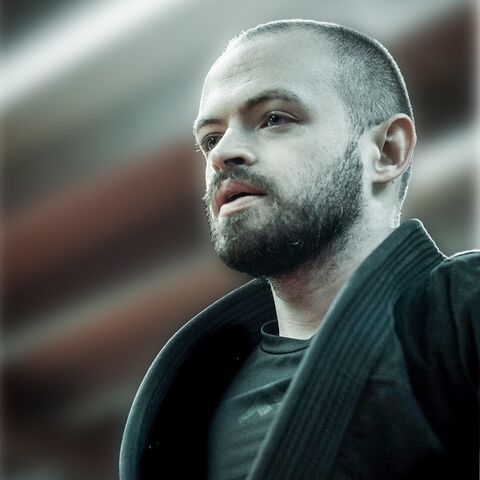
More than my training in Brazilian Jiu-Jitsu.
It's a container there,
A martial arts container,
Where you have to spar and try and remember what you've learned under pressure against resistance is the perfect learning environment.
And very quickly,
You realize where you're fooling yourself.
It's like as if we've turned the Stoic gym equipment into just museum exhibits.
We admire and discuss it.
We photograph it.
But we don't train.
We don't lift.
So what does Stoic practice then actually look like?
Not in ancient Rome,
Obviously,
But in your life?
It's probably smaller than you think,
But also more specific.
Let me give you a few examples.
So the first thing is morning preparation.
This is what Marcus did every day.
Before you check your phone,
Before the day starts to happen to you,
Take two or three minutes to preview what's ahead.
Not your schedule.
I mean your challenges.
Who might frustrate you today?
What could go wrong?
Where are you likely to react rather than respond?
And for each one,
Mentally rehearse how you want to show up.
Not how you usually show up,
But how the best version of you would handle it.
This is premeditatia malorum.
Rehearsal creates readiness.
The reason it works is neurological.
When you mentally simulate a scenario,
You're laying down neural pathways.
You're practicing the response in advance.
So when the moment comes,
You're not improvising from zero.
You're executing a pattern you've already run.
It takes three minutes,
But it will change how you meet the day.
Another basic one,
Evening reflection.
This is Seneca's practice.
Before you go to sleep,
Review your day.
Not your tasks,
Your responses.
When did you react?
What triggered you?
What would you do differently?
And here's the key.
No judgment.
Seneca said he approached this like a trial where he was already acquitted.
The point isn't to beat yourself up.
The point is to notice.
And over time,
You start to see patterns.
You start to discover that you're always reactive after bad sleep.
Or that certain people reliably trigger you.
Or that you handle mornings better than afternoons.
This self-knowledge is power.
You can't change what you can't see.
Five minutes is all it takes,
But you do it every night.
And another practice,
The pause.
This is the discipline of ascent.
This is what Epictetus considered the most essential stoic skill.
When you feel the spike,
The anger,
The anxiety,
The impulse,
Pause.
One breath.
And in that pause,
Ask,
Is this within my control?
Not,
Can I influence this?
That's not the question.
The question is,
Is this thing I'm reacting to actually something I can control?
If it's someone's opinion of you,
No.
If it's an email someone already sent,
No.
If it's traffic or weather or the past,
No.
Once you see that clearly,
The grip loosens.
This doesn't take minutes,
It literally takes seconds.
But you have to train it.
You have to practice catching yourself before the reaction completes.
These three practices,
Morning preparation,
Evening reflection,
The pause,
You could argue are the core of daily stoic training.
And they don't even require hours,
They just require consistency.
What I'm describing here is a shift in identity.
From consumer to practitioner,
From reader to trainer,
From someone who studies stoicism to someone who trains as a stoic.
This is harder than reading.
It's easier to buy another book than to actually pause before you react.
It's easier to listen to another podcast than to do the evening reflection every night.
It's easier to feel like you're making progress through consumption than to do the unglamorous work of repetition.
But repetition is the only thing that rewires reflexes.
The Stoics knew this.
That's why Epictetus had students live with him for years.
That's why Marcus wrote the same ideas to himself over and over.
That's why Seneca practiced his evening review every single night.
They weren't trying to understand the philosophy better,
They were trying to become it.
And that takes time,
Practice,
And structure.
And I've been thinking a lot about this for quite a while,
About what it would look like to actually train,
Not to just read.
To have a structured practice,
A daily rhythm,
Accountability that keeps you honest.
Something that bridges the gap between the philosophy on the page and the person you want to become in the moment.
And I've actually been working on something,
And I'll share more details with you soon.
But for now,
I just want to leave you with a question.
What would change if you actually practiced one stoic exercise every day for a month?
Not read about it,
But practiced it.
The morning preparation,
Or the evening reflection,
Or the pause.
Just one,
Every day,
For 30 days.
I think you already know the answer.
The gap between knowing and doing doesn't close through knowing more.
It closes through doing.
Thanks for listening.
I'll see you back here soon.