Can you control the words I'm about to say?
Can you control the next sentence that comes out of my mouth?
Can you control the people in your life?
Maybe you can influence them.
You could say you have partial control over them.
But really,
Do you?
Say you try to manipulate someone into doing something for you.
You can't be 100% certain that they'll do everything you want.
Maybe they'll do some of the things and you'll feel some satisfaction of getting your own way.
But they may not do everything you want.
There may be unforeseen factors,
Unexpected problems which come up that ultimately lessens your control over other situations in the long run.
Can you control how much your partner loves you?
Can you control how much money you earn?
In our Western self-empowered society,
The temptation is to say,
Hell yes,
I can control all of these things and I will control them to get the outcome I want.
It's tempting to believe in the idea that we can control our destiny,
We can control our surroundings and climb to the top of the success ladder.
We are told that as long as we trust ourselves and break the rules and ignore the naysayers and work hard,
We will certainly attain success.
But there's a problem.
The problem is of course this way of thinking.
It's as much a recipe for failure as it is for success.
I mean,
Think about it,
The world is littered with failures who trusted themselves and ignored the naysayers.
How many talented,
Hard-working people have gone to their graves unsatisfied with the level of success they achieved in their particular field?
Randomness plays a much larger role in our lives than the self-help gurus want us to believe.
And in dis-acknowledging the role of things outside of our control,
We only end up suffering.
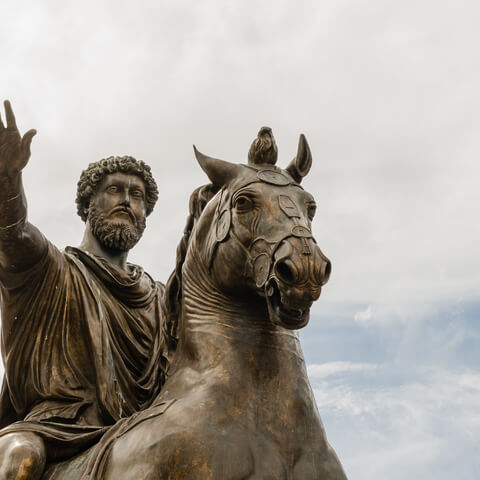
In Stoicism,
We focus primarily on the things we can control.
And those things are actually quite limited.
We really only,
When it comes down to it,
Have control over our conscious thoughts and actions.
And because of this,
It is far wiser to set internal goals that revolve around our own thoughts and actions rather than external goals which revolve around other people's thoughts and actions,
And the external world in general.
To provide an example,
Let's dive into a visualization.
Imagine you are in the World Championship Final of a tennis match.
You are on the last game.
So far,
It's a perfect draw between you and your opponent.
The next minute or so of your tennis game will determine who wins the World Championship.
This could change your life forever.
And you are about to serve.
Get into this moment.
Feel the breeze on your sweat-covered skin.
Hear the quiet chattering of the crowd,
The feel of the fuzzy yellow ball in your hand,
The balance of the weight on your worn-out legs.
How will you approach the remainder of this game?
The typical way would be to want to win,
And to do everything in one's power to win.
But this is not how a stoic sage would approach the game.
A stoic sage would actually not try to win the game at all.
A stoic sage would not put their efforts and energy and focus into trying to beat the other player.
This is a foolish goal.
That in the end is outside of your control.
The other player could get a lucky break.
Your leg could suddenly cramp.
The amount of sleep.
The difference in genetics.
The weather.
Each of your diet.
The crowd.
And many other factors beyond your control will influence who will actually win.
What you can control is your own effort in playing to the best of your ability.
Of following your process.
You can try to play your best game,
Regardless of the end score.
If you know in your heart that you played your best game,
You knew you did the things that you had been practicing,
You had been training for.
You kept your mind in the right place.
If that was your goal,
And you did that,
Well,
Then you would still win,
Even if you lost.
So go back now into the tennis match,
Just before you're about to serve,
And visualize playing from this internal goal of playing your best game.
And let go,
Completely let go,
Of who actually wins.
How does that feel?
In what ways could you use the same perspective shift,
This stoic fork of letting go of the externals and focusing instead on your inner goals in your everyday life?
Now bring to mind for a few minutes some of the other challenges you face in your day-to-day life,
And imagine setting similar internal goals,
Free of the outcome.
If you see an attractive person at a bar and want to go on a date with them,
That is outside of your control,
I'm sorry.
No matter how good looking you are or funny,
It is outside of your control.
But taking the initiative to say hi is within your control.
To the stoic,
As soon as you say hi in this kind of situation,
You've already won.
And anything else,
Whether that be a date,
A drink,
Or marriage,
Is just a bonus.
You took control of your own destiny by setting an internal goal.
Now if you're an author,
You can decide to write five pages a day,
You can decide to try and write the best book you can,
You can decide to try and follow the steps required to publish it,
But you cannot control how much other people will like your book.
You cannot control whether it gets published.
And it would be foolish to spend your energy worrying about that stuff.
I spent a few minutes thinking of all the ways you could set internal goals in your own life,
Visualize the letting go of the externals.
This will lead actually,
Paradoxically,
To not only a happier life,
But more success in those fields because the tennis player,
Or the novelist who writes for internal fulfillment to achieve internal goals,
Is actually more likely to get results.