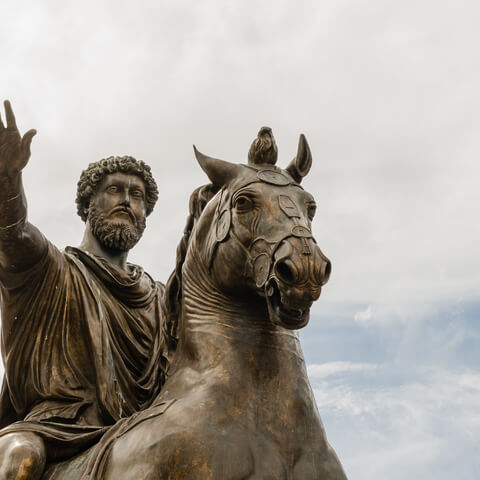
The following is a clip from a conversation I recorded with Donald Robertson,
A cognitive behavioral psychotherapist and renowned expert on Stoicism.
Donald specializes in bridging ancient philosophical wisdom with the modern psychology to enhance resilience,
Emotional clarity,
And well-being.
Enjoy.
I can't imagine someone who's practicing Stoicism to have an outlook that is very violent and aggressive.
Or is that accurate to say that?
Or,
You know,
It's just,
Yeah.
I mean,
He says in the meditations,
You know,
You'd have to be crazy or you'd have to be,
You know,
Really kind of hypocritical in a way.
I mean,
The true interpretation of this is a little bit more nuanced,
But obviously in meditations,
He says over and over and over again that what matters to him is a feeling of brotherhood,
Brotherly love,
Really.
And the story is called Philostoria,
By the way,
You know,
Like the this is one of the central principles of Stoicism is this idea of brotherly love and the brotherhood of mankind.
Cosmopolitanism,
The idea that we all are citizens of the same cosmos.
So Marcus mentions Roman citizens,
I think,
Like twice in the meditations.
But on every page,
Virtually,
He mentions not being alienated from others,
Cultivating natural affection towards them,
Overcoming anger and exhibiting justice in his relationship with others,
Like all these interpersonal virtues.
But they're all in reference to humanity as a whole,
Like not just to Roman citizens,
Which is remarkable if you think about it,
Because he's Roman emperor and he's writing this while he's meeting Germanic and Sarmatian envoys every day.
So he's talking about the guys that he's at war with,
Right?
When he says,
You know,
That he should cultivate natural affection towards the rest of mankind and view them as his kin,
He means it.
But he's still at war with them because they invaded his country.
But he's not,
By any means,
If there's any shred of truth in the meditations,
You know,
He's the opposite of a warmonger.
He really he doesn't see these guys as the enemy or as other like he views them as his brothers and sisters.
Yeah,
Yeah,
That's like,
I think that one of the most inspiring things for me,
At least reading the meditations,
Is this perfect balance that I see between strength of character and compassion,
You know,
Because that's a really difficult thing to kind of balance.
A lot of people are just too agreeable,
Too compassionate and pushovers.
But you see this incredibly powerful,
Strong human being who's also like going out of his way to practice tolerance and forgiveness and,
You know,
Kind of seeing how he relates to people.
He says something weird about that.
He says that true manliness consists in the strength of character to exhibit kindness rather than aggression.
And people ridiculed Marcus Aurelius.
Supposedly the general that instigated the civil war against him called him a philosophical old woman.
So they thought he was too soft.
But Marcus responds to that and he says,
No,
You're the angry people are weak people.
Like angry people think they're strong,
But actually they're weak.
And he says it's it's people that have mastered their anger and are able to exhibit compassion that are potentially the strongest characters.
And that's what he aspires to be like.
But this kind of understanding of stoicism is rare in the modern world because.
The terms of using Greek for Greek philosophy generally became degraded over the past 2000 years,
And so when people say cynical today,
They don't mean that someone followed the philosophy of Diogenes,
Like they just mean that someone's sneering and negative about things.
When someone says I'm an epicurean,
They just mean that they enjoy fine wine and food.
They don't mean that they drink barley water and pot of cheese like the ancient epicureans did.
Academic,
Sophist,
Skeptic,
Like all these terms mean something slightly different now,
Something much cruder and more simplistic than what they originally meant.
And so stoic now means unemotional when we write it with a lowercase s.
And in psychological research,
It's commonly used as a term to denote toxic,
Maladaptive ways of emotional coping.
There are large volumes of research showing that lowercase s,
Which involves suppressing emotions,
Is like definitely not a good thing.
Like again,
Like the weird thing is people who suppress their emotions believe that they're strong,
But they're more prone to mental illness.
So they're actually very vulnerable,
Weak people as a result of this maladaptive coping strategy.
Like of course they believe that they're strong.
They're actually shown to be weak.
It's a fragility,
A weakness that it causes in us when we can't handle our emotions and we disguise them and we conceal them and we try to suppress them.
But that's not what ancient stoicism means.
It's completely the opposite.
In fact,
Ancient stoicism is the inspiration for cognitive therapy,
Which there are huge volumes of research showing is good for us.
So on the one hand,
We've got this thing that is bad for mental health.
On the other hand,
We've got this thing that we know is good for mental health and they're both kind of associated with stoicism,
But they're opposites.
It reminds me of this quote from William Blake,
The poet who said,
We both read the Bible day and night,
But you read black where I read white.
So a lot of people misconstrue stoicism and turn it into something that's almost the complete opposite.
And part of that is that they completely ignore the reference to social virtue in ancient stoicism.
Stoicism was the inspiration to a large extent for early Christian ethics.
So no one says that early Christianity was self-centred and non-emotional.
It's a little bit brotherly love and forgiveness,
Obviously,
Supposedly.
But that part of it is all in stoicism.
It very much seems to be inherited.
They still use very similar language.
The Stoics are in the New Testament.
By the way,
It's a bit trivial for you.
Not a lot of people know that.
In the Acts of the Apostles,
They're actually mentioned.
St.
Paul goes to Athens and he gives a speech at a sermon at the Areopagus at the foot of the Acropolis.
And it says that he was talking to Stoic and Epicurean philosophers there.
And he actually quotes a Stoic author called Aretas to them,
Who was an ancient poet and student of Zeno,
The founder of Stoicism.
So the early Christianity is steeped in Stoicism.
The early church fathers,
Many of them had studied Stoicism.
They refer to it.
Even St.
Paul,
We're told in the New Testament,
Was talking to the Stoics and reading Stoic literature.
But somehow,
People ended up thinking of Stoicism as this kind of unemotional,
Mr.
Spock,
Cold hearted,
Kind of atomistic,
Individualistic thing.
And Christianity has been the complete opposite,
Weirdly.
But these are caricatures.
Ancient Stoicism,
As you know,
Particularly Marcus Aurelius,
In every single page of the meditations,
He talks about his cultivating a sense of brotherhood and affection and kindness and compassion towards other people.
Yeah,
I mean,
I feel like I'm using Stoicism a lot,
Raising my three-year-old and I know firsthand experience that it makes me more compassionate.
It's a tool that really helps me connect and show more love and be a better dad.
It's not like I'm cold and distant from my child.
I'm seeing that every day.
100%.
Even Epictetus,
This pretty tough guy,
Says that it's human nature.
If you see a small child,
You want to get down in all fours and play and interact with them.
It's natural to have affection for children.
The Stoics really celebrated what they call,
The phrase in English is we use as natural affection,
But actually in ancient Greek it kind of means paternal or familial affection,
Philistorgia.
This is central to Stoic ethics.
The Stoics think human nature is that we're designed to care about children.
They think we should cultivate that and extend it and learn to care about humanity in general.
Part of their theology is they think we should emulate Zeus.
We don't worship Zeus,
But they did.
They thought the goal for them was to become more Zeus-like.
They said Zeus is the god of hospitality and friendship,
Among other things in ancient Greece.
The Stoics took that aspect of them very seriously because they thought of Zeus as being the father of mankind.
They thought Zeus has paternal affection for the whole of mankind.
If you were to be god-like and Zeus-like,
You'd have this broad,
Encompassing perspective,
Like omniscience,
But you'd also have this unconditional affection for the whole of creation,
The whole of mankind.
That kind of helps to define,
In their eyes,
What they think the ideal is for humanity.