The following is a clip from a conversation I recorded with Donald Robertson,
A cognitive behavioral psychotherapist and renowned expert on Stoicism.
Donald specializes in bridging ancient philosophical wisdom with the modern psychology to enhance resilience,
Emotional clarity,
And well-being.
Enjoy.
Were the early Stoics Buddhist monks?
Some of them didn't wear shoes and they kind of went about in robes and stuff.
Maybe some Stoics shaved their heads.
There's a little bit of kind of ambiguity in some of the actually Roman texts that there's some indication that some Stoics might have shaved their hair.
I think it could be like they looked a bit like Buddhist monks.
I think the Cynics probably looked a bit like Buddhist monks.
It's a weird and interesting and important question,
Because what's underlying it is some obscure areas of Greek and Roman history.
I think a lot of probably realize that Rome and the Mediterranean world evolved separately from the culture in India and East Asia to some extent.
People might not realize why that is.
There's a very simple explanation for why it is.
It's because Persia is in the middle.
Why?
So the Persians controlled commerce for most of history between East and West.
They controlled the Silk Routes,
And so they kind of wouldn't allow merchants easily to go for or envoys to go from one country to the other.
Nevertheless,
Of course,
Over the centuries,
There was some contact between these cultures.
Alexander the Great conquered Persia,
And he took philosophers to the north of India.
So there was contact.
The Greeks even have a name for the holy men of India.
They call them the Gymnosophoi,
Which just means naked wise men.
Here's a really deep dive obscure bit of trivia.
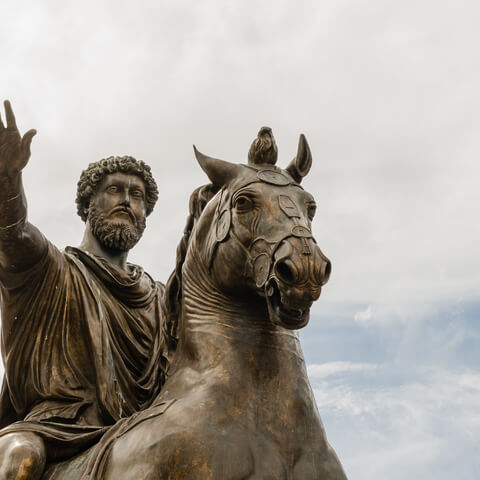
Marcus Aurelius had a Greek secretary who was a philosopher,
A Platonist.
We're told that he traveled all around the Mediterranean,
And he went to Egypt.
We're told that he spoke with Gymnosophoi.
Now,
It's not clear whether that just means naked wise men that lived in North Africa,
Or it means Indian sages that had traveled to Egypt or somewhere in Africa.
So it's a slightly ambiguous hint that maybe someone close to Marcus Aurelius might have actually met.
The Greeks and Romans wouldn't distinguish between Hindu and Buddhist.
So it's possible Marcus had some limited contact with that culture,
But certainly there's one late source that says that Socrates spoke to an Indian merchant and engaged in philosophy with him.
But the main connection is that Pyrrho of Elis,
Who's the founder of Greek skepticism,
A philosophical tradition,
Traveled to India with Alexander the Great.
Yes,
They went there.
So some people believe that Greek skepticism is Buddhism in disguise.
Not Stoicism,
But this other Greek philosophical tradition that was a kind of rival of Stoicism may have been somehow affected by these Hindu-Buddhist teachings in India.