Find a comfortable position,
Seated or lying down,
And let your eyes close gently.
Take a slow deep breath in through your nose and release it through your mouth with a soft sigh.
Let that exhale carry any residue of sleep.
Again,
Breathe in fully and let go completely.
One more time in and out.
Allow your breath to return to its natural rhythm without forcing anything.
This morning,
We are going to practice something the ancient Stoics considered essential.
This is not a form of positive thinking,
But more so a form of clear seeing.
The philosopher Epictetus taught that much of our suffering comes from wanting what we don't have and then ignoring what we do have,
So we end up chasing the next thing,
Forgetting the gifts already in our hands now.
So gratitude for the Stoics wasn't about pretending everything is fine.
It was about accuracy,
Noticing reality as it is,
Including the good that's easy to overlook.
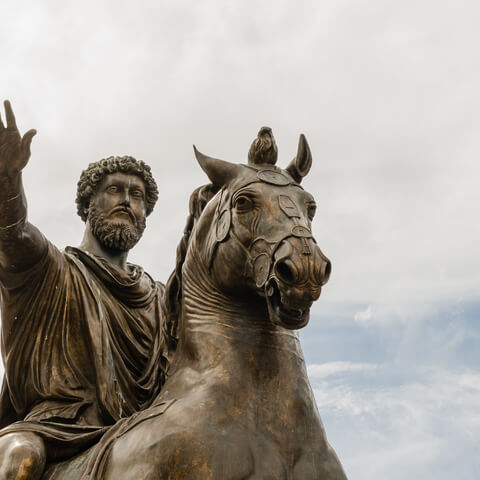
Marcus Aurelius wrote in his private journal,
When you arise in the morning,
Think of what a precious privilege it is to be alive,
To breathe,
To think,
To enjoy,
To love.
And this morning,
Let's take his advice.
So bring to mind something simple you're grateful for,
Doesn't need to be profound.
Could be the bed that you slept in,
The warmth that you experience in this moment,
The fact that you woke up today at all.
Don't just name it,
Try to feel it,
Let the appreciation settle in your body.
Think of a person you're grateful for,
Someone who has shaped you,
Supported you,
Or simply shown up when you've needed them.
Picture their face,
Feel what they mean to you.
And finally,
Consider something about yourself you're grateful for,
Like a quality or a skill,
Something maybe that you've survived or accomplished.
This is not arrogance at all,
It's just honest recognition.
You've come through things and you're still here.
These are three simple gratitudes,
And already your brain chemistry is shifting.
You're priming yourself today to notice what's right in the world other than what's wrong.
The Stoics had another practice that might seem strange at first,
But it does supercharge gratitude.
It's called negative visualization or premeditatio malorum.
So briefly,
For just a moment,
Imagine these things weren't in your life that you're grateful for.
So the person you pictured,
The simple comfort,
The quality you possess.
We don't want to create fear,
But to break through the fog of taking these things for granted.
Seneca wrote that it is not the man who has too little that is poor,
But the one who hankers after more.
When we briefly imagine loss,
We can return to what we have with fresh eyes and we can see its value.
Now release that visualization and return to the simple fact that these things are in your life right now and today.
Let this gratitude wash over you,
But make it deeper this time.
Before we close,
Set a small intention.
At some point today,
Maybe during a meal or a conversation or a quiet moment,
You'll pause and notice something good,
Something you might have overlooked.
And you'll feel this warmth of appreciation.
That's the practice.
Not once in a meditation,
But threaded through life.
The Stoics didn't just think about gratitude,
They lived it,
Daily,
Deliberately.
Take one more deep breath.
Feel your body here,
Present,
Grounded.
When you're ready,
Wiggle your fingers and toes.
Slowly open your eyes.
You've already done something valuable this morning.
You've remembered what matters.
Go well.