So whatever your work is,
Whether it's a job,
And by work I want to use that word loosely,
I don't think you need to even have an actual official career to call something work.
If you want to call the drawings in your sketchbook work,
Great.
If you want to call studying your martial arts practices work,
Great,
That's work.
However,
The thing is that you want to spend some time on and take seriously,
That is work in this context.
So what I recommend is having a pre-work ritual.
So in the Mind Illuminated,
Which is one of my favorite meditation books,
John Yates Kuldasa has a six-point preparation before meditating.
I have a few Mind Illuminated meditation tracks,
I actually have one out at the moment that's one hour,
But there's two more coming out.
And at the start of each meditation,
There are six preparation points.
So the first one is,
What is your overall motivation for meditating,
Just generally?
And so we can apply that to work.
What is your overall motivation for working?
What's your mission?
What's your end plan?
Point two is,
What is your specific goal in this session?
So what do you want to get accomplished during this very session?
And then the next one is,
What are your expectations?
Do you have high expectations?
Do you think you're going to be successful or low expectations?
And then ultimately,
To drop them and to ask yourself,
Point four,
Am I going to practice diligently?
Yes or no?
There's no self-deception here.
I'm about to work,
Am I going to give it my all?
Maybe you will,
Maybe you won't,
But either way,
Commit to that,
Yes,
I will,
Or yes,
I won't.
If it's a yes,
Stick to that,
I'm going to commit to this work session.
And then point five is,
Are there any things that could distract me emotionally,
Physically,
In the environment,
On my phone?
And then what am I going to do if those distractions come up?
And then finally,
The sixth point is posture for meditation.
But you can also think of that more broadly with work as environment.
So how am I going to be working?
Is my space the right kind of space?
Do I have what I need?
Is my context,
My posture,
My mind and my environment ready for me to go to work?
And maybe you go,
Hang on a second,
I actually want to play some calming music,
Or I want to make sure I have a drink,
Or I want to put everything on airplane mode first,
And now I'm good to go.
Finding ways to enjoy your meditation practice is the biggest meditation hack there is.
Do what needs to be done to find it fun,
To find it interesting.
It's not something to just tick off the to-do list,
It is something to actively enjoy.
I say to my clients all the time that one of the best things that they can possibly do is meditate.
And sometimes they get into this discussion about,
Well,
Are you saying I should meditate for awakening,
Or enlightenment,
Or calmness,
Or to manage stress?
And I think what I say is,
All of those things are great,
But the real reason I think you should meditate is because if I was talking to a version of you right now that had meditated for the last 365 days without missing a day,
I would be talking to a very different person.
As it stands right now,
You can't stick to anything.
When you can practice meditation every day,
And meditation is a great practice because there's always a reason not to do it,
You're just sitting alone,
Often in silence with some guidance.
Often procrastination comes up,
Often thoughts of boredom come up.
Often there's more exciting,
Interesting things that go and do.
When you can get to a point where you can meditate every day,
You've unlocked something very special.
Even if there are no benefits within the meditation itself,
And there will be benefits of course,
But even if there aren't,
A writer I like,
Alain de Botton,
Says,
You can measure a person's wisdom by looking at how well they can sit alone in a room on their own.
You wouldn't believe,
To the meditators now,
They'd be like,
That's easy,
I can sit on my own in a room all day,
But you wouldn't believe how many people would say,
That sounds like absolute hell,
I'd be tearing at the walls.
After 30 minutes,
I wouldn't be able to cope.
I'd be asking for the Wi-Fi code.
But meditation teaches you this amazing skill of being okay with just being.
If you can be okay with just being,
If you can enjoy just breathing,
It's almost like life becomes turned on to easy mode.
I'm happy just sitting and following my breath,
So I guess I don't really need that much,
As much as I thought I did.
Yeah,
It's pretty cool,
Pretty cool revelation.
On work,
Yeah,
Getting a pre-work contemplation and running through the six points is really good.
Seneca says,
If one does not know which port one is sailing,
No wind is favorable.
I also recommend coming up with what's called a performance statement.
So this is sort of like a mantra or an affirmation that you create yourself.
So it could be something like,
Every time I get distracted,
I will make a note of the distraction,
Then return my attention to the task at hand.
And that becomes your kind of performance statement.
So you're working,
You find yourself getting distracted,
Suddenly your favorite social media app calls to you like a siren and you get lost and you tell yourself,
I'm going to look at it for like a millisecond.
And then you find out two minutes has gone by,
Then you just go,
Oh,
My performance statement.
Every time I get distracted,
I will make a note of the distraction,
Then return my attention to the task at hand.
So you write a quick note,
Get back to work.
The next part of the routine is doing the work.
So the aim here is to try and make work similar to a meditation.
So I'm hearing,
But the question is,
Can you apply this meditation mindfulness approach to other areas of your life?
Because you always hear on the popular guided meditation apps,
At the end of the meditation,
They say very calmly,
You know,
Try to apply the mindset and the intentions and the perspective you've been practicing in meditation to the rest of your life.
And then we just go,
Oh,
I'm done.
Meditation is over.
Let's just carry on with the rest of my day.
You know,
Does anyone struggle with that?
Or do you feel like you actually apply the meditation perspective and practices to other areas of your life?
Some meditation experts say that there really is no separation between meditation and the rest of life.
And really,
There isn't.
Life is life.
Consciousness is consciousness.
Your mind isn't not your mind when you're not meditating.
It isn't not your mind when you are meditating.
Everything is the mind,
Always.
Every single moment of consciousness is just your mind.
Whether that's meditating or watching TV,
There's still the mind in action.
And so some would say that even retreat,
There's no separation between life on retreat and life outside of retreat.
The distinction is just a distinction you make in your mind.
So to go far on the path,
It's worth trying to see other things,
Not just formal meditation,
As meditative practices.
Marcus Aurelius says,
If you seek tranquility,
Do less.
Or,
More accurately,
What is essential.
Do less,
Better.
Because most of what we do or say is not essential.
If you can eliminate it,
You'll have more tranquility.
But to eliminate the necessary actions,
We need to eliminate unnecessary assumptions as well.
So Marcus Aurelius was also an essentialist.
So my son is now five and a half,
And I've had him a lot since he's been born.
And I remember thinking to myself at one point,
I have no time to meditate.
I have no time to do these things that are important to me.
All of my time is focused on just,
Especially the earlier years,
Just watching him and making sure he's okay and making sure his essential needs are met.
I just felt like I didn't have time.
There were times where you couldn't really leave his side because he would,
Who knows,
Do something very dangerous.
And I just remember thinking I didn't have any time.
And then I had this insight,
What if my time with him was meditation?
And I started actually,
I used this app on my phone that kind of blocked all other apps.
And I was like,
Right,
I'm actually meditating,
Watching him now.
So like an active meditation and just using mindfulness and attention.
And why not,
Right?
Because that's what it would be like on a retreat.
You know,
When you're not on the cushion,
When you're not meditating,
You still are meant to meditate,
But you're meant to meditate when you're walking around,
When you're doing chores,
When you're tidying up.
So it was a practice in,
You could say it's actually the best form of meditation to apply that level of mindfulness to life.
Because it was ironic that I could sit in silence,
Just seeing my breath coming and going.
But then I would watch my son want to play with a pedal for 20 minutes.
And I would find it very difficult to just be present during that time because it was just like,
This is taking so long just to go anywhere,
To walk anywhere.
And I don't find pedals that interesting anymore.
I've kind of grown out of that a little bit.
But when you meditate,
You realize that boredom and distraction are actually just thoughts.
And if you pay attention to them,
They just arise and pass away.
I've read a bunch of different parenting books,
And they all have that one thing in common,
Which is the one advice they all swear by is give that sort of undivided attention special time to your child,
A minimum of 15 minutes a day,
Just you one-on-one with the child.
And just watch,
Don't even direct,
Just let them do what they want to do and just give feedback,
Mirror,
Observe,
Notice.
So it is kind of like an active meditation that they are recommending.
And the idea is that if you can just do this,
Most of the behavioral challenges will just automatically disappear.
They're often just coming from lack of connection.
And it's a real gift to someone young just to give them your attention.
So we're going to talk a little bit about working with people because sometimes we have to work with other people.
I recently released a premium track called Three Pillars of Skillful Communication,
Cheat Sheet.
And so that is a kind of a quick primer on how to communicate effectively.
But a shorthand version of that would be an acronym that I like called EAR,
Or Ear.
And so good communication can be summarized as using empathy,
E,
Assertiveness,
A,
And R for respect.
So if you look back on your troubled relationships,
Difficult dynamics with other people,
And you ask yourself,
You know,
What did I do?
Did I play a role in that?
Sometimes it can be hard to tell.
If you see that you were speaking with empathy,
Assertiveness,
And respect,
Then as far as I would be concerned,
You're pretty much guaranteed to be speaking well.
But if you're lacking empathy in what you're saying,
So you're just not acknowledging how other people are feeling or thinking,
If you're kind of hiding your own thoughts,
Bottling things up and withdrawing,
Or if you're just being disrespectful,
Like sarcastic,
Passive aggressive,
Name-calling,
Then yeah,
You're not speaking well.
And the Stoic approach to relationships is to focus mostly on yourself.
So Stoics are very anti-victim mentality types of people.
You know,
It's more like,
Hey,
We can't actually control other people.
Sometimes it would be nice,
But it's actually impossible.
We can't control ourselves.
And so let's act in a way that we are happy with and let whatever happens happen.
That's the Stoic perspective.
And so in a relationship,
A Stoic would be like,
Hey,
What do I think is good behavior?
What do I think is the right way to act?
I'm going to focus on doing that.
If another person wants to mirror me and match me,
Great.
My actions have now changed the relationship.
And if the other person doesn't want to do that too and play along,
That's fine too.
I'm not going to feel guilty for that.
I'm going to feel good because I know I've acted good,
Because that is within my control.
I have a 10-day course,
Stoic Survival Guide for Navigating Troubled Relationships and Toxic People,
And I think that is,
It's got 2,
547 students and an average rating of 4.
93 out of 5,
Which I take the ratings seriously because I mean,
If 2,
547 people have done that course,
Presumably because they've been struggling in a certain relationship and the average rating is 4.
93 out of 5,
It's not even about like a nice compliment to me that just shows that it's working.
And that's the ultimate compliment really,
Is if it actually works.
Like someone could say,
Oh,
That was really fun to listen to,
But it didn't make any difference to me.
Then I'd much rather someone saying,
That was hard to listen to,
I struggled with that,
But it actually made a change in my life.
That would be like,
Okay,
Great,
That's kind of what I'm looking for.
That was way more useful.
So there's a famous quote by Marcus Aurelius,
And this is using a technique in Stoicism called premeditation of adversity.
You may have some questions about this if you're new to Stoicism.
So the Stoics recognize that if they contemplate negative,
Potential negative events that could come up in the future,
That would actually be good.
That would actually make them have more peace of mind and be more prepared to deal with whatever is about to come.
Now some people would say,
Well,
Hang on a second,
Thinking negatively about the future,
Wouldn't that manifest those things happening?
It's one of those things that it's hard to really have a conversation where anyone comes away and is giving like a yes,
It would or no,
It wouldn't kind of answer to that because it's how do you disprove that or prove it.
But the way that I would say that we're thinking about it is like this.
When you go on a plane and you have a pilot,
That pilot has to be prepared if they're any good for every possible negative eventuality that that plane could experience.
If the engine fails,
If the wing breaks,
If the wheels can't come down,
You want that.
You don't want a pilot that is only saying,
I'm just expecting the positive,
I don't think anything bad's going to happen yet.
You want a pilot who is very confident and is expecting the positive,
But is also aware that planes are planes and planes can break,
And I'm ready if that happens.
Similarly,
The Stoics took an approach like that.
Same as a surgeon.
Do you want a surgeon who says,
Hey,
I know what to do for this surgery,
But if you start bleeding in a place you shouldn't be,
We're screwed?
Or do you want a surgeon going,
Hey,
I know how to do this surgery,
And if anything doesn't go to plan,
I've got like 50 years of experience.
So you're in good hands.
That's the surgeon you want,
Right?
It's someone who's aware.
The same with the apps that we use.
The apps,
Even Insight Timer,
The app is iterated.
Certain things like bugs are found in the app,
Issues are found in the app,
And then the app gets better in response to those things.
So if Insight Timer are doing their job well,
They're actively looking for flaws and weaknesses within the app to make it better.
The premeditation of adversity is kind of like that.
You are optimistic,
You're never thinking of yourself as a victim,
But at the same time,
You're aware that there could be obstacles that come up,
And you're not going to try and convince yourself that that won't be the case.
It's kind of an interesting technique for certain types of people,
Depending on what you've been studying.
But Marcus Aurelius writes in his meditations,
Begin each day by telling yourself,
Today I shall meet with interference,
Ingratitude,
Insolence,
Disloyalty,
Ill will,
And selfishness,
And all of them due to the offender's ignorance of what is good and evil.
But for my part,
I have long perceived the nature of good and its nobility,
The nature of evil and its meanness,
And also the nature of the culprit himself,
Who is my brother,
Therefore none of these things can injure me,
Nor can anybody implicate me in what is degrading.
Neither can I be angry with my brother,
Or fall foul with him,
For he and I were born to work together,
Like two hands,
Feet,
Or eyelids,
Or the upper and lower rows of teeth.
So he's saying that I could meet with people who on the surface could seem difficult,
On the surface could seem toxic,
On the surface could try and betray me.
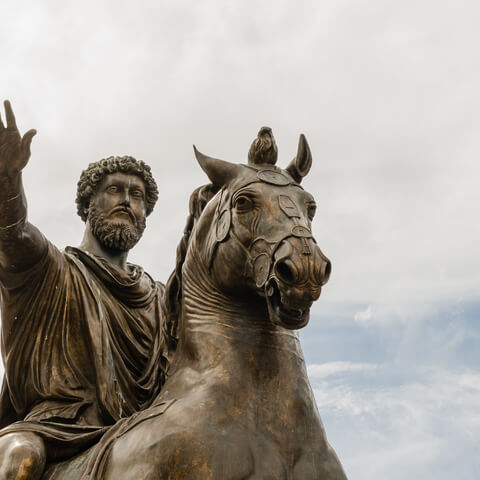
He was emperor of Rome,
The most powerful person in the entire world.
So he wielded a lot of power when he wrote this.
But then at the same time,
He's saying that these people,
They don't really know right from wrong in a deeper sense.
They're not very wise.
They haven't really developed a philosophy of life.
They don't know good and evil.
And so I'm going to do my thing,
I'll let them do their thing,
And I'm going to practice tolerance and compassion for their ignorance.
So it's sort of like a pre-meditation,
But also a way of being accepting of reality,
Of how things are.
Because what would happen if he didn't say this to himself?
He as emperor of Rome can arrest anybody,
He can imprison anybody,
He can do worse to anybody as well,
He is the law.
And he goes to work,
And Marcus meets with people that are insolent,
Disloyal,
They have a lot of ill will,
They're selfish,
And he's not mindful.
He's surprised,
He's taken back.
And so he has a bad day,
He loses his temper,
And he makes a mistake.
And he gets someone hurt.
Not a good plan.
He doesn't want to be that kind of leader,
That kind of emperor.
So he's reminding himself,
Hey,
I'm going to probably meet with people that are going to trigger me.
This is not going to manifest them.
This is just the way that it is.
This is the way that my life is.
And so when that happens,
This is how I plan to respond.
Does that make sense to you,
Or was that a bit of a tricky one to get your head around?
And then after work,
I recommend a post-work reflection.
So you can just.
.
.
When you're doing something difficult,
So I used to go out in my early 20s and practice different kinds of social challenges and social skills,
Different kind of ways to build confidence and self-esteem.
And now I practice Jiu-Jitsu for the last six years,
Brazilian Jiu-Jitsu.
And when you've had a bad session of learning something,
It's easy to start thinking of all the things you did wrong.
But what I've learned is that the best way to learn is to list the things you did well.
Because you know what you did wrong.
But dwelling on them doesn't often help you.
It's like the Alan Watts quote,
When you get the message,
Hang up the phone.
You don't need to sit in the corner and berate yourself with all the mistakes you made when you're learning something.
If I get tapped out in Jiu-Jitsu with a certain submission,
In that moment,
It hurts.
It's like,
Ah,
Okay,
I know that I need to work on that.
I don't need to keep telling myself that I need to work on that.
But reminding myself of the things I did well,
That's going to keep me inspired and motivated and keep me coming back,
Which is what we're discovering here with meditation.
When you can do the same with meditation,
When you can find the little wins,
Reward yourself for getting on the cushion,
Find the enjoyment in the practice.
When you can do these things,
You're more likely to keep meditating.
You're more likely to stay on the path.
Kula Dasa in the Mind Illuminated says that when you get distracted during mindfulness meditation and then you wake up and realize,
You should reward yourself.
You should say,
Oh,
Wow,
I actually noticed.
I woke up.
Oh,
Well done.
A lot of us,
We do the opposite.
We end up mind-wandering and then we go,
Damn,
I was distracted.
Should be doing it longer.
You're just negatively reinforcing that.
The fact that you woke up from the distraction is the skill that you want to develop and that skill needs to be rewarded.
Try that out when you meditate next.
When you find yourself getting distracted and then you notice it,
That is a moment to stop everything you're doing and say,
You did awesome right now.
You noticed that.
Wow.
Well done.
The more you can do this,
The better,
Not,
Oh,
You suck.
You got distracted.
That is very similar to like a child coming to you and admitting to a mistake.
And you're like,
What?
You made a mistake?
You're terrible.
This is,
Oh,
Thank you for telling me that you made a mistake and owning up to it and telling me the truth.
I really appreciate you doing that,
That you feel like you can be honest with me.
Let's look at how we can learn from that.
Two very different,
Which one's going to lead to better behavior in the future?
That's the power of reward.
So after your work session,
Look at three things that you did well and sort of congratulate yourself for those things.