So what I'm going to be talking about today is anxiety,
Some common causes of anxiety and antidotes for anxiety through a stoic framework.
Before I get into that,
I'll tell you a little bit about myself.
So I'm 32 right now,
I'm an entrepreneur,
I have a bunch of websites,
I'm a teacher,
I have a podcast,
There's a lot that I have going on in terms of content creation.
And it's funny how I stumbled on this because I would never have thought that I would have been teaching people how to work with anxiety,
It's not something that I ever envisioned that I would do.
And I was kind of pushed into it because of trauma,
Right,
Like suffering,
Setbacks.
And I'll tell you a little bit about how I experienced anxiety,
And then how this took me on a journey to learning how to deal with it.
So when I was 18,
I was in a band,
I played guitar,
Everything was good,
I had a good upbringing,
Good parents,
Nice friends.
We had a new band player,
And he was an ex-convict,
A bit shady,
But whatever,
Seemed like a nice guy.
One night after band practice,
Late at night,
He decided to take a lot of Valium and drink a lot of vodka.
And he passed out in the backseat behind me as I was driving home.
And I woke up to,
Or he woke up to,
With his hands around my neck,
And he pulled a knife out.
And he was threatening to kill me,
He basically held me hostage as I was driving home.
And he wasn't making any sense,
He was really threatening,
And I managed somehow to slip my head out from the knife,
From his hands,
Under the seatbelt,
Got out the door,
Called the police.
He was so out of it,
He couldn't even escape the door,
Like he couldn't even get out,
Which is worrying,
Because in that state he could have done anything,
With a knife in his hands against my neck.
So initially I brushed it off,
I go,
Cool story,
I escaped getting murdered,
I'm fine,
You can wear it as a badge of honor.
But eventually,
About a year later,
It started to kick in.
I was in university,
Studying filmmaking,
And I heard a story about a mugging that happened,
A knife mugging that happened close to where I was living.
And I thought my mental health was good,
But as soon as I heard that,
It was like the cracks in my psyche started to appear,
And all of a sudden I started to feel more anxious,
I felt like the trauma was gripping me,
I felt afraid.
And that's when the kind of late onset PTSD symptoms started to kick in.
Symptoms like hypervigilance,
Going out at night became really difficult,
Having a partner back then,
You'd say you'd go out for a date or something at night,
You're on edge every time you turn a corner,
Every time you see someone who's shady.
If you see a dog,
It's no longer a dog,
It's a dog that could bite you.
If you see someone on a street corner,
It's no longer just someone on a street corner,
It's someone who could stab you.
And the mind becomes very,
Very active.
And anyone who's had any kind of mental health issues knows that one of the first things that starts to deteriorate are your relationships,
Because you feel isolated from people,
You feel like kind of shame,
You feel different.
And so you kind of withdraw,
And then it becomes this negative loop,
You withdraw,
You start acting a bit weird,
They don't want to spend much time with you anymore.
And slowly but surely,
The anxiety starts to seep into other areas of your life.
And that was the beginning when I was about 18,
19 years old,
Of experiencing anxiety.
And over time,
The anxiety would turn into panic attacks,
Hypochondria,
Trips to the doctors,
Heart palpitations,
Going to the hospital,
Just like the full spectrum of anxiety.
And what I always do,
Luckily,
I don't know how I developed this trait,
What I always do is,
When I'm faced with a problem,
I read,
Like I read a lot,
I research it.
And I'm,
No matter what's going on,
I'm always kind of optimistic that I'll be able to figure it out,
Even if it takes years.
So I just started reading and researching.
And through my research,
I found stoicism,
I found other types of self-improvement modalities.
And I like to think of stoicism as a framework.
I don't think of stoicism as like,
The ultimate cure for everything ever.
Stoicism is a framework that you can then put other stuff on top of.
So that's how I like to think about stoicism.
If you have any questions about what I'm saying,
Just let me know and I'll respond to them.
So over the years,
It took me five,
Six,
Seven years to really deal with my anxiety to the point of basically overcoming it.
And I did that through various means like martial arts practice to overcome my fear of confrontation,
Different types of journaling exercises and meditation practices,
Also just leaning into my fears,
Going traveling solo and things like that.
It was all through the framework of stoicism.
Stoicism,
It definitely is similar to Buddhism.
In fact,
Some say that the early Stoics were Buddhists that came to Greece.
So there's definitely like,
You could say that stoicism is like Buddhism for the Western mind.
And stoicism definitely is a complete philosophy of life.
Like modern stoicism is kind of like,
There's a lot of talk about resilience training,
But stoicism as it was originally intended is a complete framework for life.
So one of the key features of stoicism is dealing with negative emotion.
Because if you're anxious,
Depressed,
Scattered,
Unlikely it will be that you can act with compassion and virtue and make good decisions.
So the Stoics recognized if you become more tranquil,
You can make better decisions and be more useful in society.
So there are three main types of negative mood.
So you have anger,
The Stoics talked a lot about anger.
I'll discuss that in a separate talk.
You have grief,
Which would be anything related to sadness.
And then you have anxiety.
And in anxiety,
You have fear and worry looped in there.
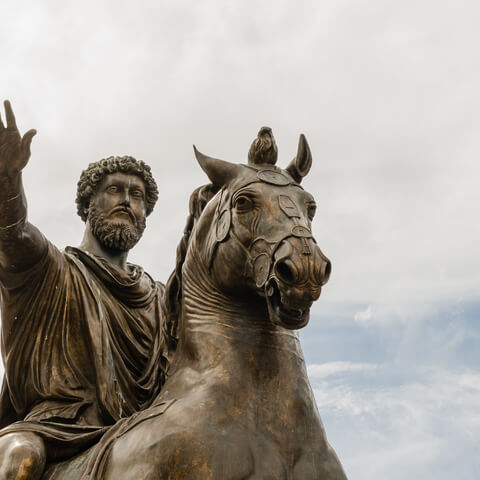
So I'm just going to read a quote to you by Marcus Aurelius.
He said,
Quote,
Today I escaped anxiety,
Or no,
I discarded it because it was within me,
In my own perceptions,
Not outside,
End quote.
When I first heard that,
I was thinking,
Well,
You know,
How can you just discard anxiety?
You know,
Like the feelings are so intense.
How can you just say,
Oh,
That's within me.
I'm going to discard it.
Well,
This is where a slightly deeper understanding of stoicism becomes useful.
So the Stoics have this idea called the dichotomy of control,
Where they divided the world into things that they could control and things that they couldn't control.
And a really simple way to think about this was anything external is not within your control,
Right?
It just isn't.
If you're aiming for success,
You know,
If you're aiming for an external goal,
Like,
You know,
I want to earn this amount of money or get this kind of body or meet this kind of person,
You can definitely optimize the chances of you getting it.
But at the end of the day,
It's not within your control because anything could happen.
Like,
You know,
Anything could happen tomorrow that could stop that from happening.
If you think of someone playing sport,
You can train as hard as you like to win a game.
But at the end of the day,
If the wind blows a different way,
You can lose.
You know,
If you get a bit of bad luck,
You can lose.
So what the Stoics realize is the things that are within our control are internal.
So our thoughts,
Intentions,
And actions.
And so they kind of believe that everything external to us is neither good nor bad.
Like even things like wealth and health.
They're preferred,
You know,
Like they're preferred,
But they're not truly good in and of themselves because you can still be healthy and be a psychopath.
You can still be wealthy and be a psychopath.
In fact,
Health and wealth could facilitate a psychopath being better at hurting people,
Right?
So the key thing,
The best thing to a Stoic is virtue.
And that is the type of human being that you are,
The character that you have.
So that's a good way to think about the dichotomy of control.
In terms of anxiety,
The idea that helped me the most is the metaphor of anxiety being like a flame.
So if you suffer with anxiety,
Like the bad news is,
When you first hear this,
Is there's no way you can overcome anxiety without going into anxiety.
There's no way you can do it.
To cure anxiety,
You have to go into it.
You have to deal with it.
You have to face it.
It's kind of like,
Say you have a fear of dogs.
So you can avoid dogs and therefore you avoid the trigger and you avoid thinking about them and all that kind of thing.
That's one way to deal with it.
But that's not going to cure you of your fear of dogs,
Right?
As soon as you see a dog,
You're going to have the same fear come back up.
In order for you to overcome the fear of dogs,
You have to gradually desensitize yourself to the idea of a dog.
So that's the bad news,
Is that you're going to have to deal with your anxiety.
The good news is that there are lots of ways to do this in a way that isn't too difficult.
And one of them is based on psychological techniques called cognitive exposure.
But I'll get to that in a moment.
So the metaphor you can think of with anxiety is that it's like a flame.
It's like a flame.
Anxiety is like a flame on top of a candle.
And what a lot of us do when we feel anxiety is we try to kind of blow out the flame.
We try to kind of like lightly blow on it.
But imagine anxiety is like a flame,
One of those joke candles that just keeps coming back.
So you blow on it weakly,
You try to get rid of it,
Doesn't work.
Keeps coming back,
Keeps coming back.
The true way you overcome anxiety is by burning the flame more so that the wick disappears.
And when there's no wick,
There's no flame.
So the way you overcome anxiety is by intentionally rousing the feelings of anxiety to the point of it burning itself out.
And there are many techniques to do this.
I don't want the idea of that to make you anxious.
But by going into it in a conscious,
Intentional way,
We can burn the wick.
So that's like the basic route of overcoming anxiety.
In terms of the causes of anxiety,
There's four leading models on that.
So the first model is cognitive.
And this means that our thoughts cause our anxiety.
And this is what I was describing.
I'd be walking around,
I might see a shady looking character.
I have a thought,
Oh,
What if they've got a knife?
And how does that make me feel?
Way more anxious.
So the thoughts,
The cognition,
The way that we think.
And you have in CBT,
Cognitive Behavioral Therapy,
Which was inspired by Stoicism,
You have exercises like rationally analyzing the thoughts that you have and then challenging them.
With social anxiety,
You'll often find people mind read.
Oh,
I know they don't like me.
Oh,
I know they think I'm stupid.
Oh,
I know they don't think that I'm funny.
You don't know that at all.
But you believe that it's true.
And therefore,
You get the feelings.
In Cognitive Behavioral Therapy,
You'd challenge that.
Do I really know what they think?
No,
I don't.
In CBT,
You also have things like black and white thinking.
Say you make one mistake.
Oh,
I've blown everything.
You know,
You fail one exam.
Oh,
My entire education is ruined.
Black and white thinking.
And you can Google cognitive distortions,
CBT,
To learn more about these.
But one of the ideas is cognition is a cause of anxiety.
The second leading idea is biological causes.
So you take away four hours of sleep a night.
You take away a good breakfast or a good dinner.
You strip your calories down.
You're going to get anxious.
We are biological organisms.
We're animals.
If you force yourself to be sedentary,
If you make yourself malnourished,
You're going to get anxious.
So if you are suffering with anxiety,
The first place I'd actually recommend you start is,
Am I sleeping well?
Interesting fact about sleep.
There has not been a single psychiatric condition ever discovered that isn't linked with poor sleep.
So anytime you see someone who has any kind of mental health issue,
They will almost always have a sleep problem too.
Like people,
Like sounds extreme,
But people have like killed over being hungry,
Being very hungry and angry.
Like it can get very intense.
So yeah,
Just like for you to think about now biologically,
Like how is your diet?
How is your routine?
How is your self-care,
Exercise,
Like the basics?
You've got to get those dialed in.
The third model,
This is a really interesting one when I first discovered it,
Is called the hidden emotion model.
And this is,
To summarize,
It's being too nice.
Like if you suffer with being very nice and agreeable,
That can make you repress emotions that will then come out as anxiety.
So if you're like a people pleaser,
If you don't speak up,
Don't speak your mind.
Have you ever had that feeling where you didn't say something and then you were thinking about it later?
I wish I said this,
I wish I said that.
If you're that type of person,
And typically these types of people,
Like I'm one,
You know,
I'm very agreeable,
We tend to hold in a lot and then explode.
But it's not healthy,
Basically.
So training to become more assertive can actually help with your anxiety.
Say there's a really important conversation that you need to be having with someone in your life,
And you're just repressing it,
Repressing it,
Repressing it.
Don't be surprised if you develop anxiety.
You might not even connect it,
Right?
But the hidden emotion model is often a very obvious reason for it.
So again,
If you feel anxiety,
Look at your life.
Are there any obvious things that I'm not addressing?
Address those,
You know,
Like just write a list.
What am I not dealing with?
And then deal with it.
And then the fourth model is exposure.
And the idea of this is that when we avoid something,
We tend to become more anxious about it.
The metaphor that I've learned from Jordan Peterson is the matter of a dragon.
If you avoid the dragon,
The dragon grows bigger.
As soon as you face the dragon,
The dragon shrinks.
You know,
We've all had experiences of procrastinating on exams or paying taxes or whatever,
Like any kind of difficult,
Boring work.
We put it off,
Put it off,
And then it just grows in our mind.
And that can make us more anxious.
And obviously,
The opposite is true.
By going into the thing that we're afraid of,
Our anxiety reduces.
We feel more courageous.
We feel more powerful.
But yeah,
Just learning to speak your mind in a way that is not aggressive or passive,
Because some people that are very agreeable are either a complete pushover or a complete kind of like bossy boots.
And that the real skill is learning to just be like,
Hey,
I feel this.
Oh,
When you said that,
I felt triggered.
I felt a bit angry.
Or when you said that,
I felt a bit upset.
Just like to lead with that,
To have the confidence to do that.
People who are high in agreeableness,
Which is a big five personality trait.
I think I scored about 80 out of 100,
So I'm pretty agreeable.
We tend to repress things,
And then they get bigger and bigger.
So what you can just start doing is train yourself to just even say something small in the moment,
Like,
Oh,
I'm not comfortable with that.
Just that alone can start to become a skill that you build to become more.
So these are the four models of why we cause anxiety.
The thing about these models is that they're all true.
You might have some people that are convinced that it's this model.
It's biology.
We can fix anxiety with pills.
But they're all true in different ways,
Depending on what's going on.
The second thing to clear up is the difference between fear and anxiety.
The goal in life is not to become fearless.
As I know a lot of people talk about that,
Oh,
Become fearless.
Fear is actually,
From a stoic perspective,
A rational response to a threat that is present.
So a crazy example.
If a huge fire broke out in your house,
It would be rational for you to feel fear and then leave the house.
That's an obvious example.
If someone down on the street pulled out a sword and started running after you,
It's like,
Okay,
I'm in danger.
Fear is rational.
I should get out of the way.
Anxiety is not like that.
Anxiety is more about the prediction of something that might happen.
So anxiety is not about what's in front of you.
It's about what could be in front of you.
It's about potential.
It's like you see a rope and you ask yourself,
Is it a rope or a snake?
And then you get preoccupied with that.
I got a list here,
A basic rundown.
Anxiety,
You avoid potential threat.
It's often irrational.
It's often based on hypervigilance.
You're scanning things.
You're on edge when there's nothing actually dangerous in front of you.
And yeah,
You're basically just risk avoidant.
You go through life minimizing all possible risks.
Fear,
On the other hand,
Is rational.
It's dealt with,
It's based on a real threat.
And it's often biological in the sense of it being like a fight or flight response.
So that can be useful just to differentiate between anxiety and fear.
I'm going to list some classic forms of anxiety.
So we have chronic worrying,
Specific phobias,
Performance anxiety,
Public speaking anxiety,
Panic attacks,
Obsessions and compulsions.
So OCD is a form of anxiety.
We have PTSD and hypervigilance,
Which is what I was talking about.
Concerns about appearance,
That can be a huge thing.
Any kind of imperfection can make you withdraw and make you afraid to go out.
Health worries and agoraphobia,
Which is fear of leaving the house.
For me,
I've had a lot of those.
Agoraphobia,
Not so much.
Health worries,
PTSD,
Panic attacks,
Performance anxiety,
Chronic worrying.
When you feel anxiety,
It can feel like,
Oh my God,
How do I overcome this?
How can I work with this?
But please,
If you take anything away from this,
Please have hope that this is something you can definitely work with.
I promise you.
And I want you to see it as a cool project.
Instead of having this frame of,
Oh,
I have anxiety and life sucks,
Have it like,
Oh,
I have this thing going on for whatever reason,
This anxious pattern.
And now I'm motivated to figure out the solution to this problem.
And there are ways to do that.
Try and frame it as a problem that you can solve.
In my Stoic Anxiety course,
I make the point that the most important thing you can ever have to overcome anxiety is persistence,
Perseverance,
Just not giving up.
You could try five different techniques and they don't do anything.
The sixth technique could completely change everything.
Okay,
So Seneca quote,
We are often more frightened than hurt,
And we suffer more from imagination than from reality.
So the Stoics knew a lot about anxiety.
There's a reason they wrote a lot about suffering and grief.
If you look at the life of Marcus Aurelius,
Just a few facts.
Marcus Aurelius had 14 children,
Six survived.
Seneca had one child,
A boy who died.
So we read these works and we think like,
Oh,
They seem so detached and tranquil,
But these people suffered,
They suffered a lot.
And that's why they prioritize philosophy.
So in my research of overcoming anxiety and working with it,
I discovered at least 40 different individual techniques,
Like specific ones.
And I'm happy to keep going over different ones,
But to be honest,
They can all be condensed into three different types of technique,
Sort of different variations on a theme.
So the three different interventions for anxiety that work consistently according to the research,
Is rational analysis,
Which would be dealing with the cognitive part.
You have reframing,
Which is like deciding on a different frame.
And that can go very deep.
That's not just the,
Is the glass half empty or half full kind of reframe.
Framing can go extremely deep to the point that you,
Maybe a difficult question for you is,
Could you get to a point where you actually appreciate your own anxiety?
And what would happen to your anxiety if you could get to that place?
You know,
So reframing can be radical,
Like a radical changing of relationship.
In Buddhism,
Ken,
You mentioned this,
There's an overlap between Buddhism and Stoicism.
In Buddhism,
The goal isn't to get rid of your emotions.
When you're mindful,
You actually feel your emotions more.
What you do as you practice in meditation is you change your relationship to your emotions.
So they remain,
But your relationship is different.
It's like,
It's like living with someone.
You still live with them,
But you now have a different dynamic with them.
So you have rational analysis,
Frame control or reframing.
And then the third one is exposure.
Exposure is very powerful.
And there are two different types of exposure.
You have physical exposure,
Which is classical exposure in the literature.
And that would be,
Oh,
I'm afraid of heights.
Let's gradually spend time higher and higher and higher and then cross a bridge.
But the cool thing about exposure therapy is you can also do cognitive exposure.
And the Stoics had a lot of different exercises where you can mentally rehearse exposing yourself to your anxiety.
Interesting fact about exposing yourself to your anxiety in your mind.
When we feel anxious,
A lot of us,
Like when we hear the idea of that,
We're like,
Why would I want to do that?
I already have anxious thoughts.
Why would I intentionally expose myself to anxious thoughts?
I already have them all the time.
And the reason is,
Is because when you have anxious thoughts,
You don't choose them.
When you have anxious thoughts that typically comes out in the form of worrying,
You aren't doing that,
Right?
There's like an unconscious pattern that's happening and it's kind of taking hold of you and you're almost fighting against it.
When you intentionally choose to meditate on your anxious thoughts and almost stir them up in a structured,
Safe way,
That is contemplation,
Not worry.
And when you can contemplate and sit with that,
That's when you start to burn the wick of anxiety.
So a lot of the anxiety interventions are counterintuitive in that way.
You know,
A great mantra that I heard when I was on a retreat once,
Whatever is coming is going.
Whatever you're dealing with is also leaving,
Right?
It's a good way to think about it.
So you'll have access to my seven-day anxiety meditation course that walks you through a bunch of different techniques from the Stoics.
And also we're going to be going over one now.
Each of those is based on one of these three things.
So the what-if technique,
Which is what we're going to be going over in a minute,
Is based on rational analysis.
We have maxim creation,
Which is based on reframing.
You create your own Stoic maxim to help you deal with the overwhelming thoughts in a really short,
Concise way.
Mindfulness of sensations,
Which is again a type of reframing.
And how can we get to a place where instead of fighting the anxiety,
We can sit with it?
You know,
That's a vital step in dealing with anxiety.
If every time we feel anxiety,
We try to run away from ourselves,
How are we going to be able to work with it?
So we need to be able to sit with it.
Okay,
I'm feeling this anxiety.
I recognize it as energy in my body.
It's not pleasant,
But now I can actually start to investigate it.
We have the view from above,
Which is a classic Stoic technique where you imagine looking down on your life from a different perspective.
And this is in CBT is known as cognitive distancing.
So typically when we feel overwhelmed,
We really feel like in our bodies,
We really feel like we're looking out of our own eyes.
We really feel like center stage.
If you change the perspective and imagine the same situation from a CCTV camera,
It's like a detached way of seeing things.
You can suddenly feel a bit more relief.
Like it's not as intense anymore.
Well,
The Stoics took this even further and they would view the world and their life from the cosmos.
And it's a beautiful technique.
We have the Amor Fati technique,
Which comes from Friedrich Nietzsche.
And he described the formula for greatness for human beings in loving your fate,
Getting to a point where you can love your fate.
So if the external world is not within your control and your life is subject to good or bad luck,
You can't control it.
You could have bad luck next week,
Good luck the week after,
Bad luck in a month.
Then why would you do anything other than try to love it?
Because you're fighting against something that you don't have control over.
But the thing you do have control over is your attitude towards it.
In terms of books for anxiety,
A really,
Really great book that was very inspiring for me is a book called When Panic Attacks.
And this was written by David Burns,
Who is one of the best CBT therapists around.
And yeah,
He's inspired by Stoicism.
So it's a CBT book,
Which is like modern Stoicism,
When Panic Attacks.
And then I'd also just recommend introductions to Stoicism.
So that would be Donald Robertson's Stoicism and the Art of Happiness,
And William B.
Irvine's A Guide to the Good Life.
Just good introductions to Stoicism.
But When Panic Attacks is a really good practical book,
Specifically working with anxiety.
And then as we go through the list,
We have premeditation of adversity.
So the Stoics would often premeditate worst case scenarios in the mind's eye.
Because when you premeditate on the worst case scenario,
In a calm,
Again,
It's not in a worrying kind of way,
It's in a calm,
Rational way,
They would contemplate the worst case scenario,
Then imagine dealing with it properly.
So it's not just imagining,
Oh,
This terrible thing happens,
It's no,
This terrible thing happens,
How do I handle that?
And so they're kind of using their mind as a form of virtual reality Stoic training,
Where they're dealing with setbacks,
And then practicing using excellence of character and virtue and wisdom in overcoming it.
So one of the things I do every day in my journal,
Is I just ask,
What are the obstacles that could come up today?
And what am I gonna do about it?
You know,
I just have a think,
Well,
This could go wrong,
That could go wrong.
And what am I gonna do?
And often the answer is,
I'll just be more patient.
Like,
Oh,
You know,
I'll handle it.
You know,
I've got here,
I've got here,
If things are okay,
I'm sure I can handle whatever comes up in the same way.
But simply writing that out and being prepared for it means that when nothing happens,
If it does happen,
That I'm like,
Oh,
Yeah,
I knew this was a possibility and you don't surprise me.
But if it doesn't happen,
I'm more grateful.
I'm like,
Oh,
Wow,
I escaped that potential setback.
You know,
I feel really good about that.
But I'm gonna guide you through one technique now.
It's a really simple technique.
This is called the what-if technique,
Also known as the downward arrow technique.
And so sometimes the things that cause our anxiety,
We're not even aware of.
Like,
We're not really aware of the root for things that cause us anxiety.
So what will typically happen is we'll think it's this reason or that reason,
But because the feelings are so uncomfortable,
We can't really sit with it and get into it.
So the question I have for you,
And this is something you can write down or just visualize,
Is bring to mind the anxious situation,
Event,
Thought,
Anything that causes worry,
Panic,
Anxiety in your life.
Think about that now.
And the question I have for you,
A very simple question,
Is if this thing you're worrying about came true,
What would that mean?
What would be the worst-case scenario if that came true?
And when I say worst-case scenario,
Don't just skip all the way to,
Well,
The whole world could explode and we'd all die.
I mean,
Like,
Realistically,
What is the worst-case scenario?
So if you have a fear of,
If you've got to do a talk in a week and you have anxiety about it,
Well,
What is the worst-case scenario?
Well,
I give that talk and nobody likes it and my colleagues think that I'm stupid,
Something like that.
And what would that mean to you if your colleagues thought that you were stupid?
And so what we want to do here is,
It's called a downward arrow technique.
So we have the initial anxiety,
Then we ask,
Well,
What if this came true?
What would it mean?
And then we should have a new anxiety show up.
And you can ask,
Well,
What would that mean if that came true?
So you go down and down and down.
So this new anxiety,
This new fear,
This new problem,
What would happen if that was true?
What would that mean for you?
What would be the real problem?
What's the worst-case scenario?
And then sit with that and ask,
Well,
Okay,
Same thing again.
What would happen if that came true?
What would that mean?
And you can go through this technique.
I encourage you to go through this technique today and tomorrow and do it properly.
It's the first meditation in the course,
Which you can do,
But I don't want you to think of the techniques that I teach you as you do them once and that's it.
It's more about training the skill.
You might have to do the what-if technique a few times before you get really comfortable with it.
Draw arrows on a piece of paper.
Get really clear about it.
If you're not willing to do this,
Which is like a three to five minute investment of your time,
Then the likelihood that you'll be able to overcome anxiety is low because it's not a big investment of time and effort.
And if David Burns,
Who's the therapist behind this,
Says that consistently,
For all of the people that read his books,
The biggest difference between those who improve and those who don't are the people that actually do the exercises.
And actually the people who don't just hear it and go,
Oh,
That sounds cool.
I can see how that would work.
Maybe I'll do that one day.
That's not really how the process works.
You have to engage with it.
And I'll give you an example of the power of the what-if technique.
So David Burns himself had a child,
The therapist who wrote When Panic Attacks.
And his child was struggling to breathe and turned blue,
Like a newborn baby turned blue.
And the child had to go to special care and they sent David Burns home.
And he was super anxious,
Right?
So he did the technique that he encourages his clients to do.
So he asked,
What would it mean if my child had breathing difficulties and really struggled to breathe?
And he said,
Well,
I could have a disabled child.
I could have a child that needs a lot of care and a lot of attention.
And what would that mean if that became true?
Well,
People would judge me.
You know,
People would judge me.
There'd be a stigma attached to me.
And in that moment,
He woke up,
You know,
Like,
Oh my God,
Like,
No.
Like,
This is not right.
Like,
There was an old pattern of fear of being judged by other people within that situation,
The terrible situation of his child being ill.
And so he got back in the car and he drove back to the hospital and said,
I'm going to do whatever it takes to be there for my child.
And his child was okay in the end,
Fortunately.
But that's what this kind of technique can reveal to you.
You think it's about one thing,
But when you dig a little deeper,
It can be about something else.
So in summary,
Really quick recap.
Anxiety and fear are different.
Fear is rational response to a threat that is present.
Anxiety is an irrational response to a threat that could be.
Four models on the cause of anxiety.
You have exposure,
You have cognitive,
You have the hidden emotion,
You have biological.
And then in terms of overcoming your anxiety,
You have three different intervention strategies.
You have reframing,
Which is changing your relationship to the anxiety.
You have cognitive or rational analysis where you challenge the thoughts that cause anxiety.
And then you also have exposure,
Which is going into the things that make you afraid.
There's actually a theory,
It's called terror management theory.
And the idea of terror management theory is that when we get reminded of our own mortality,
Which is like all the time on TV,
Like every show you watch,
There are people dying in it,
Right?
Like name me a TV program or a film you watch that people don't die in,
Right?
Like everyone dies in these TV shows and films.
And also the news is just like death,
Death,
Death,
COVID death.
Whenever we get reminded of mortality in that way,
It triggers a deep rooted fear of death,
Like a terror.
And that terror that gets triggered,
Which is not normal at all,
If you imagine that we evolved to live in small tribes and suddenly you're just getting bombarded about death from the TV,
That terror makes you more impulsive.
It makes you spend more.
It makes you overeat.
It isn't good for you.
So I try to avoid the news for that reason.
Because even though you think you can handle it,
You're still basically opening up your wellbeing to someone else coming along and be like,
A hundred people were bombed yesterday and you've got to be able to process that.
And it's like,
Okay,
I feel like I can handle that,
But can you?
So the last three points about the reframing and the cognitive exposure.
So that would be the three core interventions for anxiety.
There are lots of different techniques,
But they all come back to three main categories.
Exposure.
So that means mentally or physically exposing yourself to the anxiety.
This is one of the practices that I did when I had anxiety was imagining getting into violent situations and just sitting with it,
Not needing to do anything,
But imagining it in a very calm,
Relaxed way and just exposing myself to it.
The other one is rational analysis.
Journaling is a great way to do that.
If you just start a journaling practice,
I start investigating your traumas,
Your worries,
Your fears,
That can really help you see them better and challenge some of the distortions in your thinking.
Yeah,
Like imagine something,
You know,
You have a fallout with a friend and instead of thinking about it,
You just go and journal about it.
Guarantee you'll see things differently.
You'll be like,
Oh,
Okay,
Maybe I was being too harsh.
Maybe I wasn't showing much empathy.
Yeah,
Maybe they're not too bad.
They've done all these good things for me as well.
But if you just think about it and just feel the anger and the irritation,
Then you're probably not going to be able to get to that perspective.
So rational analysis often through journaling is great.
And then the last one then is reframing,
Changing your relationship to it.
I mean,
Certain types of anxiety can be fun,
You know,
Like you think about theme park rides and things like that.
I'm not here to say that anxiety needs to be stamped out from your life in all ways.
You know,
Anxiety can give you a wake-up call when you need it.
But if you feel in your heart that anxiety is holding you back,
Then it's time to start making changes.
I heard something from Jordan B.
Peterson.
I've tried different therapists and coaches in the past.
I like the idea that you need to find a therapist who you feel is smarter than you.
As simple as that.
I'm not talking about IQ,
But just like the type of therapist that you feel like,
I feel like I could learn something from you somehow.
Maybe it's their life experience.
Maybe it's the qualifications that they have.
But you don't feel like,
Like I had over the phone counseling once.
That was like a free thing that I received when I lost someone dear to me.
And I spoke to the person on the phone and it just felt like they were just following a script.
You know,
Like I just didn't feel,
I just didn't continue with it for that reason.
But there are really good websites now where you can find a therapist.
I would just encourage you to do a lot of research and just at the same time,
Follow your intuition on it.
Yeah,
Thank you.
So much for visiting and please stay in touch.
Leave me a comment.
So thank you very much.
Take care.
Thank you everyone.