So you're going about your life and you notice that you get some kind of bad luck omen.
It could be a natural omen like the weatherman is telling you that it's going to be raining on the day that you've planned to go out.
Perhaps you get into your car and it starts to make a strange sound as if it's going to break down at some point.
Maybe you have bad luck twice and someone tells you bad luck comes in threes.
Maybe you've applied for a job and afterwards someone tells you that they know of a person who applied and they are very competent.
It could be something mundane like you're exercising and you hear an ominous click in your knee which makes you wonder if you have some kind of permanent injury.
And there are superstitious types of bad luck like you break a mirror or you walk under a ladder.
It's not uncommon for us,
Even the rational among us,
To get a sense that something's off.
Like bad luck is just around the corner.
Things are about to get worse.
And my recommendation from you,
And this comes from Epictetus,
Is to not be alarmed if you sense bad luck coming your way.
In fact,
As soon as you feel any sort of worry come up,
Say to yourself,
This sign has no significance for me.
This could only affect my body,
Possessions,
Family or reputation.
But not me.
Not my will.
Not my soul.
Not my ability to judge,
To decide.
Not my rational thinking capacity.
You've heard me talk in my lessons about the dichotomy of control,
A central principle in Stoic philosophy.
There are some things that are up to you and some things that are not up to you.
Things that are not up to you will include your body,
Your possessions,
Your family,
Your reputation.
Things that are up to you is basically your intentions,
Some of your actions,
Your considered opinions,
Your judgments,
Internal things.
So what we're doing here is we're using the bad luck omen,
A sign from the universe,
As a way to remember the dichotomy of control.
Oh,
Bad luck is coming.
That's okay.
This will not actually affect me.
It will affect,
Potentially,
Things outside of my control.
But I will always have the ability to decide how I respond.
What you want to learn is the skill of turning everything to your advantage.
Why?
Because you can do that.
So why wouldn't you do that?
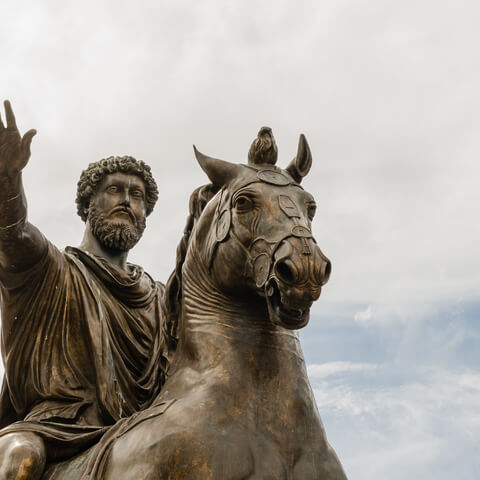
The classic Marcus Aurelius quote,
What stands in the way becomes the way.
The impediment to action advances action,
Right?
It's like the obstacle is the way.
When you look around your room,
You may think that you're seeing structures like tables and chairs and computers,
And in my case,
A microphone and a door,
Cupboards.
On the deepest level,
What we're really seeing are tools and obstacles.
So when I'm looking at the door,
What I'm really seeing is a portal.
When I look at a handle,
What I really see is something to turn,
To open that portal.
When I see a microphone,
What I'm really seeing is a way to communicate with you.
And there are also obstacles that may be blocking or hindering my path.
The Stoic approach is to see every obstacle as just another tool.
So the world becomes a series of tools.
Let's say that you want to walk from one place to another place,
And in the way there is a hurdle.
You could walk up to that hurdle and say,
Oh no,
This sucks,
Right?
I have to now walk around the hurdle or get over the hurdle,
And that's expending my energy.
And so you do that,
And then you keep walking and get to where you want to walk.
Or you walk up to the hurdle,
And maybe you have the attitude of a professional hurdle jumper.
A person who actually spends their career jumping hurdles.
Oh,
I guess I'm going to do a little bit of extra exercise right now.
I'm going to test my mobility.
You take the exact same journey,
But one is full of resistance and suffering,
And ultimately the irrational belief that obstacles have to induce suffering in you.
And the other perspective where you see the hurdle as a tool to exercise or to test your mobility.
You are now more in control of your own life narrative by choosing that.
You're empowering yourself.
So when you see any kind of bad luck sign,
Say to yourself,
For me,
Every sign is actually a good luck sign.
If I want it to be,
Why?
Because whatever happens,
I can derive some benefit from it.
Tell me a situation in your life that you have not derived some benefit from.
It doesn't matter what it is,
Loss,
Tragedy,
Pain,
Illness.
There has been something gained.
It doesn't take away the fact that it might've been painful,
Difficult,
Traumatic.
But there's always something to be gained from it.
A lesson,
An insight,
A perspective,
Some kind of resource.
There's always something.
So this is the step-by-step system I want you to take with you.
You encounter a bad luck sign,
Supernatural or natural.
And you say to yourself,
This sign has no significance for me because it affects things outside of my control,
External to me.
Instead,
You say,
This bad luck sign is actually a good luck sign because I want it to be.
Why?
Whatever happens,
I can derive some benefit from it.
Then you look for the opportunity.
You ask yourself,
How can this initial knee-jerk reaction bad luck sign truly be,
When I investigate it a little bit more,
A good luck sign?
How can I learn about myself,
Cultivate virtue,
Practice patience or discipline,
Etc?
Test it out.
When you encounter some disturbing thought about the future,
Tell yourself that this is actually good luck.
I'm glad this is happening to me.
See if it changes anything in your consciousness,
Your experience in your emotional life.
If you find that it doesn't help you,
If you find that it makes things worse,
Just stop doing it.
There's nothing lost.
But what is more likely to happen is that you'll find some benefit or consolation in this practice.
When I was speaking to the stoicism writer Donald Robertson,
I asked him,
Can anyone reframe things too much?
They go overboard with reframing.
And he said in his many,
Many years of psychotherapy practice and stoicism work,
He's never seen any adverse effects from people who reframe too much,
Only positive.
So I take his opinion seriously because it's based upon evidence.
Appreciate you listening.
And I hope you enjoy turning all bad luck into good luck.