How is your mental health?
This has been on my mind the last few days.
I've been thinking about mental health a lot because,
And speaking very carefully,
I was asked to help out in a situation over the last few days of somebody who's got poorly.
What I find a lot of the time is that one is brought in when it's too late already,
You know,
Or when things have kind of got to a difficult situation,
Then we turn to our practice,
Or then we turn to thinking about what we could have done,
Should have done,
Would have done.
And so it's been something that I've been sort of sitting with for a few days,
Quite honestly,
And I've mentioned in a couple of other spaces because of having to kind of almost go in like a kind of firefighter,
I suppose,
Into a difficult situation recently and do the best that one can.
Sitting with this this morning and thinking about holding this space and thinking about what practice I would recommend to anybody just kind of genuinely wanting to look after their mental health a little bit better.
And interestingly,
It was the Vipassana practice that sort of came to my sort of sense of things.
You know,
I'm a big Zen fan,
But in terms of understanding ourselves and what's going on,
I've actually become quite a big fan of the insight practice recently,
Or the Vipassana practice.
And so I thought I wanted to kind of just kind of share that with you and for us to have a kind of sit together.
The reason that I feel this is a good way to work from directly,
You know,
Experiencing some things over the last little while,
We often are in kind of reaction to reactions of things within ourselves,
And we don't realize that this is kind of going on.
We think we're reacting to stuff in the world,
But actually we end up reacting to our own thoughts about things.
You know,
I should have thoughts like this,
And I shouldn't have thoughts like that.
I want to feel like this,
And I don't want to feel like that.
And if we try to use like a more focus-based practice of kind of like being mindful about things and so on,
Then very often it's like we're trying to hold a rudder through a stormy sea,
As opposed to kind of learning how to actually sail the stormy sea and look at the causations and so on.
And so the Vipassana practice actually gives us insight into our own mind,
Into our own heart,
Into our own feelings,
And into the phenomena of the world.
Because if we only operate on the surface level of dealing with things when they're right in our face,
And we're dealing from a conditioned sort of point of view,
Or a reactive point of view,
Then we very quickly move to a poorly place,
You know.
The other thing that is often problematic is the way that so many of us have been raised,
Is that we put together an idea of our lives.
We put together an idea of who we're supposed to be,
Or a set of ideas of who we're supposed to be,
And then try to kind of get those blocks in an order.
And of course,
That's not really who we are.
And if we add in meditation as another thing we have to get right,
That somehow helps us sort our blocks out in order,
Then again,
That often leads us to difficult mental and emotional places.
So what the Vipassana practice I find is really helpful for is quite early on in our journeys,
Beginning to see that we're not just our thoughts and feelings,
That we're not just the sensations that we're having,
That we can meet those in a less reactive and less judgmental sort of way,
Create a better landscape for ourselves.
That we see the shifts and changes in permanence is actually our friend,
That hanging on to fixed thoughts of ourselves isn't going to take us anywhere,
That we learn to move with who we really are under the surface.
And so we learn that kind of inner space of who we are.
And that within all the noise of the comings and goings of the world and of our mind and emotions and so on,
There is an aspect to us that is a constant.
And so from that constant place within ourselves,
We can actually meet the shifts and the waves with a lot more kindness.
So I thought we would just lean into that a little bit today.
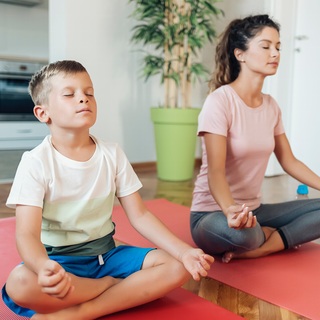
So let me invite you to take your seat for meditation and just begin to physically tune into your body.
Just physically tuning into your body and getting a good grounding.
So by this,
By grounding,
What I mean by that is not thinking about being embodied,
But just feeling into your body.
Perhaps even noticing the physical aspect of your body and the space around your body.
So where your physical form kind of ends and the room begins.
So you can feel the space outside of yourself.
Feeling your feet against the floor and your bottom against your meditation cushion or chair,
And allowing yourself a gentle upright posture.
Your eyes can be opened or closed,
Your hands in your lap in,
You know,
Yoga meditation posture or in your lap in a more traditional style.
And not trying to focus,
Not trying to change anything,
But just simple awareness of your body and the contact of your body with the space.
So we're feeling into the space around us,
Just with your nervous system.
And then also feeling into the space inside of yourself.
So there's a space within and there's a space without.
And our kind of physical existence kind of sits between these two spaces.
Very often when we're in our creating of ourselves through fixed ideas or reactions,
Or trying to get things right all the time,
Or get our ducks in a row,
It seems like the inner space has pressure in it,
Or the outer space has pressure in it.
But actually the space inside and outside are just spaces.
So we just allow a sense of equalizing within these spaces and just becoming aware of the nature of your physical form and space.
And noticing that as you balance outer space and inner space,
And the quality of your body as a kind of intermediary between these two spaces,
You also become aware of a third space.
You might call this the mind essence,
Or the heart essence,
Or the heart-mind essence,
Or the awareness.
And one of the key,
I don't know if it's a secret or not,
Certainly not a trick,
But one of the keys to meditation is the investigation of the kind of heart-mind-awareness essence of what that is,
Or who that is.
Observing the mind,
Observing the emotions,
And learning for yourself.
And you can very quickly,
But I invite you to not react when seeing,
You very quickly see patterns of thought that you have.
You see thoughts arise and pass away.
You see thoughts that are fixed.
You see stories that you're always telling yourself.
You see the belief systems that have been put upon you.
If you put your ducks in a row in this order,
If you do your furniture in this order,
If you order your life in this way,
Then it will all work out.
Things that you've staked your life upon,
The feeling equivalents of those things.
If I get this,
And this,
And this right,
Then I'll be happy.
And it's not that those things may not have truths in them,
But by just even gently sitting with the heart-mind,
The awareness,
Within the sense of the outer space and the space within,
With the feeling of your body,
And not trying to focus,
Or change,
Or control anything,
We see we are more.
We see that we are the life that comes before all of these things.
But we are often trained to think our life only begins,
Or is invested in these things,
And that we have to create some kind of perfect order,
Or upgrade this bit,
Or change out of this bit,
Or change out of that bit.
And then we'll have a life.
Then it will be okay.
When in truth,
You have a life,
All of it is your life.
And if we are,
For want of a better word,
Balanced in these three spaces,
Or at the center of ourselves,
And we see the rows of thoughts,
And feelings,
And situations that we have been trained or created for ourselves to think we have to line up,
Or believe in,
Then we actually have some better choices that we can make,
Because otherwise we're often in control,
And panic,
And fear about slippages,
And movements within the situational aspects.
And hence,
Our mental health,
Our emotional health,
And so on,
Will slip depending on our attachment to these conditioned ideas,
These arrangements of furniture,
And so on.
So I'm not asking you to reject those structures,
The structures of school,
The structures that your parents taught you,
The structure that the workplace and the culture tells you,
The things you've been told about what it means to be a good member of the country or the society.
But to simply look from this balanced space,
That kind place of seeing.
You're also aware of the sensation of yourself,
What it feels like to be you,
Alive in this place,
In this body,
And again,
Not with reaction,
Or judgment,
Or criticism,
But merely allowing yourself to be the whole observer,
And learning from within the feeling of sensation,
Understanding the nature of sensation,
Where it's coming from.
And understanding in this way,
We may be carrying a meditation story that we picked up somewhere,
Because there's a lot of this in the,
You know,
In the last sort of decades of meditation teaching,
Of somehow we then have to not have sensation,
Not have mind,
Not have feeling,
Which is wholly untrue.
It's just we're learning the nature of our toolbox.
We have a life,
We have a human body.
We want to live fully,
Not in projection,
And falseness,
And inauthenticity,
And reaction.
And you might also,
From this space,
Kind of be aware of phenomena,
Because you're sitting in this kind of,
It's like the seat of balance.
This is the,
I'm thinking of the words axial point,
For some reason.
When we sit in this seat of balance,
We're in this balance of the three spaces.
It's the meditation seat of the world,
In many ways.
The person that they call the Buddha,
Used to call this the one seat.
It doesn't matter where you're sitting on the earth.
If you're sitting in this way,
You're sitting on the one seat.
And so you also can become aware of the nature of phenomena,
Of how things arise and pass away,
Of time,
Of material,
Of systems,
Of interconnectedness,
Of interdependence,
Of that seemingly gentle feeling of warmth,
Or kindness,
Or universal love of oneness that lies just beneath the clinging to the phenomenal.
And again,
It's not a rejection of phenomena,
It's a seeing of who we are within it all.
So in this gentle way,
We're actually letting the practice be a kind of quiet act of friendship with ourselves.
Just notice how your mind feels now.
Notice how your emotions feel.
Notice your relationship with your body and the space around you,
The space inside you.
So often when we think about looking after our mental health,
We think about trying to control our mind in some way,
Or to control our emotions in some way,
To get something set up in our mind in a certain order.
And sure,
We may need to have simple systems and regulation in our life so that we live well.
But the knowledge of creating those systems from ourselves has to come from ourselves.
Or we can look at somebody else's map,
But also find our own truth within that.
Somebody else's map can be helpful,
But we still have to attend to things our own way.
So just inviting you now just to take a moment of just letting all of that go,
Just sitting in peace,
Enjoying the practice.
The feeling of your body,
The spaciousness around you,
The spaciousness within,
The awareness that unifies the spaces.
Not trying to take a learning or a teaching from what you've seen,
Because sometimes words won't fit what we see,
But we know what we're seeing.
And we have a simple choice we can make to allow an aligning from who we are rather than a false created life.
And that comes naturally as a kind of perfume from you rather than a big effort.
Just inviting you now to allow your in-breath a little bit more,
Just to be here in the space.
Opening your eyes if they're closed,
Maybe moving side to side a little.
And we'll gently draw this practice to a close.
May this practice be for our own highest benefit.
And by being so,
May it be of benefit to all beings.