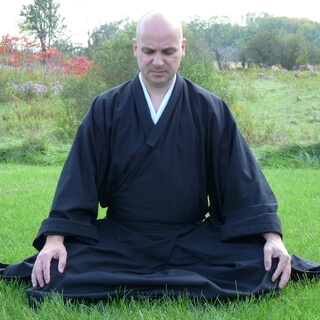
Hello,
It's me,
Joe,
The Autistic Buddhist,
And in this session,
I'm going to talk about unhelpful people.
I recently heard a few sessions from other teachers on how to manage difficult people and avoid toxic relationships.
I asked myself what my thoughts were on this subject,
And this is what this session is about.
In my life journey,
I have met both helpful and unhelpful people,
And I have also been both a helpful and unhelpful person.
Having autism in my younger years,
I was more unhelpful than helpful to myself and to others.
As I have learned,
Unhelpful people are people who do very little or nothing to assist me in my life journey,
Either directly or indirectly hamper my ability to move towards a greater sense of understanding and serenity.
On my life path,
I have met people who are convinced that their way is the right way,
Or others who exhibit a strong,
Unnecessary sense of pride or arrogance.
I am sure that in your life,
There may be or have been one or two people who are simply not helpful,
People who are critical and dismissive of your life path,
And even unsupportive.
When I think about such people,
A part of me reminds me that,
Are we not supposed to get along with everyone?
I was speaking to a friend of mine on this topic,
And she brought up a very interesting point.
Her statement was,
Quote,
Every religion advises their followers to be wary of fools,
End quote.
I thought about that and discovered that my friend was right.
I scanned many prominent religious texts that I own and was able to find references to and warnings against,
Quote,
Fools.
What I have come to understand is that the fools in the religious texts are what we would call ignorant people,
But ignorant not as an insult,
But as how the word is truly defined.
Ignorance is a near-complete lack of knowledge or awareness,
Not having any experience or understanding of something.
And so,
By acting on their ignorance,
Their lack of knowledge,
They become foolish or unhelpful people.
There are many things which I don't know about or how to do,
Which in turn makes me ignorant of those things.
Many who do not understand something attempt to learn what they don't know so they are better informed.
I boiled an egg once for lunch.
When it was done,
It was all soft and mushy on the inside.
This is not what I wanted.
I was truly ignorant in terms of how to boil an egg.
I was an ignorant egg boiler.
Once I found out the correct time to leave the egg in the boiling water so it would be solid when I unshelled it,
I was no longer ignorant.
Going back to the religious texts my friend spoke of,
I noted that the first three I picked up all identified a segment of people who seemed ignorant of the reality around them and in these texts they are universally labeled as fools.
In these texts,
Not only is this segment of the population identified,
But instructions are often provided on how to manage them.
Before I move to these texts,
I want to emphasize that the term fool is a person who does not have knowledge to see or understand the truth.
Now to the texts.
In the Quran,
There is a statement that says,
Quote,
Shall we believe as the fools have believed?
Verily,
They are the fools,
But they know not.
I really like this sentence because it says they are fools,
But they know not.
So the sentence acknowledges that these fools are people who do not know.
In the Bible,
I found,
Do not answer a fool according to his folly,
Or you will be like him yourself.
Basically saying that if you engage with a fool and act foolishly,
Then you are a fool as well.
In the Talmud,
Never tell a fool he is a fool,
Or you'll have an angry fool.
I included that one in because it's kind of funny.
And there's some truth rooted in it as well.
In the Rig Veda,
Which is a Hindu text,
It says,
It is impossible for the fools to tread the path of learned ones.
And I like that one too,
Because it says,
Unless you're aware of the reality around you,
Unless you're aware of yourself,
Of what your path is,
Then you really can't travel it effectively.
And from the Buddhist text,
The Dharmapada,
Which has a whole chapter on fools,
Actually,
It says,
Should a seeker not find a companion who is better or equal,
Let him resolutely pursue a solitary course.
There's no fellowship with the fool.
That's a pretty strong statement,
Because what it says is,
It's better that you follow your life path alone,
Rather than travel it with a fool.
Although all these quotes have differing contexts,
They all identify the existence of a person or persons who is seen as one who is a hindrance to others.
Therefore,
In this session,
I would like to discuss,
Not fools or ignorant people,
But what I call unhelpful people.
To start,
I would like to present a working definition of the unhelpful person,
And then review how these individuals impact our lives.
Firstly,
The unhelpful person is driven by the ego.
In a previous session,
I described the ego as a defense mechanism responsible for keeping out all that we see as harmful.
And in that session,
I explained that the ego today assesses people,
Ideas,
Events as potentially harmful when they're not.
Therefore,
The unhelpful person has rejected all conditions,
Solutions,
And supports contrary to their own beliefs or understanding.
And having done so,
They react when their perspective is challenged.
The ego also adopts ideas about itself which it seeks to consistently legitimate.
Poor self-esteem is the ego's rejection of anything that gives the person a sense of worth.
And so,
These individuals,
Whether overly assertive or overly dependent,
Tend to feel a strong discomfort towards others who are balanced or stable.
And because of that discomfort,
They attempt to confront or attach themselves to them.
I am sure that in your life you have met some of these individuals,
And I have as well.
Although autism is more accepted now than it used to be,
When I advised people I had autism,
I would get an uncomfortable reaction or an overly comfortable reaction.
Persons who reacted uncomfortably demonstrated the behavior of someone who had just been exposed to a highly contagious disease.
And the overly comfortable person viewed my declaration as a call for help and would engage me in a conversation as if you're trying to comfort a very sick person.
These people were not very helpful because they truly didn't understand what autism was.
Two people have hindered my path in two separate ways,
Directly and indirectly.
Those who are under full control of their egos have hindered me directly by attempting me to doubt my own path.
They criticize and provide misguided advice.
It appears their goal is to make me believe that nothing I do is right,
Proper,
Or appropriate.
They can also do this in the guise of helping,
And I feel like I'm being held back by having them around.
Those who hinder me indirectly take up my energy because they always seem like they need assistance,
Support,
Or nurturing.
They are passively aggressive and never seem to be self-sufficient or independent.
From experience,
I am able to identify these individuals rather quickly.
In the past,
I would easily engage with them to my own detriment.
But as a Buddhist,
I have learned that there are obstacles on my way to understanding.
And to engage with such unhelpful people only makes them angry.
I find that what works best for me,
Most times,
Is to pay no attention.
Like a big rock in the path in the forest,
I just simply go around it and walk on.
For those who challenge me directly,
I don't confront them.
I tacitly agree with whatever they are saying or not engage in the discussion at all.
When I was training new social work staff on how to manage difficult people,
I had this exercise that I would do.
I would ask for a volunteer and then hold out a piece of rope about 50 centimeters long.
I held on to one end and asked them to grab the other.
Then I would ask them to gently pull the rope out of my hand while I held on to it.
As I would not let go,
They could not do it.
So I would ask them,
Why can't you take the rope?
And they would say,
Because you're holding on to it.
So I would ask them to try again.
And they would.
And a little tug-of-war would happen.
I would say to them,
This is what it's like when you're engaged with someone who is unhelpful.
It is an unwinnable situation.
It just keeps going and going and the frustration escalates.
I then would say to the volunteer,
Okay,
Let's try the exercise again.
Try to gently pull the rope out of my hand when I say start.
I would then let the rope go so only the volunteer was holding it and then say start.
The volunteer then wouldn't do anything and just look confused.
I would then say,
Pull the rope towards you and try to take it from my hand.
And the volunteer would respond,
I can't.
Why not?
I would ask.
Because you have already let go of it.
Exactly.
It takes two people to engage.
If one is being unhelpful or obstructive,
I find not involving myself in the dynamic the most useful.
My point is that there are some people,
Although intentionally or unintentionally,
Will not be helpful to you.
As I stated earlier,
They simply don't know.
The impact that these individuals may have on you may range from being a nuisance to truly harmful to your well-being.
We need to take care of ourselves,
Both physically and psychologically.
And just like we avoid physical hazards and dangers for our own well-being,
We should also avoid psychological ones.
Before we can value others,
We must first take care and value ourselves.
For me,
It comes down to one thing,
Which is what I call spiritual permission.
Just like we need to give ourselves permission to make mistakes and explore new ideas,
We must also give ourselves spiritual permission to follow our paths with as few obstacles as possible.
Generally,
Permission allows us to live within limits,
Which is good for us and it defines boundaries,
Which is also a positive.
Spiritual permission is asking yourself what you are and are not willing to do as you follow your path.
How much tolerance are you going to have for an unhelpful person?
Have you given yourself permission not to associate with such a person?
Spiritual permission sounds a lot like making a choice,
Which it is,
But it goes one step further.
Sometimes,
After we make a choice,
We are hesitant and begin to doubt whether we made the right choice or not.
But in this circumstance,
You have given yourself permission to follow a certain direction.
So even if the choice you made was not the correct one for you,
You can comfort yourself by saying that you had approval to take that direction and make that choice.
Here's how it works for me.
I am in the supermarket shopping when I see Jerry.
Jerry is not a helpful person.
He is overly critical and demeaning towards my Buddhist beliefs.
What should I do?
Should I go over and say hello and make a quick exit as I am shopping and pressed for time?
What are my options?
I give myself spiritual permission to not engage with Jerry.
He is not seeing me,
So I will not draw attention to myself.
For the sake of my mental health and life journey,
I have given myself permission to move on.
Later,
If I doubt my decision,
Maybe I should have at least said hello,
I remind myself that I had permission to take the action I chose to take.
I took a course of action which I thought about and then approved.
When I have worked with people who have had boundary issues regarding relationships,
I explain the concept of spiritual permission and ask,
What do you have permission to do?
And if the person is wondering about taking a certain action,
I ask,
Have you given yourself permission for that?
I also ask the person to consider the following before they give themselves permission to pursue or not pursue a certain action.
First,
How do you feel about this choice?
Secondly,
Will this choice better your circumstances?
Thirdly,
What do you expect will happen once you have made this choice?
And lastly,
If you are not sure,
Can you give yourself permission to not make the choice now and think about it some more?
The last thing I want to say about this is giving yourself permission for an action or decision is not a frivolous exercise.
It is an act of consciousness that needs to be given careful consideration.
Because if you give yourself permission to do things that harm yourself and others,
Then you become unhelpful.
Thank you very much for listening to this session.
I hope it was of benefit to you.