Hello,
In this session I would like to talk about the two truths.
Now the two truths represent a fundamental or core teaching in Buddhism and for those who are not familiar with Buddhism or are not Buddhists they can present as quite a paradox and that's fine because there's a lot of paradox in Buddhism overall.
So let me explain to you what the two truths are.
The two truths are the Buddhist understanding of what truth is and it's divided into two different categories.
The first category represents what is called relative truth and there are different terms for that and if you're reading some Buddhist material or talking to a Buddhist you may hear that person use the term relative truth or conditional truth or provisional truth.
They all mean the same thing.
I prefer conditional and what provisional,
Conditional,
Relative truth means is that that is the truth that exists within the context of our environment.
The second category represents the truth that exists outside the context of our environment and that is sometimes referenced as ultimate truth,
Unconditional truth,
Or absolute truth.
So let me give you those three terms once more.
Provisional truth,
Ultimate truth,
Conditional truth,
Unconditional truth,
Relative truth,
Absolute truth.
I'm going to use the category conditional and unconditional truth because it's the one I'm most accustomed to.
Let's start with conditional truth.
Understanding the difference between these two truths is essential in Buddhism and if you wish to practice meditation then it's very important that you understand what the two truths are because they will help define your meditative practice and they will give you a framework to understand meditation when you're practicing it.
Let's talk about the two truths specifically.
Again,
I'm going to use the categories conditional and unconditional truth.
A conditional truth is dependent on conditions.
It's defined as a reality that is completely subjective to its context.
So a conditional truth can change.
It doesn't make it untrue.
It just means that it's more flexible and relative.
For example,
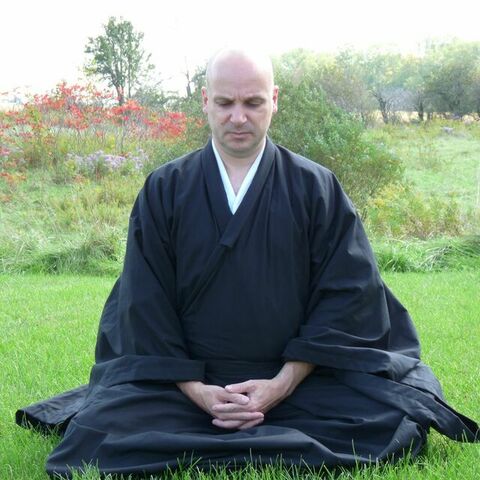
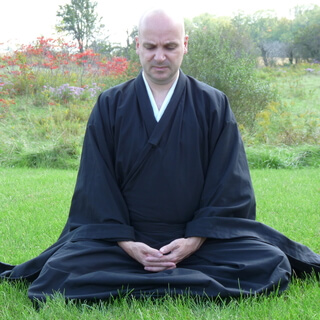
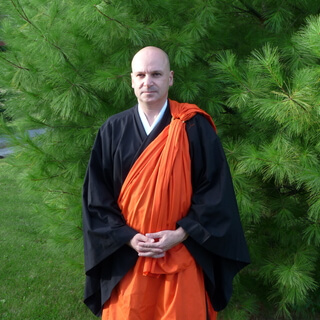
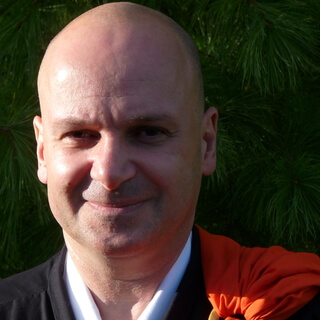
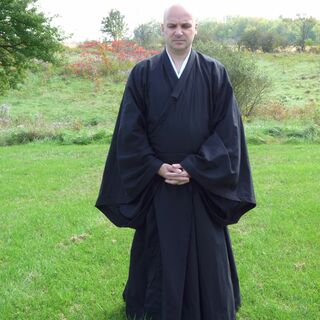
As you can tell by my profile picture,
I am bald.
If I were in a room with a bunch of other bald people,
The truth would be that everyone in this room is bald.
That's not wrong.
That is in fact the truth.
If someone else walks into the room with beautiful brown hair,
Now the truth that everyone in the room is bald is no longer true.
It's changed and it's changed because the environment has changed.
The context has changed.
So the truth changes.
It now is everyone in the room is bald except for that person or not everyone in the room is bald.
You cannot dispute the truth.
The fact that it changes doesn't make the previous truth wrong.
That is called conditional truth.
Truth that is conditional on the environment and its circumstances.
The majority of truth that we experience is conditional truth.
Let's move to the category of unconditional truth.
Unconditional truth is not dependent on its context or its environment.
One needs to recognize primarily that unconditional truth does not change.
It stays the same regardless of circumstances,
Conditions or environment.
Let us return to the room of baldies.
The absolute truth or the unconditional truth is that everyone experiences pain and regardless of someone else walks into the room with hair,
The unconditional truth remains true.
We all suffer.
In Buddhism,
There is a very important core teaching of the Buddha called the Four Noble Truths.
I'm not going to get into the Four Noble Truths in detail but I will explain for the purpose of this session that the Four Noble Truths are all unconditional absolute ultimate truths.
Let me tell you what they are.
The first is that as long as you live you will experience pain regardless of where you are or who you are.
Regardless of your position or your status,
Your wealth,
Your fame,
Your health,
Your intelligence,
If you are alive you will experience pain and suffering period and that is an unconditional truth.
You cannot escape pain and suffering.
You can try but ultimately you will not be able to escape it.
Different people will experience different pain and suffering to different degrees at different times from each other.
At the end you will not be able to find someone who would say I have never felt pain.
The second noble truth suffering is the result of attachment.
I can do a whole session on this noble truth alone because I'm very interested in this truth in reference to the statement of attachment and many many people get confused as to what attachment in this context means but it's actually very quite simple.
It doesn't mean that you can have no attachments.
It means that you need to be aware to what the attachments in your life are.
This is also an unconditional and ultimate truth.
Every attachment a person has will result in suffering.
Why do we suffer?
Because of attachment.
The third noble truth is that suffering can be ended in this lifetime.
It is possible or rather probable that you can end a vast majority of your suffering in this lifetime.
I wouldn't say you can end all of it because then we're going to get into a very detailed discussion about the definition of suffering and how it ends and so on and so forth.
It becomes a very academic discussion on the details of the philosophies of Buddhism and I don't think that's particularly useful to us at this time.
But the third noble truth says despite the fact that everyone suffers and everyone's attached to things you can still end the majority of your suffering,
The vast majority of your suffering.
And the fourth noble truth which is again an unconditional truth that is a truth regardless of circumstances conditions or environment is that the way to end suffering is the eightfold path.
I know in our society we don't like to be dictated to and we don't like the idea or it's no longer popular for any organization or body or group to say to someone if you want to become a better person here's our program follow our program sounds a little bit cultish but for over 2 500 years Buddhists have believed as I believe and you are free of course to believe whatever you want that goes without saying even though I just said it is that the eightfold path is the way to end the majority of your suffering.
I'm not going to get into the eightfold path I could do a whole session on that as well.
Let me explain the conditional and unconditional truth in reference to a personal experience and that perhaps will help you understand the two terms a little bit more.
When I first started my meditation practice I would enter my meditation practice with a series of conditional truths however after meditating for quite a long period of time I had an experience with one particular meditation.
I didn't prepare for it I didn't anticipate it but during one particular meditation I experienced what I would label as entering the core of my existence or the center of my being.
I was able to lose all attachment and all connection with my environment and my thoughts.
What I was left with was the center of who I am or what I think I am.
It's very hard to explain but it was existence in a place that has no interference.
I was able to experience ultimate and absolute truth firsthand.
What I found is in that experience when I was inhabiting what I term as the core of my existence there was no differences there was no diversity there was no measures that one could use to outline that this thing is different than that thing.
What I'm trying to say in my own convoluted way is there was no conditional truths.
What I felt instead is complete harmony.
I was in harmony with all sentient beings.
I didn't have reactions to any idea of a sentient being whereas in conditional truths I would very much have a reaction to some sentient beings.
For example if I saw a snake along a path I would react to that.
Fundamentally what I experienced during that particular practice is absolutely no distinction between myself and the world.
It was an incredible experience.
One I have never experienced before and only have experienced a few times since.
It's not the kind of experience that you can sit down in meditation and say okay I'm going to have this incredible experience today.
In one of my sessions where I'm going to talk about meditation specifically which is Shikantaza the meditation that I practice I will explain more about how that meditation works and our expectations regarding meditation.
Let me now enter the world of my autism because the big question for me which has always been a persistent question is how does my Buddhism and my autism get along?
How do they co-exist?
And I have found through my life experience my Buddhism helps my autism a great deal.
And how does that happen?
First of all my autism tells me and conditional truths tell me that I'm very different from everyone around me.
Physically different,
Psychologically different,
And emotionally different.
And those are all true.
They're conditional truths.
Because I'm autistic I see things differently,
I behave differently,
I interact with people differently.
Again all conditional truths.
But my Buddhism tells me that at the core of my experience if I strip away all those conditional truths I'm actually more the same than different from other people.
And the things I have in common with others outweigh those conditional truths.
In other words the absolute truths are the absolute truths that exist in everyone.
Having learned that I've been able to connect with people a little bit easier than before.
I have not become un-autistic.
I still remain autistic with all the conditions and all the behaviors that come with that particular mental health issue.
However I have been able to do things I would never have done before.
In approaching people and in speaking to people I no longer focus on differences.
I'm not interested in your conditional truths.
Really I'm not.
And I'm not interested in my own conditional truths because our conditional truths are going to be different.
What I'm interested in is the things that bring us together.
The things that I can share with you that you will respond and react to in a way that expresses harmony.
In other words we can talk about things and we can interact in such a way where there is more connection than disconnection.
The other aspect of my autistic life that has improved in understanding and living these two truths is that I have a greater sense of comfort with differences.
At one point differences,
Change,
Made me feel extremely anxious.
They still make me feel anxious.
They still cause frustration and fear in my brain and in my mind because of the autistic disorder.
But that's been dialed down a bit.
If on the radio of anxiety the volume was set at 10 before it's probably at about seven now.
And that may not sound to you like a big difference from 10 to 7.
But when you live with that type of anxiety,
That persistent relentless anxiety,
A reduction in that anxiety,
Any reduction is felt immediately.
And it's comforting.
And I'm very glad to have the Buddhist philosophy available to me that has helped me deal with that autistic issue.
Therefore in social settings which I on occasion participate in but not for very long,
I focus again on the similarities.
When I have those thoughts that I don't want to be here,
This is uncomfortable,
This is too much stimulation,
I say to myself,
You know what Joe,
There are other people here feeling the same way as you,
Autistic or not.
There are other people who would probably want to be elsewhere at this time.
People who are uncomfortable here and a little bit anxious themselves regardless of whether they have autism.
In connecting with people in general,
I seek out the similarities,
The things that will bring us together.
The other result of having learned and incorporated the two truths in my life is that I have become more compassionate.
Growing up autistic,
I did not have the skills or the ability to express compassion.
I may have felt it but I didn't know what to do about it.
My brain,
My mind was more reactive than anything else.
And in some cases it still is.
But now there's compassion there as well.
And the sense of compassion that allows me to act and to behave in a compassionate manner.
The other day I saw in my home a wolf spider.
Now wolf spiders are really really amazing creatures.
They tend to come into the home usually in the fall when it gets too cold for them outside.
They look ferocious and they look menacing.
And in the past when I saw a wolf spider,
My immediate reaction was to stomp down on it and crush it because it was scary.
Recently in the home I saw a wolf spider and I didn't crush it.
I didn't end its life.
I didn't immediately think to myself that it was harmful or that I should be afraid of it.
I thought that the wolf spider was probably feeling very cold outside and had come into the home to seek warmth.
And the thought I left it with was,
This is your world too.
I have no right to end your life.
And I left it alone.
It sensed my presence and it ran away and ducked under a door into another room.
That left me with a greater feeling of satisfaction rather than a feeling of suffering.
I would like to end by saying that yes my autism does make me different.
And if you're autistic as well,
We're still different.
As the saying goes,
If you've met one person with autism then you've met one person with autism.
And so conditionally we are different.
But I'm not focused on that and I'm not concerned about that.
I want to know how we're the same.
And despite the fact that we've had different experiences in life,
We've both felt pain,
We've both felt loss,
We know what it's like to feel joy,
We know what it's like to feel comfort,
We know what it's like to feel fear,
And we can relate to one another in that respect.
And I know through my involvement in Buddhism and the meditation practice that fundamentally at the core of our beings we're not different at all.
Thank you for your gifted time and for listening to this session.
And I hope I have said something to you that you will find useful and beneficial.
And always remember to be kind.