Welcome to your yin yoga practice.
Before we begin just take a moment to make sure that you have everything you need for your practice today.
You'll need a yoga mat and if you're in a cooler climate make sure you have a blanket to cover yourself with during the relaxation at the end.
You may also need to support your body with props in some of the postures.
If you have yoga blocks those are great but you can also use cushions or pillows or a folded blanket to support yourself.
And if you have a yoga bolster that may be useful too.
So make sure that you have some of those with you in case you need them.
Yin yoga is a passive practice where postures are held for several minutes to stretch into the connective tissues.
These tissues are delicate and can be injured if they're stretched too forcefully or intensely.
It's good to be able to feel that something is happening but you should never be forcing a stretch or pushing yourself into a position.
And you never want to be feeling any physical pain as you practice.
Pain is a signal from your body that the position that you're in is not safe or beneficial for you.
So if you do feel any pain at any time come out of the pose.
You can come into a resting position until the next posture or you can move back into another posture from the class that you didn't experience any pain in.
If you have any injuries or health conditions make sure to consult with your doctor before starting a new practice.
Yin yoga can have many benefits for health and recovery but it is important that your body is suitably recovered that the stretches will benefit the tissues and won't potentially make the injury worse.
So do please check with your doctor first for your safety.
As this is an audio session I will talk you in and out of the postures verbally but if at any time you're unsure of a posture and don't know if you're in the right position you can always pause the recording and do a quick internet search to bring up a picture.
I've included names for all of the postures so that you can easily do this if you need to.
We're going to begin today in reclining butterfly.
So come to lying on your back with the soles of your feet together and the knees opening out towards the sides.
You can support your thighs here with blocks or cushions if your knees are up very high away from the mat or if your legs feel uncomfortable here.
So that your legs can rest down and relax into this position for a few minutes.
Bring the arms up over your head keeping the elbows relaxed and just take a moment here to bring yourself into your body for your practice.
Take a long deep breath in and feel into how your body is feeling today.
Notice any sensations that are present in your body right now.
Just watch,
Tune in and observe.
In today's practice we're going to be focusing on postures which target the liver meridian.
In traditional Chinese medicine the liver is connected with the wood element and the season of spring.
The meridian runs on both sides of the body from the insides of the big toes up the inner legs over the groins,
Over the front of the body to the sides and up the sides of the body to the liver.
So our postures today are working with the inner legs,
The groins and the sides.
So now just bring your awareness to the pathway of the liver meridian.
Feel into the energy channel running from the inner big toes up the inner legs,
Over the groins and up the sides to the liver on the right and in line with the liver on the left.
Just observe anything you feel here.
There's no right or wrong,
Just send your awareness to these energy pathways and notice what you feel.
In traditional Chinese medicine the liver is said to be the organ that enables us to plan and envision.
And the season of spring is the time for renewal and growth.
A time where nature invites us to move out of our comfort zones and grow into new things.
It's also a time for cleansing,
A time to let go of anything that we no longer need to carry with us in order to expand and grow.
So if you have a plan or a vision for your life that you're ready to move towards,
You might like to take a moment now to bring that vision into your mind.
And to make the gentle intention for today's practice to help you to release any emotions or beliefs that are holding you back from that vision.
And once you've made that intention,
Let it go and forget all about it.
The practice will do the work for you now.
All you need to do is move yourself into the postures.
Now bring your hands to the outsides of your legs and push the knees up.
Bring the feet to the mat at hip distance apart and drop the knees in towards each other.
Take a few breaths here to observe how your body's feeling after that first posture.
And we're going to move into a gentle reclining twist.
So bring your knees back to face upwards and take your arms out in line with your shoulders with the palms of the hands facing upwards.
Now let your knees drop down towards the left.
Just let the legs relax all the way down.
And you can keep your head facing up here or turn the head to look over the right shoulder.
Remember in yin yoga we're never forcing anything.
We just come to the point where we feel like something is happening and relax into the posture.
And today we'll be holding the postures for two to five minutes.
If you're not really feeling anything at all here,
You can deepen the stretch by taking your left foot to rest on the top of the right thigh.
Feel into your body and observe the sensations that arise as you rest here.
And we'll just take a few more breaths in this posture.
Slowly make your way out of the posture.
If your left foot is on the right thigh,
Bring the foot back to the mat and bring the knees back up.
Bring the head back to the centre.
And keeping the feet at hip distance apart,
Drop the knees back in together.
And take some breaths here to observe how your body feels.
To notice any effects from the posture.
And we'll go to the other side.
Drop your legs towards the right and either keep your head looking up or turn the head to look over the left shoulder.
If you need a deeper stretch,
Take your right foot to rest on your left thigh and relax into the posture.
Just scan over your body here to see if there are any places where the muscles are clinging.
And if you find anywhere,
Relax those muscles.
It's when the muscles are relaxed that we can best access the connective tissue.
Check that the thigh muscles are relaxed.
The shoulders are relaxed.
And we'll stay here for another minute.
Slowly make your way back out.
Bring the right foot back to the mat and take the knees back to the centre.
Bring the head back to the centre and drop the knees together.
Take some breaths here to observe.
And now take the legs out to straight,
Opening the legs so that the feet fall out towards the corners of the mat.
Next we're going to come into banana pose.
We'll move the right leg first,
So bring the right foot to meet the left foot.
Either taking the ankles together or crossing the right foot over the left ankle.
Now bring your upper body towards the left so that your body comes into a curved banana shape.
Take your arms over your head,
Taking the right wrist into the left hand.
And relax into the posture.
Relax the arms and the shoulders.
Relax the legs and the hips.
Relax the feet.
If there are any areas that feel especially tight or uncomfortable,
Use the breath to help with the release.
Inhale into the tight or uncomfortable area and feel the exhalation carrying some of that tension away.
We'll just take a few more breaths here.
And slowly make your way back out.
Bring the right leg back to the right side.
Release the arms and bring the upper body back to straight.
And take some breaths here to observe any effects from the posture.
Noticing any differences between the left side and the right side.
And we'll go to the other side.
Bring the left leg to meet the right leg.
Either taking the ankles together or crossing the left ankle over the right ankle.
Take the upper body towards the right and bring the arms up over your head.
Taking the left wrist into the right hand this time.
Relax the arms over the head.
Relax into the posture.
Usually the left and the right sides of the body feel very different.
It's normal that one side is a bit tighter than the other.
So feel into the sensations that come up as you rest on this side.
Remember to breathe into any tight or uncomfortable places.
And slowly make your way out.
Bring the left foot back to the left side of the mat.
Release the arms back to the sides.
Re-straighten the upper body and take some breaths to observe.
And now bring your knees in towards your chest.
Roll over to one side and come up onto your hands and knees.
We're going to come into some dragon poses.
So if you have sensitive knees you might like to take a folded blanket under your knees to give them some extra support.
Start with your knees under your hips and your wrists under your shoulders.
And now step the right foot forwards between the hands.
Making sure that the knee is aligned above the ankle and not coming too far forwards or backwards.
And now lift the left leg and step the leg back slightly.
Dropping the knee to the mat with the weight just above the kneecap.
And relax into the posture.
This is baby dragon.
Relax the hips.
Relax the thighs.
Keep breathing into any discomfort.
You're welcome to stay here if this position is giving you exactly what you need right now.
Or if you'd like to go a little deeper,
Now bring your right hand to the inside of the right foot.
And walk the right foot out towards the edge of the mat.
Coming into dragon flying low.
If you're more flexible you might like to come to your forearms here.
But remember we don't want to force anything or feel too strong a stretch.
So only come down if it's a reasonably comfortable place to rest for the next few minutes.
Otherwise stay on the hands.
Check in with your body again to make sure that the hips and the thighs are relaxed.
The feet are relaxed.
The upper back and shoulders are relaxed.
And if you'd like to open the hip a little more,
Now drop onto the outer edge of the right foot.
And let the right leg fall out towards the right into winged dragon.
You can rest on your hands or on your forearms here.
Keep breathing.
Bring the right foot back to the mat.
And from here we'll come into a twist.
So take the right hand to the right thigh and gently twist your upper body towards the right.
Remember this is a yin twist.
So just turn until you start to feel that something is happening.
Keep the shoulders relaxed.
The thighs relaxed.
And slowly make your way back out.
Bring your right hand back to the mat.
And step the right leg back behind to come back to your hands and knees.
Take your time to come out carefully.
We don't want to make any sudden movements and stress the tissues after stretching so deeply.
From here we'll come into downward facing dog for a counter pose.
So turn the toes under behind and exhale to lift the hips up towards the ceiling.
Press into the bases of the fingers to lever the hips up and away.
And if you want to stretch out the backs of the legs you can pedal the legs here.
Taking alternate heels to the mat and bending the opposite leg.
And now bend the knees,
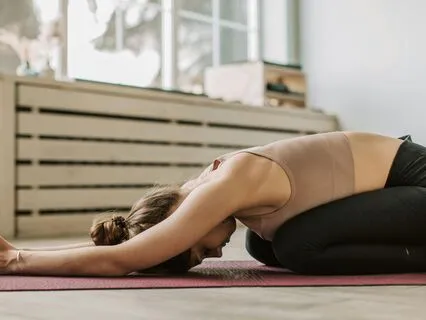
Bring the knees back to the mat and sit back onto the heels to rest into child's pose.
Take the forehead to the mat and stretch the arms out in front of you.
Or if it feels better you can fold the arms and rest the forehead onto the forearms.
Or take a block under the forehead.
Relax into the posture.
Bring the hands to the outsides of the knees and slowly curl up,
One vertebrae at a time.
And come back to your hands and knees for dragon on the opposite side.
Step the left foot forwards between the hands,
Keeping the knee aligned with the ankle.
And lift the right knee off the mat,
Step the right leg back slightly and drop the knee back to the mat with the weight just above the kneecap.
Relax into the posture.
You can stay here or to come into dragon flying low bring the left hand to the inside of the left foot and step the left foot out to the side of the mat.
Staying on the hands or coming to the forearms.
Check over your body again to make sure there's no clinging in the muscles.
And to come into winged dragon drop onto the edge of the left foot and let the left knee fall out to the left.
Keep breathing.
One of the benefits of yin yoga is that it teaches us to relax into discomfort.
And discomfort is essential for experiencing the growth and expansion that the season of spring invites us towards.
We can only grow when we find the courage to step out of our comfort zone.
And we can learn to do this by resting with the discomfort as we practice.
And then our practice comes with us off the mat and into our lives.
Bring the sole of the left foot back to the mat and bring the left hand to the left thigh for your twist.
Gently turn the upper body towards the left.
Just until you feel some intensity happening.
And relax and breathe.
Take your time to make your way back out.
Bring the left leg back behind you to come back to your hands and knees.
And we'll come back into downward facing dog.
So turn the toes under and lift the hips towards the ceiling.
Relaxing the head and the neck.
Keep pressing into the hands,
Into the bases of the fingers to encourage the hips as high as you can.
And keeping the height in the hips,
Descend the heels towards the mat.
Taking a long stretch through the backs of the legs.
And a long stretch through the spine.
And bend your knees,
Take the knees to the mat.
Sit onto the heels and rest forwards into child's pose.
Take some deep breaths here to observe any effects from those postures.
To observe any sensations.
Perhaps any feelings of energy moving.
Bring your hands to the sides of your knees and slowly curl up,
One vertebrae at a time.
And once you've come all the way up,
Make your way to sitting with your legs apart.
And next we're going to come into half butterfly.
So sit with your legs at a comfortable open distance.
And if it feels uncomfortable to sit like this,
Sit onto a block or folded blanket to elevate the hips.
Bend the right knee and bring the right foot to the left thigh.
If the back of your left leg feels very tight or if your knee bends off the mat,
Take a block or a cushion under the left knee.
So that the leg can just relax down.
And if your right knee is lifting up,
Place some support under the right thigh as well.
Turn the upper body to look over the left leg.
And if this is already giving you some intensity,
You're welcome to stay here.
Or if you want to come forwards,
Take a breath in to lift the chest.
And exhale to fold forwards over the left leg.
Folding until you feel that edge arrive,
When the intensity increases.
Relax the hands at the sides of the left leg.
And relax into the posture.
Observe the new sensations that arise for you in this new position.
In traditional Chinese medicine,
The liver is the organ that's responsible for the smooth flow of energy or qi around the body.
And for the smooth flow of emotions.
And when there are blockages or disturbances in the flow of liver qi,
We can feel excessive anger,
Frustration,
Irritability and resentment.
Where a smooth flow of liver qi brings us feelings of kindness,
Compassion,
Patience and acceptance.
So as we practice today,
We're encouraging those positive feelings.
Kindness,
Compassion,
Patience and acceptance.
Slowly walk the hands in to curl yourself back up.
Take the right hand to the outside of the right leg.
And push the right knee up and straighten the right leg.
Taking the legs back to open.
We'll take a gentle back bend as a counter stretch here.
So take your hands behind your back,
With your fingers turned back towards your body.
Press into the hands to lift the chest and open the front of the body.
And take a few breaths here to observe.
And come back to sitting up straight to go to the opposite side.
This time bring the left foot into the inside of the right thigh.
And take any support that you need for the legs.
Stay sensitive to where your body wants to be on this side.
You can stay upright here.
Or if you want to come forwards,
Take a breath in to lift up.
And exhale to fold forwards over the right leg.
Take the hands to the sides of the leg.
Turning the palms to face upwards can help encourage the shoulders and the upper back to relax.
And relax into the posture.
Because the liver is responsible for the flow of emotion,
Sometimes intense emotional releases can happen when we target this meridian in our practice.
And although the liver is especially connected to anger,
Frustration and irritability,
It does connect to all of the emotions because it's responsible for their flow.
So if you do feel any emotions arising as you practice,
Or any old memories coming to the surface,
Just be aware that your body is releasing these in the same way as it's releasing physical tension.
And observe them as they come up and make their way out.
If emotions do arise,
These are the feelings that it's time for you to let go of in order to expand and grow towards your vision.
So just allow them to happen as you rest in the posture and observe.
Knowing that they're moving out,
Just like the physical tension.
Slowly walk the hands back in to come back up.
Take your left hand to the outside of the left leg,
And take the left knee back up,
And then straighten the left leg out,
Bringing the legs back to their open position.
Take your hands behind your back again,
And press into the hands to lift and open the chest,
Observing any sensations,
Any effects from that last posture.
And from here we'll come into butterfly.
So now bring the soles of the feet together so that the knees fall out to the sides.
You can support the thighs with blocks or cushions if that feels best for your legs.
And if this is giving you the intensity that you need,
Stay upright.
Otherwise we'll fold forwards.
So inhale to lengthen up,
And exhale to fold forwards over the feet,
Dropping the head towards the feet.
Take the hands to the sides of the feet with the palms facing upwards.
Make sure that the thighs are relaxed,
The shoulders are relaxed,
The feet are relaxed.
We're going to stay in this one for a little bit longer,
So we'll have three more minutes here.
Take the hands to the feet,
And slowly walk the hands up the legs to curl back up.
Take the hands to the outsides of the thighs,
And push the knees up,
And take the feet to the mat at hip distance apart,
And slowly rock the legs from side to side,
Observing any sensations,
Any feelings,
Any effects from the posture.
And now bring yourself into any comfortable seated position.
We're going to do some eye exercises.
Traditional Chinese medicine recognises a connection between the liver and the eyes,
So we'll do some movements for the eye muscles to help encourage a good flow of blood to the eyes for overall eye health.
These exercises are a little more young,
But they're great to include when we're working with the liver,
So no sit in any way that's going to be comfortable for you here.
You can sit onto a block or a blanket if that feels best for you,
And you can cross your legs or kneel,
Or do whatever it is that you need to do to be able to sit comfortably for the next few minutes.
Bring your spine to straight,
And relax your shoulders.
And as we go through the exercises,
Do your best to keep your head as still as you can,
So that the movements come from the muscles in your eyes,
And not anywhere else around your head or your neck.
We're going to begin by moving between looking up and looking down.
So keeping your head still,
Look up towards the ceiling,
And look down towards the floor.
Make several of these movements,
Moving the eyes to look up as far as you can,
And as far down as you can.
And now we're going to change to looking towards the left and the right.
So now look as far to the left as you can,
Remembering to keep the head still,
And as far to the right as you can.
Move between looking to the left and the right some more times.
And now relax the eyes.
Bring the gaze back to normal.
Next we're going to make a big circle around the outsides of the eyes.
So look up to the top,
And start to circle around the edge of the eye in a clockwise direction.
Move slowly here,
And take care to circle over every part of the outside of the eye.
As you do this,
You might find that there are some places that feel a little more challenging to move over,
Or places that you naturally skip past.
These are the places where your muscles most need to work.
So if you find anywhere that this happens,
Go back and move over that area very slowly.
And now change direction and circle in an anti-clockwise direction.
And now relax the eyes.
Bring the gaze back to normal.
Now take your arm out in front of you,
And bring your thumb up and in line with your eyes.
Focus on your thumb,
And exhale to bring the thumb in towards your nose.
Keep focusing on your thumb as it moves towards your nose,
Allowing your focus to move from far to near.
And as your thumb reaches your nose,
Inhale to stretch the arm back out again.
Keep following your thumb as your arm moves back out,
And repeat this a few more times,
Exhaling the thumb to the nose,
And inhaling to straighten the arm,
Keeping the focus on the thumb.
And release the arm.
Relax the eyes back to normal.
And just close your eyes here,
And take a few breaths to notice how you're feeling,
Perhaps noticing any feelings or sensations in your eyes.
And now make your way down to lying on your back,
And we'll finish with a reclining twist.
Bring the knees in towards the chest,
Keeping the knees and the ankles together,
And shift your hips slightly towards the right,
So that your spine stays aligned for the twist.
Take your left hand to the outside of the right thigh,
And drop the knees to the left,
Keeping the left hand on the right thigh to keep encouraging the legs down.
Now bring the right arm up and out to a diagonal angle,
And you can keep the head looking straight up,
Or turn to look over the right shoulder.
Relax into the posture,
And observe the new sensations that arise for you here.
We're staying in these final twists for five minutes on each side,
So we've got three more minutes here.
Bring the left hand down to the outside of the left thigh,
And push the legs back up.
Restraighten the hips,
And take the feet to the mat at hip distance apart,
Dropping the knees together,
And take some breaths here to observe.
And we'll twist the other way.
Bring the knees back in towards the chest,
Keeping the knees and the ankles together,
And take the hips towards the left,
And bring the right hand to the left thigh to push the legs down towards the right.
Keep the right hand at the left thigh,
And bring the left arm up and out to a diagonal angle,
Either keeping the head looking straight up,
Or turning to look over the left shoulder.
And relax into the twist.
We'll be here for five minutes.
Take your right hand down to the outside of the right thigh,
And push the legs back up.
Restraighten the hips,
And bring the feet back to the mat at hip distance apart,
Drop the knees together,
Take some breaths to observe.
And it's time for your relaxation.
So make sure that you're going to be warm enough.
Take any extra layers that you need to stay warm.
And if you're comfortable here,
You can remain like this,
With your knees resting together.
Or if you want to come into Shavasana,
Take your legs out to straight,
A little wider than hip distance apart.
If you want to support your knees,
You can take a rolled up blanket under the knees.
And you can also support your head with a block or a cushion.
And let your body completely relax here.
Bring your awareness back to the liver meridian.
The energy pathways running from the insides of the big toes,
Up the inner legs,
Over the groin and up the sides towards the liver.
Just observe these energy lines.
Notice any sensations that you feel along the pathway of the liver meridian.
Just watch.
And now let your awareness of the liver meridian go.
And the next few minutes are yours to relax completely as you receive and integrate the benefits of your practice.
Slowly begin to reawaken the body.
Start to make some small movements.
Start with the fingers and the toe.
The hands and the feet.
And bring the arms up over your head to give yourself a long stretch all the way down the sides.
From the tips of the fingers to the tips of the toes.
Bend the knees and bring your knees in towards your chest.
Hug the knees and begin to rock gently from side to side.
Easing out any tension from the lower back.
And keeping your eyes closed,
Roll over to one side and bring yourself up to sitting.
Sitting with your eyes closed,
Just take a moment to reconnect to your vision.
The plan or vision for your life that you are ready to expand and grow in.
See and feel it vividly as if it's happening right now.
And just watch as that vision expands for you as you observe and acknowledge it.
And now bring your hands together and rub the palms of the hands together to create heat in the hands.
When you feel that heat,
Bring the hands up to the eyes and place the palms of the hands over the eyes.
Keeping the eyes covered,
Slowly blink the eyes open to receive the prana from your hands.
And gently release the hands to let the light back in.
This brings us to the end of the practice.
Thank you for joining me today.