This is a breathing or pranayama practice as it's known in yoga.
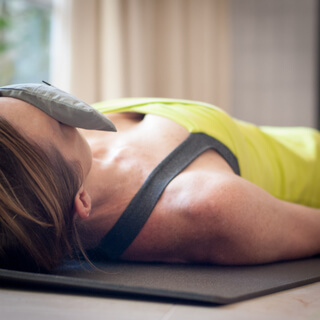
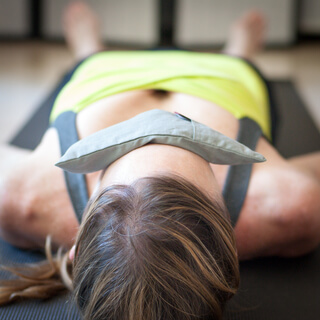
You're welcome to take a comfortable seated position for this practice or if you prefer you might like to try it lying on your back.
Unless instructed otherwise,
Breathing in yoga is usually performed through the nose if possible.
But you're always welcome to adjust the practice to suit your needs.
You might like to keep your eyes open or close them now.
Making yourself comfortable and without changing it too much just yet,
You might start to become aware of your breath.
You might observe your breath at your nostrils,
Sinuses,
Back of your throat or your chest.
You might notice it in the gentle rise and fall of your abdomen.
Choose one of these places or any other sensation of breathing and take a minute or so now to observe the ebb and flow of your natural breath cycle.
Thank you for watching.
You're welcome now to leave your hands where they are or place one hand on your chest and another on your abdomen.
Then you might start to breathe more deliberately with your abdomen.
As you inhale your abdomen might rise and as you exhale it might soften and fall away.
Inhale your abdomen lifts,
Exhale it releases.
Continue in your own time with several rounds of this abdominal or diaphragmatic breathing.
If you placed your hands on your torso you might notice that the hand on your abdomen moves more and perhaps the hand that is on your chest moves less.
While this technique may seem counterintuitive at first,
Breathing in with your abdomen pushing outwards does a couple of things.
First it potentially deepens and slows your breath encouraging your diaphragm to move downwards.
Secondly it works with your vagus nerve to invoke a relaxation response in your body.
So this is a tool you have at your disposal any time you would like to self soothe.
This technique can be done in daily life and in quite a subtle way.
Taking three more abdominal breaths.
Two.
And one.
Releasing control of your breath now.
You might like to rest while I describe the first of our formal pranayama or breath training.
The first of these is a practice called Viloma 1 and this translates to against the grain breathing.
So in this practice we might break our inhalation into three parts and count one long exhalation.
So in a moment I will count inhale 2 3 pause,
Inhale 2 3 pause,
Inhale 2 3 and count a long exhalation from 9 all the way down to 1.
This breath is a useful foundation and supports a relaxation response in your body.
We'll practice nine rounds together synchronising our breath now by exhaling through both nostrils.
Begin inhale 2 3 pause,
Inhale 2 3 pause,
Inhale 2 3,
Exhale 9 8 7 6 5 4 3 2 1,
Inhale 2 3 pause.
Inhale 2 3 pause,
Inhale 2 3,
Exhale 9 8 7 6 5 4 3 2 1,
Inhale 2 3 pause.
Inhale 2 3 pause,
Inhale 2 3,
Exhale 9 8 7 6 5 4 3 2 1,
Inhale 2 3 pause.
Inhale 2 3 pause,
Inhale 2 3,
Exhale 9 8 7 6 5 4 3 2 1,
Inhale 2 3 pause.
Inhale 2 3 pause,
Inhale 2 3,
Exhale 9 8 7 6 5 4 3 2 1,
Inhale 2 3 pause.
Inhale 2 3 pause,
Inhale 2 3,
Exhale 9 8 7 6 5 4 3 2 1,
Inhale 2 3 pause.
Inhale 2 3 pause,
Inhale 2 3,
Exhale 9 8 7 6 5 4 3 2 1,
Inhale 2 3 pause.
Inhale 2 3 pause,
Inhale 2 3,
Exhale 9 8 7 6 5 4 3 2 1,
Inhale 2 3 pause.
Inhale 2 3 pause,
Inhale 2 3,
Exhale 9 8 7 6 5 4 3 2 1.
Release control of your breath now.
You're welcome to return to natural breathing.
So while you're resting here,
I will describe the next pranayama or breathing exercise,
Known as samavritti or equal ratio breath.
Also known as box breathing,
It can help in this practice to visualize the shape of a box or square with four equal sides.
At this moment I will cue inhalation for a count of four on the first side,
Then pausing to retain your breath at the top of your inhalation for a count of four on the second side,
Exhaling for four on your third side,
And finally pausing at the bottom of your exhalation for another count of four on the final side.
If your count is too fast or too slow for you,
You're always welcome to make any adjustments you might need.
This breath can be useful to balance your nervous system and regulate emotion.
It can promote calm readiness without fatigue or loss of energy.
I'm exercising our breath now by exhaling through both nostrils.
Begin.
Inhale,
Two,
Three,
Four.
Pause,
Two,
Three,
Four.
Exhale,
Two,
Three,
Four.
Pause,
Two,
Three,
Four.
Inhale,
Two,
Three,
Four.
Pause,
Two,
Three,
Four.
Exhale.
2,
3,
4 and pause.
2,
3,
4.
Inhale.
2,
3,
4.
Pause.
2,
3,
4.
Exhale.
2,
3,
4 and pause.
2,
3,
4.
Inhale.
2,
3,
4.
Pause.
2,
3,
4.
Exhale.
2,
3,
4 and pause.
2,
3,
4.
Inhale.
2,
3,
4.
Pause.
2,
3,
4.
Exhale.
2,
3,
4 and pause.
2,
3,
4.
Inhale.
2,
3,
4.
Pause.
2,
3,
4.
Exhale.
2,
3,
4 and pause.
2,
3,
4.
Inhale.
2,
3,
4.
Pause.
2,
3,
4.
Exhale.
2,
3,
4 and pause.
2,
3,
4.
Inhale.
2,
3,
4.
Pause.
2,
3,
4.
Exhale.
2,
3,
4 and pause.
2,
3,
4.
Inhale.
2,
3,
4.
Pause.
2,
3,
4.
Exhale.
2,
3,
4 and pause.
2,
3,
4.
Release control over your breath now.
And simply rest in your natural cycle.
You're welcome to stay here and rest a little longer.
Or you might like to roll to your favorite side or open your eyes.
Completing your pranayama practice.