This meditation is for the physical source of your pleasure,
Which is in the pelvic floor.
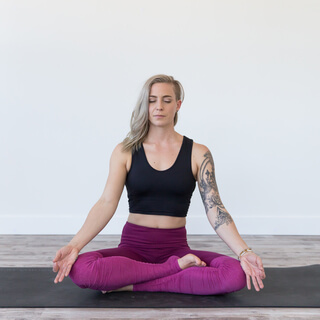
You may find it helpful to do this meditation sitting on either a pillow,
A throw cushion,
Or an inflated ball of some sorts that your physical body is receiving feedback.
Go ahead and set yourself up in a way that you can have a tall neutral spine.
Whatever it is that you are sitting on at the very least is going across the pelvic floor area.
So you can think of this from the tailbone to the pubic bone and then from one side to the other in the sit bones.
Once you're sitting comfortably,
Nice tall neutral spine,
Begin to deepen your breath.
Feel your body expand to accept the inhale and then soften as you exhale.
Maybe a few of these breaths have a bit of a sighing tone to them in through the nose and then sighing through the mouth,
Just releasing any tension from the jaw,
The neck,
Your forehead.
Continuing to focus on expansive full breaths.
Feel that as you inhale,
The breath is sent all the way down to the pelvic floor area.
And as you exhale,
The movement starts in the pelvic floor to initiate the exhale.
Whatever it is that you are sitting on,
Notice if that helps you as a frame of reference to feel the musculature,
The hammock of your pelvic floor sway in the wind of your breath.
As you gently inhale and expand downwards,
Can you feel the musculature push down gently as it makes room to accept the breath?
When you exhale,
Can you feel that area of your body slightly contract and lift as if gently helping your body to push the exhale out?
Notice that if you intuitively inhale and squeeze the pelvic floor,
Be very intentional about your breath here.
And tend for the inhale to create length as the pelvic floor pushes down into the cushion or the ball.
A little bit of strengthening as the pelvic floor contracts and lifts up with the exhale.
If you don't notice or sense the physical movement,
Just imagine that you can and envision these areas,
This musculature activating as we mentally explore your pelvic floor muscles.
Without moving,
Just be aware of these four bony prominences.
Your tailbone at the back,
The very base of your spine,
Your sit bones on either side left and right,
And your pubic bone at the front.
These four bony landmarks give us roughly the edges of what we consider the pelvic diaphragm.
If you imagine that this area has a kite-like feel to it,
So it has a give with the breath,
Imagine as you inhale,
Expands downwards,
Exhaling,
Expanding upwards.
And as you continue to breathe,
Be aware,
Just conscious,
Of the musculature that connects your tailbone to your pubic bone.
Know that if you engage slightly,
You might feel a little shortening of that area,
As if the tailbone could pull towards the front and the pubic bone could pull towards the back.
And in a cross-like manner,
The musculature that connects your left sit bone to your right sit bone.
Know that you can engage the musculature to gently draw the left sit bone towards the right and right towards the left.
These muscles also work in quadrants,
So the pubic bone connects to the right sit bone,
Forming the front right quadrant.
You could gently pull the sit bone on a diagonal forward towards the pubic bone.
You have the back right quadrant and the right sit bone to the tailbone.
You have the back left quadrant,
Again from the tailbone to the left sit bone.
And then the front left quadrant,
Left sit bone to the pubic bone.
So there are six different directions of engagement.
And your experience here is simply to notice.
There's no forcing.
Just enjoy the experience of beginning to tap into and connect with your physical source of pleasure.
Take another deep full breath in,
Send it down to the pelvic floor.
And then sigh it out through your mouth.
Take a breath in,
Feel that gentle downward movement.
Now as you exhale,
Try to draw the right sit bone towards the pubic bone.
You inhale,
Relax and lengthen the front right quadrant.
As you exhale,
Try to engage the back right quadrant,
Right sit bone towards your tailbone.
You inhale,
Again releasing,
Softening.
As you exhale,
Engage back left quadrant,
Left tailbone towards your sit bone on the left side.
Exhale,
Engage back left quadrant,
Left tailbone towards your sit bone on the left side.
The breath in creates expansion,
Softening the engagement.
Again exhaling,
This time front left quadrant,
Left sit bone to pubic bone,
Diagonally shortening.
Inhale to let it all go.
Then as you exhale,
Pull both sit bones in towards one another.
Breathe in,
Release and relax.
Breathe out,
Pubic bone to tailbone,
Engage.
Front towards the back,
Shortening.
Breathe in,
Release.
Let it out through your mouth.
So if you've been sitting cross-legged,
I want you to cross the opposite leg in front.
You may notice this affects your ability to connect with a different musculature.
Once you've re-crossed your legs,
Again lengthening your spine,
Finding that fullness of breath.
We'll work our way the opposite direction.
Take an inhale,
Feel the expansion downwards.
As you exhale,
Draw the left sit bone towards the pubic bone.
Inhale to soften through the whole musculature in this area.
Exhale,
Intend to engage,
Left sit bone pulls towards the tailbone.
And when you inhale,
Releasing the back left quadrant.
Inhale,
Releasing the back left quadrant.
Exhaling,
Contract tailbone towards the right sit bone.
Inhale,
Release,
Soften.
Exhale,
Right sit bone towards the pubic bone.
Let it go.
Take an inhale,
Draw the tailbone towards the pubic bone front to back.
Let that go.
Take a big breath in.
And draw the sit bones in towards one another,
Pubic bone to tailbone.
Both front quadrants,
Back quadrants,
Squeeze.
And then inhale deeply,
Fill your body up,
Allow the pelvic diaphragm to really move into the ball or the pillow.
Sigh through your mouth.
Allow your body to breathe at its own natural rhythm.
Notice any increased awareness as you breathe.
And then inhale,
Release,
Contract tailbone to the pubic bone.
Notice any increased awareness as you breathe to the beautiful musculature of your pelvic floor.
Know that this area and all areas of your body are completely yours,
Yours to embody,
To experience pleasure,
Yours to thoroughly enjoy and connect with.
Take one more full breath in here.
Let it out through your mouth.
Intend before you get up and move to check in with this physical area of pleasure a few more times throughout the day as you walk,
As you breathe,
As you move.
May you know the strength and the source of your physical pleasure.
Namaste.