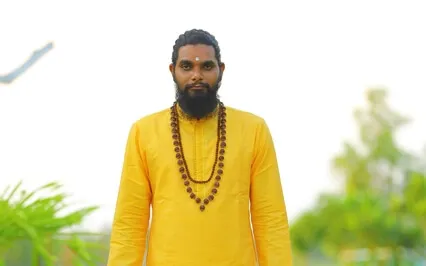
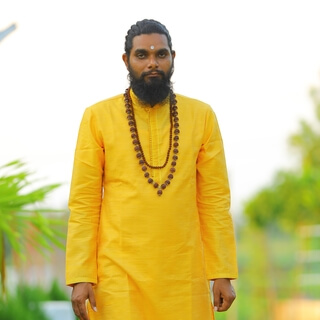
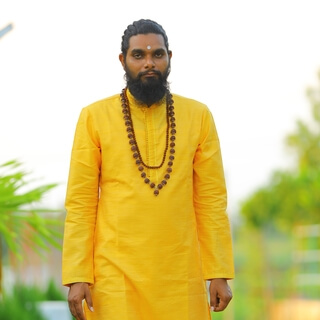
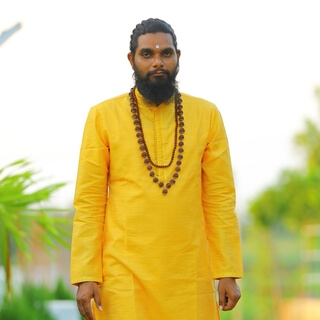
Namaste and welcome to day 3 of the level 2 course on Siva Kundalini Sadhana.
Yesterday you learned about nadis and your Sushumna nadi was activated.
Today you are going to learn about karma.
Human life is very precious.
It takes around 84 lakh births before one can be born as a human being.
So when one is born as a human being one should strive to realize who am I.
When we realize who we are in essence our mind gets settled and we will be at peace.
Karma can be described as the collective impressions from our thoughts and actions that are imprinted on the mind.
All our experiences also like eating,
Drinking,
Speaking or thinking can be imprinted on your mind in the form of impressions.
These impressions form a psychological pattern.
Based on this psychological pattern we develop perception.
Perception is a way we see the world.
Through our perception we enter into an illusion or maya.
Whatever punya or papa which is your good karma or bad karma prior to this birth is called accumulated good or bad karma and is called Sanchita karma.
Some part of the Sanchita karma is taken and we are born with it in this life.
We experience the good and bad karma based on the portion of Sanchita karma we brought with us in this life.
This is called Prarabdha karma.
While experiencing the Prarabdha karma we accumulate some new karma which is known as Agami karma.
After we die this Agami karma is added back to the Sanchita karma and again we are reborn to experience our good and bad karma.
This cycle of birth and death continues.
When one is able to break the cycle of birth and death then it is called Moksha or Mukti.
It is a common misconception that a lot of people think if they have good karma balance then they will not have to take rebirth.
For instance if someone has some good karma balance then they have to take birth to experience that good karma.
Good karma is like having golden cuffs whether they are golden or not cuffs will always bind you.
For one to break this cycle of birth and death they shouldn't have any karma balance good or bad.
It doesn't mean that we shouldn't do any work.
We have to do work in such a way that we shouldn't get attached to the result of the actions.
If you are thinking about a person or a thing or a goal then you get attached to them and the more we think about them the more we get attached to it and it results in runalubandha or karmic link.
This karmic link creates a lot of karmic debt.
Once the karmic debt is cleared then we get separated from that person or a thing or a goal.
Moksha is nothing but nullification of Sanchita,
Prarabdha and Agami karmas.
The word karma often is understood in a negative connotation.
Karma is neither good nor bad.
Karma or karmman in Sanskrit is derived from the root kar to do and man action.
Doing can be at a physical level or at a mental level.
At a physical level it can be an action or it can be a thought in mind.
When we are in a state of doing whether it is an action or just a thought the result of the karma gets attached to the individual.
When there is a cause then it is followed by effect.
Some of the effects can be immediate and some of them can be felt in the long term.
For instance helping someone is an action and a possible effect of that is that one might derive joy or satisfaction.
Karma is a summation of the action and the effect due to that action.
Various actions physical mental etc performed by us or stored in the form of samskaras or impressions.
According to Padma Purana we come across Chitra Gupta who takes up the humongous task of keeping track of our actions on earth and rewards us according to our karmas.
In Sanskrit chitra means picture and gupta means secret.
All our actions are being stored in the form of secret pictures called samskaras or impressions.
One might have a question can't we turn off this constant recording?
Is there no escape from this continuous loop of cause and effect?
Is there a switch that we can turn off?
Obviously these are interesting and relevant questions.
Yes it is quite possible.
We need to understand our breath a little more in detail to find answers to this question.
We breathe from our nose and a little observation will reveal that at any given point of time we breathe more from one nostril either left or right and less from the second nostril.
Of course for a very brief period of time we might find that the breath from both the nostrils is equal.
This is during the transition period when the breath moves from the right nostril to left or vice versa.
When we breathe through nostrils we are actually receiving energy or prana.
When the prana flows from the left nostril then we say Ida Nadi is active and when the prana flows from the right nostril then we say Pingala Nadi is active.
When the prana is balanced between both the left and right nostrils equally then we say Sushumna Nadi is active.
When we breathe through nostrils we are actually receiving energy or prana.
When the prana flows from the left nostril then we say Ida Nadi is active and when the prana flows from the right nostril then we say Pingala Nadi is active.
When the prana is balanced between both the right and left nostrils equally then we say Sushumna Nadi is active.
So this recording of our actions happen when our breath flows through either in Ida or Pingala Nadi.
The Sushumna Nadi has three further subtler Nadi's Vajrinnyi,
Chitrinnyi and Brahmanadi.
When the prana is flowing through the Brahmanadi of Sushumna then the recording of our actions is turned off and new karmas performed are free from attachment.
We will now start the initiation of Sushumna Nadi activation.
Do not try to do this while you are driving or operating machinery.
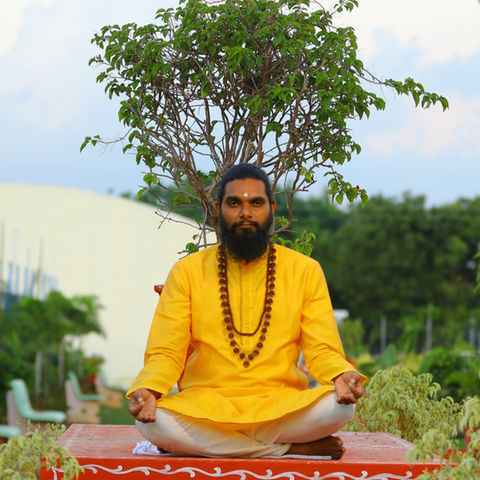
This practice has to be done in comfortably seated position on the ground or in the chair.
Be seated in a comfortable state.
Keep your spine,
Neck and head erect.
Now place your palms on your legs gently with your palms facing upward.
Keep Chin Mudra by touching your thumb with your index finger gently on both the hands.
Keep your eyes closed and focused on the space between your eyebrows and chant the Sivoham mantra.
I will now initiate the process of activating your Sushumna Nadi.
Until and unless I say you to open your eyes,
Don't open your eyes and simply chant the Sivoham mantra.
You Now slowly rub your palms for five seconds till you feel the warmth in your palms and now place the palms on your eyes.
Be there for ten seconds then slowly open your eyes by looking into your open palms.
Now you can rub your face,
Head and body with your palms.
Today you learnt about karma and how to avoid creating new karma by activating the Sushumna Nadi.
On day four we will learn about other ways you can burn your karma.
I hope you learned something new today.
Thank you for joining me in this session and I look forward to seeing you on day four.