Namaste and welcome to the level 2 course on Siva Kundalini Sadhana.
In case you haven't taken the level 1 course,
I would strongly encourage you to take it on Insight Timer.
In level 1,
You learnt about the practice of awakening the Kundalini energy.
You were initiated with a mantra and we had guided meditations using this mantra.
You also learnt about different brain states and the wave frequencies associated therein.
Then you learnt about the process of meditation and its benefits.
What is meditation?
Meditation means mind plus attention,
Keeping your mind attentively on a particular point or subject or idea or thought.
That single focused thought is what we call meditation.
Most of us think that we are living in the information age but we are slowly transforming into the age of attention.
Even though we have a world of information,
We are only receiving what our attention is allowing us to receive.
In the recent past,
Due to the explosion of social media,
Human attention spans have reduced.
Day by day,
Our attention spans are getting shorter and shorter.
In meditation,
When we focus on a particular point or subject or idea or thought,
Our attention slowly increases.
When we practice meditation regularly,
Our attention span expands.
You might be wondering,
How will that help me?
For us to complete any task,
It requires undivided attention.
The more the complexity of the project or task,
The more attention one needs to successfully complete it.
Hence,
A focused mind makes the execution of any task easier.
Every new year in January,
Many people make several new year resolutions.
Very soon,
They realize that they are not able to work on the new year resolutions.
One might think that those people are lacking motivation but they actually are lacking attention.
They are lacking attention to follow through on their goals.
Meditation helps build up your attention span and makes getting work done easier.
To understand how we can achieve that single-minded focus,
We need to understand how the mind works.
Like the primary function of the eyes is to see and the primary function of the ears is to listen,
The mind's primary function is to think.
The mind has two doors or channels through which it thinks.
One is through images and other through words or sounds.
For instance,
When someone asks you to think about your house or car,
You can observe the image of your house or car projected onto your mental screen.
We can say that now the mind is thinking through images.
The second door is through sound or words.
If someone asks you a question,
It generates several thoughts.
The number of thoughts we have in a day can number in the thousands.
So if we end up counting the number of thoughts one has in a lifetime,
It is almost unlimited.
But however,
The mind can do only three thoughts.
That is,
The thought of the past,
Present or future.
So if we end up counting the number of thoughts one has in a lifetime,
It is almost unlimited.
But however,
The mind can do only three thoughts.
That is,
The thought of the past or present or future.
Most individuals either live in the past or future,
Contemplating the past or anticipating the future.
Very few people are able to live in the present moment and make the most of their lives by abiding in the present.
Now let us understand about meditation in more detail.
To begin the meditation process,
One has to sit in contemplation.
So the one who is performing the meditation is called Dhyata.
Then this person has to contemplate on something.
The object on which the Dhyata is contemplating is called Dhyaya.
When the meditator or Dhyata contemplates on an object or Dhyaya,
That is what we call as meditation or Dhyana prakriya.
For the Dhyana prakriya or meditative process to happen,
There are three prerequisites.
We need to close the two doors of mind,
That is images and sounds or words.
We need to let go of thoughts pertaining to the past,
Present or future.
We need to focus on the Dhyaya or the object of contemplation.
If the meditator or Dhyata can contemplate continuously for 12 seconds on the object or Dhyaya without any thoughts,
The meditator reaches a state called Dharana.
Twelve such Dharanas together,
That is 144 seconds or 2 minutes 24 seconds constitute a state called Dhyana or meditation.
Twelve such Dhyanas together,
That is 28 minutes 48 seconds constitute the state of Savikalpa Samadhi.
However some of us it is difficult to meditate.
It is because we live in two worlds,
That is outer and inner world.
Outer world is whatever we are experiencing outside ourselves and the inner world is what we experience inside us.
When you close your eyes to meditate but if you find it difficult to meditate,
Then it is due to the fact that even though your eyes are closed,
You are still in the outer world.
So if you want to experience meditation,
You need to withdraw yourself from the external world and start your journey into the inner world.
Now we will do a process that will help you draw your senses inwards.
Be seated in a comfortable position and relax.
Draw your attention inwards by closing both your ears with your thumbs and close your eyes with your index and middle fingers.
Now observe the inner sounds.
Be in this state for 2 minutes.
Now we will do Samadhi practice and close our session for today.
Do not try to do this practice while you are driving or operating heavy machinery.
This practice has to be done in a comfortably seated position on the ground or in a chair.
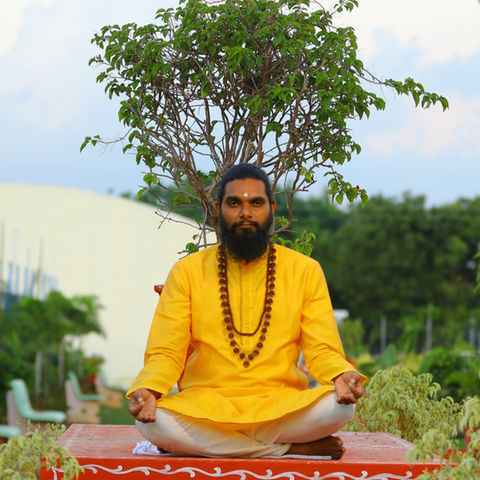
Be seated in a comfortable position.
Keep your spine,
Neck and head erect and in a straight line.
Now mentally repeat along with me the mantra and observe the gap between the 2 recitations.
See war hum.
See war hum.
See war hum.
See war hum.
See war hum.
See war hum.
See war hum.
See war hum.
See war hum.
See war hum.
See war hum.
See war hum.
Now slowly rub your palms for 5 seconds till you feel the warmth in your palms and now place the palms on your eyes.
Be like that for 10 seconds.
Now remove your hands from your eyes and slowly open your eyes by looking into your open palm.
You can rub your face,
Head and body with your palms.
Today you learnt about Dyata,
Dyaaya,
Dhyana Prakriya i.
E.
Meditation and Samadhi.
Then you also learnt how to draw your senses inwards.
On day 2 we will learn about Nadi's and Karma.
I hope you learnt something new today.
Thank you for joining me in this session today and I look forward to seeing you on day 2.