Hello and welcome to our three-part yogic breath.
For this one we're going to be playing a little bit with some muscle isolation,
Sending our breath into a couple different parts of the body.
And to do so we're going to want to try to set ourselves up for success with our breathing in general.
So you're going to want to be sitting with a nice tall spine for this one.
So if you're in a chair,
Maybe try pulling your back away from the backrest a little bit,
Sitting a little bit forward on the seat and planting your feet firmly on the ground.
If you're sitting on the floor,
Whether it's cross-legged or in any other forms of lotus,
Half lotus,
Seza,
Anything like that,
You're going to want to make sure that your hips are balanced and pointing directly up towards your ribs.
If you find you're leaning back at all,
Perhaps prop yourself up on a block,
Bolster,
Zafu,
And you want to try to get your torso balanced over your hips so you're not using much in the way of muscle to keep you in this position.
So find yourself in that position now.
And then before you begin,
Notice what the natural rhythm of your breath is.
Without changing it simply because we're noticing it,
Just observe if it seems really deep right now or shallow,
Slow or fast.
Maybe notice what part of the body the breath is naturally going right now.
Does it feel like it's going deep into the belly?
Maybe you feel your ribs expanding.
Or maybe if it's that shallow breath,
Maybe it's just going to that top part around your collarbones or your clavicle.
And that's essentially what we're going to be playing with with this breath.
It's changing the way that we breathe and what we're doing is we're training our body to get used to using more of our lung capacity.
We're training our diaphragm as well to be able to pull deeply down,
Allowing in lots of fresh air into the body.
So to start,
We're going to focus on our belly.
Perhaps it helps if you take your hand and you rest it on your belly.
And then just think about sending your breath deep and down to that area of the body.
As you inhale,
Feeling the belly press against the hand.
Exhale,
Contracting back in.
Just really for a few breaths,
Sending it deep and down,
Maybe nice and slow.
And see if you can,
As you're warming up your diaphragm,
Start to really fill your belly.
Moving in deep into that area until your belly won't go out anymore.
And then exhaling.
And if this is a challenge for you,
Perhaps this is where you stay for the duration of this meditation or pranayama.
Feeling your breath.
You can use this as a single-pointed focus meditation,
Keeping your awareness on the breath,
How it feels to fill your belly,
The feeling of the belly pressing against the hand.
Letting it occupy as much of your mind as possible with this breath.
When you feel like you have that under control,
We're gonna try shifting into the chest a little bit more.
So we're gonna still start by filling up the belly.
Deep inhale,
Fill the belly up.
And then when the belly feels like it can't,
Inhale into any longer.
Let the breath fill the rib cage so you feel all those muscles expanding between the ribs,
Really feeling out your chest.
And then when you exhale,
Exhale from the chest first,
Leaving the belly expanded.
And then belly falls last.
If you'd like for this,
You can even put your other hand in the center of your chest.
So inhale,
Belly fills up.
And then chest puffs up a little bit.
Exhaling,
Chest first,
And then belly.
Keep trying that breath.
And what you want to watch for and try to avoid is this idea of using your muscles to puff up your chest.
Let it come from the breath that'll happen naturally.
You're not engaging your back muscles to arch your back at all or press your chest forward.
Your shoulders don't need to do anything for this.
Let it just come from the natural action of filling your abdominal and thoracic cavity.
Keeping your awareness on your breath,
Filling the belly,
Filling the chest.
Exhale from the chest.
Exhale from the belly.
Notice how that feels,
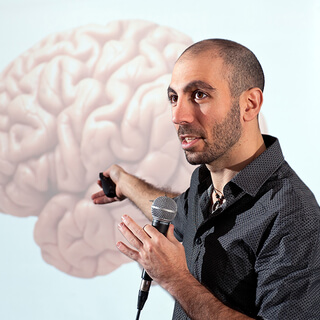
How parts of the brain are working to isolate these areas of breath.
And perhaps this is where you stay with this exercise.
And then if you want to engage all three parts of our breath,
We'll introduce that clavicular breathing.
So we still inhale deep into the belly.
Feel that expand as much as it can.
And then when it feels like it can't expand anymore,
Open up your chest,
Send the breath into your ribs.
And then lastly,
That area right at the top of your clavicles,
Feel all three parts fully inflated and exhaling from the clavicles,
The chest,
And lastly,
Your belly.
Inhale,
Belly,
Chest,
Clavicles.
Exhale,
Clavicles,
Chest,
Belly.
So with your own natural rhythm.
And if it gets to be too much to be doing all three,
You can always go back down to just chest and belly.
Or maybe just back down to the belly.
We call this a practice because it does take practice and kindness to yourself if perhaps it's not coming today and may not come tomorrow.
If you keep practicing,
There's plenty for you to learn along the way.
So you can keep going with this breath as long as it feels comfortable.
And when you're ready to finish,
Just allow your breath to go back to its natural rhythm.
And notice if that's any different than when we started.
Maybe it's slower or faster,
More shallow or deeper.
Maybe you're just that much more aware of your breath now.
Thank you for joining me for this three-part Yogic Breath tutorial.
Namaste.