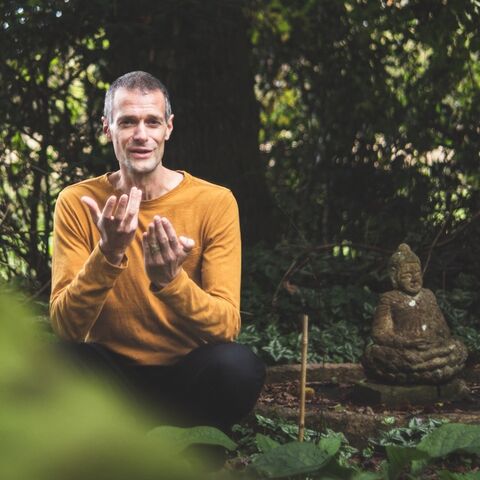
Hey,
Josh DuPold here.
Something came up during this interview where it needs an intro,
I feel,
So you'll see why towards the end of the intro.
On April 19th,
2024,
Master Space Oil Wizard and orator Alan Carroll and I could have very well approached nearly all the things about talking.
Who knows?
Likely not though.
However,
It was beyond fascinating to dive pretty deep into the particulars of deftly wielding the spoken English language.
While Alan doesn't directly address a few questions and points I put to him,
Some of the topics we get into include creating proper speaking spaces with what Alan terms space oil and the power thereof,
Framing speaking not so much as language as choosing and controlling the vibrations of the air,
Dissolving conditioning,
Removing ballast,
Knowing versus not knowing,
Words per minute,
Neglect,
Care,
And how to wisely exercise the instrument,
Slowing down,
Pausing,
Stillness,
Savoring,
Fluidity,
Beauty,
Patience,
Listening,
Art,
The five elements,
And of course,
Space oil.
Towards the end of our chat,
I caught Alan saying,
Quote,
I've earned my living for the last 30 years teaching people how to not speak and it works,
End quote.
I didn't say anything about this on the show.
I asked him afterwards if that was deliberate and he confirmed it was,
But I'll just leave it at that for now for your interpretation of what he meant about teaching people how not to speak.
And with that,
Here's Alan and I.
Holiness,
Welcome.
This is Josh of Integrating Presence and today I've got Alan Carroll with me.
Alan,
How's it going?
Blessings.
Blessings to you,
Josh,
And the audience.
Well,
Thanks,
Alan.
And who is Alan Carroll and what does he do?
Well,
I have different types of personalities.
Today's personality is definitely a personality of what game am I playing?
And I've been blessed to be able to,
At an early age,
To question the game that I was in because it didn't bring me a lot of satisfaction.
Because it didn't bring me a lot of satisfaction.
And so,
That got me on a spiritual journey because that's where the other game is.
And so,
For 50-60 years,
I've been playing this spiritual game and if you can earn a living and also play the spiritual game,
Then it's like downhill skiing rather than trying to ski uphill.
It's more downhill kind of a skiing film.
And the discovery of how to earn money and be on the spiritual journey at the same time,
If you can combine the need of the audience to be able to do something that they can't do now.
And it turns out that it takes you into the Buddhist direction.
Because the Buddhist direction,
For me,
Is that there's a space between the sounds that human beings speak.
That human beings speak.
And the amateur speaker is not able to control the creation of the sound and the creation of no sound.
And why they can't do it is because they.
.
.
So,
That's what I train people to be able to stop,
Make a sound,
Breathe,
Anchor.
So,
You're achieving a state of stillness between every sound you speak.
And when you can do that,
You got to be present to do it.
You can't disrupt the pattern of your speaking and not be in the speaking.
You got to be able to disrupt it.
And that's called controlling the timing of your speaking.
So,
I'm in the timing business.
Well,
This is lovely and wonderful,
Alan.
And I think this is kind of going to form a lot of our conversation here today.
I did notice after I spoke with you that it was,
If I might say this enough,
It seemed like there was kind of a transmission.
Because being in this podcasting thing,
Of course,
It's speaking.
And I mean,
Today,
Kids today,
They text each other,
Right?
They text a lot.
I don't know if the spoken word is valued as much,
But I want to get into this mastery of the spoken language,
A command of the English language,
And kind of the power it can have for harm and for helpfulness,
For furthering one's enslavement,
Imprisonment,
Metaphorically speaking,
Or can be like a sword that cuts through bonds for liberation.
And when we have this skill and mastery in the right hands,
I think it can be very helpful.
And in the wrong hands,
Maybe it can be more harmful.
However,
Most of us have to communicate on a day-to-day basis.
And talk about the importance of the spoken language in and of itself,
No matter how one uses it.
And then maybe go into once it's reached a level more of mastery,
What changes?
And then,
How does all that relate to spirituality versus maybe the base program or the everyday world that we're in?
And you can even talk about the importance there as well.
So,
I think I threw enough on your plate here.
And I will just say this notion of the pause.
We talked about this off air last time.
In music,
One of the things that defines a great musician is not how well they play the notes so much,
Or it's just as much as how they approach empty space when they're not playing a note.
So,
That space in between.
And one of the tips I was given is I do it a lot of ums and ahs,
Getting it maybe a little better sometimes.
One of the techniques is to be comfortable with those pauses.
One of the challenges I have is I want to try to cram so much.
We have this limited time.
And if I can get everything I want in to a short amount of space,
Then I feel better.
But that's not necessarily the case.
It has to be well-spoken and put in the right way that carries some power and umph to it.
Yeah.
So,
There's plenty of challenges here.
And I mean,
Just language itself is just mind-blowing,
That we can make mouth noises and we can understand each other.
It blows my mind.
Where do the words come from?
How can we just talk and formulate sentences out of nothing?
You know,
Sometimes we can think about what word choice,
But a lot of times,
You know,
It just comes forth.
And it's really a miraculous type of thing.
Not to mention foreign languages,
Which I'm trying to learn Danish now.
We won't even get into that because that's a whole other ballgame too.
So,
All right,
Alan.
The power of the language that we speak,
I would reframe it before we open the door.
Erase the word language because that creates a separation feeling,
Like your language,
My language.
Change the word vibration.
When we speak,
We're simply vibrating the air.
Some people are articulate when they vibrate the air.
So,
The sharpness of the vibration,
The power of the vibration is like at a higher frequency.
So,
It penetrates a little bit deeper.
So,
You have a vibration and you have a choice when you speak.
You can vibrate the air for love or you can vibrate the air for ego identity,
The preservation of my identity in the conversation.
Now,
Josh,
Shut your goddamn mouth and listen to what I have to goddamn say.
So,
Now,
I change the vibration of the air.
And the first vibration,
There's compassion behind what you're saying.
There's a loving,
Feeling blessing behind what you're saying.
The judgmental,
Critical part of us is not there.
So,
Your ego can't sniff it out.
No,
There's no attack going on here.
So,
You're able to sweeten the air and through a feeling of contribution and love.
And so,
You have a choice of the vibration of the air.
But most people are automatic speakers and they have no choice.
They're automatically reacting to what the moving in front of them says is going on.
And until you realize that you're the source of the movie,
You're going to be playing with the wind because the movie is inside,
It's not outside.
Stuff you see that's outside is just a projection of the tape that's a 35 millimeter slide that's behind your neck there.
That's the light shining through that creates the movie of your life.
But you got to be able to realize that the paintbrush of the creation of the movie is in your hands.
But you're only going to realize that if you can wake up from what?
Well,
From the automatic reaction of,
I know.
So,
Immediately,
If you say,
You know,
Then immediately you've painted something and it's much better to be able to say,
I don't know.
But the ego is in the knowing business.
So,
The ego is not going to say,
I don't know.
Of course,
I know.
Come on,
I know.
And a lot of defensiveness of the illusion comes out of people rather than the opportunity to have more compassion,
Which means you have to let go of the 35 millimeter slide and make it clear.
There has to be blank.
And that's called not knowing.
It's just a tabula rasa.
It's just an empty space there in front of you.
And that's the first rule of The Course in Miracles.
The Course in Miracles says to look at the reality in which you live as if nothing in there has any meaning.
And what do you mean by that?
Well,
Just play the game.
So,
I play that game of everything has no meaning.
And so,
It allows you to be more still in the vibration of your speaking,
Which then allows you to be more observant of the world in which you exist.
So,
Now there's a space between you and the things.
And when there's a space between you and the things,
You can manage the things.
And there's a choice that I,
The bigger self,
Can make when I'm using this power of my speaking.
And the hurtfulness is that people don't know who they're speaking for.
They just,
I'm speaking for me.
What are you talking about?
I'm speaking for me.
Yeah,
Me,
Me.
Well,
Well,
What's me?
Well,
Me turns out to be what Eckhart Tolle talks about,
The best one I like,
Is the me that most people think about me is like their resume.
How I would consider myself to be the I am,
I am,
I am,
I am.
And you draw a circle around all those conceptual identities,
Or all concepts are conceptual identities.
And then you put a circle around that,
That's your ego.
So,
That's a conceptual ego.
And the Lord has given us a sword that that conceptual ego can use for good or evil,
Or not for good or evil,
For preservation,
Or surrender.
And so,
Most people use the sword for preservation,
Rather than for the preservation of the all.
And so,
You got this,
And Sadhguru said the same thing,
This comes from Sadhguru.
He said that the mind's identity has different components.
And the first component,
He said,
Was the intellect.
And the intellect was described as a sword,
A knife,
A very,
Very sharp intellect.
And he said,
But who holds the sword?
The sword is held by your identity.
Who are you?
Well,
Those are,
It's just simply the program,
Or the media of what you've watched in the life,
And what people have told you is so,
And so we live in that identity.
And so,
That's called your ego.
So,
People are in the,
I need to preserve the identity of who I am.
And God has given me a sword.
And when you consider,
If you're stuck in who you are as defending your identity,
Rather than the space from which the identity comes,
Which would be more spiritual,
Then you're defending an illusion.
And there's no,
There's no,
There's no joy in that.
Momentary gratification,
But,
You know,
Impermanence seems to be around for everybody here.
And it's like grass talks about,
It's like grasping sand,
Holding sand in your hand and holding on to it,
And it just drains through your hand.
It's like,
That's what things are like.
And that's what,
And so it's like,
It gives you a really a grateful feeling of the moment that you're in and the appreciation and the love that you're able to vibrate the air with that will make the flowers grow.
And you can also switch over to the preservation of my identity.
And I'll tell you what's going to happen about here.
You got to go over there,
There,
There,
And don't talk back to me.
I'm sick and tired of what you had to say to me.
So you can,
You can make that sword,
The sword of love,
Or you can make it the sword of hatred.
And hatred is just bounce backs at you.
You'll just bounce,
You'll be more hatred yourself.
And that leads into the,
Into the,
Into the forgiveness conversation.
I'll throw that one back to you.
You can talk about forgiveness a little bit.
Well,
It's,
It's interesting,
You,
Forgiveness,
And this was a huge game changer for me,
Forgiveness.
I'll just mention it briefly before I go back.
And I've done this several times in the podcast,
But,
You know,
I was raised in a Christian tradition.
And one of the things that was never taught is self-forgiveness.
You know,
When I learned that I could forgive myself,
It was a huge game changer,
You know?
And even recently I've learned this technique of forgiving what's in myself,
Something that I might be critical of in the world outside me or for those around me.
Maybe there's something in myself that I could forgive that will help along that process.
Another huge thing about forgiveness is it can't be forced.
I don't feel it can be really forced,
Especially maybe for some people,
But it seems like it will happen when it's the right time.
This word forgiveness has a kind of Christian,
More of a Christian background.
But to me,
The wisdom of this is basically letting go of a burden that,
That I no longer need to carry around.
So I can ask for forgiveness.
I can,
I can forgive another and I can forgive myself.
So a three-way forgiveness.
And even folks that aren't there yet,
They could go as far removed as,
You know,
Maybe I can start to consider sometime in the future as a possibility to start considering,
Wondering about and looking into the possibility for forgiveness,
You know?
So it's just this kind of like approaching,
Dancing around.
Because when I really saw the power of forgiveness,
I thought it was a no brainer,
But a lot of people that can't do it,
You know,
They're just not there yet.
And that's to force yourself into forgiveness or to forgive another,
Ask for forgiveness,
Forgive yourself.
It might just not be that possible yet.
But I think when we can see the wisdom that this grudge that I might have for someone else,
It's not hurting them anymore,
Really.
It's only gnawing at me a burden on myself.
So when the time comes,
I might be able to put that down and walk away from it.
So Alan,
You touched on a lot of stuff here.
A couple things that came up.
Well,
The thing that really struck me when you said you,
There's no meaning.
Now I definitely see that as an exercise and it's a good way to kind of quiet the mind.
Because if I'm always trying to find meaning in every little thing,
And I know I did this early in my practice,
I kind of had to have an answer for that.
You know,
What does this mean?
You know,
What's the meaning in this?
What's the purpose or things like this?
So,
You know,
I definitely see that as a really good exercise,
But I wonder about how it might contribute to this possibility of like solipsism where nothing really matters.
There's no truth,
You know,
And with that,
Maybe I'm going a little bit too far,
Extrapolating a little bit too far or that,
You know,
If that's the case,
Well,
Then there's really no incentive to be ethical unless I'm missing something.
You know,
I want you to clarify a little bit more what you mean about no meaning.
And then if you mean there's like no meaning in life or no meaning in doing anything,
You know,
It's just kind of a nihilistic type of thing.
I don't think you mean that.
And then I want to ask you a little bit,
Since you're,
I would consider you kind of a language expert.
So I wanted to see what could be said a little bit about NLP as far as schooling me,
Because I haven't really studied this at all.
So I think that's enough for now.
Okay.
What comes to mind is that there are five elements.
Sadhguru talks about the five elements,
India talks about the five elements,
The Chinese talk about the five elements,
But what are these five elements?
Well,
There's the physical world we live in.
All right.
So there's physical elements,
They call it the earth.
There's the fire,
Which transforms things like water to heat,
The air to smoke and gas.
There's the air,
Earth,
Fire,
Water.
And so those are the physical elements that combine the world in which we live.
Okay.
But there's a fifth element.
But the problem with the fifth element is that it's a metaphysical element.
It's metaphysical.
What do you mean,
Josh,
That it's metaphysical?
Well,
It means that I have two hands that I'm holding up face to face.
And if I say,
Can you taste it?
Can you hear it?
Can you see it?
Can you smell it?
Can you feel it?
You'll say,
No,
There's nothing there.
But you know there's a space.
You know there's a space.
So if you can consciously create space between the sounds,
Which you have control of in every moment of now and every time you speak,
To be able to perform your thoughts requires space.
You become more spacious.
And as you become more spacious,
The gunk,
Which is the glue that holds the crap of the past and past and future and tight ego,
It constipated part of ourself,
It begins to dissolve.
Every time you let these bubbles of space float around,
It begins to loosen up.
And in speaking,
When you create space,
The key to professional speaking,
When you create the space,
Is the understanding of articulation.
And there's a definition that I use.
It's a definition.
And it starts with,
Well,
When you speak,
Are you able to take the thought form that's inside your head,
Let's say,
And you're going to bring it out into the outer world by vibrating the air through the instrument,
Like the flute.
Most people don't have much control over the flute.
So the flute is sort of like an automatic flute.
It automatically plays the music.
I don't have to think about the flute.
I want to think about what I want to say,
But I don't have to think about the flute.
So if you can practice creating a space every time that you speak,
It's like throwing ballast off the hot air balloon.
And when you throw the ballast of the weight of the hot air balloon,
It gets higher and higher and higher.
So in the speaking business,
How much ballast do you throw into the space every time you speak?
And you said in the beginning,
Gee,
People talk about I talk a lot when I speak.
I say,
Well,
I talk a lot of when I speak too.
And so if you can create space between the sounds that you speak,
You now have lowered your words per minute.
And most people,
Obviously,
I would say don't think about their words per minute.
But if you think about your words per minute,
And you control your words per minute,
You become more mindful of the minute.
You become more present in the minute because I have to be present to tell the flute to shut up,
To pause in the music,
Allow the audience to savor the smell of the wine,
To allow you to digest the beauty of the music.
And in articulation,
We call what I just did fluidity.
How fluidity does Alan speak?
Is there any at all fluidity?
No.
Josh,
I look and I don't see any fluidity at all.
And so that's the reality in which they live.
But if you can create fluidity,
Then you're not stuck to the particles and the particles are the content of your identity.
And all of a sudden,
The drain of life passes through and you become a hell of a lot more compassionate for the love of life when you can clear the tubes that are blocking with your constipated conceptual identity,
Which needs to be dissolved.
And you dissolve it by able to pause consciously every time you speak,
If you like.
Because it's a free world,
Josh.
I'm sure it's free over there in Denmark.
I'm sure it's free.
You can speak there.
You can make vibrate.
You vibrate the air right there.
Denmark,
You vibrate the air,
Right?
Yeah.
And then there's also vibrating out of which orifice,
Right?
When we vibrate that air and some people talk about diarrhea of the mouth too,
Right?
That's a messy game.
So Alan,
This goes back to another thing I wanted to ask about,
Self.
So all the folks you've interviewed,
You've interviewed some amazing folks.
I was listening to a few of the podcasts before we went on air here and there's a lot of spiritual wisdom and knowledge in those.
One of the questions I like to ask folks here,
Especially in this realm,
This spiritual thing,
For lack of a better word,
Is what is self?
What is your understanding of this notion of self?
You talked a little bit before about encapsulating the ego.
How would you define self or your understanding of what that means in maybe why it's important?
You're right.
There's lots and lots of words they use to describe self with a capital S.
And every time they talk about the self,
It's the self with a capital S versus self with a small s.
And I'm going to use the word,
The higher self is a self that I used for years.
It's the higher self,
Capital S.
And I'm going to call the higher self the Holy Spirit,
The Father,
The Son,
And the Holy Spirit.
They're a triad up there.
There's three of them.
God is the source.
Source of what?
The Son of God.
Therefore,
You are the Son of God.
And what and what speaks through the Son of God?
The Holy Spirit.
So,
The Holy Spirit is your ability to speak for the Holy Spirit.
Well,
Who are you to speak for the Holy Spirit?
Well,
You have a choice.
You can choose to.
.
.
What would the Holy Spirit do in this situation?
Well,
The Holy Spirit would do this.
Love,
Compassion,
Peace,
Joy,
Surrender,
Let go,
Open space,
Flexibility,
And fluidity in their speaking.
My ego is in the constipation business.
It wants to keep that ball of thoughts together.
Thoughts together.
And the preservation of the ball of thoughts keeps me constipated.
And you don't know you're constipated until your physical body starts doing stuff to you.
Diseases.
Guru has said that 95,
98% of all the physical issues that you think you got are caused by the way you paint the pictures of what you see in your mind.
And so,
Your mental thoughts.
But people don't manage their mental thoughts,
Josh.
They don't think about managing their mental thoughts,
Because that's done automatically.
And I know.
So,
I don't need to manage mental thoughts.
And so,
I say that you may not,
At this point in time,
Be able to manage the thoughts that you think.
But you can damn well manage the thoughts that you speak.
And so,
Don't give me this,
I'm spiritual.
You'll be spiritual if you can wake up enough to tame the tongue.
Tame it,
Baby.
Tame the tongue of the ego.
And when you can tame the tongue of the ego by making it shut up and speak,
But you want it to.
.
.
When I want to speak,
I will say what I want to say.
And I have control of the brake and the accelerator.
Well,
Then you have a choice about how you want to vibrate the air.
And when you become more present,
The quality of the formulation of the thought,
Because you're able to get control of the voice.
And the voice is manifestation.
When you be able to control the power of your voice,
Control the vibration of the air,
To be able to be still,
Be able to discern rather than judge,
What a gift to the world to be able to do that.
And what you're doing when you are going from the land of judgment to the land of discernment is that you are taking the fifth element and you're practicing through meditation and relaxation and centering and grounding and breathing,
Creating space between the constipated thoughts that are constantly scurrying around in your mind.
And everybody can do it.
Everybody can create space.
And you don't have to do.
.
.
In addition to,
Of course,
You're doing your meditation,
But you can create space between the sounds that you speak.
And what's the benefit of that,
Alan?
Well,
First of all,
You can breathe.
If you don't have a space between the sounds,
You can't suck in oxygen.
And the instrument needs oxygen.
It needs the prana energy.
But I can't do that and speak at the same time.
And when in there,
When you're able to take the breath in,
You can then have the ability to tell the physical body to anchor,
Ground and center,
Because you're not worrying about making a sound.
You're worrying about focusing on getting instrument.
Yeah.
Grounded and then make the sound.
And when the instrument's grounded,
The quality of the formulation of the sound will look professional and sound professional,
Whether it's auditory or.
.
.
And of course,
The visual will get better too.
This is a really great skill.
And like I said at the beginning,
You know,
It depends what we do with it,
Right?
Because it is a very powerful thing.
And so,
It is a great responsibility as well.
And we know the power of self-responsibility.
I just want to kind of echo some of these things.
You know,
The fifth element of space in the Buddhist Theravada canon,
You know,
We talked about the four great elements.
And of course,
Sometimes it's also mentioned the space element,
Right?
And sometimes it goes into the consciousness element.
And every once in a while,
They mention the release element,
Which is a little bit maybe seemingly esoteric.
But I won't go into that because it's kind of beyond my pay grade,
Other than to say like,
You know,
We all know how tightly bound things are.
And then when something releases,
How amazing that is.
Okay.
Now,
The other thing though.
.
.
Sure.
To jump in on psychologically,
What you got to get to the point in that forgiveness conversation,
Is that what you have to release is what we'll call the big G.
The big G are grievances that you have about the movie that you've been watching for the last 50,
60,
20 years.
You've got grievances,
Complaints about the movie.
And that becomes your identity.
Your identity and your complaints become the same thing.
What do I complain about?
I tell you what I complain about.
I complain about them.
And then of course you get a club of the same complainers.
And so then you form a song and a group.
And I'm sure there's donations made to the politicians who are going to send their people to Washington for the complainers.
And so people are complaining and they're called grievances.
And forgiveness is the forgiveness of the grievance that you painted yourself.
And so when you start with the idea that what you see in the movie at this point in time has no meaning,
There's no grievances then.
And then that is called not thinking.
That is called stillness.
That is called in the mindfulness game,
A space of non-judgment.
A space in which there are no judgments because judgments are thoughts about the space that you're in.
So there is no judgments.
You got to get them little critters to disappear.
So all you got is a clear space.
That's all you got is a clear space.
And so how do you get the,
You have to go back,
You have to dissolve it.
And so you have to forgive.
You have to practice forgiveness of the grievance.
And at first the ego is in the grievance preservation business,
Not in the letting go business.
Because it would be suicide for me to let go of that grievance because that grievance is part of my identity.
That's who I am.
I am a man.
And you can tell the depth of the penetration of the identity by the loss of center the person has when they're discussing what they're talking about.
They're just,
They're gone.
And there's nothing you can say because they're so stirred up.
You have touched the,
What in politics,
The third rail,
You touched the third rail,
Baby.
And you know,
And I know they talk about,
Well,
What's the biggest grievance people have is my God is better than your God.
I mean,
You talk about gods and my God,
And then I speak for the word of God.
It's like,
Whoa,
My God,
I'm doing this in the name of God.
And then you're talking on an illusion.
And if you can speak for the word of God,
Then you would act as if you spoke for the word of God.
And so a lot of people say they speak for the word of God,
But would God do that?
Is that the way the Holy Spirit would frame it?
You have to be able to create space around the game.
So the game is that I'm in is the ability to create space.
And they're called metaphysicians.
People who are looking in the metaphysical domain,
Which we'll call space,
Bringing it down into the physical world,
Which we'll call a pause.
In the pause,
Take a breath,
Ground the body,
Get the body still,
Look at the movie.
Movie has no meaning.
What's the meaning you can paint is forgiveness for whatever offense that you think you're getting right now,
Whatever you don't like in the movie.
If you are offended,
Immediately you notice it and you paint it with love.
You paint it with love,
You paint it with forgiveness.
And what you're doing is you're laughing because the paint is coming from you and you can now choose what colors you're going to use.
And it turns out that you can paint your every moment as heaven,
Every moment as the rest of God,
Every moment as a contribution,
Every moment as an act of compassion and love.
That's a choice.
Or you can be the ego game,
The preservation of your sacred identity.
My wife and I enjoy watching a show before we go to bed.
The mad Duke and the house comes out with a tourist or trying to do something to his house,
And he's going crazy,
Has no clothes on.
He has his machine gun going like this,
Scary.
And,
Oh,
The hair coming out,
80,
85 years old.
I'll die before I let someone come into my house.
And I'm going scattering,
The bullets are going.
And then he falls dead.
Then they show you the bearing of the grave.
And they took the coffin and they made it vertical.
And on where the head is,
They put a window,
Diamond window,
Diamond.
And the window was facing the house.
So he wanted to die standing up facing the house.
And so that's his identity.
People will stand up and face the house of horror rather than relax and let go and release the grip of the thoughts.
And in order to release the grip of the thoughts,
You have to have the grease.
You have to have the fluidity in order to dissolve the glue that holds the thoughts together.
And what is the grease that dissolves the glue?
The grease that dissolves the glue is called space oil.
You have to be able to place,
You have to be able to put space and oil the content of your speaking.
And you'll then be more fluid.
And that's the number one tool of an articulate speaker is fluidity.
Because the opposite of fluidity is constipation.
Most people are constipated when they speak.
Sure.
And it's a skill like anything else.
I mean,
It takes training,
Effort,
And kind of the right guidance and a lot of practice,
Just like anything else,
Any other skill to hone.
The guidelines that are given for wise speech is,
Is it kind?
Is it necessary?
Is it helpful?
Is it the right time to say it around the audience?
And does it create harmony or does it create division?
Does it create concord or will it divide?
So yes,
These are things that I'm still living up to,
Obviously.
Does that come from the Buddhist tradition?
It does.
This is the right speech part.
Right speech,
Yes.
These are the guidelines on right speech.
So is it kind in the not speaking harsh words?
Right,
Is it kind would be the Holy Spirit,
Which you're saying,
What would the Holy Spirit speak in the Buddhist movie?
You're speaking for the Holy Spirit.
If you speak with kindness,
Compassion,
Love,
Forgiveness,
Then you're speaking for what the Holy Spirit would do.
And that's a blessing.
So you become a saint,
At least a saint,
Josh,
You got to be a saint.
If you're doing a thing,
We'll send something to Rome and we'll get you blessed.
You got the Christian background,
It's good for your resume for being a saint.
It came in handy.
It finally came in handy.
And this speaks also to these unwholesome roots or some people call them the poisons.
If we really want to get down to the root of a lot of this stuff,
It's ill will.
Some people say anger,
But ill will,
I think is really where it's at because there are some times when anger can be helpful.
I feel some people would disagree with me,
But ill will,
Wanting to harm,
That's a poison and an unwholesome root.
Greed is the other one,
Greed.
And then ignorance or delusion,
Not in the psychological sense,
But just not understanding reality for what it really is.
That's the toughest one,
Because when we're deluded or ignorant,
We don't really know that we are.
And so the remedies,
Of course,
For that one is wisdom.
And then the remedy for greed is generosity.
And the remedy for ill will is kindness,
Loving kindness.
And then I want to talk about- I like that too.
Buddhist people,
They certainly know how to hit a golf ball.
I'll tell you.
Straight down the middle.
There's no right,
There's no left.
There's no just perfect divots.
I tell you,
You Buddhist people.
Straight forwardness.
Now,
Putting it into practice is another story though,
Is another thing.
Reciting these things,
Speaking these things is one thing,
But actually exemplifying them in our conduct and behavior,
Well,
That's a training and a practice too.
Now,
Space,
The other thing that came up around this is holding space and how vitally important this is.
I mean,
We could talk about it metaphorically,
But actually being there for someone and creating an environment and a presence and an attentiveness to be there for someone and let them be who they are.
And it can be really healing and supporting.
And I often overlook that,
That it's also in our words too.
And I like how your training and your methodology is actually about when speaking.
The guidelines for speaking is when you should speak and how you should speak,
But the actual words flowing out of the mouth,
I find,
Which you say,
Very helpful.
Now,
The other end of all this is,
Well,
One quick thing about thoughts.
I call it thoughts and thotting.
I use that because if we close our eyes and pay attention to our thoughts,
Sometimes things are going to pop into our heads.
We don't want to be there.
They just happen to be there.
And that's what I call thotting.
We don't really have much control over that.
But if we actively say,
Okay,
I want to think about a pink elephant.
I want to think about where my car keys are.
Then I can actively think about those things.
But sometimes we might just close our eyes and a song lyric might come into our mind,
A memory,
Whatever mental activity we don't seemingly have control over.
So I think this is a good definition.
And I like this notion that we do have seemingly quite a bit of choice in our speaking,
Especially if we train it as well.
The other thing that the whole other side of this coin we haven't talked about is listening.
So of course we need to,
Well,
Not necessarily.
I mean,
We can kind of talk to ourselves.
Some people say that's the first sign of going crazy,
Right?
But do a Hamlet dialogue or something.
But on the other end of this,
We have the listener.
So I was wondering if you have anything to say about listening and skills for this as well and how this might actually help speaking or do you look at this side too?
Space exists everywhere.
So there is a drought of space oil,
Although it exists everywhere.
There's a drought of space oil between the words that people speak.
And there's a big drought of space oil between the thoughts that people think.
Until you're able to control at some degree the thoughts that you think,
You will continue to be offended by things that you can't listen to.
I'm not offended by things that are beautiful.
Matter of fact,
I'm attracted to things that are beautiful because what I think is beautiful,
You don't think is beautiful.
That doesn't make any difference.
If I think it's beautiful,
I'm attracted to what I think is beautiful.
Now I have no listening for things that are ugly because now there's ugliness in the movie that I'm watching.
And what do I now do with ugliness?
Well,
I can erase ugliness.
I can get upset about the ugliness.
I can give money to people who will handle ugliness things.
I will get on the streets and I will protest the ugliness thing.
This is really,
Really,
Really ugly.
And so there's choices that you can make when you see ugly things.
But as you practice,
You talked about creating spaces,
Creating pauses,
Creating air bubbles that create the Drano,
You become more spacious.
And when you become more spacious,
You go to a place of consciousness where there is an open space.
And in psychology,
We call that open space,
The observer,
A witness,
Or the watcher,
Or the guardian.
It's a.
.
.
Omuchi talks about the second bird in the tree.
There's the doer bird down here doing do,
Do,
Do,
Do,
Do,
Do,
Do,
Do.
And the second bird,
Absolutely still,
What in the movie theater,
Watching the show,
Enjoying a bag of popcorn,
Taking deep breaths and the Holy Spirit.
And so there's a transformation that occurs when you begin to realize that there's space between the thoughts that I speak.
And then I can access those thoughts.
I can access,
I have control of the thoughts that I speak.
That means you're going to slow down the words per minute.
I'm slowing down words per minute.
If I was just doing normal,
Ordinary,
Hey,
How's it going?
Just talking,
It's about 180 words per minute.
But if you begin to slow down your words per minute through practice,
You disrupt the automatic pattern of the ego.
And in my number one favorite movie that will go into the coffin with the glass window,
It's going to be the Matrix one,
Because that was the best,
Most entertaining,
Transformational.
So the pause becomes the red pill.
And most people are busy with the blue pill,
Living in the illusion of the reality of permanence,
Seeking for permanence in an impermanent world and wondering why you're suffering.
It's like,
Well,
I don't know why I'm suffering.
Well,
You're seeking for something that you,
You're seeking for constipation.
I want it to stay,
Baby.
Keep it inside of me.
Yes.
And,
You know,
Let it go,
People.
And there's so many people tell you,
Well,
How do you let it go?
The easiest one that I love was the Buddhist.
Bless all the thoughts that you're thinking and let them go.
The good one,
The bad ones,
The horrible ones,
Just bless them all.
And in order to bless something,
You have to be able to see it.
And you got to be the observer to be able to see the thought.
And now that I can see the thought,
I manage the thought.
I can manage the thought.
I can bless the thought.
And so I no longer become a victim of the thought.
Whatever the thought was,
I no longer become,
I no longer have the feeling that I'm a sinner.
So the salvation,
It's just that Christianity will tell you that the forgiveness of sin leads to salvation.
What is the sin?
The sin is the,
Is the grievance that you hold against yourself inside that you're projecting onto that a-hole in the goddamn movie.
Not,
No,
No,
Not you.
No,
No,
No,
No,
No.
But you know,
As I know,
It's comes from within.
It's projected outside.
Space is very healing as we need.
We need more space,
People.
We need to,
We need to form an organization,
The United Space Federation,
I think we'll call it.
Because it's already named,
But you think it's the outer space that he's talking about.
No,
He's talking about the United Space.
It's the inner,
It's exploring- Inner space.
Inner space.
Yes.
It's a beautiful place to be,
Inner space.
Indeed.
When you talked about the ugly and the beautiful,
It brought to mind this perception or practice of seeing the ugly and the beautiful,
And the beautiful and the ugly.
And then,
What is the other version of this?
It's also kind of seeing both beautiful and ugly,
And the beautiful,
Is that what it is?
And ugly and beautiful,
And the ugly.
So,
Or something as neither ugly or beautiful,
Or seeing it both at the same time.
So,
This is a really kind of mind-bending practice sometimes,
Because we have been conditioned a lot to make that judgment of ugly and beautiful.
The idea I give a lot is David Lynch,
The filmmaker,
He would take these photographs,
Sometimes close up of pus,
Something really nasty,
And blow it up really big,
And it looked like this beautiful work of art.
And when people,
When they asked people,
They'd say,
Oh,
This is beautiful.
What is this?
And he would tell them,
And they immediately would have a different reaction to what it was,
Because they didn't know beforehand.
So,
It kind of plays with that notion.
Now.
.
.
It's true.
It's true.
People live in an illusion.
And how do you,
What's the medicine that you take that will alter the illusion that you're in,
That leads to joy and satisfaction rather than suffering?
And there's something about forgiving and letting go of your point of view about what you're seeing in the movie.
You think you are your point of view,
But there's a possibility that your point of view is programmed based on your conditioning.
But how do I escape from my conditioning?
Disrupt the electrical circuits of the conditioning by taking the red pill when you speak.
Because you can't be,
You've got to be present in order to pause between the sounds that you're speaking.
So,
You can't,
You are aerating the overheated anger.
See,
I can't maintain,
It can't be,
I can't,
It's hard to keep disrupting the anger with relaxation.
It just doesn't work that way,
Josh.
I don't know where you live,
But you can't get angry and relaxed at the same time.
Come on,
Josh,
Don't they teach you anything in Buddhist schools?
And so,
You can't get angry if you practice pausing.
And so,
Now you get control of the instrument that's playing the music.
It really is.
So,
Now I can play beautiful music.
This mindfulness of body helps us do that too.
And one of the easiest things to let go of,
I feel,
Once we tune into how bad anger feels in the body,
It's a little bit easier to let go of than greed.
Because if we feel into how it feels in the body,
We then know that we have a choice.
If we want to really feel that way,
Then we can see and allow that to say,
Well,
I don't want to feel like that.
I can see how that makes me feel.
So,
Now I have a choice.
I can see that.
So,
Do I want to choose otherwise?
Wow.
I tell you,
That's the preacher speaking there.
Whoa.
I tell you,
That's the truth.
That's the gospel truth you're speaking about.
Try it out for yourself.
Don't take my word for it.
That's what that Christianity stuff is.
God bless them.
I've heard it right here in this podcast.
That's the voice of the Holy Spirit.
That's what the Holy Spirit would say.
You can feel it.
You can feel it in your body.
You feel the purity of the thoughts that come from contribution and love and service,
Not contaminated by the pain of the ego.
That's the self that answers your question.
What's the self when you're speaking for yourself?
The higher self.
Alan,
One of the things that I'm having a psychological barrier for adding more space oil is patience.
This seems like,
I don't know if people are maybe thinking about this or tuning into this.
Maybe they can see the benefit of it.
But to me,
It seems like a hurdle can be you have to have patience for this.
Alan,
Why can't you talk faster?
I don't have all day here.
I'm from New York.
I only have a New York minute here.
Respect my time and start talking faster.
What would you say to that criticism like that,
Playing devil's advocate?
Because it just seems like it's so time consuming.
Another thing I just thought of is I listen to have this feature.
It's called smart speed.
You push this button and the algorithm will automatically take out the pauses between people's speaking in order to save them time.
I'm just like,
Oh boy,
I think this has conditioned,
Helped condition the way I talk.
I'm like,
Oh,
I listened to so many podcasts with smart speed on and it saves me a lot of time,
But what is that doing to my speaking?
Time support,
Josh.
Come on.
Time support.
Get a hit in there now.
Come on.
Come on.
Giddy up.
I tell you,
You Eastern boys got to come out to the West where we live.
I tell you guys,
Don't you?
Yeah,
Right.
People live in a fast world and wonder why they're suffering.
They're suffering because there's no space.
Space is a space of relaxation.
Space is a space in which you can aerate.
It's a screen door experience rather than a storm door experience.
There's holes all over the place aerated by you creating space between the thoughts the ego speaks because the whole reality is sort of an egoic projection of your thoughts under this three-dimensional holodeck that we all live in,
Calling it the reality in which we live,
Thinking that there's a me and there's a there rather than I'm creating it until you realize that the paintbrush is in your hand.
And you're not going to realize that until you wake up and are able to create,
We're able to claim to be a metaphysician.
And I'm going to practice the tool of a metaphysician is the tool of stillness,
Tool of space,
Tool of forgiveness.
And then you are bringing the Holy Spirit down into the constipated earth and healing it by your own vibration,
Your own,
And your speaking is one of the big ways that you vibrate,
That you connect to the outer world.
Art's another one,
Beautiful art that's just beautiful things that are just blessings,
Awe,
Words of wisdom.
You use the word wisdom wisdom and it turns out that you want to be wiser,
You want to know where wisdom lives.
Wisdom does not live in the content that's already there.
But if you can separate the content when you speak and create an empty space,
You can breathe and you can go for a diving trip and you can dive down into an empty space and you'll discover that wisdom,
A higher level of awareness exists in the empty space between the thoughts that you're rippling on the surface.
You're diving down deeper and you have creativity lives there too.
So Steve Jobs is a big fan of LSD.
He said,
You haven't done LSD.
Well,
God damn,
I can't tell you because he realized that there's a creative part of ourselves that we never,
That gets stuck down with the conditioning.
So how can you,
How can you burn through it quickly?
And so you can burn through it quickly through artificial means.
And of course,
I'm a child of the sixties.
I don't know nothing what you're talking about.
I don't believe you.
And so the,
So we,
But you can burn through it also with meditation and you can burn through it consciously.
This is my message to the audience.
If you can,
You can burn through that,
That,
That,
That consciously,
Not only with meditation,
Not only with drugs,
You can burn through it by pausing between the sounds that you speak and it will increase your ability to perform your thoughts at a higher level of quality.
So when it's necessary to perform your thoughts at a high level,
The quality in front of a large audience,
In front of a podcast,
Whatever you're performing your thoughts at a high quality,
You use space and you stick spaces in there.
So you're able to keep the instrument in a state of relaxation,
Which gives you time to think about not only what you want to say,
But also how I want to formulate the thought in order to have it the maximum penetration into the effectiveness of whoever is listening,
Whether it be auditory in the podcast world or whether it be video in the YouTube world.
And space is the key that is missing except with professional speakers like actors,
Politicians.
I mean,
They're great space creators and it's free.
It won't cost you.
There's nothing.
You don't have to send anything.
Where do you want to do?
I'm in the space business and I sell cans.
You'll get a physical can.
It's called space oil.
I will send it to you.
It's $59.
95.
It's a specialty because we're getting 10% off.
We know that.
And it comes already full of space.
You look inside,
There's nothing there.
So it's space.
And it says space oil on the outside.
And anytime you find yourself constipated,
That you have a hard time getting through something,
You pick up that can and you squeeze it three times.
If it's a little bit,
Six times,
But if it's a lot,
You get squeezed at 20 times a day,
But no more than 20 times a day.
And you will notice that whatever you were issues with is now going to be dissolved.
So that's my message to you and my desire for you to buy those space cans and oils.
And by the way,
I'm just teasing.
Do not send me anything.
I was going to say,
This isn't from the Rockefeller Foundation.
Is it the space oil or that?
That was snake oil that he was selling.
That's snake oil.
No,
It's not snake oil.
This is space oil.
You got to be clear about that one.
Yeah.
Okay.
All right.
Alan,
This has been really,
Really cool.
I just wanted to highlight the importance of space.
Something that came to me is this,
I think it's called the discourse on the lesser discourse on emptiness.
And there's a contemplation that we can experience this for ourselves.
You contemplate what's called village.
And this is the everyday workaday world and notice how kind of busy and chaotic it is in the mind.
And I'm not going to do this very deep,
But I'll mention this.
So if anyone wants to look this up and do it later,
Then you zoom out,
Then there's the forest,
Right?
And we know how we feel when we go into the wilderness or just even a nice park.
There's not the busy hustle and bustle of the village.
Then we take one more step back and we go into earth,
Contemplation of earth,
The entire earth as a whole,
Right?
And how much more peaceful that is.
So then when we drop that,
Then there's space,
Boundless space.
There's no boundary to how far space can go,
Right?
It's boundless.
So,
I mean,
We can stop there.
There's a couple other layers where if you remove that,
What's behind that,
It's boundless consciousness.
Removing that is boundless nothingness or nothingness.
And one of the most subtle layers of existence it said is if that's removed,
Then there's neither perception nor non-perception and that's a very subtle layer.
So anyway,
Yes,
This is profound and I appreciate so much Alan's articulation of this,
Talking about the fluidity,
But more important the pauses in the space that is interjected and kind of crafted in with our speaking.
I know it's poised to help me so much and pretty much anybody that wants to have any kind of communication and we need that communication every day or most every day,
Right?
Whether it even be with ourselves.
So Alan,
Thanks again for being here and speaking with me and the audience,
Whoever's listening to this.
What would you like to bring people's attention to and take the folks out here with the final message,
Please?
Well,
The game that I've been playing,
The game of mindfulness,
We bring that into,
This is the secret I'll tell you right now,
We only use one tool.
The only tool we really use is the tool of a professional speaker.
And you ask yourself,
Well,
What's the tool of a professional speaker?
Uh-huh.
See,
This is my message.
The tool of a professional speaker is called timing.
You control the timing of your speaking while you are speaking.
So I've been demonstrating various speeds of speaking we're talking today.
And there's speeds where I get excited so my words per minute go up and there's times when I just chill and taste the sweetness of stillness in our conversation.
And that's a nice place.
That's blessings and love and cherish and compassion,
Live in that space.
It takes a lot of energy to speak.
It doesn't take much energy to love.
Then you relax when you love.
So my message is to,
You want to love yourself?
Give yourself space.
Where can't you give yourself space?
The space you can't,
Where you can't give yourself space is where you hold grievances against yourself for the sins that you think you have done.
Son of God cannot create sin.
You are,
You are the Son of God.
You are the Spirit.
You are the Holy Spirit encased in the physical body.
And so we train speakers how to be mindful,
Professional mindful speakers.
And it's a,
What happens is they begin to realize that they're,
They have the power within themselves to transform their ability to speak.
And boy,
When you see that on a videotape,
As I said,
I've earned my living for the last 30 years teaching people how to not speak and it works.
Because today's conversation and from my point of view was valuable.
The clarity of the conversation we had really what was valuable.
And so that just was a nice partnership,
Josh.
So I appreciate the opportunity to speak about something we both love and to be able to articulate it with the fifth element of space and space is where our heart is saying is where we are.
With the fifth element of space and space is where our heart is saying is where love,
Love is giving something space to be the way it is,
The way it isn't.
Anyway,
You're listening was a great question.
We'll hold it for the next time because there's a problem with listening is that you you have to let go of your point of view which you have to have fluidity and people don't have fluidity.
So with pausing it gives you fluidity not only with the way you speak but also with your you're willing to be flexible to listen to other people's points of view.
And really we should do another one on listening because listening is a there's a problem with listening and it has to do well anyway,
Another one.
It is very important.
And so thanks again for doing this Alan and may all beings everywhere find the most optimal spaces and ways to articulate their highest most beneficial speech for the well-being and liberation of all.
May all beings everywhere realize awakening and be free by now.
How sweet it is,
How sweet it is Joss when you speak.
I would almost say amen.
Amen.
One could say that.
Amen,
Amen.
All right.
Thank you all.
Bye-bye.
Bye-bye.