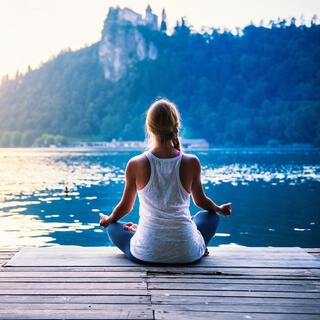
Welcome.
My name is Diane Harris and I feel both grateful and privileged for the opportunity to share with you now.
Thank you for inviting me into your space.
This is part two of the Nourish series.
It's a place for you to restore,
Rejuvenate and come home to yourself.
In this series you'll be guided into a shape to hold for the practice.
But you can do this practice in whatever shape calls to you.
So please listen to your internal guide.
Not taking or staying in any posture that doesn't feel right for you.
Listening in to what you need is the way that you honour and respect your body and yourself.
Today's practice is going to be a twist from lying on our backs.
So you'll want to have a couple of pillows handy and maybe a folded blanket.
If you already know this shape and if you've already practiced this with me before,
Then you can go ahead now and settle into your twist while I cue the people new to our community.
Please note that if you do have any low back issues,
Osteoporosis,
Neck issues,
Then you may want to stay lying flat on your back for the whole practice.
And please just listen in to what feels intuitive and natural for your body.
So come to lying on your back and you may want to be on a mat or a folded blanket if you are not on a carpeted area.
Before we start to move,
I just want you to feel the support of the ground beneath you.
Notice and feel every place where your body is in contact with the floor.
And when you feel that contact,
When you notice the sensation of the contact,
Let that be a signal to your body to relax.
Set your pillows up to the right side of your body,
Just a little bit below hip level.
Bring both legs in towards your chest.
Let your arms be out wide like the letter T.
And they can help control your movement as you slowly lower your legs towards the pillows on the right side of the body.
So we're endeavoring here to keep the shoulders flat so that more of the twist is in the thoracic rather than your low spine.
And if you don't need the cushions or the pillows,
You can just push them out of your way.
And when your legs have landed,
Invite all your muscles to soften.
Let the tension begin to dissolve.
And as we land into this shape,
Today we're going to practice simple breath awareness.
Your breath happens naturally.
It's an involuntary and unconscious action.
Although we also have the option to direct and control our breath.
But today and right here,
Right now,
I want you to again and again try to let your breath be natural.
Your breath will be affected by your physical,
Mental,
Emotional or spiritual state.
And it's quite natural as you come to the beginning of a practice that your breath might feel a bit anxious or shallow.
So let's just stay here together and with the support of the ground below you and the freshness of the air above you,
Let your inhale be soft and easy and your exhale the same.
You might notice here that your breath has four parts to it.
You have the inhale as it fills your lungs,
Fills your belly and there might be a slight pause and then the exhale as the breath slowly leaves,
The diaphragm softens.
A slight pause at the exhale till the breath naturally comes in.
Can you notice that pause at the top of the inhale and the bottom of the exhale?
Can you notice it without holding,
Without extending it?
Just noticing that it's part of the natural breath rhythm.
Like a soft and easy wave in the body.
The same way our heart and our internal organs work on their own without us directing them,
So can the breath.
If you're finding it difficult to let the breath become natural,
Try gently turning up the corners of your mouth to encourage a playful curiosity rather than efforting.
Breathing in and breathing out with that slight smile.
And when we're breathing here and doing nothing else at all,
You might notice body sensations.
You might notice your mood.
You might notice fluctuations of the mind.
When you come to your next inhale,
What are the sensations you feel with the inflow of your breath?
Does it feel like a soft whisper?
Does the air feel cool as it comes in through the nostrils?
How does your inhale feel?
And when you reach the top of your inhale,
What do you notice in your body as your inhale comes to its crest?
Perhaps a pleasantness as that crest of the inhale is naturally followed by your exhale.
Where in the body does your exhale feel like it starts?
Do you exhale fully?
Is there a warmth to the air?
As you come to the full exhale,
How long is the natural pause?
Does it feel easy or does it feel grippy and holding?
Try to tune in to the natural transition that comes at the end of the exhale as your inhale begins.
Without doing anything at all,
The air comes in,
The chest and the abdomen left.
Softly in and softly out.
Still letting your breath be however it wants.
What do you notice about the fluctuations of your mind?
Has your mind come to a little more stillness and presence by the very fact that you were paying attention to your breath?
Using this anchor of breath to stay here now.
The mind wanders and pulls away and then with the attention on the breath,
You're right back again.
Maybe you notice a little bit more tranquility of body and mind.
And with that,
Tranquility becomes some space for the natural movement of the mind,
The mood and the breath.
We're going to shift now to the other side and I really encourage you to move nice and slow.
The slower we move,
The more in tune we can become with our body and our whole self.
Engage a little bit in the abdominals.
Let your arms be a support.
Ground it into the floor as you bring the knees back towards center and then stretch out long on the floor.
Shift your cushions to the other side of your body and then let's just commit to stillness on the floor with your legs long and your breath soft.
A moment of gratitude for yourself that you're here for yourself.
You're here to tune in.
If you're doing this practice maybe after work and before you move on with your day,
It's a chance to help you shift gears so that you can move on with your day in a way that feels good,
In a way that you choose to feel.
To move to the other side,
Let your knees come once again towards your body.
Bring your arms by the sides.
Try to keep the shoulders flat so use as many cushions as you need and let your legs come over to the left side of your body now.
Let the landing of the legs feel really good.
Notice wherever you're holding physically,
Even after we think we've let go,
We're still holding on a little with the muscles,
Often through the core,
The glutes and the thighs.
So let's come back to a surrendered body and a surrendered breath.
Coming back to the natural breath as we enjoy the benefits of this spinal twist.
When we come into a twist,
It's a great massage for the abdominals.
It can eradicate any sluggishness in the liver,
The spleen,
The pancreas,
Strengthen the intestines,
Can relieve any tightness or catches in the low back and in the hip region.
So as you surrender in this twist,
You're toning both the organs and the spine.
It helps to keep the spine elastic.
And even though our core we endeavor to explore a slow deep breath.
Not just the soft organs but also the soft tissues of the spine improve the resiliency while we're also enhancing the health of the spinal bones and the joints.
We twist to unwind physically and emotionally.
As we build resiliency in our spine,
We also build resiliency in our capacity to face life fully.
This time with yourself where you make this space,
Where you have a chance to notice the turnings of the mind and moods and emotions.
You create a suppleness and freedom in your spine and your heart.
Maybe now it might feel good to even notice the openness of your chest and let your attention to the natural breath be in your heart space.
Just as the breath will stimulate and tonify the internal organs,
Your attention of the breath in the heart encourages you to stimulate and tonify your interaction with the world around you and the world within you.
Imagining the chest broad and open.
Imagining the heart open with space to hold whatever comes up.
We can not only detoxify our organs as we compress them and then release them and invite in fresh blood and oxygen,
But we also can detoxify our state of being by letting go of whatever we don't need.
So as thoughts rise and moods arise without even having to name or investigate them,
Can you just let them come in,
Feel and notice their emotional charge and let them pass.
Whether it's joy or anxiety,
A high or a low,
These feelings are there because they want you to feel them.
They want to be seen.
Your breath has made space for them to arise.
And maybe by letting them rise and be seen,
They can then move on.
And if you find they drag you into thought and analysis,
Come back to your natural breath.
Notice the sensation of the inflow,
Soft,
Cool air and the release and letting go of the warm air as your body and heart also let go of any pain.
Softly in and softly out.
Softly in and softly out.
Four part breath.
The inhale comes.
Feel the pause.
The exhale into the support of Mother Earth.
The pause drawing strength and encouragement from the grounding.
As you inhale and invite the universe into your body.
The inhale,
This breath is our connection to the outer world as we draw it in.
And we're going to move now back onto our back.
So again with a slight engagement in the abdominals.
Maybe moving even slower this time as you raise the knees from the ground and then uncurl onto the body,
Onto the backside of your body.
Feeling soft.
Feeling a connection to yourself.
Take a moment right now to tell yourself something really nice.
Notice exactly how you feel.
Thank yourself for the gift of this time in your relationship with yourself.
And may you always know your own goodness and let it shine brightly.
Namaste.