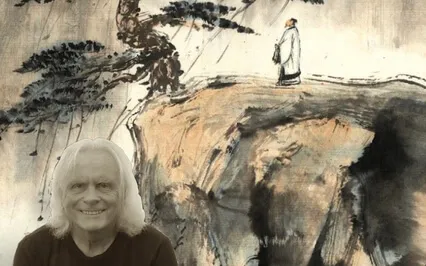
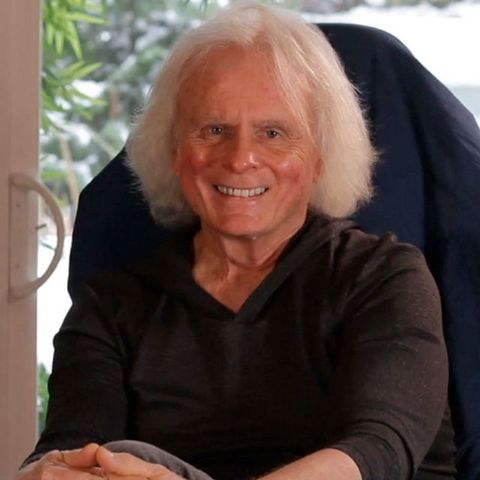
Welcome to the Wandering Sage from Home School.
Observations,
Sat Song and Meditations from Master Spiritual Teacher,
G.
P.
Walsh.
This podcast contains excerpts from G.
P.
's sat songs and public talks,
As well as meditations,
Audio blogs and music from his decades of spiritual teaching and healing.
Much of the material is G.
P.
Answering questions from sincere seekers of truth.
Welcome to the Wandering Sage from Home School.
May all beings everywhere end suffering and be happy.
I've just myself been pondering a lot about this idea that is one of the central ideas of Buddhism.
Along with no self is the idea that all is mind.
And everything we experience is mind and projection of mind.
Now what that means in a very real sense is that I never actually experience anything other than mind.
And my mind in the Buddhist sense,
You know,
These days especially non-dual teachers tend to use it more about mind being nothing other than the thought patterns.
That's one way of defining it.
That mind is not a thing,
But it is simply the word given to a collection or a functioning and that functioning is called thinking.
And what is thinking but the flow of thoughts,
Right?
Thoughts in patterns.
And this is what we know of as mind.
The Buddhist idea of mind was far more expansive.
Every experience,
Right?
Be it a thought or a sensation or a perception or an emotion,
The sum total of all experience was mind.
And they put it in such a way,
Buddha put it in such a way that you would see mind as substance,
Not as a perceiving vehicle,
But as the creating vehicle.
That what you perceive doesn't exist separate from the perceiving of it.
In other words,
Perceiving and creating were one and the same.
And that the fundamental ignorance,
Which he said was at the foundation of the entire chain of cause and effect and everything has come flowed from that was the ignorance that believed that what I was perceiving existed independently from me.
So in other words,
I'm looking behind me,
You're seeing one side of palm trees,
Some other trees on the other side,
You're seeing a barbecue grill.
And the belief is that they exist whether I perceive them or not.
That's what definition of objective is.
And that's what most people's definition of reality is.
Well,
Buddha would have said,
Not true.
It does not exist without a perceiver there to perceive it.
It has no existence whatsoever.
I mean,
It is completely nothing until it is perceived.
And in this sense,
It is not perceived the way the senses perceived in that something is there and then it comes into the view of my senses.
This perception is the creation of it.
So there's nothing but perception.
And this was encapsulated in the teaching called the five skandhas.
And the skandhas refer to each of the levels of belief leading up to consciousness.
The first level being simply form,
Right?
There's no object without form.
There's no,
Nothing exists without form,
Right?
It then otherwise it's blank.
It's empty.
So form is that first thing,
That first something coming into existence.
The next skandha was sensation.
That is,
I'm experiencing it.
But in Buddhist meditation,
If you examine it closely enough,
You find that there's absolutely nothing in any sensation and in any form that tells you conclusively that what you are experiencing exists independent of your perceiving of it.
And therefore the form literally disappears because there's nothing there being seen into sensation itself.
That is sensation without any source.
Now imagine a 3D world,
Right?
All these experiences,
Talking,
Having conversations,
Other beings,
And there's nobody there.
From the point of view of experience,
There is,
And it's pure sensation without anything causing it.
And at that moment when you see that it is sensation without anything being perceived,
Without anything actually there,
Even the word sensation ceases to have any meaning because it means,
Right,
The sense is picking up some external object.
And both of those collapse into the third skandha,
Which is perception.
And suddenly it's only perception,
No form,
No sensation.
Means there's no body.
There's nobody and there's no body.
There are no senses.
The senses themselves appear only as an image in the mind.
The fourth skandha is objects of mind.
What is a perception now gets identified,
It gets named,
It gets categorized,
It gets associated,
It gets all this stuff.
An entire universe gets built around it,
Which in turn interacts with the perception.
But I'm going through the short version of this,
But you can see the potential that even perception will then disappear into the objects of mind,
Because what do we see?
We see objects,
Right?
When I see a tree,
Right,
You can see all of the different levels at which this perception takes place until it finally is simply tree.
It's got a whole history and life and categorization and genus and all that sort of thing.
And then it finally folds into consciousness,
The sense of being,
Which in Buddhism is not the last step.
In Advaita Vedanta it is,
But in Buddhism it is not.
Consciousness is not the same as the self.
Whereas in Advaita,
It would be regarded as that pure awareness or consciousness.
But it's talking about exactly the same thing.
I wanted to discuss that.
Because what you experience,
I want to look at this in a very practical way.
So this isn't just kind of a philosophical thing to look at.
Make you sound smarter at a party about,
Oh,
The nature of perception.
I know what that is.
But how does that impact our life?
Well,
When I form a concrete belief about something,
Which is an object of mind,
I am literally believing it into existence.
If I believe that it's hard to make a living,
It will be hard to make a living,
Not because it actually objectively is,
But because you believe it that it is.
Like anything,
You know,
I hear this a lot from my female students.
There's no good men out there.
Where are all the good men?
And when you say that there are no good men out there,
And you believe that,
You literally create the experience of there being not any good men out there.
You have believed it into existence.
Now,
Can you grasp the power of that?
Every single thing that's ever gone down in your life has been a result of your beliefs.
And of course,
The majority of those beliefs were installed in you before you had any say over the matter.
They were just installed.
They were not deliberated.
It didn't ask for your permission.
You were just taught this.
You began to believe it.
You picked up both quiet,
Invisibly transmission from your parents,
Just energetically,
Patterns of thought that had been in the family forever.
And then,
Friends in the media and this conglomerate of stuff.
And you formed a view of reality that you believed in and thus created your entire experience.
If I believe I am not worthy and I should be punished,
Then I will experience life through the lens of not being worthy.
That's the perceptual lens.
And it will create form and sensation that match that.
Now,
As you can tell,
This is kind of like what they teach in the law of attraction.
But they don't take it far enough.
It's really quite remedial.
You are the arbiter of the entire thing.
What you believe manifests as reality.
There is no objective reality.
None.
Zero.
It then behooves us to two things.
One is be very vigilant about the kind of thoughts you entertain,
The kind of things that,
God,
This always happens to me.
Guess what?
It's always going to happen to you.
Why?
Because of the power that's making it always happen to you.
You are the power.
You are the Buddha.
You are the creator.
You are the I am.
You are Brahma.
You are the creator God.
You are Yang Wei.
I really want you to grasp the significance of this.
And then what would it mean?
If I'm the if I'm the one creating my whole life and everything in it and everyone in it every single perception I have.
Well then who am I?
All of this has proceeded forth from me.
Therefore it is all me.
Everything.
Nothing left out of that.
Well then who are you?
Not just this person sitting here listening to this guy talk.
Clearly not.
You've created me.
Who are you then?
The creator of the universe.
Too much to take?
Is that too big?
Oh I'm not that big.
Do we want to not take responsibility for all of it?
Do you want to continue to imagine yourself suffering at the hands of others or at the hands of circumstance or the hands of some unfair world out there?
Or do you want to step into the ultimate authority?
Which is the knowing who you are,
Identifying yourself with the Brahma self.
This recognition is the Buddha.
That is the Buddha made manifest.
The reality is the Buddha.
The experience of it is the Buddha.
This is Buddha nature.
This is also Christ consciousness.
Christ spoke from this place.
I and my father are one.
If you've seen me,
You've seen the father.
He even said in the Gospel of Thomas,
He who drinks of my mouth shall become as I am and I shall be he.
Or she.
What was he pointing at?
He who drinks of my mouth,
Which is exactly what I'm speaking of right now,
I and my father are one,
Shall become as I am.
I am,
Sound familiar?
And I shall be he.
I'm going to leave it at that.
This is the kind of thing that you ponder because remember that using the other definition of mind,
The tendency of thinking,
Our thought patterns have all anchored themselves in the original fundamental belief,
I am the body.
I'm the body in a world.
So I am here,
The world there.
That is the original illusion.
That is the original ignorance.
You're not the body in the world.
You are that from which both the body and the world have emerged.
You are the all.
And the practice,
As it were,
Is watching the thoughts that revolve around that sense of a finite limited self identified as the body and going,
Ah,
There it is.
It's just a pattern of thought that has gotten put into place and not been scrutinized.
Thank you for listening to the Wandering Sage from Home School.
Have a question?
Email it to questions at gpwalsh.
Com and GP will take it up on one of his weekly broadcasts.
And be sure to download GP's free ebook,
Angels in the Basement at gpwalsh.
Com.
Again,
Thank you for being here and remember to always let your wanderings take you deeper within.