So,
You see that until now we have covered four sutras.
Look at it.
What is that?
Atiyoga nushashanam.
Yoga is a discipline and education of the mind.
So when you are thinking,
When you are repeating,
After listening through the audios and then you start contemplating.
Yoga is discipline and education of the mind.
But what yoga is?
Yoga is the highest state of mindfulness.
But what is mindfulness?
So normally we talk about,
It is emptiness.
So I will take you to that emptiness.
So now,
Okay,
Emptiness.
So emptiness means that mind should not contain any of its object.
Now what did you learn?
That this mind lives in five subjective states.
Mind is dreaming of heaven.
It is obsessed.
It is alternating the thoughts and the images,
Wandering state.
Okay.
And the mind is,
You know,
The mind is totally obsessed with some fancies and imagination,
The moorha.
Oh,
These states cannot achieve mindfulness.
Now you see,
You are contemplating what will happen one day that you become aware of the very classification of these subjective states of the mind.
We are going a little deeper.
So we are summarizing the four sutras.
So what is going to happen?
You are at your workplace,
You are talking to your employees.
You are discussing something serious.
And at the same time you become aware,
Oh,
It's a wandering state.
Let me hold on.
Return to the fourth state of one-pointedness.
Why?
So two things will happen.
When you return to one-pointedness,
It will help you at your work.
At the same time,
The mind will get an idea that I have to live in one-pointedness in order to succeed in meditation.
That is how the contemplation should work in your life.
You are talking to your honey and the mind has some obsession.
It wants to express it and you hold on to it.
No,
Only two states.
I want to live only in two states.
You see,
That is how it should work.
What I said,
Contemplation and reflection.
Then we,
You know,
I'm thinking contemplating.
So what is the second sutra?
Yoga is emptying the mind of its content.
Have you ever thought of what is,
What do you mean by emptiness?
We simply say,
Okay,
Emptiness.
Now I understood.
We have to reflect on this emptiness.
I'll come to that emptiness later.
And then what happens?
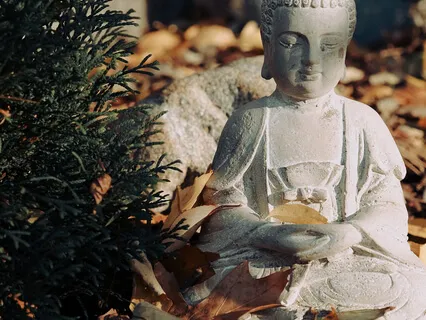
In the entire Buddha meditation,
What we say?
Emptiness,
Nothingness.
Yeah,
We all know it.
We have read it.
We have Googled it.
Right?
Emptiness,
Nothingness.
So when you follow the principles of the Buddha,
They say,
I am nothingness.
They don't believe in the entity,
Which is I.
It's not a question of belief.
We are not followers.
We are seekers.
But Patanjali goes a step further.
Did you contemplate on this?
Yoga,
Mindfulness is emptying the mind of its content.
So then the third sutra,
What it says,
When you empty the mind of its content,
When there is a state of nothingness,
I see that nothingness.
Buddha says only nothingness.
You are no more.
He stops there.
Patanjali says,
No,
I witness nothingness.
And who is this I?
That I is my real self.
Are you getting it?
That I is my real nature.
So still there are two things.
I witness nothingness.
I see nothingness.
In Buddha,
Only nothingness.
Forget about I.
In Patanjali,
We say yes.
So he begins with that I witness that nothingness.
Do you see that?
Now go to the fourth.
When you do not live in a meditative state,
This mind take you to the path of the craziness by engaging you into the first three states.
I give you one example.
In this one,
This is wondering mind.
This is how it happens.
You know,
You are the mind is following a specific path and your mind returns to that kind of an wandering state.
So we were talking that when we do not live into that state of emptiness,
Then the mind goes back to the first three states.
One of them is,
You know,
What is that one of them?
When this mind is totally absorbed into the body,
It gives you a sense of forgetfulness mind.
On the other hand,
You get an idea that I'm in meditation.
When you get a shock,
All the thought stops.
When you feel too much tired,
The mind goes into the body.
So we have to recognize these subtle states of the mind.
One example.
So now the fourth one.
Now understand when we say nothingness,
When we follow the path of the Buddha,
We are nothingness.
What does it mean?
Take an example.
You sink into an ocean.
Now you do not return.
You don't recognize yourself.
There is no I.
Nothingness.
What is what Patanjali says?
Thar's sutra.
Tada drashtu swarupaya vasthanam.
Then in the second stage of meditation or mindfulness,
I see that nothingness.
I witness that nothingness.
So you see that I'm using the same emptiness and nothingness in three stages.
And what is the third stage?
Because our mind has been recognizing the waves in the ocean are separate.
But now I don't see that separation.
That is the climax of meditation.
So you see that you use the emptiness in all the three stage,
Three steps.
So Buddha's emptiness stops there.
Nothingness.
Let me let me give you,
You know,
I'm just out of a joke.
Let me give you anesthesia.
Your brain stops working.
Is that mindfulness?
That happens in the second subjective state of the mind.
The mind gets totally obsessed with one thing.
It is absorbed into the body.
You don't have a thought.
That is also nothingness.
So our master says,
No,
We have to continue the journey.
We have to continue the journey.
So Patanjali clarifies,
I see,
I witness.
This is my real nature.
It is pure consciousness.
Nothingness was a means to an end.
In Buddhist meditation,
Nothingness is an end.
Do you see that?
So that is how the Buddha explains the five states of the mind.
That is why I always say,
Please contemplate,
Reflect on this.
The more and more you contemplate,
Just,
You know,
As if you start thinking with eyes closed,
Okay,
What are these four sutras?
But what is going to happen in the ultimate,
The climax?
That nothingness has no existence.
Why?
It acts like a wave.
It has no existence,
Only the pure consciousness,
The real self,
That exists and that real self is made up of pure consciousness,
Truth,
Love and wisdom.
Oh,
I am permanent peace.
I am love.
Will you seek love outside?
I am the wisdom.
Do you seek any knowledge outside?
See that I am the truth.
So nothingness in the ultimate journey becomes a means to an end.
In the beginning,
It is an end.
Again,
That end becomes a means.
Oh,
Let me see that nothingness.
That is what we see in the Saturday's session with that teaching.
Are you getting it?
That we do not understand,
We do not want to understand.
Nothingness,
Okay,
Nothingness.
As if nothingness is my smartphone,
No,
I got it.
It will not work.
Then we cannot go deeper into meditation.
So once we are clear that out of the five subjective states of the mind,
Only the two subjective states of the mind can take me to the journey of meditation.
That is one-pointedness.
And the one-pointedness of the mind means here that we become a seeker,
Seeker.
One point only.
How I become a seeker?
When I know what is discernment,
When I know what is dispassion,
When I know I can enter into calmness,
I can withdraw my mind,
I know the difference between the sense organs are absorbed into the objects and sense organs are withdrawn from the objects.
When I know what exactly is the faith,
That faith comes naturally,
I have a clarity,
I have a conviction in my mind.
This is the meaning of one-pointedness.
So normally you see that if you do not contemplate what will happen,
I know one-pointedness,
My mind is constantly wandering,
I cannot focus my mind.
So then we talk of a concentration of psychology.
In psychology,
We have oscillation of attention and we say we have concentration.
There are only two states in modern psychology.
Oscillation of attention means wandering mind and focus.
Focus on one object at the same time you are struggling to keep other objects at bay.
There are no in psychology.
We talk about only two states.
So here the one-pointedness is totally different.
So just think of it.
Oh,
We have to,
This is what the nothingness,
I see the nothingness.
Now I see that nothingness is nothing but the waves.
I am an ocean.
So it is an integral part of my mind.
I need not to worry it.
I can enter into that state at any time at will with my awareness.
Then what happens?
You are living,
You are working in meditation.
So how to achieve that?
What are the lot of stuff that we have to undergo from experiencing the nothingness,
Actual nothingness?
I will take up that later,
Slowly,
Something I remember.
So once you experience,
Once you start the journey of meditation,
The Patanjali says that glimpse of nothingness,
You undergo the four stages in which these four stages are known as Sampra Gyat Samadhi,
Sampra Gyat meditation.
You see gross objects.
You know,
You have been talking to me about your experiences.
So when you see the physical objects clearly,
It is one stage.
When you see the subtle objects,
It becomes the second stage.
When you experience,
No,
I don't want to talk.
I'm totally absorbed in the joy,
Ananda.
The joy of,
Joy without object,
Joy.
I know I saw an object full of joy.
I saw,
You know,
You just take an example that I,
Joy of looking at the moon,
Joy of looking at,
You know,
I see the image of my honey.
Only the joy takes the dominance and other states of meditation.
And then what happens?
I,
In the fourth stage,
You see that I am alone.
I don't want to talk.
I want to remain quiet.
That is another stage.
So now as we progress into this journey,
We will recognize all these four stages of mindfulness and meditation.
And then the fifth stage comes,
Which is known as Aas Sampra Gyat Samadhi.
Aas Sampra Gyat means without any object.
So you get a glimpse of nothingness.
What I explained,
Nothingness of Buddha,
I witnessed nothingness and now nothingness is just an obedience.
You see,
So what happens as you go through four more stages and at last what happens?
Why you are talking of nothingness?
It is a wave and I am an ocean.
I am this here.
There's nothingness is also a wave.
The moment,
The wave,
The thought is a wave.
There's nothingness is a wave.
When you live,
Work and play in that state of mindfulness.
Are you getting it?
So one has to contemplate and reflect.
Last thing,
Contemplate.
So how do you contemplate and reflect?
Through the words.
Words gives us the knowledge.
What is the word?
It is a thought.
Thought is a product.
It is a concept.
Concept is a product of knowledge.
But here the master adds viveka,
Discernment.
So when you contemplate and reflect,
What happens?
The word,
The thoughts remain at the physical level and by the discernment,
You enter into that knowledge in your mind.
And that knowledge takes the first three states of the mind at bay.
You instantly recognize.
Oh no.
I don't want to keep my mind into that state.
That.
So you start moving your mind into the fourth and the fifth state.
And that takes you into a meditative state even when you are talking,
Even when you are living.
And that is why we have been doing what we have been doing that mantra.
What is mantra?
Mantra is also a word.
It's a knowledge.
So we want to,
We want to extract that knowledge from the world.
And that knowledge decolors the mind from its anxiety,
Wandering state and suffering.
Are you getting it?
I'm trying to explain everything logically.
I'm not talking of any God or a cult or a dogma or a belief.
Remember,
If you do practice one type of meditation,
That is also true.
One can achieve,
But it becomes a cult.
When we do different practices of meditation,
We break that notion that this is the only way.
There are hundreds and thousands of ways.
Don't be so serious.
Let us start.
Close your eyes.
Close your eyes.
So close your eyes.
Let us start our journey of meditation.
So fast as eyes are closed.
Let us go a little deeper with the same mantra.
So first is I am become aware of I am.
Then I know I am.
I believe you know you are.
Why we are conscious being.
And this I am is only one reality pervading everywhere.
That is why I am in Ananda.
That is what is absolute existence,
Consciousness and bless my friends.
So look at the body.
Looking at the body.
You see that when the mind,
I told you when the mind is absorbed into the body because of tiredness,
Because of extreme attachment to the body,
That leads us to the second subjective state of the mind.
It appears like mindfulness or meditation,
But it is not.
Can we recognize that?
Over here we say we are adding sato guna means I say become aware of the body from the top of the head to the toes and experience the steadiness in the body and then look inside the heart.
Look inside the heart in the space.
You are looking inside the heart in the space.
And in that space,
You look at a point in the space.
The reference point is point in the space inside the heart and our mantra first line of the mantra we sing together,
Singing and listening.
You are singing mentally.
Why I started singing mentally?
I jumped from to the third stage directly.
So when you are singing mentally,
You can do it at any point,
Anytime in your daily life.
Sarvesham swasthir bhavatu,
Three times.
Sarvesham swasthir bhavatu,
Sarvesham swasthir bhavatu.
Now singing,
Listening and meaning.
What is the meaning?
Well being.
Well being.
So well being,
Sarvesham swasthir bhavatu,
Sarvesham swasthir bhavatu.
You see the well being everywhere.
Now understand that very scene.
First let us do it.
Sarvesham swasthir bhavatu,
Sarvesham swasthir bhavatu,
Sarvesham swasthir bhavatu,
Sarvesham swasthir bhavatu.
Now singing,
Listening,
Meaning and applied knowledge means the wisdom.
I just give you a clue.
When you sing,
You know the meaning and you see that very meaning in yourself and everywhere.
How can you say the person is your honey?
You see that being honey in that person.
You love someone.
You see that love in that person.
Same way,
Sarvesham swasthir bhavatu,
Sarvesham swasthir bhavatu,
Sarvesham swasthir bhavatu,
Sarvesham swasthir bhavatu,
Sarvesham swasthir bhavatu,
Sarvesham swasthir bhavatu.
Second is singing and listening,
Just mentally you sing,
What do you sing?
You are listening in the first stage.
Sarvesham shantir bhavatu,
Sarvesham shantir bhavatu,
Sarvesham shantir bhavatu.
Singing listening and meaning shanti means peace.
Did I tell you peace?
The space within.
Sarvesham shantir bhavatu.
Meaning you know the word is physical,
Meaning is subtle.
Sarvesham shantir bhavatu,
Sarvesham shantir bhavatu.
You see that?
Sarvesham shantir bhavatu,
Sarvesham shantir bhavatu,
Sarvesham shantir bhavatu.
Now singing listening and meaning and applied knowledge.
You see the peace behind and inside is all pervading.
It is pervading,
It is present in our friend,
In our enemies,
In our strangers,
Everywhere.
Can we really see that?
Full the mind to see it.
Sarvesham shantir bhavatu,
Sarvesham shantir bhavatu,
Sarvesham shantir bhavatu.
When women told me in the beginning it was difficult but after six or seven weeks she says that I'm constantly singing and now it comes naturally to me when I go to work.
So I had some reservation against my colleague at work and that reservation is gone because it was causing trouble.
Third line singing and listening.
Sarvesham,
Sarvesham,
Where did you?
Sarvesham,
Purnam Bhavatu.
You pay attention,
You extract the knowledge,
You extract the cream from the word.
Now singing,
Listening and meaning.
Meaning is completeness,
Wholeness.
I am whole.
What it means?
The mind stands within you.
It doesn't go outside.
It is only because of incompleteness the mind is running in the first three states.
Sarvesham Purnam Bhavatu.
Sarvesham Purnam Bhavatu.
Sarvesham Purnam Bhavatu.
Sarvesham Purnam Bhavatu.
Singing,
Listening and meaning.
Sarvesham Purnam Bhavatu.
Sarvesham Purnam Bhavatu.
Sarvesham Purnam Bhavatu.
Sarvesham Purnam Bhavatu.
Sarvesham Purnam Bhavatu.
While singing,
Listening and meaning,
We are doing six times and singing,
Listening,
Meaning and the knowledge also six times.
Sarvesham Purnam Bhavatu.
Just be there.
You see that sense of completeness.
Now you don't depend on the mantra in the word.
Every time you speak.
Sarvesham Purnam Bhavatu.
Sarvesham Purnam Bhavatu.
Sarvesham Purnam Bhavatu.
Last line,
Singing and listening.
Sarvesham Purnam Bhavatu.
Sarvesham Bhavatu.
Sarvesham Bhavatu.
This is very powerful.
If you are singing in your mind with the meaning,
With the knowledge and we'll go a step further today.
Singing listening and meaning.
Sarvesham Bhavatu.
Sarvesham Bhavatu.
Singing listening meaning and the knowledge six times.
Sarvesham Bhavatu.
Sarvesham Bhavatu.
Sarvesham Bhavatu.
Sarvesham Bhavatu.
Sarvesham Bhavatu.
Sarvesham Bhavatu.
Chant mentally couple of times.
Chant shanti shanti shanti.
You see that shanti.
You see that is the goal of this chanting,
Simply chanting habitually.
You know when you don't have a right knowledge to chant why I'm chanting what happens?
Mechanical,
Mechanical,
And then mind says okay you want to change me now I will change you.
Master every time stress knowing knowing with clarity,
Doubt free knowledge.
I know I did talk about four steps being a listener being a speaker,
No listener no speaker and breaking the habitual pattern.
So we will use that just imagine you woke up you wake up in the morning visualize you wake up in the morning and you are singing mentally.
Sarvesham anyone?
Sarvesham Swastir Bhavatu.
Sarvesham shanti bhavatu.
Sarvesham Purnam Bhavatu.
Sarvesham shanti bhavatu.
Now imagine visualize you are going to sleep you lie down on your bed you switch off the light put on the fan or switch off putting the blanket on the body and the body is lying in a corpse pose and then you sing.
Sarvesham Swastir Bhavatu.
Sarvesham shanti bhavatu.
Sarvesham Swastir Purnam Bhavatu.
Sarvesham Mangalam Bhavatu.
Just imagine you are in a restroom after a wake up in the morning and the mind goes there.
Sarvesham Swastir Bhavatu.
Sarvesham shanti bhavatu.
Sarvesham Purnam Bhavatu.
Sarvesham Mangalam Bhavatu.
You are in a kitchen?
Just imagine you are in a kitchen and you remember.
You are walking visualize you are walking and you remember.
You are talking visualize and you are reciting.
Imagine a person you like and you are doing it.
Imagine a person you do not like you are singing in your mind.
The mind should de-color the crazy stuff and color with this mantra.
Now only once what is the message here?
Sarvesham Swastir Bhavatu.
So we understood a state of well-being.
What happens when there is a state of well-being?
You experience Sarvesham shanti bhavatu.
You experience peace.
So well-being and peace merge together and when they both merge together then what happens?
You experience the sense of wholeness.
Sarvesham Purnam Bhavatu.
Can we become aware of the well-being,
Peace and sense of completeness?
Then what happens?
Sarvesham Mangalam Bhavatu.
Auspicious moment.
What auspicious?
So your every moment in your life passes through auspiciousness.
That is the essence of this mantra.
That is why I have been requesting please do it,
Do it,
Do it,
Do it.
Let the mind pick up,
Discover,
Experience auspiciousness from one moment to the next,
From one activity to the next,
From waking to sleeping to dreaming to waking up,
From talking to honey,
From talking to a stranger.
Every activity should be coming from or guided by that auspiciousness.
That is the one goal of these mantras.
Beautiful.
Now you see the space outside the head and the neck.
You are moving into an auspicious moment that contains the well-being,
The peace and the sense of wholeness.
From the space around the head and the neck to the shape,
Next moment auspicious.
You see the shape.
Now you experience the sensation auspicious.
That is how our masters explain it.
And then you experience the stillness within,
In the body,
In the head and the neck.
Right arm in the cylindrical space.
And the moment you are aware of the cylindrical space,
You see that auspicious moment is there.
Every moment,
From moment to moment.
So looking at the cylindrical space all around the right arm to the shape of the right arm,
The space shape,
Then the sensation,
But the auspiciousness is in the background.
You see I have been stressing again and again,
You should have a right knowledge based on the teachings of our masters.
I'm not teaching,
I don't know anything.
And experience that state of the stillness within.
That stillness is also with auspicious moment.
It blows our mind.
Is it possible?
Mind sees.
By practice we make it possible.
Cylindrical space all around the left arm.
Remember the auspicious moment,
Movement from the space to the shape,
Shape to the sensation,
Sensation to the stillness in the left arm,
The middle portion of the body and a circle of a space all around the chest and the belly.
You may say,
Should I imagine?
Okay,
Imagine.
What you imagine is the fact.
No worries.
It doesn't disturb you mind.
Movement from the space to the shape is physical,
Is less important than moving in auspiciousness.
Did you,
I think you all have picked up the point,
The words are physical,
The very discernment is subtle.
The mind must move into subtle shape in the sensation and from the sensation,
The stillness there.
It is the stillness in the body,
Not stillness of the body.
You see the knowledge,
Knowing makes a tremendous difference.
Stillness of the body,
Mind has to work.
Stillness in the body,
The mind is free.
Mind only has to recognize.
It is there,
Cylindrical space all around the right leg.
A spacious moment now you remember to the shape of the right leg.
Imagine there again auspiciousness,
Stillness there again,
That auspiciousness continues.
It's one stream,
Cylindrical space all around the left leg.
I add steps in meditation from different tradition to accelerate the process.
So the space all around the left leg,
Now what you remember,
I know you remember movement,
So you remember auspiciousness to the shape,
Sensation,
Stillness,
Entire body in a cylindrical space.
Auspiciousness,
Shape,
Sensation,
Stillness,
Moving the mind,
Casually walking,
Taking your time in that auspicious moment from the crown of the head to the heart.
When you are seeing in that auspicious moment,
You deepen,
You go deeper from the heart to the crown of the head.
Take your own time.
Deep breath.
.
.
.
.
.
.
.
.
.
.
.
.
.
.
.
.
.
.
.
.
.
.
.
.
.
.
.
.
.
.
.